

World Birds IUCN statusLC · Least ConcernGlobal IUCN category. BirdLife v10 (2025); taxon matching: AviList 2026 / IOC 15.2; checked: 29.10.2026. The list year is not the species assessment date. Source and method · BirdLife OrderPasseriformesPasserines FamilyCalyptomenidaeCalyptomenidae
African Broadbill
Smithornis capensis
A small forest bird with a broad flat bill, short tail and brown-and-white streaks. In display it may expose white back feathers and make a distinctive mechanical sound by vibrating wing feathers.
Biometrics
Length
Male12–14 cm
Female12–14 cm
Shared species value
Wing length
Male7.01 cm
Female7.01 cm
Shared species value
Weight
Male21–26.9 g
Female17.4–27.5 g
African Broadbill
Patchy distribution in suitable sub-Saharan forests and dense woodlandObservation guide in its natural range
Look for three features together
Do not rely on a single featureBill breadth is clearer from a suitable front or underside view; check it with the short tail.
The conspicuous rufous breast area of similar broadbills is absent; the belly centre may be plainer.
Hidden back feathers may be exposed during display flight. Do not expect the same sound and appearance in every everyday flight.
Compare male and female
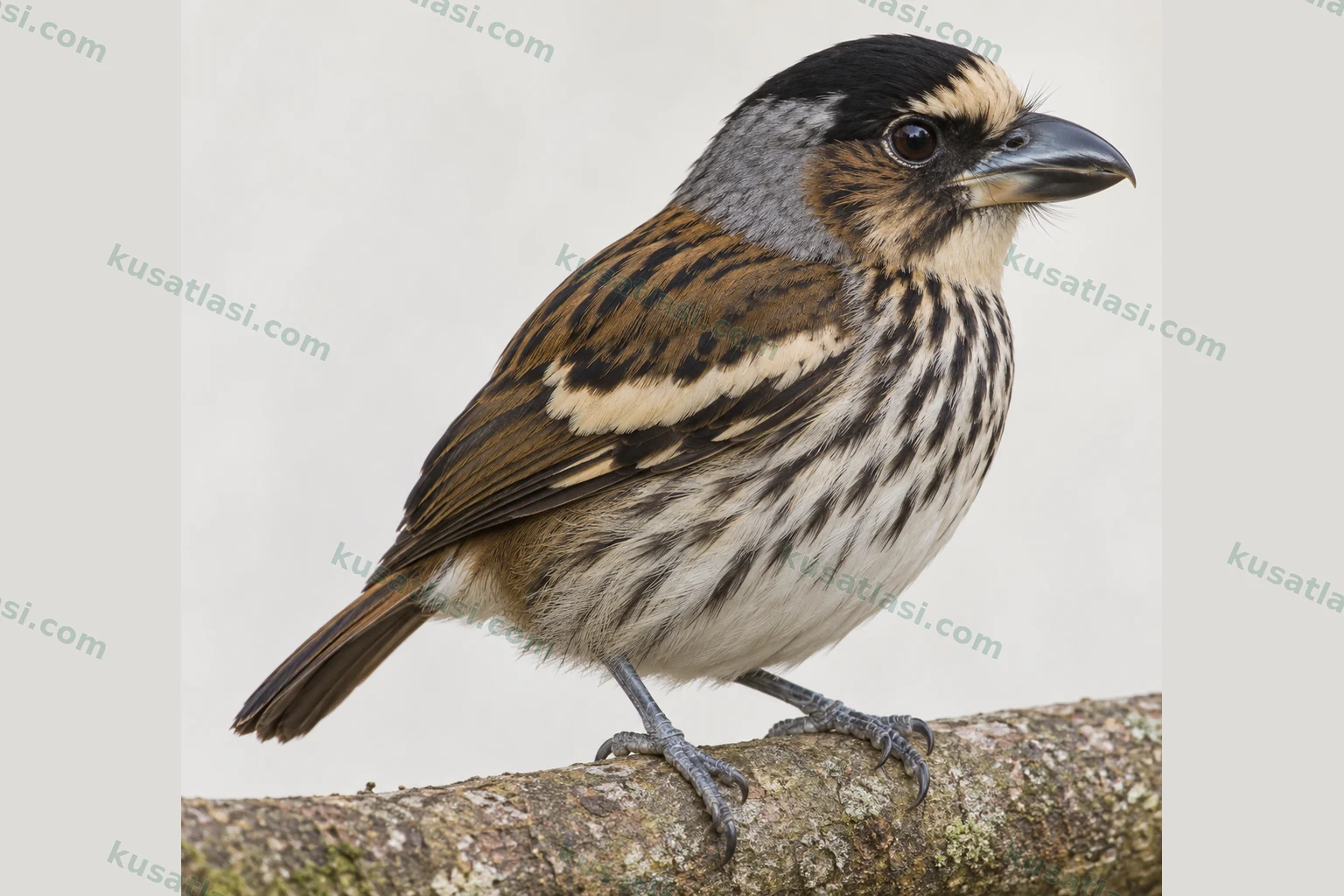
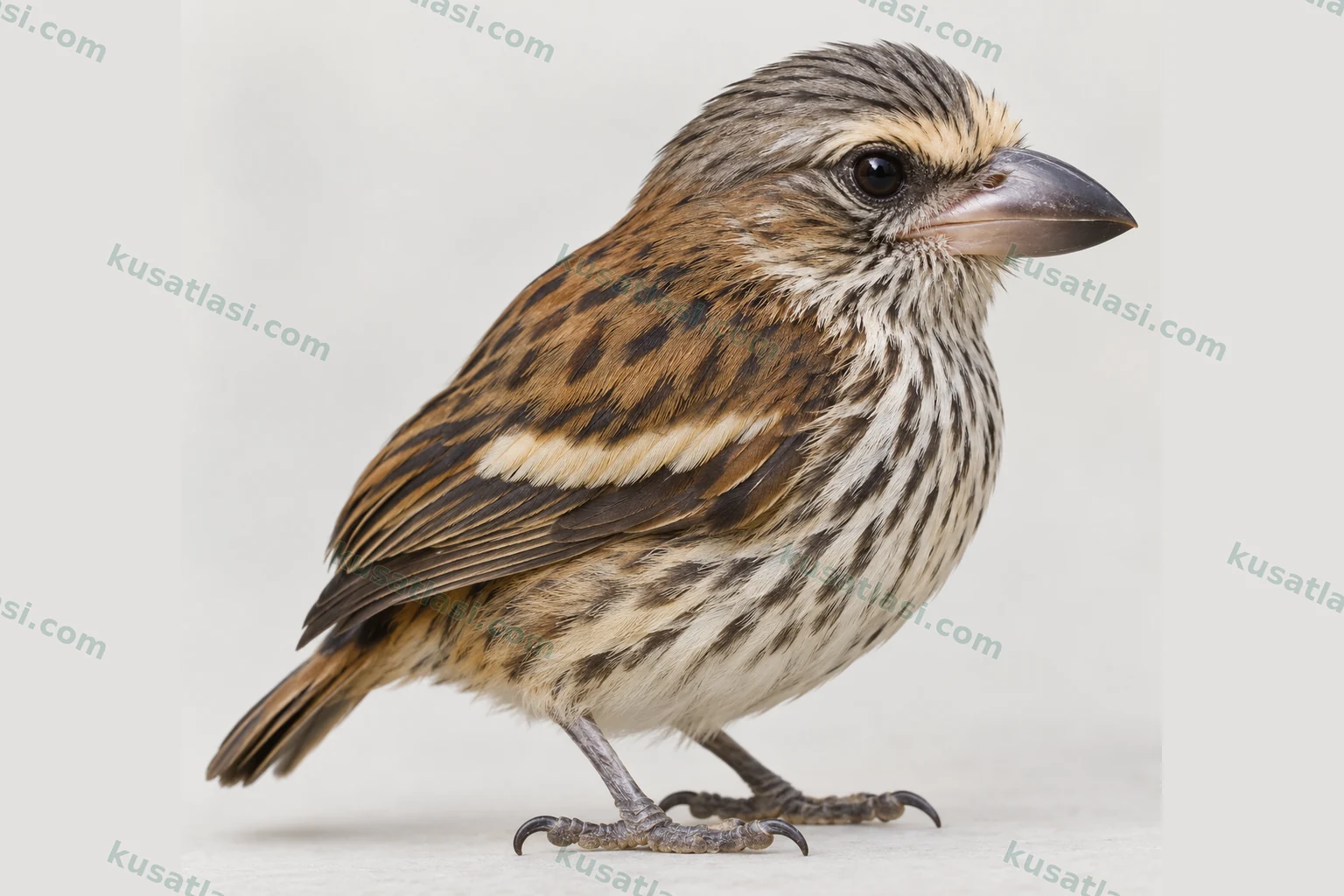 FemaleMale
In good light, the male’s black crown and the female’s duller, finely streaked crown may help. Retain geographical and shadow differences; young can resemble females. Darkness alone or food carrying does not determine sex certainly.
Where to look in its natural range?
Watch riverine forest, dense scrub and lowland tree cover from the existing path. Do not drive out a motionless perched bird or open vegetation around a hanging nest.
The species is mainly resident in southern Africa. SABAP1 reports Zimbabwe breeding August–February, concentrated October–December, and KwaZulu-Natal laying September–December. Sound activity changes detection; this is not shared presence or breeding probability for all Africa.
January
Mainly resident; sound activity may alter detection. Within the Zimbabwe atlas’s August–February breeding-record interval. Not a percentage of presence or migration probability.
February
Mainly resident; sound activity may alter detection. Within the Zimbabwe atlas’s August–February breeding-record interval. Not a percentage of presence or migration probability.
March
Mainly resident; sound activity may alter detection. Outside the Zimbabwe atlas’s main breeding-record interval; this does not mean no breeding throughout Africa. Not a percentage of presence or migration probability.
April
Mainly resident; sound activity may alter detection. Outside the Zimbabwe atlas’s main breeding-record interval; this does not mean no breeding throughout Africa. Not a percentage of presence or migration probability.
May
Mainly resident; sound activity may alter detection. Outside the Zimbabwe atlas’s main breeding-record interval; this does not mean no breeding throughout Africa. Not a percentage of presence or migration probability.
June
Mainly resident; sound activity may alter detection. Outside the Zimbabwe atlas’s main breeding-record interval; this does not mean no breeding throughout Africa. Not a percentage of presence or migration probability.
July
Mainly resident; sound activity may alter detection. Outside the Zimbabwe atlas’s main breeding-record interval; this does not mean no breeding throughout Africa. Not a percentage of presence or migration probability.
August
Mainly resident; sound activity may alter detection. Within the Zimbabwe atlas’s August–February breeding-record interval. Not a percentage of presence or migration probability.
September
Mainly resident; sound activity may alter detection. Within the Zimbabwe atlas’s August–February breeding-record interval. Within the reported KwaZulu-Natal laying interval. Not a percentage of presence or migration probability.
October
Mainly resident; sound activity may alter detection. Within the Zimbabwe atlas’s August–February breeding-record interval. A month of concentrated records in this region. Within the reported KwaZulu-Natal laying interval. Not a percentage of presence or migration probability.
November
Mainly resident; sound activity may alter detection. Within the Zimbabwe atlas’s August–February breeding-record interval. A month of concentrated records in this region. Within the reported KwaZulu-Natal laying interval. Not a percentage of presence or migration probability.
December
Mainly resident; sound activity may alter detection. Within the Zimbabwe atlas’s August–February breeding-record interval. A month of concentrated records in this region. Within the reported KwaZulu-Natal laying interval. Not a percentage of presence or migration probability.
Nest, egg and incubation
Both sexes may build an oval/bag-like nest hanging from a low branch with a side entrance. Regional accounts report one–three eggs and female incubation of 16–17 days. Both sexes may feed; three young from one successful Golwe nest left at 14–16 days old. This small local sample is not an invariant development time for all populations or the end of care.
The loud mechanical display-flight sound comes from certain flight feathers vibrating in airflow. Wings striking together are not the main mechanism. Shorter true vocalizations also occur; not every call is wing-generated.
Do not play recordings to attract birds; observe quietly, especially near nests.
Species information
Quick Identification
The African Broadbill, Smithornis capensis, is a small, compact brown-and-white bird that is easily overlooked in dense trees. Its short tail, streaked back and underparts and broad bill, especially apparent from below, should be considered together. The centre of the lower body remains relatively plain and pale, while dark streaks stand out on the breast and flanks. Long motionless perching can give the impression that no bird is present; identification should not depend on searching only for movement.
During display it may make a tight circular flight and return to its perch. White back feathers, largely concealed in ordinary posture, can be raised and create a bright flash during this flight. A white flash or mechanical sound alone nevertheless does not settle identification without seeing the bird. Similar members of the same genus also display. The most useful comparison checks the broad bill, compact proportions, breast streaking and presence or absence of a rufous breast patch on the same individual.
General Appearance and Posture
The back and wing area have warm brown tones, with dark streaks on the back. Pale cream or buff tips to some wing feathers may suggest a light bar. Underparts are mainly whitish; breast sides and flanks may have warmer pale tones with dark streaks. A plainer central belly does not make the whole underside unmarked. Leaf shadows must be distinguished from genuine dark streaks by checking again when the bird changes angle.
Bill width may not be fully apparent in a side view. Looking from below or an appropriate frontal angle reveals its broad flattened shape more clearly. There is no need to flush the bird for that angle; wait for natural movement. A short tail and compact head–body proportions help distinguish it from many slender elongated insectivores. Puffing, angle and an intervening branch can change those proportions, so visible tail length in one photo is not a measurement by itself.
Geographic forms can differ in colour tone. Rather than assigning a definite subspecies from one lighting condition, record locality together with the pattern actually seen.
Males, Females and Young Birds
The current specialist account describes the adult male's crown as black, the forehead pale buff and the nape greyer. Females are similar, but the crown may be duller grey with fine dark streaks; a paler female crown is noted particularly in some geographic forms. These differences require a good angle and light. Every bird whose crown looks black in leaf shadow is not a male, while a male's crown can appear paler in strong light.
Young may generally resemble females, with weaker warm pale forehead tones and crown streaking. This is not a detailed day-age key. Disordered plumage or briefly hiding just after leaving a nest cannot establish precise age alone. Growth measurements from a scientific chick study are not adult body lengths to apply to every photographed bird. Actual parental feeding can support the plumage assessment; another bird merely being nearby is not proof of parenthood.
Breeding studies distinguish female incubation from both sexes feeding chicks. A food carrier therefore cannot be called male solely from that action. Crown appearance, angle and the tracked individual's behaviour should be assessed together. If a sound sex label cannot be assigned, recording an adult is more useful than forcing uncertainty into male or female.
Appearance in Flight
A display may involve a tight turn around a branch and return to perching. Exposed white back feathers can produce a brief flash in the dark forest. This is not the same as an ordinary feeding flight. Absence of display sound or visible white during daily movement does not exclude the species. Short tail, broad bill and streaked breast on the perch complete the flight view.
Experimental research showed that display sound comes from particular flight feathers vibrating in airflow. That differs from the simple idea of wings clapping against each other. The display wing movements cannot be converted to ordinary flight or migration speed. Wingtip motion measured in the study is not the speed at which the entire bird travels.
Voice and Behaviour
The loud mechanical vibration in display makes the bird easier to notice. A written “krrrr” comparison approximates its structure, not the full rhythm, strength and pitch of the natural sound. This wing-produced sound does not mean every call is made by the wings. Researchers also reported shorter true vocalisations before display that can be heard nearby. Those two sound types should remain distinct.
Outside display the bird may stay still in cover and be missed. The southern African atlas suggests that higher spring and early-summer reporting could reflect greater sound activity. More birds heard does not necessarily mean more arriving from elsewhere that month. Natural displays do not require playback, provocation or branch cutting. Letting a silent bird remain on its perch gives a longer identification view without disrupting space use.
Similar Species
1. Rufous-sided Broadbill, Smithornis rufolateralis, can confuse through compact shape and similar display. Cornell's comparison identifies a rufous breast area as one helpful difference. African Broadbill lacks that distinct patch; check dark streaks on pale breast and the broad bill together. Both congeners can make display sounds with their wings, so a mechanical sound alone does not decide between them.
2. Grey-headed Broadbill, Smithornis sharpei, is another close congener. Cornell also mentions lack of rufous breast when separating African Broadbill from it. A female African Broadbill's greyer crown must not alone produce a Grey-headed identification. Breast, wings and bill need to be seen together; an inadequate view should not receive a species label merely matching a colour in its name.
Global Distribution
The African Broadbill is patchily distributed in suitable sub-Saharan forests and dense woodland. Western areas around Sierra Leone, Liberia and Ghana, central Cameroon, Gabon and Congo basin, and eastern and southern Uganda, Kenya, Tanzania, Zambia, Malawi, Mozambique and other suitable woods provide the broad context. Geographic forms are also reported in Angola and Zimbabwe. This does not mean all intervening land is continuously occupied.
Suitable densely covered Limpopo and KwaZulu-Natal sites and eastern Eswatini are important in the southern region. Zambezi-area and northeastern Namibian records need their local patchy context. Being easily overlooked in atlases means few records do not always mean few birds; missing records cannot, conversely, create a definite extensive resident range. Modelled and observed map cells are not the same evidence as confirmed breeding habitat.
Status Within Its Native Range
The 2024 global assessment gives Least Concern, LC. The 2025 South Africa, Lesotho and Eswatini assessment region gives Vulnerable, VU. Different global and regional categories are possible. Loss of dense understorey and fragmentation matter regionally. An older statement of no global threat does not make local habitat loss unimportant.
The current regional account separates modelled range contraction, habitat change and reporting probability. A percentage reduction in modelled area is not directly counted individual loss. Continuing records in protected areas do not establish the same condition everywhere unprotected. Judging the population to be secure requires considering the condition of its cover and repeated research together, rather than relying on a single successful encounter.
Migration
Southern African specialist and atlas accounts treat it as basically resident; a regular intercontinental route is unverified. Greater seasonal audibility or reporting is not automatically migration. Breeding displays make otherwise silent birds more detectable, so presence and detection probability are not given the same meaning in the calendar.
Nor is every bird assumed to remain on the same branch or tiny forest patch all year. Precise individual routes between populations were not verified here; countries are not joined by invented lines. Zimbabwe breeding records and KwaZulu-Natal laying months keep their respective regional contexts. The range of months reported in one country does not automatically apply to all West and East African populations.
Breeding Habitat
The bird associates with dense scrub, riverine forest and woodland understorey, and may use mid-levels of lowland evergreen forest. Tall trees alone do not define suitability: continuity and structure of the cover matter too. The current regional assessment considers understorey degradation and isolation of forest patches. One large tree in an open park is not equivalent to natural dense woodland.
Nest Site
Both sexes may build the oval or bag-like nest hanging from a low branch. Its entrance is lateral; materials include bark, dry leaves, fine twigs, grass and rootlets, with spider silk possibly binding them. Regional examples place it about 1.5–3 m above ground, not a compulsory height for every nest. It may be beside a stream or damp line without necessarily hanging over flowing water.
The regional account reports typical one–three eggs and female incubation of about 16–17 days. A small northeastern South African field study observed female incubation and both sexes feeding chicks. Three chicks in one successful nest, hatching on different days, departed at ages 14–16 days (Golwe observations in 2007, not a fixed period for all populations). Incubation and nestling growth are separate intervals and are not interchanged.
Daily Space Use
Long still perching may be followed by searching within cover or short flights. Dense riverside scrub makes detection particularly difficult. Watching natural movement from existing paths gives better identification than forcing the bird out. If a hanging nest is found, do not cut surrounding plants, approach the entrance or touch chicks. A distant apparently empty nest may hold a silent incubating female.
What Does It Eat?
Specialist accounts describe mainly small invertebrates, including insects, grasshoppers, caterpillars and spiders. A broad bill does not imply dependence on one prey group. It is not described as eating only airborne insects or only ground animals. Regional lists are not the complete diet of every African population; available prey changes with cover and season.
The South African chick study observed small, mostly soft-bodied deliveries, including caterpillars, small butterflies, moths and spiders. These do not imply every adult chooses only those foods all year, or fixed prey percentages in every nest. For an unclear item in the bill, record its general shape rather than inventing an insect species.
How Does It Hunt?
The regional specialist account reports feeding on the ground, in trees and sometimes in flight. It may move towards prey around a low perch, search cover and perch again. A circular display flight differs from prey capture: do not call every short return a hunt without seeing prey carried. Record vegetation layer and capture location separately.
An adult's contribution to feeding is evaluated for the actual watched interval. More male deliveries in a field study does not mean females never feed. Male-biased care at one nest is not a fixed species percentage. Removing leaves or branches to see an entrance can disrupt delivery; unseen prey must not be recorded as zero prey.
Display Sound Comes From Wing Feathers
An experimental study published in 2016 examined the display's mechanical sound. High-speed images, simultaneous sound and wind-tunnel tests support airflow-driven vibration of particular flight feathers, rather than wings clapping as the principal mechanism. How sound is produced and why this communication evolved are different questions; proposed evolutionary explanations are not presented as settled findings.
White Feathers Are Not Always Visible
White back feathers exposed during display can remain concealed when perched. The research author's field account also describes that brief white flash. Failure to see a large white area on a branch does not immediately select another species. Views of the same bird perched and displaying are better than expecting unrelated photographs to show one identical appearance.
A Few Nests Do Not Give a Species-Wide Rate
Of four active nests followed at Golwe in 2007, one successfully produced three young. Valuable records of loss and care from this small local sample are not breeding success for all Africa. Female incubation and both sexes feeding were observed. Greater prey delivery by one adult does not remove the other's care role.
Reporting Is Not Numerical Increase
A bird remaining still in forest becomes more detectable while displaying. Atlas explanations of greater spring and early-summer reporting also consider increased sound activity. This is not automatically migration or more breeding pairs. Global LC and southern regional VU also concern different scales; one bird cannot determine a whole region's conservation condition.