

World Birds IUCN statusLC · Least ConcernGlobal IUCN category. BirdLife v10 (2025); taxon matching: AviList 2026 / IOC 15.2; checked: 29.10.2026. The list year is not the species assessment date. Source and method · BirdLife OrderPasseriformesPasserines FamilyPittidaePittidae
African Pitta
Pitta angolensis
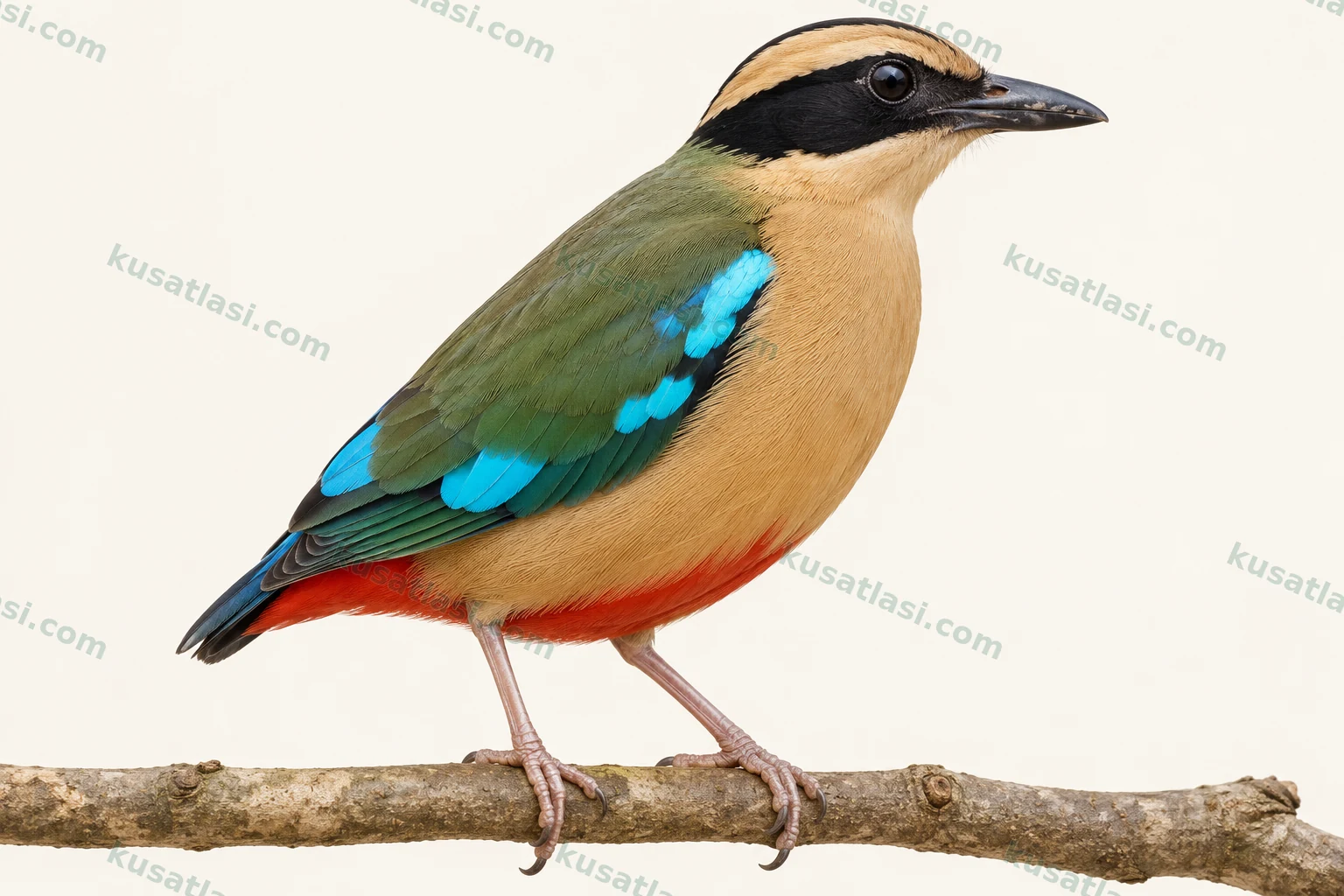
It is a colourful, short-tailed bird of the forest floor; black head and pale eyebrow, green back, blue wing areas and red belly are assessed together. The sexes look similar.
Biometrics
Length
Male18–20 cm
Female18–20 cm
Shared species value
Wing length
Male10.29 cm
Female10.29 cm
Shared species value
Weight
Male79–92 g
Female81–98 g
African Pitta
Densely covered woodlands of western, central and southeastern AfricaObservation guide in its natural range
Look for three features together
Do not rely on a single featureLook for the broad pale eyebrow above the black head.
See the buff breast, green back and red underparts on the same bird.
The breast and throat boundary is important when separating Green-breasted Pitta.
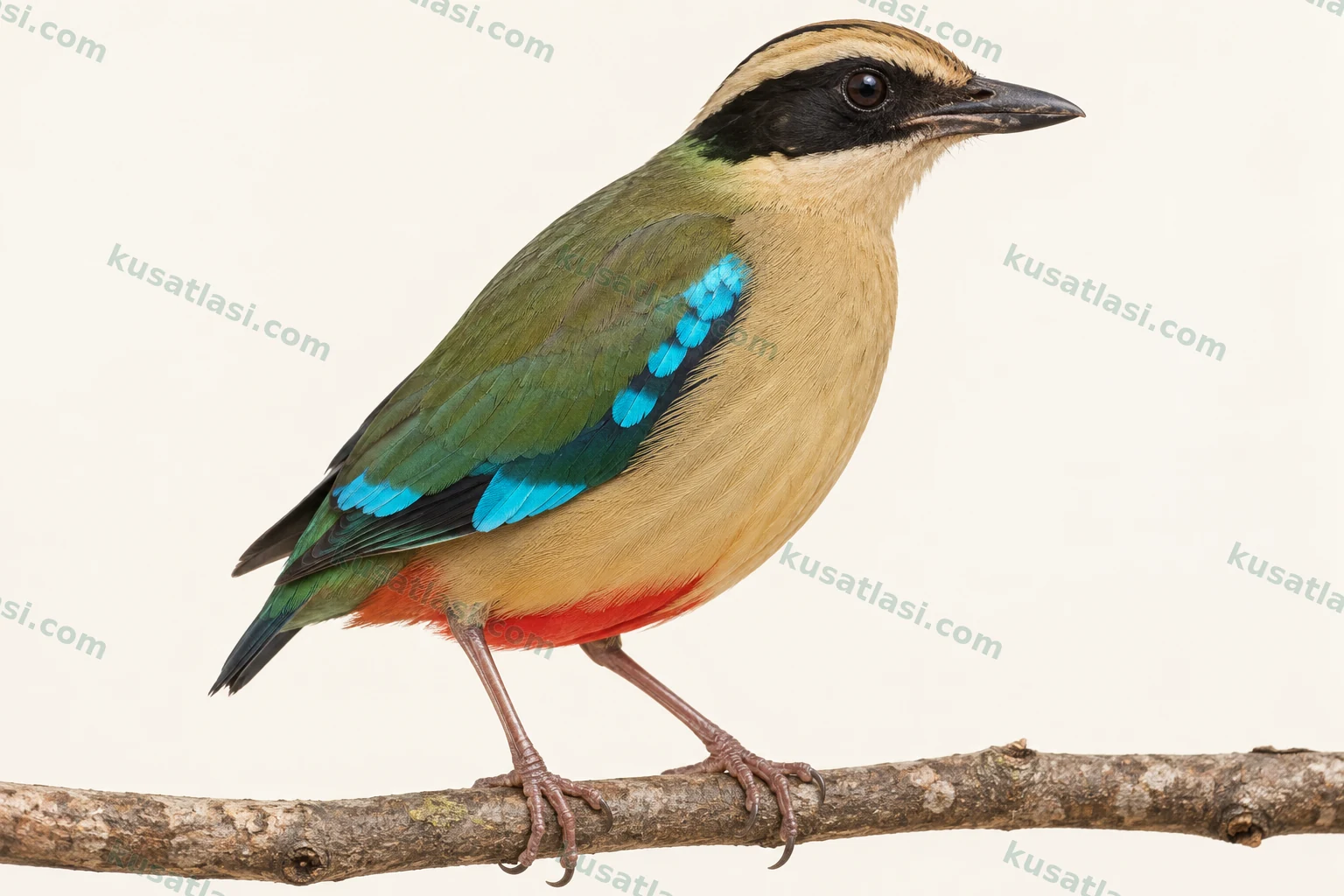
Compare male and female
 FemaleMale
Adult males and females have very similar basic plumage patterns; colour intensity alone does not determine sex with certainty.
Where to look in its natural range?
Quietly watch dense layers and small natural openings of riverine forest.
The Zimbabwe atlas provides regional arrival and egg-laying periods; this is not a shared migration calendar for all western populations.
January
Resident and moving western populations are considered separately from the southeastern intra-African breeding migrant. No verified regional date specific to this month was provided; this does not mean local absence.
February
Resident and moving western populations are considered separately from the southeastern intra-African breeding migrant. Zimbabwe: many birds leave in February, with occasional records extending into April.
March
Resident and moving western populations are considered separately from the southeastern intra-African breeding migrant. Zimbabwe: many birds leave in February, with occasional records extending into April.
April
Resident and moving western populations are considered separately from the southeastern intra-African breeding migrant. Zimbabwe: many birds leave in February, with occasional records extending into April.
May
Resident and moving western populations are considered separately from the southeastern intra-African breeding migrant. No verified regional date specific to this month was provided; this does not mean local absence.
June
Resident and moving western populations are considered separately from the southeastern intra-African breeding migrant. No verified regional date specific to this month was provided; this does not mean local absence.
July
Resident and moving western populations are considered separately from the southeastern intra-African breeding migrant. No verified regional date specific to this month was provided; this does not mean local absence.
August
Resident and moving western populations are considered separately from the southeastern intra-African breeding migrant. No verified regional date specific to this month was provided; this does not mean local absence.
September
Resident and moving western populations are considered separately from the southeastern intra-African breeding migrant. No verified regional date specific to this month was provided; this does not mean local absence.
October
Resident and moving western populations are considered separately from the southeastern intra-African breeding migrant. Zimbabwe, historical regional atlas: arrivals begin in late October and are concentrated in November and early December.
November
Resident and moving western populations are considered separately from the southeastern intra-African breeding migrant. Zimbabwe, historical regional atlas: arrivals begin in late October and are concentrated in November and early December. Zimbabwe: this is within the reported egg-laying period.
December
Resident and moving western populations are considered separately from the southeastern intra-African breeding migrant. Zimbabwe, historical regional atlas: arrivals begin in late October and are concentrated in November and early December. Zimbabwe: this is within the reported egg-laying period.
Nest, egg and incubation
The nest is domed and made of small twigs, grass and leaves; the regional compilation gives 2–4 eggs. Both parents incubated in a single Zambezi nest observation. Total incubation duration and age at first flight in days were not verified.
The Zambezi field observation recorded a short, explosive, frog-like call, as well as quiet incubation changeovers.
Do not play recordings to attract birds; observe quietly, especially near nests.
Species information
Quick identification
The African Pitta, Pitta angolensis, is a compact, short-tailed bird of the forest floor. A broad pale eyebrow across the black head, green back, blue wing areas and red belly attract attention together. The yellowish-buff breast grades into the red belly below. Eyebrow colour may vary among subspecies, so its yellowness alone does not determine identification. Make sure that the head, breast and back being assessed belong to the same individual.
Despite bright colours, it is hard to notice in dense scrub. A bird standing in leaf litter may look like a dark shape in shade. When movement reveals a blue wing area or red underparts, following the entire colour arrangement is more useful. A red belly alone does not identify it: its closest relative, Green-breasted Pitta Pitta reichenowi, also has red underparts. Breast colour, the throat area and head pattern must be seen together.
General appearance and posture
The body ends in a short tail; the legs may become conspicuous as it walks through low leaf litter. The crown and head sides are black. The broad pale eyebrow runs towards the back of the head. A historical museum description reported a brownish-buff upper section and paler lower edge to the eyebrow of western specimens. The current species is not restricted to that museum series’ locality; one subspecies’ details are not applied as a fixed pattern throughout the range.
The back is green. Blue tips to the wing coverts and a pale blue rump above the tail contrast with dark wing feathers. The breast is warm pale yellow or buff, with olive tones in parts of the flanks. Belly and undertail are red. A historical specimen account also reported reddish colour in the pale throat area; requiring a pure white throat in every individual would be inappropriate. Forest shade suppresses these colours, while a bright opening makes the pale eyebrow and blue wing tips particularly distinct.
Males, females and young birds
Males and females have very similar basic plumage patterns. A scientific comparison of the closely related African pitta species also treats the adult sexes of these two species as similar in appearance. Calling a brighter-looking individual male and a paler one female is not a reliable field key. Light, feather position and subspecies differences can produce appearances mistaken for sex differences.
In a direct nest observation in the Zambezi Valley, the two parents’ plumage looked essentially alike, and individuals were followed using a personal mark on a wing covert. One incubating by day and the other by night describes care at that nest; it is neither a plumage difference nor a male-by-day, female-by-night rule for every nest. An individual followed through behaviour is distinguished from a sex assumed from a photograph.
The historical museum account describes young birds as duller, with the red underparts appearing paler pink. This does not make every shaded, pale adult a juvenile. A feathered juvenile also differs from a newly hatched nestling. Size differences between two birds together do not give an exact age in days. Family relationships are more strongly supported by observed care and the context of birds moving together.
Appearance in flight
Blue wing tips and pale areas of the flight feathers may show during brief flights or displays. A portion hidden in a folded wing appears when the bird opens it. Short tail and compact body also contribute to the appearance. A single blue wing fragment must not become a certain identification without adequate views of black head, pale eyebrow and red underparts. A view only from behind cannot establish breast colour.
The atlas account records small upward hops during display. This movement from a branch or fallen tree is not a long-distance flight. Seasonal arrival in southeastern Africa is a separate scale of movement. A short flight direction in a forest opening cannot be turned into an intra-African migration route. To see the bird again, an observer can wait at the viewing gap instead of entering the scrub.
Voice and behaviour
The Zambezi observation recorded a short, explosive, frog-like call; the bird could subsequently fall silent and disappear into cover. Vocal periods may make it easier to find, but it should not be expected to call continuously. A parent behaving silently during an incubation change shows that a nearby bird’s silence does not mean absence.
It searches for food through leaf litter on the forest floor. Ground feeding and using a raised support for display are different parts of the same way of life. A bird seen only displaying is not assumed to spend its entire day on a branch. Sound direction can mislead in dense vegetation; a call not matched to a visible bird is treated more cautiously as a separate observation note.
Similar species
1. Green-breasted Pitta, Pitta reichenowi, is the most important close comparison. The scientific comparison describes its darker green breast in place of the African Pitta’s buff breast, with a narrow dark area below the pale throat. Both may share black head, pale eyebrow and red underparts. Breast and throat boundary are therefore examined together in suitable light; a blue wing area alone does not separate them. Variable appearances in western and central Africa require additional care.
2. Other forest-floor birds briefly glimpsed in leaf litter can be taken for pittas because of body shape. For the African Pitta, look for pale eyebrow, black head, green upperparts and red underparts together. If the view does not show the entire pattern, leave the record at a more general level. Similar-coloured Asian pitta plates are not automatically used as the comparison list for a natural African observation.
Global distribution
The species occurs in different populations in western, central and southeastern tropical Africa. The western subspecies pulih is associated with Sierra Leone to western Cameroon, and the nominate angolensis with southwestern Cameroon to northwestern Angola. Longipennis extends from southeastern Democratic Republic of the Congo and southeastern Tanzania to areas farther south. These broad descriptions do not mean that all intervening forests are occupied. Suitable dense cover and local records must be assessed together.
Status within its native range
The current list classifies it as Least Concern. Being hard to find locally and its global threat category are different kinds of information. The southern African atlas notes a small number of regularly known sites in Zimbabwe and the possibility of other overlooked breeding sites. The latter is a possibility based on its secretive habits, not a verified number of new nests. Western populations’ appearance and movements are not applied unchanged to the southeastern breeding visitor.
Migration
Southeastern populations undertake intra-African breeding migration. For Zimbabwe, the atlas account describes arrivals beginning in late October, concentrated mainly in November and early December; many birds leave in February, with occasional records extending into April. These dates are examples from a regional historical account, not identical arrival days each year or a common absence calendar for every subspecies. Resident and moving western populations must be considered separately. The map shows general geography and dated observation samples; no sequence of countries or precise flight path untracked by the source is drawn.
Breeding habitat
The southeastern atlas account highlights lowland evergreen riverine forest with dense undergrowth and small openings together. Fallen trees and branches may be used for display. During migration it may also occur in other scrub or woodland patches; brief stopover habitat and nesting forest are not the same thing. Tree cover seen from above does not alone show that dense ground cover is preserved.
Nest site
The nest is a domed structure made of materials such as small twigs, grass and leaves. The regional specialist account reports possible use of upper branches of a young tree and 2–4 eggs. A directly watched Zambezi nest documented two eggs and both parents incubating, a single-nest observation for African Pitta. Total incubation duration in days could not be verified for this work. The gap is not filled with the duration of another related pitta.
Daily space use
It uses ground leaf litter to feed and raised supports within cover to display. Seeing the same bird in these two places describes its habitat from different perspectives. Quiet incubation changes near a nest can reduce visibility. Natural arrivals and departures should be watched without approaching. Moving a branch, opening cover or using sound to draw out a parent may alter care behaviour; the precise nest location is not shared in the general observation layer.
What does it eat?
Its main food is forest-floor invertebrates. The AVONET record and the foreign specialist account agree on this feeding orientation. The specialist compilation includes insects, many-legged invertebrates, snails and similar prey; detailed dietary proportions are insufficiently known. The list does not mean that every food is eaten equally each day or that every subspecies shares the same seasonal proportions. Historical feeding notes from captivity do not replace measured food proportions in the wild.
How does it forage?
It searches on the ground among fallen leaves and cover. Directing the bill towards the ground shows searching, but prey is not named certainly unless the small item taken is seen. Carrying a food item in the bill and swallowing it immediately are different observations. A bird heading towards a nest during breeding is likewise insufficient proof of food carrying. Scattering leaves beforehand or leaving live bait to watch its natural search is inappropriate. Waiting at a fixed viewing opening makes it easier to distinguish ordinary ground feeding from display movements.
Colourful does not mean easy to see
Green back, blue wing areas and red belly form a vivid combination. Even so, the atlas stresses the species’ ability to remain hidden without attracting attention. Dense cover and its ground-dwelling habits make it difficult to see all colours at once. Not seeing it in a suitable forest is therefore not proof of absence. Timing of sound and movement changes detectability.
Display supports and feeding sites differ
The atlas reports hopping displays from fallen trees and branches. Feeding, however, is associated with the leaf-covered forest floor. A photograph on a support does not mean the bird spends its whole life in trees. Display, feeding and nest care are different behaviours of the same bird; the meaning of a perched view depends on that context.
A personal mark, not colour, distinguished the parents
In the Zambezi observation the adults’ plumage patterns were essentially alike. Researchers followed individuals by a small personal mark on a wing covert. Division of incubation shifts between day and night was directly observed in that pair; one nest’s arrangement cannot be made a sexing key for the whole species. This example shows that behavioural observation provides different information from comparing the colours of two photographs.
A habitat-change explanation needs testing
The atlas discusses the impact of large animals opening vegetation as a possible explanation for differing occurrence on opposite sides of the Zambezi. This is not an experiment proving that the bird disappears from every forest with elephants. A plausible explanation and a measured, verified result are different things. A single-cause conclusion should not be asserted without following bird frequency, vegetation structure and observation effort together.