

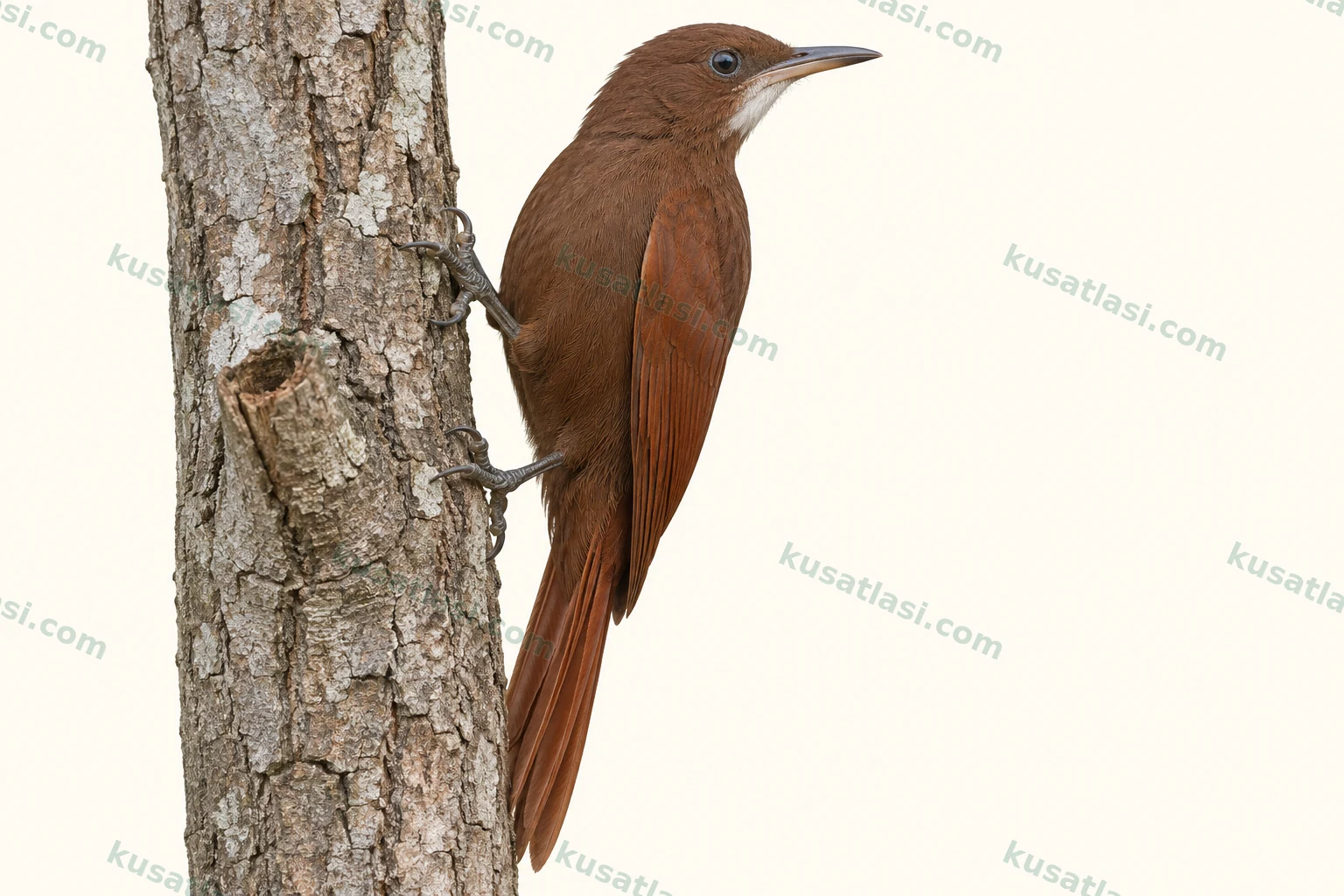
World Birds IUCN statusLC · Least ConcernGlobal IUCN. BirdLife v10 (2025); taxon matching AviList 2026 / IOC 15.2; checked: 29.10.2026. The list year is not the species’ assessment date. Source and method · BirdLife OrderPasseriformesPasserines FamilyFurnariidaeFurnariidae
White-chinned Woodcreeper
Dendrocincla merula
Plain brown Amazonian woodcreeper with bluish eyes; catches prey around army ants.
Biometrics
Length
Male16–21 cm
Female16–21 cm
Shared species value
Wing length
Male10 cm
Female10 cm
Shared species value
Weight
Male28–57 g
Female29–54 g
White-chinned Woodcreeper
Amazon basinObservation guide in its natural range
Look for three features together
Do not rely on a single featureBluish.
Unstreaked, plain brown.
Sallies after prey flushed by army ants.
Compare male and female
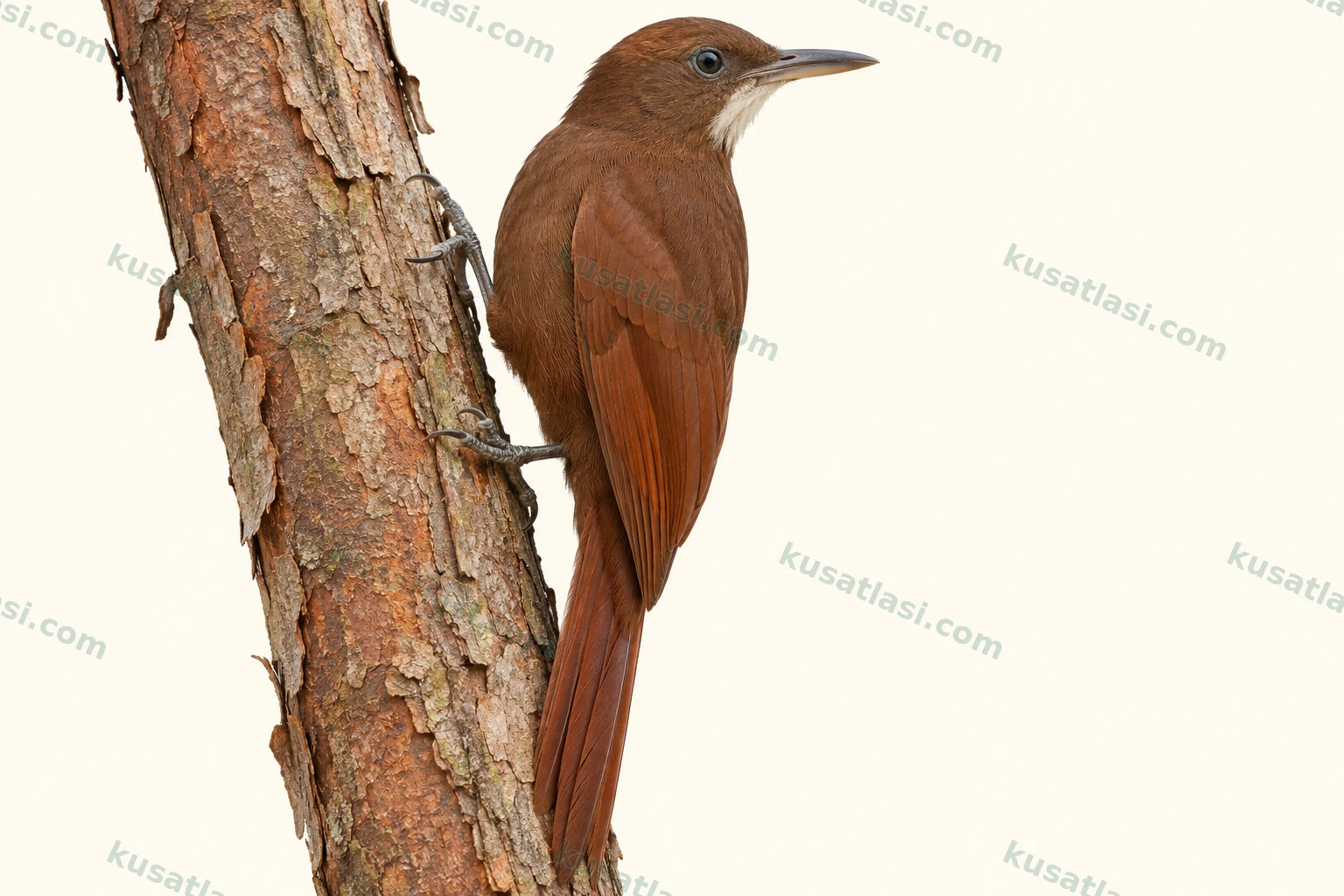 FemaleMale
No reliable detailed external sex or juvenile key was found.
Where to look in its natural range?
Around army-ant swarms in humid lowland forest.
Resident; following swarms is daily feeding movement.
All months: Data unavailable
January
February
March
April
May
June
July
August
September
October
November
December
Nest, egg and incubation
Female care of young reported; nest, eggs and developmental periods unverified.
Geographic voice differences reported in the Brazilian study.
Do not play recordings to attract birds; observe quietly, especially near nests.
Species information
Quick identification
The White-chinned Woodcreeper Dendrocincla merula is a plain brown bird following army-ant swarms in Amazonian forests. Bluish eyes, a narrow white chin–throat area and an unstreaked body are useful together. White-chinned Woodcreeper is its English name. The white area may be very limited in some individuals.
General appearance and posture
It looks medium-sized and generally unpatterned brown. Weaker facial markings and bluish eyes may distinguish it from nearby Dendrocincla fuliginosa.
Males, females and young birds
Sources did not provide a reliable detailed external sex or juvenile key. Willis's Brazilian study reports female care of young; care behaviour cannot determine the sex of every distant brown bird.
Appearance in flight
It may fly after prey in short sallies from a waiting perch. Perching on a trunk does not mean that feeding happens only by climbing bark. An unstreaked brown bird escaping in flight does not by itself distinguish similar woodcreepers.
Voice and behaviour
It is usually seen alone or in pairs near army-ant swarms. Edwin Willis's Brazilian Amazon study reports that voices at two sites near Manaus differed from forms in other regions. The same older work described little conflict between birds, whereas research at Cocha Cashu in Peru reported marked disputes among individuals of this species. Neither regional result is generalized as unchanging species-wide behaviour.
Similar species
Plain-brown Woodcreeper Dendrocincla fuliginosa has stronger facial patterning, especially a dark moustachial stripe, and lacks the bluish eye. Both may have brown bodies, so eyes and face must be seen well. Presence at an ant swarm alone does not identify the species.
World distribution
It inhabits the broad Amazonian forest belt of northern South America. Current geographic forms extend from Colombia and Venezuela through Ecuador, Peru, Bolivia, the Guianas and Amazonian Brazil. Voice and colour differences between inter-river forms have been studied.
Status in its natural range
The global category is Least Concern; Cornell's account describes it as generally sparse within its broad range. Local abundance may relate to forest structure and ant-swarm distribution. Density at one site is not applied to the whole basin.
Movements
The specialist ecological compilation treats it as resident. Following moving ant swarms is daily feeding movement, not evidence of seasonal intercontinental migration. A reliable long migration route was not verified.
Breeding habitat
It uses humid lowland tropical forest. Feeding opportunities in dense forest cover relate to prey exposed by army ants. Streamside and swamp-forest surroundings also occur among the study areas.
Nest site
Studies in Brazil and Peru report females caring for young. However, accessible original documents did not verify nest structure, typical clutch size, incubation or fledging periods. Another Dendrocincla species' cavity nest was not inserted as confirmed information for this one.
Daily use of space
It waits on branches and vertical supports near ant swarms and makes short sallies at escaping prey. Work near Belém and Manaus in Brazil reported feeding-height variation alongside other ant-following birds. This local association is not a rule of identical feeding height in every forest.
What does it eat?
It feeds on invertebrates. Small animals escaping cover as army ants advance offer prey opportunities. Following ants does not mean that the ants themselves are the main food.
How does it forage?
The Brazilian Amazon study reports sallies from waiting perches after fleeing prey and strong dependence on ant swarms. This differs from the image of a woodcreeper only picking at bark. Exact insect-group proportions and year-round consumption were not verified.
Ants expose the food
Following army ants uses a moving feeding opportunity. Prey fleeing as ants sweep the cover becomes visible. Sallies from a waiting branch explain how the bird benefits from that opportunity.
Behaviour can differ between regions
Older reports of little within-species conflict at Brazilian Amazon sites differ from marked disputes observed at Cocha Cashu in Peru. Local bird communities and prey opportunities may differ; a single causal factor has not been established.