

World Birds IUCN statusLC · Least ConcernGlobal IUCN category. BirdLife v10 (2025); taxon matching: AviList 2026 / IOC 15.2; checked: 29.10.2026. The list year is not the species assessment date. Source and method · BirdLife OrderPasseriformesPasserines FamilyFurnariidaeFurnariidae
White-throated Woodcreeper
Xiphocolaptes albicollis
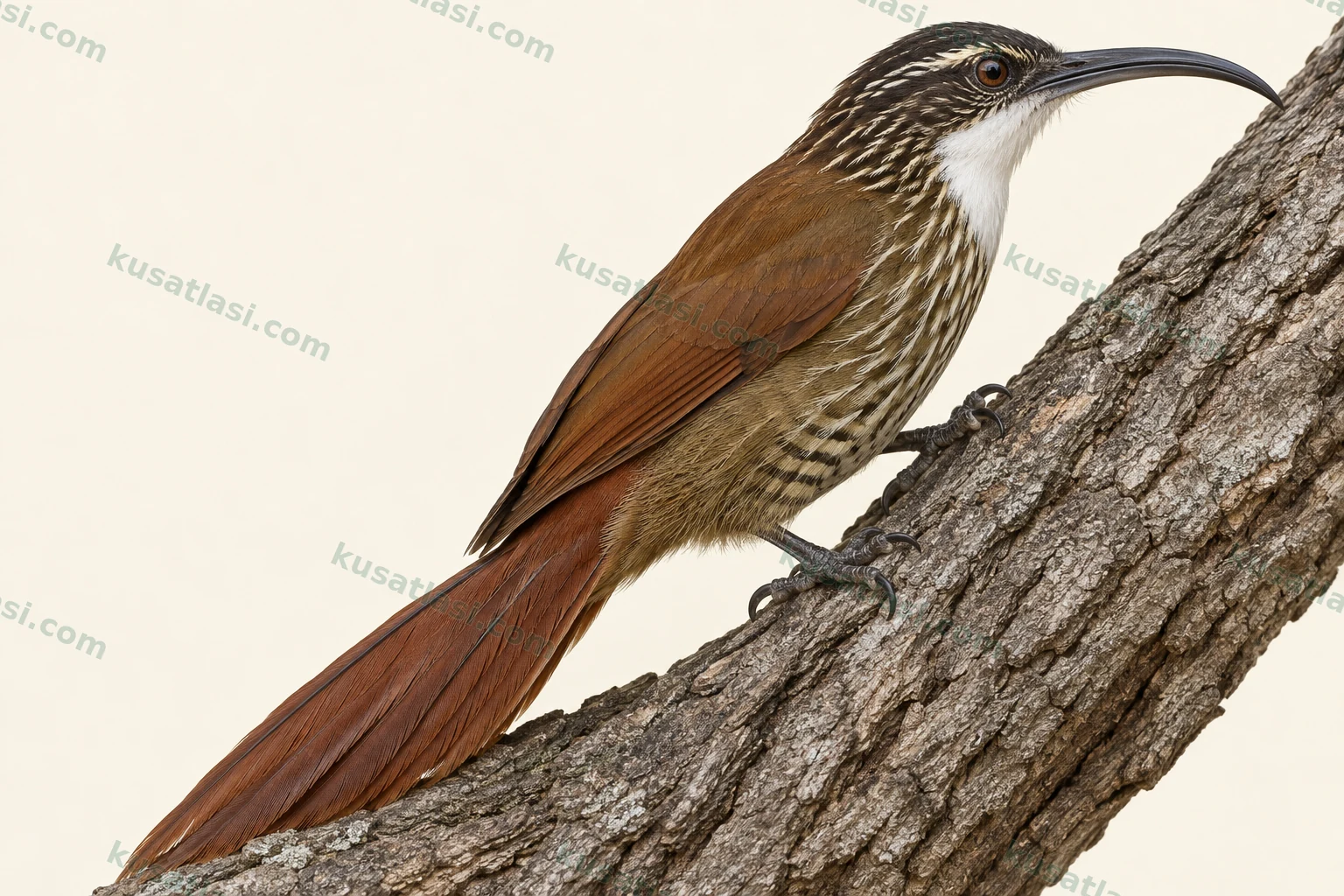
A large reddish-brown woodcreeper with a strong, slightly curved bill, a pale face and throat, and a streaked breast.
Biometrics
Length
Male27–33 cm
Female27–33 cm
Shared species value
Wing length
Male12.83 cm
Female12.83 cm
Shared species value
Weight
Male110–131 g
Female110–131 g
Shared species value
White-throated Woodcreeper
Atlantic forests of Brazil, eastern Paraguay and northeastern ArgentinaObservation guide in its natural range
Look for three features together
Do not rely on a single featureCheck the long, strong bill, pale face and throat, and crown streaks together.
Look for breast streaks and crosswise markings on the belly of the same bird.
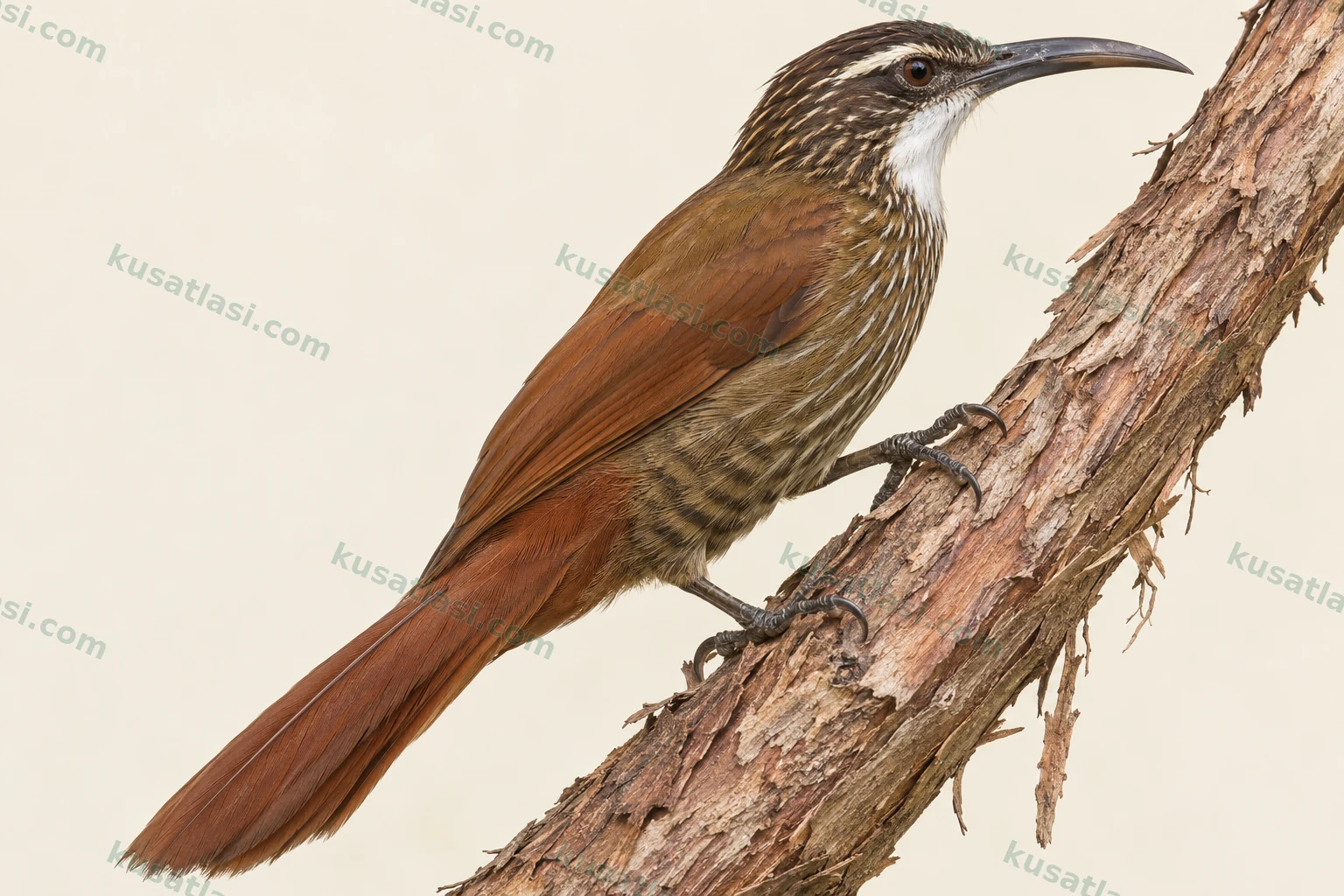
Compare male and female
 FemaleMale
No single reliable mark for sexing adults was verified. The study describes young that had recently begun to fly as having shorter tails and pale gape corners.
Where to look in its natural range?
In humid forest, watch the bird climb trunks and search among clumps of vegetation.
The species is resident. The Misiones study examines local spring breeding.
January
Breeding study in Misiones. No verified regional date was given for this month. This does not imply local absence.
February
Breeding study in Misiones. No verified regional date was given for this month. This does not imply local absence.
March
Breeding study in Misiones. No verified regional date was given for this month. This does not imply local absence.
April
Breeding study in Misiones. No verified regional date was given for this month. This does not imply local absence.
May
Breeding study in Misiones. No verified regional date was given for this month. This does not imply local absence.
June
Breeding study in Misiones. No verified regional date was given for this month. This does not imply local absence.
July
Breeding study in Misiones. No verified regional date was given for this month. This does not imply local absence.
August
Breeding study in Misiones. No verified regional date was given for this month. This does not imply local absence.
September
Breeding study in Misiones. Spring breeding season in Misiones.
October
Breeding study in Misiones. Spring breeding season in Misiones.
November
Breeding study in Misiones. Spring breeding season in Misiones.
December
Breeding study in Misiones. Spring breeding season in Misiones.
Nest, egg and incubation
The nest is in a natural tree cavity. The Misiones study recorded 2–4 eggs, 17 days of incubation and 18–22 days in the nest for the young.
A whining introduction leads into a descending whistle of four to six pairs of notes. The song is powerful and can carry far.
Do not play recordings to attract birds. Observe quietly, especially near nests.
Species information
Quick identification
The White-throated Woodcreeper Xiphocolaptes albicollis is one of the large woodcreepers of South America’s Atlantic Forest. Its head looks small in relation to the body, and its long, strong bill curves slightly downwards. The pale face and throat are important features. Examine the reddish-brown body together with the pale streaks on the crown and neck, the white streaks on the breast and the transverse pattern on the belly. The white throat alone does not separate similar large woodcreepers.
When the bird is on a tree trunk, try to see the side of the head and the underparts. Once it moves around the back of the trunk, only the brown back may be visible, hiding the distinguishing face and breast. The bill shape is easier to see from the side and the belly markings from the front. Seeing both natural postures on the same bird helps assess the full pattern without combining features of different individuals.
General appearance and posture
The long bill and large body stand out at first. The feet and tail support the bird as it climbs a trunk. A comparative study of foot bones found robust features associated with gripping trunks in this species. The finding comes from anatomical examination of specimens, rather than the size of claws visible from outside. Perching on a tree does not make it a woodpecker. The accepted taxon is a woodcreeper in Furnariidae.
Fluffed feathers can make the body look larger, while flattened feathers can make it look slimmer. The bill-to-head proportions of a bird stretching its neck upwards and those of a bird with its neck drawn in should therefore be assessed separately. A distant impression of a large brown bird is insufficient for certain identification.
Males, females and young birds
No single plumage mark was verified that reliably separates adult males and females at a distance. Bill size or the extent of the pale throat is not used without a reliable key based on measurements. The Misiones breeding study confirms that both adults brought nesting material, incubated the eggs and fed the young. This sharing of care does not mean adults can all be readily sexed by sight.
Young birds leaving the nest in the study resembled adults but had shorter tails and pale whitish-yellow gape corners. These marks were described for recently fledged birds and should not be used as an invariable key to every juvenile stage. Seeing a short-tailed bird near a cavity actually receive food can help assess its stage of development. Watch the birds’ natural interactions from a distance without disturbing the nest tree or its branches.
Appearance in flight
The pale face and underparts can be seen as the bird climbs a trunk. These details are briefly hidden during a short flight between trees. An overall reddish-brown appearance is insufficient for identification. Wait for the bird to land on the next trunk and check the bill curvature, crown and neck streaks and pale throat again. Do not assume a distinctive pattern on a part of the wing that was not seen in flight.
The tail used to grip the tree is seen from another angle in flight. The support it provides against the trunk is distinct from the way it looks in the air. It is useful to assess the two views separately.
Voice and behaviour
The song is powerful and can carry a long way. It is described as starting with a wailing sound, followed by four to six pairs of descending whistled notes. On hearing it, look for a pale face and strong bill on the tree where the bird is calling. Echoes in the forest can make the sound seem to come from a different distance or direction. Do not combine the notes of several birds singing at the same time into a single long song.
The bird is sometimes seen foraging in mixed-species flocks or in association with army ant swarms. In Brazil, it was also directly observed holding a millipede in its bill and rubbing it against its breast, belly and wing feathers. The millipede can then be taken up or dropped. The researcher discussed possible benefits associated with chemical secretions. The observation does not establish experimentally that the behaviour repels pests.
Similar species
When comparing it with the Great Rufous Woodcreeper Xiphocolaptes major, check the pale face and throat, crown and neck streaks and the pattern on the breast and belly together. Comparing bill length alone is insufficient for two large brown birds. Natural forest habitat helps put the sighting in context but does not replace a clear view of the breast pattern.
When comparing it with the Moustached Woodcreeper Xiphocolaptes falcirostris and other large woodcreepers in the same habitat, view facial streaks and underparts from the same angle. A strong bill, climbing posture and rufous colours occur in more than one species. If the photograph only shows the back, wait for the bird to turn naturally. An uncertain observation can be recorded as a woodcreeper and reviewed later using both appearance and sound.
World distribution
The natural range includes Brazil’s Atlantic Forest belt, eastern Paraguay and northeastern Argentina. The woodland used by regional forms does not form a uniform area covering every part of those countries. Moist forest structure and the presence of suitable trees matter. It has also been recorded in Araucaria forests. No single forest type is assumed to represent the whole natural range.
Status in the natural range
The Misiones study examined nests in the region’s natural and logged forests. The use of decay-formed cavities in living trees means that protecting the forest involves more than counting the trees. Losing one tree with a suitable cavity does not mean an equivalent nest site is immediately available, even if other trees remain. The local sample does not provide a population density for the entire Atlantic Forest.
Migration
The species is generally classified as resident. A regular long-distance migration route was not verified for this account. Moving through forest with a mixed flock or following an army ant swarm is foraging movement rather than evidence of migration. The calendar can describe the regional spring breeding period in Misiones without assigning the same start and end dates to all of Brazil. The map shows approximate records in native forest. These do not reveal a bird’s daily route or the precise location of its nest cavity.
Breeding habitat
Humid Atlantic Forest and Araucaria forest are key habitats. Large trees with suitable cavities are important for breeding. Natural cavities examined in the Argentine study were in living trees. Do not assume that the species nests in every dead trunk or every woodpecker hole. The suitability of the entrance and the interior cavity are separate features.
Nest site
The Misiones study examined 16 nesting attempts. Of 11 cavities used, nine were natural cavities and two were nest boxes. The natural cavities formed through decay rather than excavation by woodpeckers. Clutches of 2–4 eggs were reported on a bed of bark, pieces of leaves and seed husks. Incubation lasted 17 days and the young stayed in the nest for 18–22 days. These values apply to the regional study.
Daily habitat use
The bird can forage at different heights in the forest. Watching a bird returning to its nest at close range can alter its natural approach. The study noted that an adult that noticed an observer could delay entering. The same cavity may be reused in subsequent years or used by another bird. Preserve the safe approach and cover around the nest tree. Do not open the cavity to take photographs.
What does it eat?
Invertebrates are important in its diet. The Misiones study documented adults bringing arthropods and small vertebrates to their young. This does not show that prey proportions are the same in all seasons. The Brazilian behaviour record concerns millipedes. Rubbing a millipede against the feathers and swallowing it are different actions. Do not assume that every animal the bird holds has already been eaten. Prey given to young birds does not by itself describe the adult’s entire daily diet.
How does it forage?
It can search at different levels on trees and other plant structures. Banana stumps and bromeliad clumps were present where the millipede behaviour was observed. It has also been recorded with mixed flocks or army ants. This association does not mean it eats only ants. Note where the bird takes an item from with its bill and what it then does with it. A bird carrying prey towards the nest may be bringing food for the young. Seeing the adult actually pass the food to the young makes the record stronger.
It need not excavate the cavity from scratch
Natural nest cavities in the Misiones study formed as living trees decayed. Climbing trunks and having a strong bill do not mean the bird excavates every cavity itself. Natural processes inside a tree can provide nest sites that are hidden from view. Protecting a suitable tree helps sustain more of the habitat than its leafy crown alone.
Care by both adults was directly observed
In the nest study, both adults were seen bringing material, incubating the eggs, carrying food and cleaning the nest. The study did not establish that they shared the tasks equally. Care by both birds and equal time spent on each task are different findings. Seeing one adult more often during a short observation does not necessarily mean the other provides no care.
It rubs its feathers with a millipede
In three records from Brazil, the bird rubbed a millipede it was holding against its feathers. The secretions might deter some pests or make the prey edible. The researchers discussed these possibilities as explanations. Keep the action observed separate from its possible benefit. The record illustrates the species’ range of behaviours, without implying that every White-throated Woodcreeper does this daily.
The anatomy of climbing can be studied
A three-dimensional study of foot bones included specimens of this species. The robust bone structure and foot features associated with gripping trunks show that climbing cannot be explained by plumage alone. The tail’s support and the grip of the feet work together on a trunk. Anatomical research also helps show why similar postures in different climbing birds need not reflect the same arrangement of the feet.