

World Birds IUCN statusLC · Least ConcernGlobal IUCN category. BirdLife v10 (2025); taxon matching: AviList 2026 / IOC 15.2; checked: 29.10.2026. The list year is not the species assessment date. Source and method · BirdLife OrderGalliformesTavuklar FamilyPhasianidaePhasianidae
Blue Quail
Synoicus adansonii
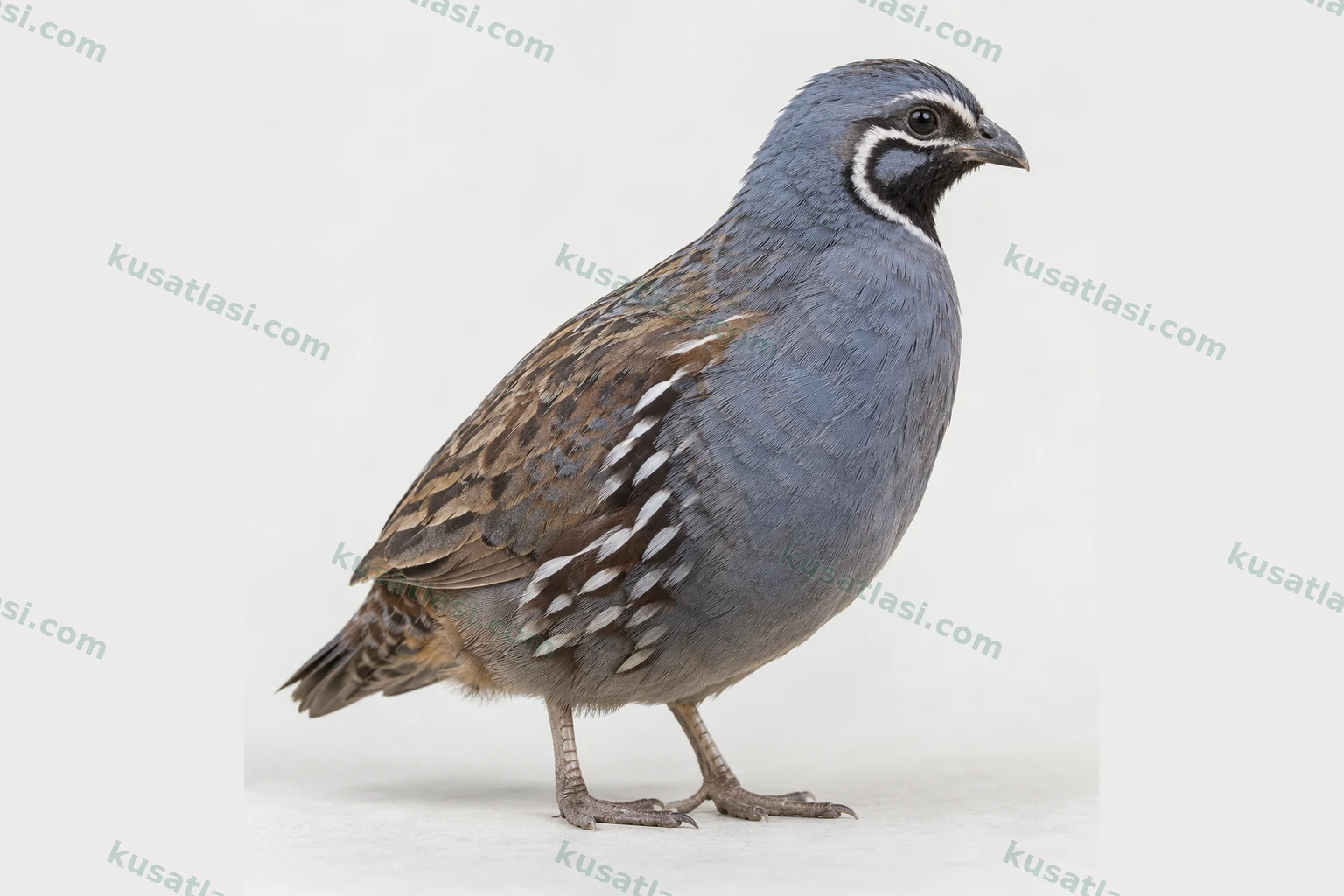
This small ground bird lives in moist grassland. The male is blue-grey with a bold black-and-white throat, while the female is brown with dark transverse markings below.
Biometrics
Length
Male12–15 cm
Female12–15 cm
Shared species value
Wing length
Male7.45 cm
Female7.45 cm
Shared species value
Weight
Male33–48 g
Female44 g
Blue Quail
Patchy moist grasslands and watercourse margins of sub-Saharan AfricaObservation guide in its natural range
Look for three features together
Do not rely on a single featureThe male has a blue-grey body, black-and-white throat and rufous wing area.
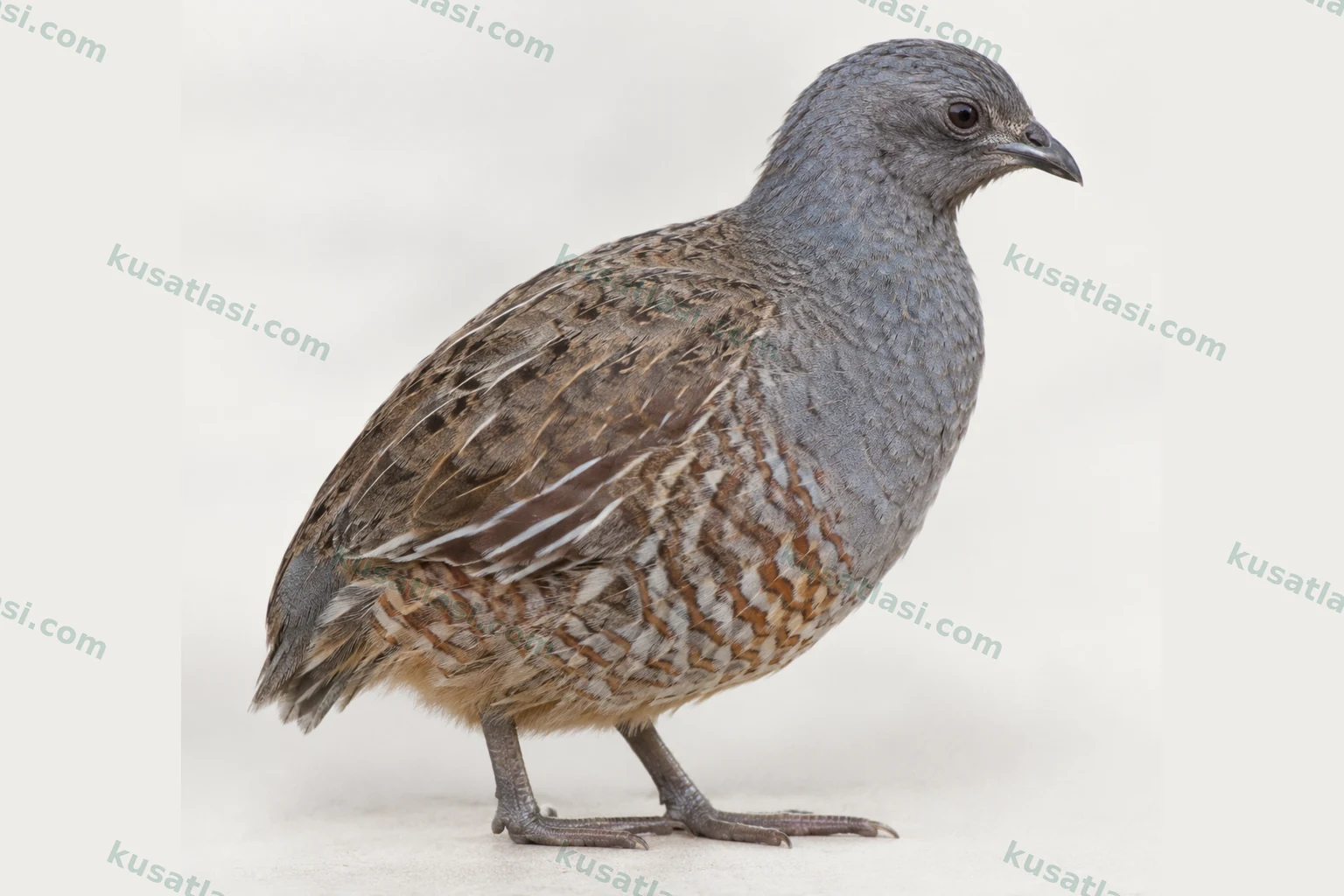
The female is brown with dark transverse markings on the underparts.
The bird uses dense moist grass, and its detectability changes with rainfall and cover conditions.
Compare male and female
 FemaleMale
The male is blue-grey with a black-and-white throat; the female is brown, and young resemble the female. No age threshold in days is applied to young birds.
Where to look in its natural range?
Watch grass openings and field edges from a distance; do not enter the cover to make birds fly.
Regional egg-laying examples are shown; historical South African information does not mean regular present-day occurrence.
January
Movement within Africa is associated with rainfall; a regular individual route has not been verified. The regional atlas reports breeding records for this month in Zimbabwe.
February
Movement within Africa is associated with rainfall; a regular individual route has not been verified. The regional atlas reports breeding records for this month in Zimbabwe.
March
Movement within Africa is associated with rainfall; a regular individual route has not been verified. The regional atlas reports breeding records for this month in Zimbabwe.
April
Movement within Africa is associated with rainfall; a regular individual route has not been verified. The regional atlas reports breeding records for this month in Zimbabwe.
May
Movement within Africa is associated with rainfall; a regular individual route has not been verified. The specialist account places this month within the breeding period in Uganda.
June
Movement within Africa is associated with rainfall; a regular individual route has not been verified. The specialist account places this month within the breeding period in Uganda.
July
Movement within Africa is associated with rainfall; a regular individual route has not been verified. The specialist account places this month within the breeding period in Uganda.
August
Movement within Africa is associated with rainfall; a regular individual route has not been verified. No verified regional date specific to this month was supplied; this does not mean local absence.
September
Movement within Africa is associated with rainfall; a regular individual route has not been verified. No verified regional date specific to this month was supplied; this does not mean local absence.
October
Movement within Africa is associated with rainfall; a regular individual route has not been verified. No verified regional date specific to this month was supplied; this does not mean local absence.
November
Movement within Africa is associated with rainfall; a regular individual route has not been verified. No verified regional date specific to this month was supplied; this does not mean local absence.
December
Movement within Africa is associated with rainfall; a regular individual route has not been verified. No verified regional date specific to this month was supplied; this does not mean local absence.
Nest, egg and incubation
The ground nest is hidden at the base of a grass clump. Specialist accounts give three–nine eggs, while the university account gives six–nine. Incubation of about 16 days is attributed mainly to the female; the male’s contribution is uncertain. Chicks walk early, but the first-flight period has not been verified.
The call is a thin three-note whistle: the strong first note is followed by two softer, lower notes. Its rhythm is assessed in comparison with other quails.
Do not play recordings to attract birds; observe quietly, especially near nests.
Species information
Quick Identification
The Blue Quail, Synoicus adansonii, is a small ground bird of damp grassland. An adult male is distinguished by a blue-grey body, black-and-white throat pattern and rufous-brown wing area. The female does not share that blue appearance: she is brown and streaked, with dark cross-markings below. Looking only for blue birds therefore misses the females. A brief movement at the edge of thick grass may not separate it from other quails before the whole pattern is seen.
The current English name Blue Quail refers to this African taxon. The older names Coturnix adansonii and Excalfactoria adansonii were used for the same bird. The Asian Synoicus chinensis is a different species that may be offered as a cage bird under identical or similar names. An escaped cage bird's photograph must not be treated as natural African distribution. Scientific name, origin and natural plumage need to be considered together.
General Appearance and Posture
In the male, the dark blue-grey from head to rear back combines with the white and black throat area. White becomes conspicuous towards the upper breast; rufous-brown and blue-grey patterns may occur together on the sides. Bright yellow legs and dark red eyes help in good views. If grasses hide the legs, this mark is unseen, not proven absent. Blue feathers can appear darker in shade and paler in sunlight.
The female has a pale central head stripe, small mixed brown-rufous markings above and more distinct dark transverse markings below. A generally brown appearance does not make all female quails alike. The direction of upper and lower markings should be checked separately: a lengthwise back streak and a transverse belly bar are not the same mark. If a bird walks in grass with its underside hidden, record which part of identification remains incomplete.
Its short tail and low body help it disappear among grasses. Looking over a hummock may expose only neck and head; while walking, the whole body may vanish behind a plant. Waiting quietly at a grass opening allows the complete posture to be seen without forcing the bird to fly.
Males, Females and Young Birds
Adult males and females differ markedly in plumage. Blue-grey underparts and a strong black-and-white throat are useful in a well-seen adult male, but that pattern is not expected on the female. Treating a brown female as a faded male, or all small blue quails as the African species, is a mistake. Domestic colour forms may vary further, so a natural identification key cannot simply be applied to a cage bird of uncertain origin.
Young more closely resemble females; the specialist French account says upperpart streaking may be stronger. This broad resemblance gives no age in days and does not make every brown bird young. Adult females are brown too. If views are insufficient for age, a female or female-like appearance can be recorded. Feather structure and which body parts were actually seen matter as much as colour.
Chicks can move soon after hatching. Walking among grasses does not mean a chick has made its first flight or can live independently. Specialist accounts describe adult care, but a precise first-flight period has not been verified. Entering grass to photograph a family may separate chicks from one another or from adults. A family appearing in an opening should be watched from a distance.
Appearance in Flight
When leaving cover, the bird may fly rapidly and directly. It often stays among grass, however, and walking towards it to force a flush is not an identification method. A brief take-off may reveal the male's blue tones, while the female is more easily confused with other small ground birds. Wingbeats, departure direction and the cover where it lands can be observed. An unseen throat or belly pattern is not filled in afterwards.
A short flight does not prove migration. Movement within a grass clump, feeding and seasonal movement are different behaviours. A wing appearing larger can also result from viewing angle. Adult plumage and the correct sound sequence provide a more useful identification combination.
Voice and Behaviour
The male's call is described as a thin three-note whistle, the first note stronger and the following notes softer and lower. Sound from within grass can help locate the bird. Harlequin Quail also has a three-part call, however, so merely counting three syllables is insufficient. Listen to note duration, pitch and repeated sequence and, where possible, link it to the seen bird.
The species may be recorded singly, in pairs or small groups. Several birds in one grassland do not show that every group member came from the same nest. Detectability may change with rainfall and cover; few dry-season records do not prove that the entire population has disappeared. Observation duration and method affect record numbers too. Trampling vegetation to find a hidden bird changes both habitat and observed behaviour.
Similar Species
Harlequin Quail, Coturnix delegorguei, uses similarly dense ground cover, and especially females can be confused during a brief flush. The adult male Blue Quail's blue-grey body, rufous wing area and throat-and-breast pattern are considered together. Strong transverse underpart markings help with females. Overall brown colour or a three-note call alone does not separate the species with certainty; details of appearance and sound are combined.
Common Quail, Coturnix coturnix, is compared for its more streaked brown appearance and pale eyebrow. The male has a dark throat stripe, but not the complete blue-grey pattern of a male Blue Quail. Brief female flight views may be inconclusive. Being in Africa alone does not exclude Common Quail: open-field and grassland birds may share geography. Record the actual signs in a doubtful sighting rather than force a certain species.
Global Distribution
It has a patchy distribution linked to suitable grassland across sub-Saharan Africa from west to east and south. It is not equally distributed throughout the continent's forests. Records in western, eastern and more southern Africa span a large area but do not imply continuous or abundant occurrence in every country. Dense damp grass cover and land use leaving the ground bare do not provide the same conditions.
Status Within Its Native Range
Historical records around southern Africa must not be confused with regular present-day occurrence. At the time of the 1997 regional atlas, records were concentrated in northeastern Zimbabwe, with older KwaZulu-Natal records discussed separately. The 2025 assessment gives the regional category for South Africa, Lesotho and Eswatini as Not Applicable; this does not mean the entire African species is extinct. The global category is Least Concern and global numbers are unknown.
Migration
The importance of residency, rain-related movement and migration within Africa differs regionally. The older atlas describes wet-season birds in Zimbabwe and some remaining into the dry season after good rains. Appearing with rain does not prove that every individual arrived from the same distant country. No individual route is drawn because the sources do not provide verified tracks. A month's sighting is not an egg-laying record; renewed suitability of damp grassland and the timing of breeding are considered separately.
Breeding Habitat
Damp meadows, grass beside waterways, marsh margins and well-vegetated field edges are places to search. Bare, closely cut ground does not replace dense grass. Ground conditions matter as well as connected vegetation in which a small bird can hide. A field record does not make every form of intensive agriculture suitable for the species: the actual grass and moisture conditions of the record should be described.
Nest Site
The nest is a hidden ground hollow at the base of a grass clump and may be lined with dry plant matter. Specialist accounts usually describe three–nine eggs and about 16 days incubation; the university account gives the narrower range six–nine. These are not converted into a new average. Incubation is mainly attributed to the female, and the male's contribution is not established. Both adults caring for mobile chicks is not the same behaviour as shared incubation.
Daily Space Use
Grass openings and edges should be watched from afar; do not enter the grass to expose the bird. A concealed ground nest may be hard to notice. Falling water levels, drainage and cover removal can quickly change the same site. Land with an old record may not be equally suitable today; notes on current ground and grass structure give the observation meaning.
What Does It Eat?
Grass and wild-plant seeds are important foods. The university account also lists green plant parts, insects and small terrestrial molluscs. It is therefore not described as exclusively seed-eating, but no study gives identical prey proportions in every region. Source food groups are not the menu of every individual observed in the field. When a tiny item cannot be recognised as seed or insect, its identity remains uncertain.
How Does It Feed?
Feeding is associated with grass and vegetation on the ground. Not every head dip by a walking bird is counted as successful feeding; the taken item is recorded if visible. A low posture during feeding can resemble hiding from a predator in a brief view. Watch the same opening from a distance to understand natural behaviour, without scattering food to redirect the bird.
Damp grassland is not merely a screen hiding the bird: it provides seeds and small invertebrates. Removing vegetation can alter visibility, food access and sheltered movement simultaneously. More sightings do not immediately mean improved habitat; less cover may simply make birds more visible. Feeding records, cover condition and observation duration are kept separate.
Blue Does Not Describe the Female
The blue in the species' name is a strong visual clue for the adult male. Females and young do not share that pattern. Searching only for the colour in a name can make part of a species invisible in the field. Separate accounts of male, female and young are important here. Female transverse underpart markings provide identification information different from the male's blue body.
Rainfall and Record Numbers
The regional atlas of southern Africa describes more birds seen in some years after good rains. This does not directly calculate numbers across the whole continent. Rain can change habitat, movements and observation conditions together. Few dry-season records and a claim of regional extinction require different evidence. Dated sightings and the methods used matter as much as the count.
Domestic Forms of a Close Relative
The Asian Synoicus chinensis is widespread in aviculture and can cause confusion through similar names and colours. The current specialist assessment specifically mentions this comparison. Treating a bird of uncertain origin as a natural African species merely because it is small and blue can add a false map record. Natural plumage, accepted taxon and observation context are examined together; domestic colour variation is not interpreted as a new subspecies.
A Walking Chick May Not Yet Fly
Early movement is part of this ground bird's life. Leaving a nest does not establish flight or independence age. If a verified first-flight period is unavailable, another quail's development days are not transferred here. Watching a family together in grass may show care, while scattering the birds to obtain that information changes the observation. Remaining in sheltered cover is valuable for adults to continue caring.