

World Birds IUCN statusLC · Least ConcernGlobal IUCN category. BirdLife v10 (2025); taxon matching: AviList 2026 / IOC 15.2; checked: 29.10.2026. The list year is not the species assessment date. Source and method · BirdLife OrderPasseriformesPasserines FamilyGrallariidaeGrallariidae
White-throated Antpitta
Grallaria albigula
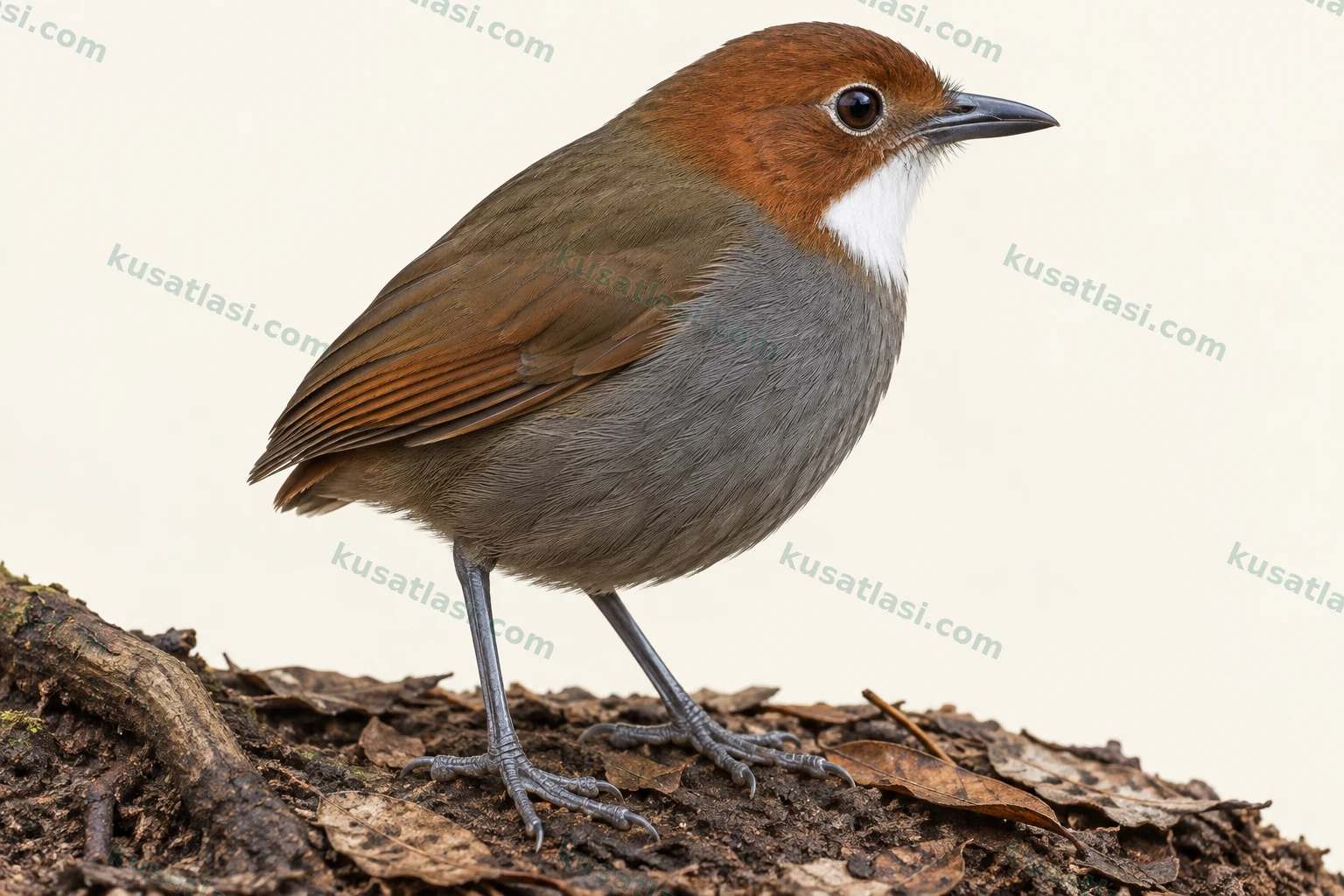
A stocky antpitta of the eastern Andean forest floor, with a chestnut-red head, white throat and pale eye surround, and grey underparts.
Biometrics
Length
Male18 cm
Female18 cm
Shared species value
Wing length
Male9.83 cm
Female9.83 cm
Shared species value
Weight
Male84–92 g
Female87–116 g
White-throated Antpitta
Andean forests of southeastern Peru, Bolivia and northwestern ArgentinaObservation guide in its natural range
Look for three features together
Do not rely on a single featureLook for the reddish head, pale eye-ring and white throat together.
Look for grey below the throat and distinguish it from a white belly.
Compare male and female
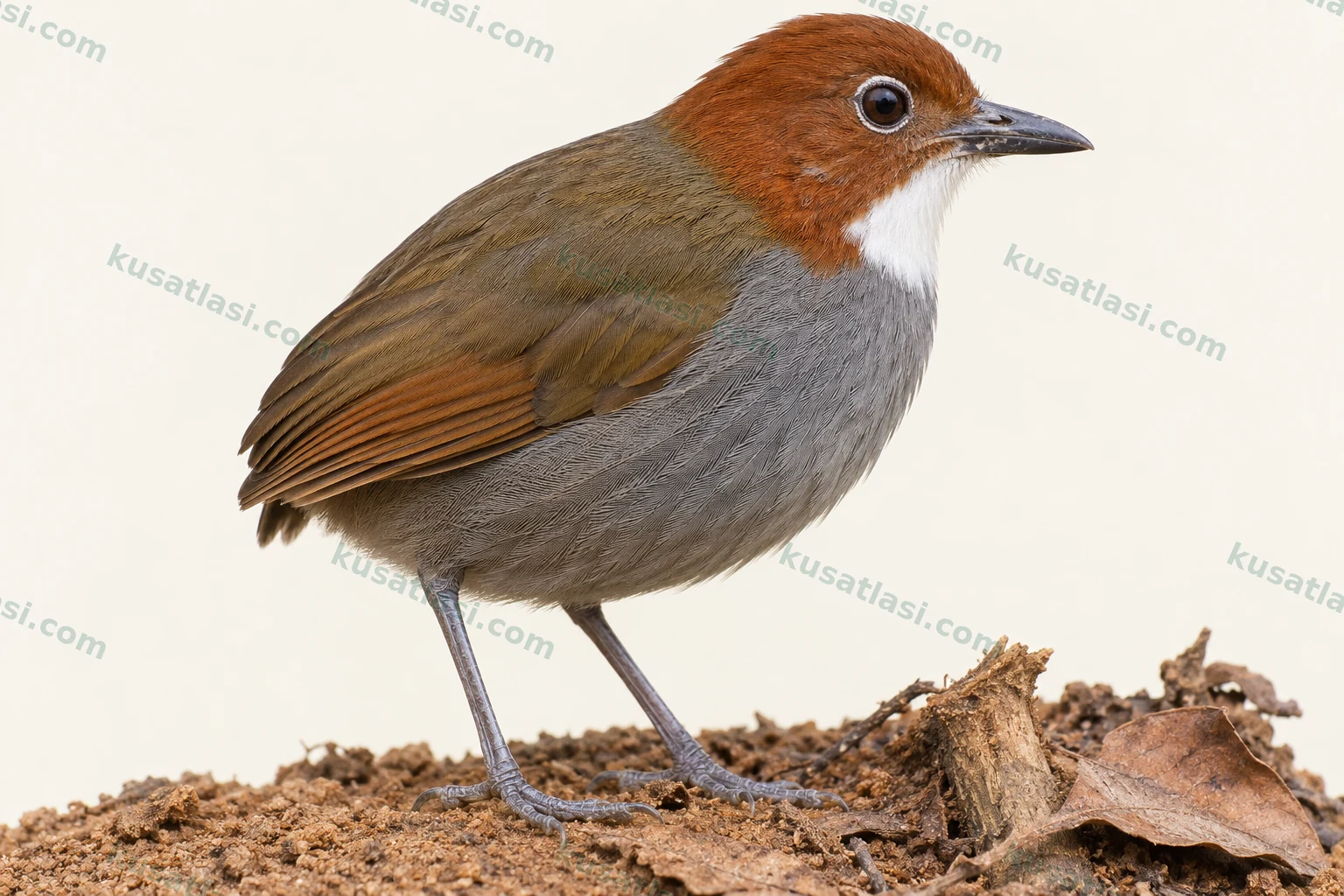 FemaleMale
No reliable key was verified for identifying adult sex at a distance or distinguishing all juvenile age stages.
Where to look in its natural range?
Look on the mountain forest floor and in dense undergrowth.
A resident forest bird. Its nest and breeding biology are unknown in the specialist review.
All months: The species is resident. No monthly breeding limits have been verified. No verified regional date is given for this month. This does not indicate local absence.
January
February
March
April
May
June
July
August
September
October
November
December
Nest, egg and incubation
Nest structure, clutch size, incubation duration and the time young birds take to develop are unknown in the current specialist review.
Listen for a breathy two-note whistle with a slightly higher second note. Compare the sound with the visible head and body pattern.
Do not play recordings to attract birds; observe quietly, especially near nests.
Species information
Quick identification
The White-throated Antpitta Grallaria albigula is a stocky, long-legged songbird of the forest floor in the eastern Andes. Look for the chestnut-red head, white throat, pale eye surround and grey underparts together. The back is a more brownish olive. Check whether the white extends over the whole belly. In this species the pale throat contrasts with the grey underparts. Long grey legs are a useful additional clue when the bird appears briefly between leaves.
In dense vegetation you may hear the bird first. When it comes into view, check head, throat and belly on the same individual. A two-note call or a reddish head alone does not rule out other possibilities. Green light reflected from leaves can change the apparent shade of grey. The white throat may even look grey in a dark image, so note where the pale patch lies as well as its colour. Entering the cover for a better look interrupts the bird's natural behaviour.
General appearance and posture
A rounded body and long legs characterise its stance on the forest floor. The warm head and cooler grey body stand out from each other. Leaning forward, standing upright or passing behind leaves can produce different outlines. The pale ring around the eye is useful in a brief view, but judging the ring's width alone is insufficient. The lighting on the feathers and the angle of the head also affect the apparent shape of the ring.
Males, females and young birds
No reliable visual key for distinguishing males and females from a distance was verified. A redder head or darker grey area does not automatically indicate sex. Two birds seen at the same site under different light can appear misleadingly different. Leave sex undetermined if the observation does not establish it.
A reliable species-specific key covering all stages of juvenile development was not verified either. Record care if you directly see food delivered into a bird's bill. Small apparent size alone does not indicate a young bird. Wet or dishevelled feathers can change the apparent body pattern. Spots on young birds of a related species cannot replace verified age information for this one. Identifying a White-throated Antpitta and determining its exact age and sex are separate judgements.
Appearance in flight
Field identification relies mainly on posture on the forest floor and the pattern of the head and underparts. A brief dash into cover may show where the bird entered without revealing the full wing pattern. No key for identifying this species from only one surface of the open wing was verified. Wait for the bird to reappear naturally and check the throat, belly and eye surround. Do not fill in unseen wing details from a picture of a similar species.
A flight or brief movement does not prove migration. A bird that disappears in one forest and is later seen in another valley cannot be assumed to be the same individual without tracking. Records show places on mountain slopes where the bird was found. They cannot be turned into a mapped annual migration route. Approaching to make it fly disrupts the observation and interrupts the normal behaviour of a bird that feeds on the ground.
Voice and behaviour
The specialist description mentions a breathy two-note whistle, with the second note a little higher. The regional Argentine account also describes a two-syllable whistle repeated at intervals. A written imitation cannot replace a recording. If you do not see the source of a sound inside the forest, consider other songbirds in the same area. Direction, distance and intervening vegetation can affect how the sound is heard. Note the limits of a faint call before identifying it with certainty.
The bird is often difficult to see. Waiting quietly allows you to watch natural movement in the undergrowth. Hearing it at a site and finding it nesting there are different evidence. The same sound heard minutes apart does not necessarily mean another bird. During a count, note place, time, direction of sound and any individual seen separately. Distinguishing repeated records from an increase in the number of birds makes regional observations more informative.
Similar species
The Peruvian specialist account suggests comparison with Grallaria erythroleuca. Check the White-throated Antpitta's grey underparts and pale eye-ring together. Elevation provides context. Finding a bird higher or lower in the same valley does not identify it on its own. If the white throat cannot be seen in full, reconsider the voice and head pattern. Breeding information and measurements of the two species are not interchangeable.
Head colour alone does not distinguish other reddish-headed antpittas. Look at the extent of white underneath, the grey areas and the eye surround on the same bird. A brief appearance on the ground does not make all Grallaria species equivalent. In particular, the similarly named White-bellied Antpitta Grallaria hypoleuca is distinct from the White-throated Antpitta Grallaria albigula. White on the belly and white on the throat are different marks.
Global range
The natural range lies in Andean forests of southeastern Peru, Bolivia and northwestern Argentina. A scientific specialist review describes the known distribution as fragmented rather than continuous. Suitable forests on eastern slopes matter more than country boundaries. Drawing one broad area from southeastern Peru to Argentina does not establish that the bird occurs or breeds in every intervening valley.
Status within its natural range
The Peruvian species account gives approximately 1,150–2,100 m. The institutional account for Jujuy and Salta in Argentina gives 800–1,700 m. These are regional ranges and should not be combined into fixed worldwide limits. First consider forest structure and known records in the region. The bird's secretive behaviour can contribute to few sightings at a site, so a single brief visit does not establish absence.
Movements and migration
An ecological review classifies the species as resident. No regular long-distance migration route was verified. Records in mountain forest in different months do not show an annual route. A recording also cannot tell which valley a particular bird came from. Approximate map records show where the bird has been found, rather than exact breeding limits or tracked migration links between mountains.
Breeding habitat
The species uses the undergrowth and floor of dense mountain forest. Humid forests of the eastern Andes are an important part of its natural range. Seeing the bird on the forest floor does not by itself establish a nest there. Suitable cover and feeding habitat should be considered separately from direct evidence of breeding. Look at forest structure as well as regional elevation.
Nest site
The 2024 specialist review explicitly says the nest and breeding biology are unknown. No typical clutch size, incubation duration or time until the young leave the nest is therefore given. Another Grallaria species' nest cannot fill this gap. An opening on the ground or a bird thought to be carrying food cannot be treated as a nest record without stronger observations.
Daily use of habitat
Searching in leaf litter and dense vegetation makes this bird hard to see. It is more useful to observe quietly from an existing path than to drive the bird into the open. Entering the cover and scattering leaf litter changes its feeding habitat. Natural openings where the bird passes can provide a view of the head and underparts together.
What does it eat?
It feeds on invertebrates. The current specialist review notes that detailed food records are scarce. A full prey list or consumption percentages could not be verified. It is therefore not described as eating only ants or depending on one particular insect. The English family name is no substitute for direct diet evidence. What another antpitta eats at the same site is not automatically a record for this species.
How does it forage?
It searches almost entirely on the ground. Clearly seeing the prey it picks up on the forest floor is strong feeding evidence. Leaning towards the ground alone does not identify the prey or prove a successful capture. Disappearing into cover need not mean the bird is pursuing prey. Leave leaf litter in place when watching natural foraging. A view obtained by putting out food is not sufficient evidence of its usual preferences.
A white throat and a white belly are different marks
The pale throat is clearly separate from the grey underparts. Although the name highlights the throat, identification takes more than a white spot. Seeing the chestnut-red head and pale eye surround together makes comparison easier. If a leaf covers the belly, leave it unrecorded. Note which marks you actually saw in a brief observation.
The known range is fragmented
Records from southeastern Peru, Bolivia and northwestern Argentina do not show equal use of all the intervening forests. The current specialist review describes this range as fragmented. Forest cover and documented presence are different kinds of information, and the map keeps them separate. A valley without records is not marked as confirmed breeding habitat simply because neighbouring records are close.
A hard-to-see bird is not necessarily scarce
In dense undergrowth the bird may be easier to hear than to see. Photographed individuals alone can give an incomplete picture of habitat use. Conversely, repeated calls from the same bird do not count as separate individuals. Keeping place and time with each record helps interpret detection limits and direct observations.
Breeding remains a documented gap
The 2024 scientific account identifies the nest and breeding biology as still unknown. Detailed studies of related species do not fill this gap. A first reliable nest record requires documentation of the parent's identity, place, date and behaviour. Opening the bird's cover or approaching its nest for an observation does not improve the evidence.