

World Birds IUCN statusLC · Least ConcernGlobal IUCN category. BirdLife v10 (2025); taxon matching: AviList 2026 / IOC 15.2; checked: 29.10.2026. The list year is not the species assessment date. Source and method · BirdLife OrderPasseriformesPasserines FamilyRhinocryptidaeRhinocryptidae
White-throated Tapaculo
Scelorchilus albicollis
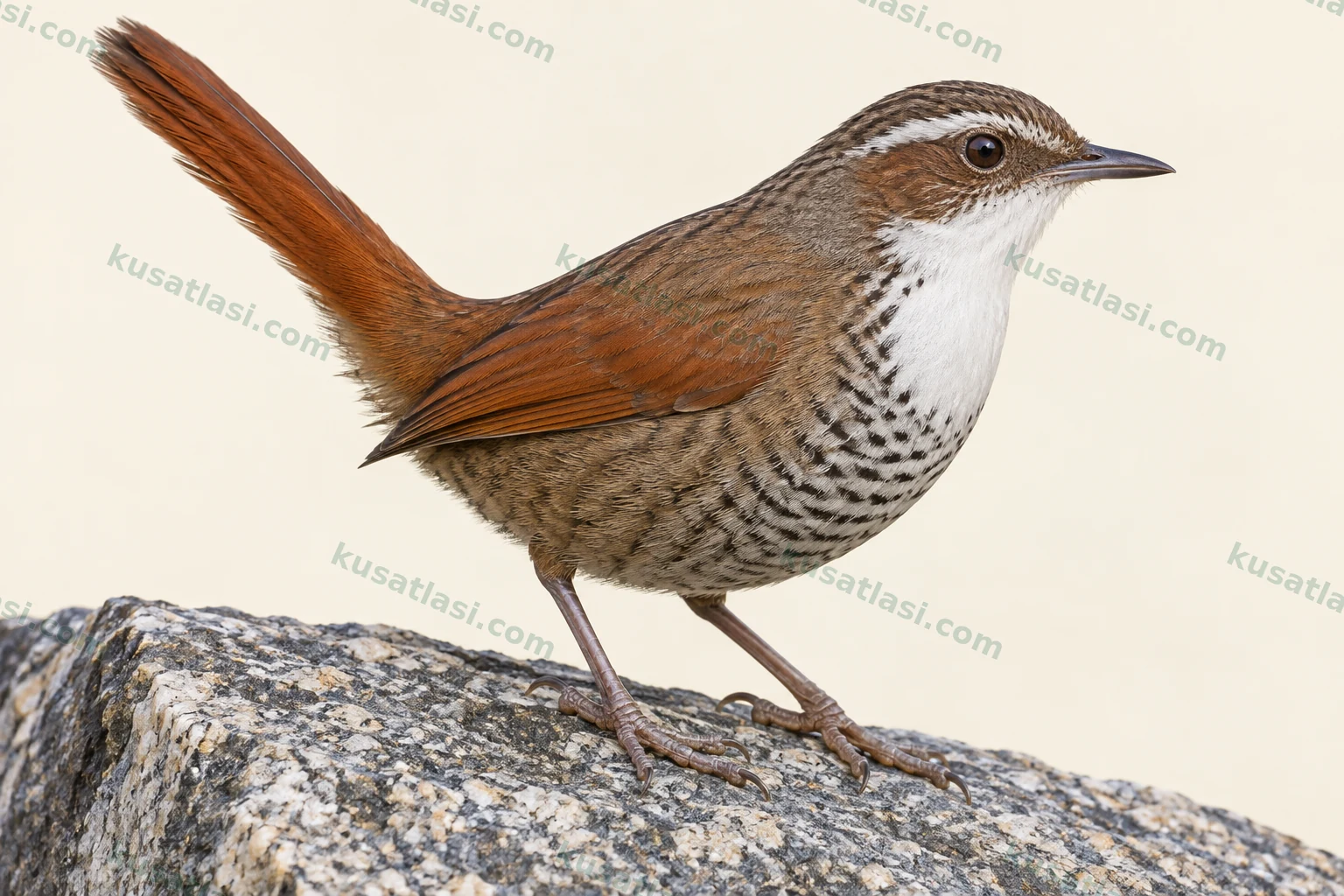
In dry Chilean scrub, look for the pale eyebrow and throat, barred belly and long reddish-brown tail that can be held upright.
Biometrics
Length
Male19 cm
Female19 cm
Shared species value
Wing length
Male7.5 cm
Female7.5 cm
Shared species value
Weight
Male52–60 g
Female45–48 g
White-throated Tapaculo
Chile, native scrub from Paposo to central ChileObservation guide in its natural range
Look for three features together
Do not rely on a single featureCompare the pale eyebrow and throat with the brown head.
Check the dark bars across the belly from a suitable angle.
Watch the long, warm-coloured tail while the bird runs and when it stops.
Compare male and female
 FemaleMale
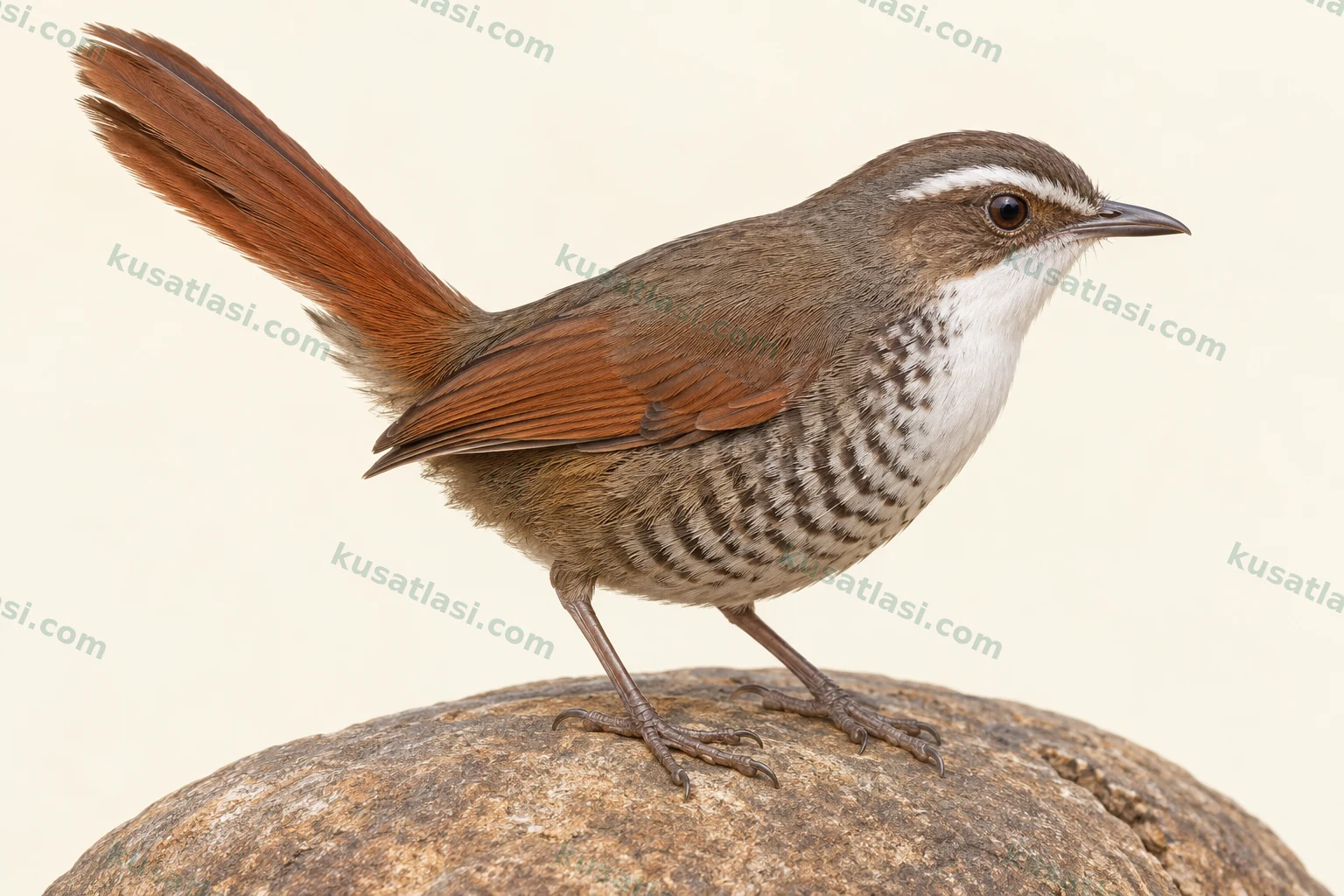
Basic plumage does not distinguish the sexes. Juvenile markings vary. One pale feather tip does not establish age.
Where to look in its natural range?
Watch shrub edges and natural ground passages on rocky slopes.
The species is resident. Nesting is reported at Fray Jorge from September to November and care of young through December.
January
Regional breeding and care of young in Chile. No verified regional date was given for this month. This does not imply local absence.
February
Regional breeding and care of young in Chile. No verified regional date was given for this month. This does not imply local absence.
March
Regional breeding and care of young in Chile. No verified regional date was given for this month. This does not imply local absence.
April
Regional breeding and care of young in Chile. No verified regional date was given for this month. This does not imply local absence.
May
Regional breeding and care of young in Chile. No verified regional date was given for this month. This does not imply local absence.
June
Regional breeding and care of young in Chile. No verified regional date was given for this month. This does not imply local absence.
July
Regional breeding and care of young in Chile. No verified regional date was given for this month. This does not imply local absence.
August
Regional breeding and care of young in Chile. No verified regional date was given for this month. This does not imply local absence.
September
Regional breeding and care of young in Chile. Nesting around Fray Jorge.
October
Regional breeding and care of young in Chile. Nesting around Fray Jorge.
November
Regional breeding and care of young in Chile. Nesting around Fray Jorge.
December
Regional breeding and care of young in Chile. Care of young may continue around Fray Jorge.
Nest, egg and incubation
It uses secondary cavities such as rock or slope hollows and unused degu burrows. The clutch is 2–3 eggs. Incubation duration and time in the nest were not verified.
Repeated groups of descending notes can be heard from dense cover or a raised rock or shrub.
Do not play recordings to attract birds. Observe quietly, especially near nests.
Species information
Quick identification
The White-throated Tapaculo Scelorchilus albicollis is a ground-dwelling bird of Chile’s dry scrub and rocky slopes. Look for the brown upperparts, pale eyebrow, whitish throat and breast, and dark barring across the belly. The long reddish-brown tail can be held up as the bird moves quickly along the ground. It is often heard in scrub. Do not attribute every brown bird in the direction of the sound to this species.
Comparing size with similar birds in rocky terrain is meaningful only at the same viewing distance and from a suitable angle. Check the pale throat, eyebrow and barring on the underparts instead of relying on the tail proportions in a distant photograph. Chile is the natural range. A claimed sighting in a neighbouring country needs separate verification of the taxon and locality.
General appearance and posture
The head and upperparts are brown and can show reddish or olive tones in places. The pale eyebrow and throat stand out against the dark upperparts. Dark transverse bars are visible across the whitish areas and the warmer-coloured areas farther down the underparts. The tail is reddish-brown. Shade can make the body look uniformly dark. If the bars disappear in one image, that does not mean the bird lacks them. Examine the breast and belly separately.
The bird can run quickly along the ground and may be easier to see when it calls from a raised branch or rock. Holding the tail upright while running makes the body look shorter. The same individual can appear to have different proportions on a perch when it changes the angle of its tail. Checking the stable plumage markings on the face and underparts, along with the outline, helps avoid this mistake. Do not enter the cover to follow the bird between shrubs.
Males, females and young birds
The research guide describes males and females as similar in basic plumage. Slight differences in average wing and tail measurements do not provide a reliable field key to sex, since individual measurements overlap. Do not call a bird male just because it looks larger or sings more strongly. Seeing the two birds of a pair from different angles can give the impression that their plumage colours differ. Compare body markings in suitable light.
Young birds can have finer barring on the underparts and pale markings on the wing coverts, the long inner wing feathers and the tips of the tail feathers. The guide notes that these markings vary and that some adults and first-year birds can look similar. One pale feather tip is therefore insufficient to determine age. Examine several feather areas together and leave the age undetermined when the view is poor. A distant photograph does not provide the same reliability as the research method, which requires detailed feather measurements.
The northern subspecies atacamae can look smaller and greyer above. The current checklist retains geographic subspecies. The atlas discusses the need to investigate further how they are connected. This discussion does not establish that the subspecies have been merged. Consider geography when assessing colour differences. Do not interpret northern and southern appearances as differences between sexes or ages.
Appearance in flight
This is a short-winged bird that moves conspicuously on the ground. It may make a short flight across a gap in cover, but identification is usually easier once it lands on the ground or on a branch. Brown wings and a reddish tail are insufficient on their own. Check the pale eyebrow, the throat and breast, and the bars across the belly.
No distinctive mark on the upper or lower wing has been verified as sufficient on its own for identification in flight. A short flight on a slope does not show that the bird is migrating. Record the flight alongside the bird’s movements on the ground and its appearance at rest, without inferring a route.
Voice and behaviour
Repeated groups of descending notes help draw attention to the species. A Chilean specialist account uses a mnemonic that recalls its local name. The mnemonic does not imply a fixed note count or the same speed every time. The bird calls from dense cover and sometimes climbs to a higher point. Check that the sound comes from the individual in view to reduce confusion with other ground-dwelling birds in the area.
The species has been recorded throughout the year at Fray Jorge. Breeding-season behaviour may be linked to rainfall, so do not assume that nesting starts in the same week every year. Raising the tail can help identify the bird, but is insufficient on its own to establish an alarm or courtship display. Repeated playback or waiting at a nest entrance to keep the bird visible can disrupt its natural behaviour. Observe briefly from a distance.
Similar species
1. Pteroptochos megapodius may occur in the same habitats. The White-throated Tapaculo appears smaller and slimmer. Consider its longer, warmer-coloured tail alongside its pale throat and breast. Running or raising the tail alone does not separate the two birds. Use face and underpart markings to support any impression of size.
2. When comparing it with Scelorchilus rubecula, pay attention to the colour of the pale area on the throat and breast. Check the natural habitat and range of Scelorchilus rubecula separately. Sharing a genus does not imply that the two birds live together across Chile. A brown back or a raised tail is insufficient when the breast is hidden.
3. Other tapaculos in dense vegetation may only be seen as fleeting silhouettes. Look for the pale eyebrow, pale throat and variable transverse belly bars together in the White-throated Tapaculo. Neither one sound nor an unseen throat patch can establish the identification. Combine a reliable photograph, natural sound and location when a record is uncertain.
World distribution
The natural range is in Chile. It extends from the Paposo area in the north to suitable coastal, scrub and foothill habitats in central Chile. Older specialist sources gave separate limits for the northern and southern subspecies. The breeding atlas shows the connection along the coast in more detail. This does not support drawing a range that fills all of Chile. Preserve the relationship with dry conditions, vegetation structure, rocky slopes and valleys.
Status in the natural range
The atlas emphasises the association with dense hard-leaved scrub and rocky habitats. Consider the location and nature of the records instead of using only a short historical elevation range. More low-elevation records do not establish that the bird is always absent higher up. Likewise, occasional records at higher elevations do not make high mountains the primary habitat of the entire species. The distribution of records, range limits and population density are distinct.
Migration
The species is generally regarded as resident and occurs at Fray Jorge year-round. The atlas notes that movements at the highest elevations have not been adequately verified. Neither complete immobility for every individual nor a long-distance route is described. The calendar shows Chile’s Southern Hemisphere breeding season. Local nesting has been reported from September to November and care of young through December. Approximate observation points do not show a migration route or a confirmed nest location.
Breeding habitat
The bird uses dense shrubs, rocky gaps and areas around valleys on dry slopes. Continuous native hard-leaved scrub forms part of the habitat of a bird that runs between patches of cover. Seeing the bird on a rock does not imply that it lives in completely bare rocky habitat. Record the cover it uses for shelter as well.
Nest site
The Chilean breeding atlas reports secondary cavities such as rock crevices, hollows in steep slopes and unused degu burrows. The bird lays 2–3 eggs in the chamber at the end of the tunnel, where plant material is gathered. This does not mean that it digs every tunnel itself. The duration of incubation and the length of the nestling period were not verified for this account. Shining a light into the entrance or opening the tunnel can harm the nest. Watch the entrance from a distance.
Daily habitat use
The ground under cover is important for feeding and movement. A shrub or rock used as a calling post is only one of the places the bird uses during the day. Clearing shrubs to see the narrow passage where it runs can remove its natural shelter. Wait quietly and observe briefly to see the bird emerge on its own.
What does it eat?
Field observations document invertebrate feeding. The authors of the Chilean atlas observed the northern subspecies taking Camponotus ants and spider eggs. These are specific observations. They do not show that the whole diet consists of those two groups or that the proportions are the same in every region. The atlas notes that information on diet is limited and cautiously considers a possible mixed diet. That possibility is distinct from a result based on direct measurements.
How does it forage?
The bird searches for food on the ground and can scratch through surface material with its strong feet. Lifting a leaf or clod does not necessarily reveal what it takes. Record any visible prey separately and leave unidentified items unnamed. A gap used to forage does not serve the same purpose as a nest entrance. Watch natural openings in the cover quietly instead of using food to draw the bird into the open. This allows its search behaviour to be seen without altering it by feeding.
Tail movement can help with identification
The warm-coloured tail raised during a quick run may be visible between dense shrubs. Similar ground-dwelling birds can also raise their tails. Combine the movement with the pale eyebrow, the throat and breast, and the bars across the belly. A picture of a running bird may not show its full body proportions. Wait for the bird to stop again to improve the identification.
It can use an existing nest cavity
The secondary cavities and abandoned rodent burrows described in the breeding atlas show that the bird need not excavate its nest site from scratch. Saying that the White-throated Tapaculo opens every tunnel would change that finding. You cannot tell with certainty from outside which animals are inside a tunnel. Do not disturb the entrance or open the natural structure to check the nest.
The local wing sample does not represent the whole species
The Fray Jorge guide specifies that its measurements were taken from the northern subspecies. The ranges for males and females overlap. They should not be applied to all southern birds as a firm threshold for determining sex. Recording where the study sample came from makes it possible to keep track of this regional distinction.