

World Birds IUCN statusLC · Least ConcernGlobal IUCN. BirdLife v10 (2025); taxon matching AviList 2026 / IOC 15.2; checked: 29.10.2026. The list year is not the species’ assessment date. Source and method · BirdLife OrderPasseriformesPasserines FamilyRhinocryptidaeRhinocryptidae
White-breasted Tapaculo
Eleoscytalopus indigoticus
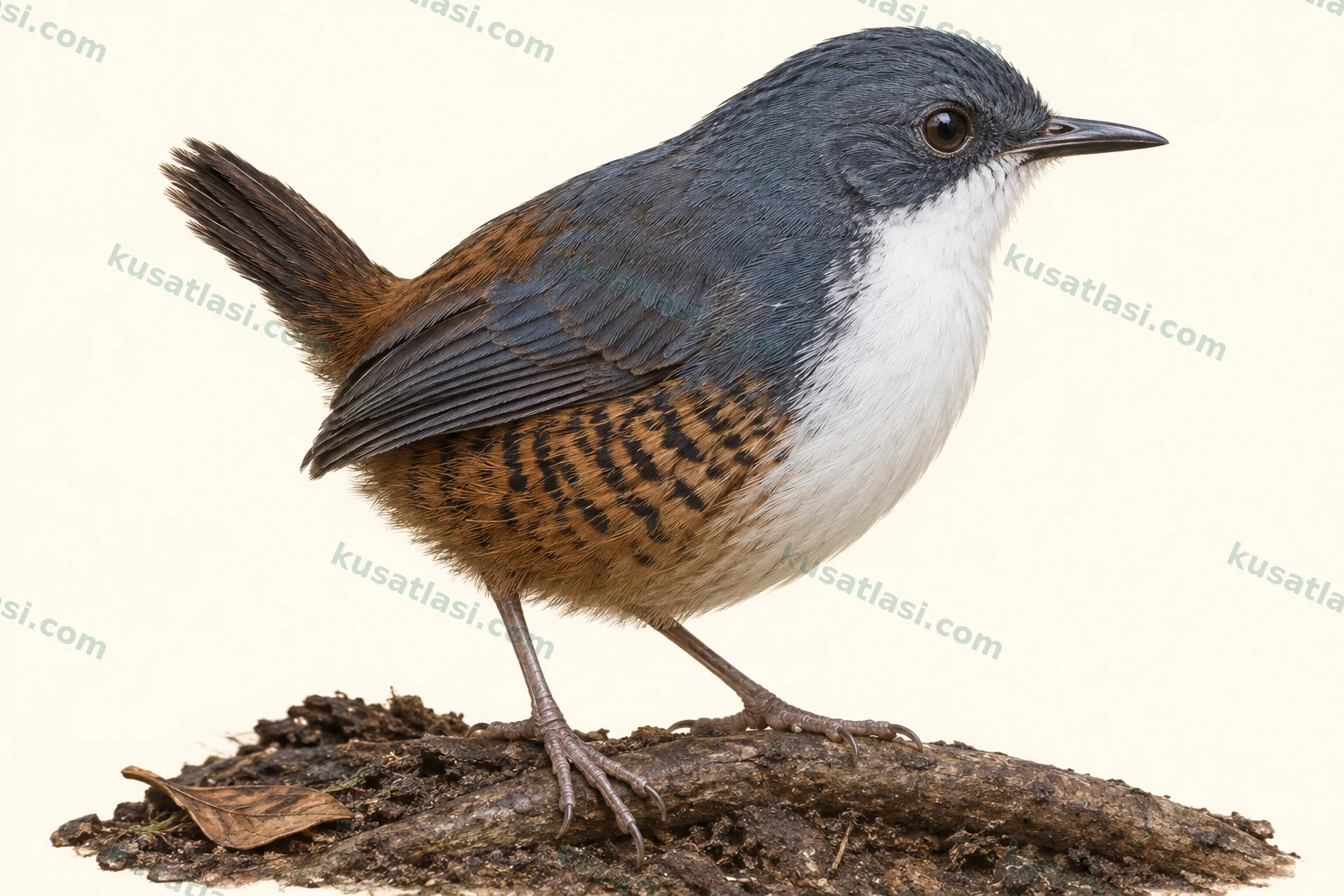
Small tapaculo concealed on the Atlantic Forest floor, with a white front and barred brown flanks.
Biometrics
Length
Male11 cm
Female11 cm
Shared species value
Wing length
Male5.19 cm
Female5.19 cm
Shared species value
Weight
Male13–18 g
Female12.2–16 g
White-breasted Tapaculo
Eastern and southeastern BrazilObservation guide in its natural range
Look for three features together
Do not rely on a single featureWhite throat and breast contrast with grey-blue upperparts.
Dark bars over warm brownish colour.
Rapid frog-like vibrating series.
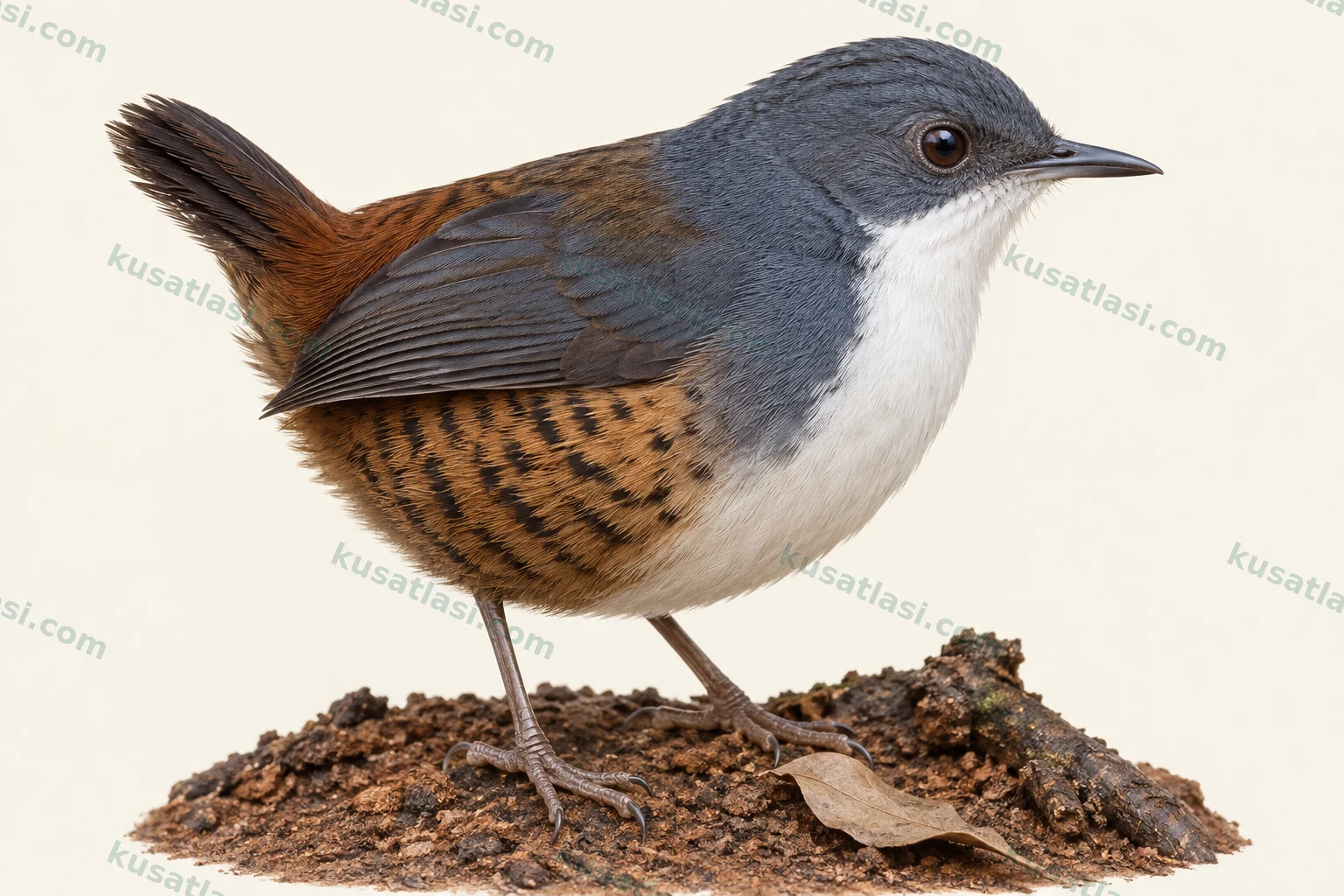
Compare male and female
 FemaleMale
General colour differences alone do not determine sex certainly; a detailed juvenile key was not verified.
Where to look in its natural range?
Humid dense ground cover in Atlantic Forest.
Resident forest species. Breeding months across the whole range unverified.
All months: Data unavailable
January
February
March
April
May
June
July
August
September
October
November
December
Nest, egg and incubation
The specialist compilation reports a spherical nest in a natural cavity and two white eggs; incubation and fledging period unverified.
Rapid frog-like trill; compare tempo and appearance together with the sister species.
Do not play recordings to attract birds; observe quietly, especially near nests.
Species information
Quick identification
White-breasted Tapaculo Eleoscytalopus indigoticus is a small compact bird living close to the ground in Brazil’s Atlantic Forest. Look for grey-blue upperparts, white throat and breast, a short raised tail and brownish dark-barred flanks together. White-breasted Tapaculo denotes the same taxon.
General appearance and posture
The pale breast contrasts strongly with dark bluish-grey upperparts. Warm brownish rear-body areas and dark crossbars on the flanks matter more when the whole bird is visible. The short tail can be held upright among dense leaves and roots; other tapaculos share this posture, so it does not identify the species alone.
Males, females and young birds
Secondary specialist guides describe females as greyer and males as darker bluish. This broad comparison alone does not determine sex certainly. The 2018 study excluded juveniles from morphological comparison; adult plumage criteria are not a verified juvenile key. A detailed juvenile identification key was not found.
Appearance in flight
It is chiefly encountered moving within dense ground cover. No certain distinguishing underwing mark in flight was verified.
Voice and behaviour
The song is a rapid vibrating series recalling a frog. Original acoustic research found faster note repetition than in Bahia Tapaculo. Accelerating series were also documented in recordings. Compare carefully without confusing other frogs or birds in the same area.
Remaining low in cover makes it difficult to see. Hearing it does not locate the bird precisely or identify an active nest, so do not open vegetation to search.
Similar species
Bahia Tapaculo Eleoscytalopus psychopompus has a similar white front. Original research found conspicuous dark bars on indigoticus’s warm buff-brown flanks and thighs, while psychopompus has dark brown, largely unbarred flanks; vocal tempo also differs. Several body regions and geography must be assessed together.
Scytalopus species also have short tails, live secretly and are found by voice. Similar habits do not place them in the same genus; inspect this species’ broad white front and warm barred rear parts separately.
World distribution
It is endemic to Brazil. The currently accepted range is Atlantic Forest from eastern Bahia to Santa Catarina and northeastern Rio Grande do Sul. AviList recognises no subspecies within it.
Status within its natural range
The current AviList gives a global category of Least Concern. Older specialist pages can show conservation classes from other dates; these are not presented as newly assessed. The sister species’ coastal areas in Bahia must be distinguished from this species’ more inland areas.
Movements
It is classified as resident. Regular long-distance migration, seasonal sequences of countries or a continent-wide route were not verified. A map record layer does not mean equal bird density in every gap of closed forest.
Breeding habitat
It uses dense ground cover in humid low- and middle-elevation forest. The specialist compilation reports regrowth forest alongside natural forest, dense streamside cover and southern Araucaria forest. Its habitat structure concerns lower hiding cover more than the trees above.
Nest site
A specialist compilation citing its sources reports a spherical nest of roots, thin twigs and lichen in a natural ground cavity or hollow fallen log, with two white eggs. This secondary breeding information is not presented as a new finding of the measurement paper. Incubation, fledging age and breeding months across the whole range were not verified.
Daily use of space
It may occur alone or in pairs around litter, roots and dense shrubs. Wait for a natural opening to see a ground-foraging bird. Removing closed ground cover changes both concealment and feeding structure.
What does it eat?
The specialist compilation reports small invertebrates. Detailed prey species or seasonal proportions were not verified. Forest-floor occurrence does not mean it eats every insect group seen there.
How does it forage?
It moves near the ground and seeks food in leaf litter; the specialist account describes turning leaves. Dense plants may surround feeding sites. Capture time for particular prey, daily energy use and sex differences in prey choice were not verified.
A genus distinction beyond appearance
Research in 2008 reassessed the former Scytalopus placement through DNA and anatomy. Vocal-organ and wishbone structure were used with genetic results to define Eleoscytalopus. Similar body shape and secretive behaviour alone do not show that these birds belong to the same genus.
Close species also differ in voice
The 2018 study compared the two Eleoscytalopus species’ sounds and measurements. Faster note repetition and flank and thigh bars jointly supported the distinction. Results concern samples from different places, not a direct mating experiment or proof that every bird sings at one speed.