

World Birds IUCN statusLC · Least ConcernGlobal IUCN category. BirdLife v10 (2025); taxon matching: AviList 2026 / IOC 15.2; checked: 29.10.2026. The list year is not the species assessment date. Source and method · BirdLife OrderGalliformesGamebirds FamilyPhasianidaePhasianidae
Ahanta Spurfowl
Pternistis ahantensis
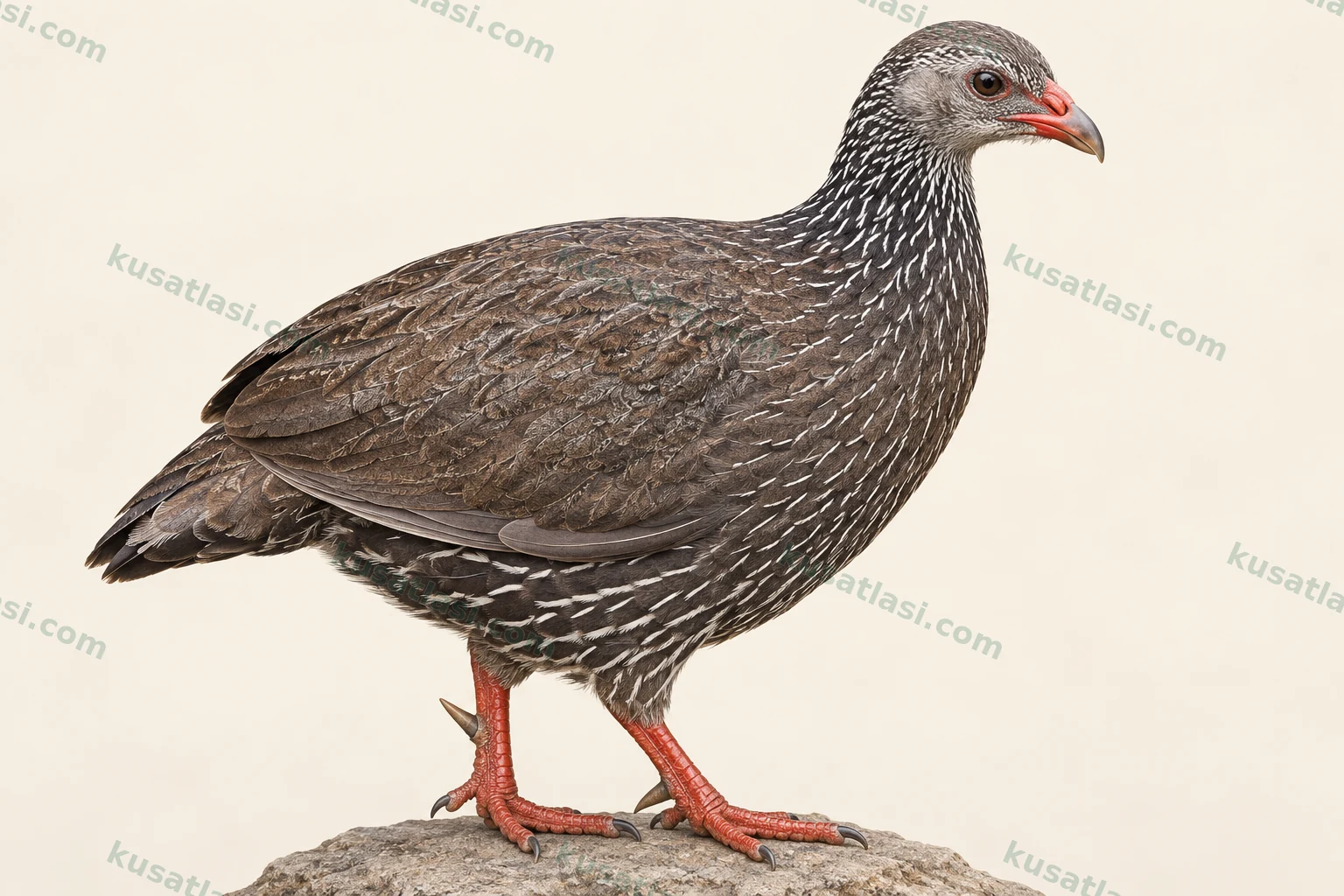
A dark chestnut-brown ground spurfowl with a pattern of pale-edged feathers, living at densely covered forest edges in West Africa.
Biometrics
Length
Male33–35 cm
Female33–35 cm
Shared species value
Wing length
Male17.32 cm
Female17.32 cm
Shared species value
Weight
Male608 g
Female487 g
Ahanta Spurfowl
West Africa — patchy areas from southern Senegal–Gambia to southwestern NigeriaObservation guide in its natural range
Look for three features together
Do not rely on a single featureOrange bill with a blackish base; yellow-orange legs.
Pale edges and U-shaped marks on dark chestnut-brown underparts.
A black eye-stripe below a broad cream-white eyebrow in the newly hatched chick.
Compare male and female
 FemaleMale
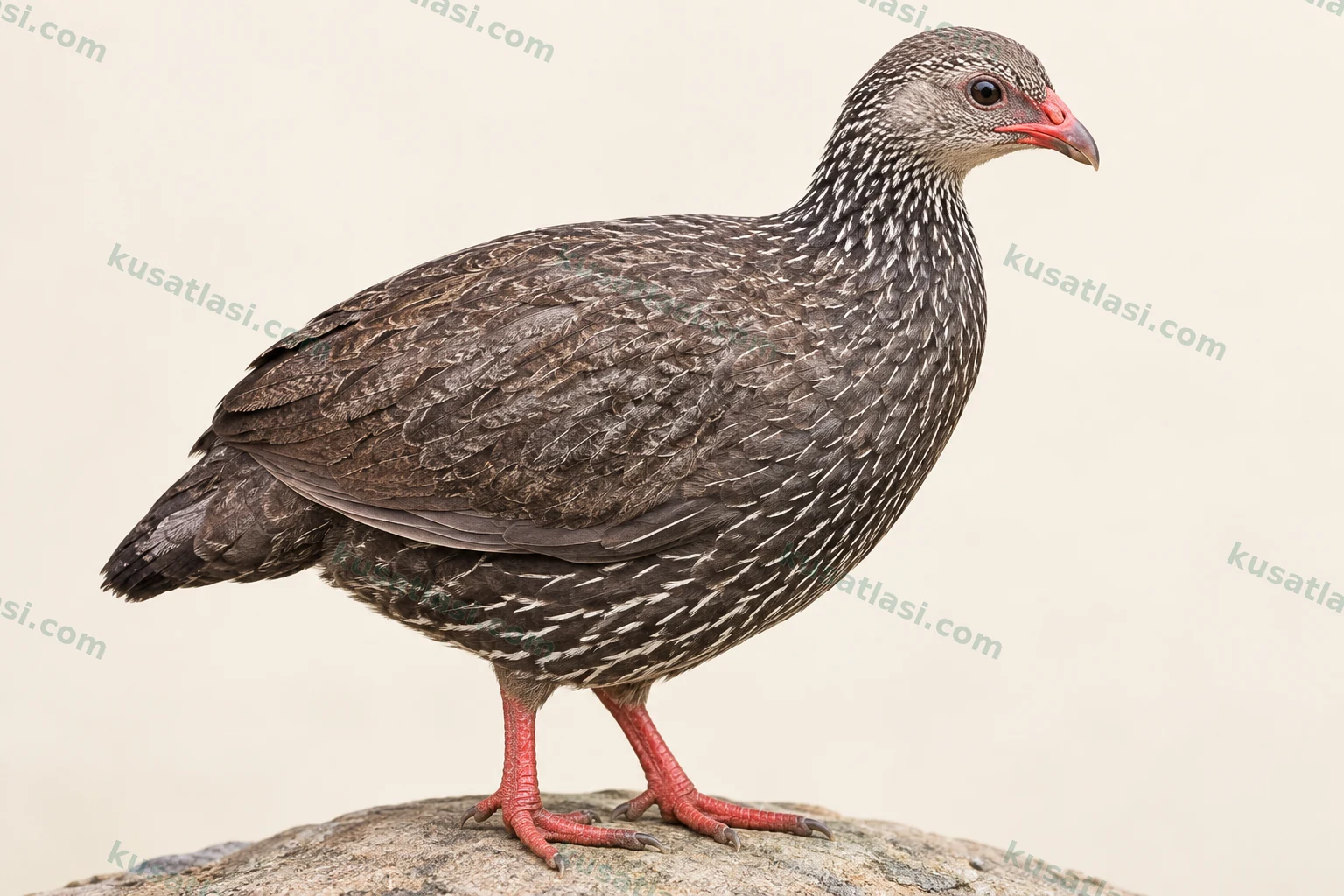
The male is generally heavier; one or two spurs are reported in males. A spur hidden on a covered leg does not determine a female; colour tone also varies geographically.
Where to look in its natural range?
Watch the ground at forest edges and small openings without parting dense cover.
Resident species; the calendar shows verified breeding stages from different countries separately.
January
Essentially resident; breeding dates differ by region. Ibadan, Nigeria — direct 2017 record: a four-egg nest and chicks hatching in the same month. Liberia — regional record cited in the publication: egg records. Senegal — regional record cited in the publication: estimated egg-laying interval.
February
Essentially resident; breeding dates differ by region. Ghana — regional record cited in the publication: chick and young-bird records, not the same stage as the egg-laying month.
March
Essentially resident; breeding dates differ by region. Ghana — regional record cited in the publication: chick and young-bird records, not the same stage as the egg-laying month.
April
Essentially resident; breeding dates differ by region. Liberia — regional record cited in the publication: a chick record.
May
Essentially resident; breeding dates differ by region. No verified regional date specific to this month was provided; this does not imply local absence.
June
Essentially resident; breeding dates differ by region. No verified regional date specific to this month was provided; this does not imply local absence.
July
Essentially resident; breeding dates differ by region. No verified regional date specific to this month was provided; this does not imply local absence.
August
Essentially resident; breeding dates differ by region. No verified regional date specific to this month was provided; this does not imply local absence.
September
Essentially resident; breeding dates differ by region. Senegal — regional record cited in the publication: a young-bird record; alone, it is not the start of egg laying.
October
Essentially resident; breeding dates differ by region. Senegal — regional record cited in the publication: estimated egg-laying interval.
November
Essentially resident; breeding dates differ by region. Senegal — regional record cited in the publication: estimated egg-laying interval.
December
Essentially resident; breeding dates differ by region. Ghana — regional record cited in the publication: an egg record. Liberia — regional record cited in the publication: egg records. Senegal — regional record cited in the publication: estimated egg-laying interval.
Nest, egg and incubation
The nest is a simple ground hollow, concealed with dry leaves and twigs. All four eggs in Nigeria hatched, and the chicks immediately left. Incubation duration and age at first flight were not verified.
The scientific description reports a two-syllable adult advertisement call and short, thin chick contact calls; these call types are not confused.
Do not play recordings to attract birds; observe quietly, especially near nests.
Species information
Quick identification
Ahanta Spurfowl Pternistis ahantensis is a brown, ground-dwelling spurfowl associated with forest edges and dense undergrowth in West Africa. Its dark chestnut-brown underparts, pattern of pale-edged and dark-centred feathers, orange bill with a blackish base and yellow-orange legs matter together. Numerous light and dark markings make it more patterned than a plain brown bird. Among dry leaves, that pattern may break up its outline; the same bird is easier to pick out beside an open track.
The English names Ahanta Spurfowl and the older Ahanta Francolin refer to the same taxon. Francolinus ahantensis in older sources is a synonym reflecting a changed genus placement. The current name is Pternistis ahantensis; not every similarly patterned West African spurfowl belongs to it. Bill and leg colours, breast and flank pattern, habitat and region are checked together. A bird appearing brown as it escapes from scrub is not enough for certain identification.
General appearance and posture
The 2019 scientific review describes dark centres and paler edges to the breast and flank feathers. The lower neck has blackish centres, reddish-brown feather lines and some white U-shaped marks. Fine wavy patterning on the back is less distinct than on the lower neck. The dark brown-chestnut ground of the underparts bears white and darker brown U-shaped marks. These may not be individually visible at a distance: first assess the overall dark tone, then the appearance formed by feather boundaries.
The bill is orange with a blackish base, and the legs yellow-orange. These are supporting marks in suitable light. Mud or shade can make the legs look darker. More westerly populations historically called hopkinsoni have been reported to be generally paler; that geographic difference is not a male–female distinction. Current AviList recognises no separate subspecies. It also matters that the 2019 review lacked data for the relevant gene region in the western population: the paleness difference alone is not proof that every population is genetically identical.
Males, females and young birds
The male is generally heavier. The 2019 review reports one or two spurs in males and none in females. A spur is a projection on the back of the leg and may be hidden by cover. Its absence from a single photograph does not immediately make the bird female. The developmental stage of a young male, the leg angle and image clarity must also be considered; the precise age when spurs develop was not verified in this review. Plumage darkness alone is not a reliable sexing key.
The newly hatched chick documented in Nigeria in 2017 was dark brown with pale bill and feet. A broad cream-white eyebrow ran from the forehead to the rear of the head, above a black eye-stripe. This is directly documented hatchling appearance, not the full plumage of a young bird approaching first flight. A chick not yet showing the adult's orange bill is not reassigned to another species for that reason. Detailed colour changes in later juvenile stages and reliable age boundaries were not verified here.
Appearance in flight
Ahanta Spurfowl is ground-dwelling; daily encounters are often among vegetation or at the edge of an opening. These facts do not allow calculation of flight speed or a precise distance covered in one flight.
A detailed species-specific underwing pattern providing certain identification in flight was not verified in this review. If a brown silhouette passes briefly, look again for marks visible on the ground, such as bill, legs and underpart pattern. Approaching to flush a bird is not an appropriate identification method; waiting for it to appear naturally at cover edges offers better observation. An adult leaving a nest or a walking chick group should especially not be followed and flushed again for photographs.
Voice and behaviour
The Ahanta example in the 2013 voice study identifies a two-syllable structure in the adult advertisement call; the syllables are described as short and muffled, like a compressed call. Written comparisons do not contain every detail of a sound recording. The same research explicitly reports short, thin contact calls of Ahanta chicks. An adult advertisement and the sound a separated chick makes are not the same call type. An unclear spurfowl sound heard alone in the distance does not establish certain identity.
The Nigerian nest record shows how well the bird can hide among dense dry leaves. Four newly hatched chicks left the nest immediately; an empty nest the next day did not mean breeding failure in that case. Walking does not prove independent feeding or flight. A species-specific study comparing all the partners' care duties in detail was not verified here; the pair and family organisation of other spurfowls is not transferred directly. Observers hearing contact calls keep their distance to avoid separating chicks from their mother.
Similar species
1. Double-spurred Spurfowl Pternistis bicalcaratus is an important West African comparison. Its dark greenish bill and greenish legs differ from Ahanta's orange bill and yellow-orange legs. The paler arrow-shaped and streaked underpart pattern is also considered. Two spurs alone do not identify bicalcaratus: an Ahanta male can have two as well.
2. Scaly Spurfowl Pternistis squamatus has similarly pale-edged body feathers. The 2019 review describes its bill as red; its main distribution extends east from southeastern Nigeria. Ahanta's natural range is the patchy forest belt west of the Niger River. Region, colour and pattern must be combined; which side of the river an observer is on does not replace the complete identification of an unseen bird.
World distribution
The range is patchy in West Africa west of the Niger River. The 2019 review distinguishes populations in southern Senegal–Gambia and northern Guinea-Bissau; southern Guinea, Sierra Leone and western Liberia; then Côte d’Ivoire, Ghana, Togo, Benin and southwestern Nigeria. These are regions associated with suitable forest and dense cover, not the entire surfaces of the countries. Gaps are not filled merely by joining national borders. Neither all Nigeria nor the Congo Basin is added because a similar spurfowl was seen.
Status within its natural range
The current global category is Least Concern. This does not mean it is common everywhere. The 2018 nest publication treats it as a rare or uncommon resident in Nigeria and notes that agricultural conversion and overhunting may contribute to declines in some places. The Ibadan record is the country's first documented breeding record, not proof that the bird first began breeding there that year. One nest does not measure growth or decline of the whole West African population.
Movements
It is considered essentially resident; a regular intercontinental migration route was not verified. Short local movements due to cover or food conditions do not mean every individual stays on the same point all year. Conversely, the distance between two sightings is not a tracked migration distance for that bird. Calendar breeding examples are local: a Nigerian January nest, a Ghanaian December egg or a Liberian April chick do not describe the same stage. One start and end date is not imposed on the entire range.
Breeding habitat
It uses forest edges, wooded strips along watercourses, secondary forest and places where farmland and dense cover adjoin. Undergrowth developing in abandoned openings and along waterways matters; the expert synthesis also reports Ghanaian coastal scrub and some montane stream forests in Sierra Leone. These examples do not restrict it solely to coasts or mountains. Its occurrence on a campus with suitable cover does not mean every urban park can support breeding.
Nest site
The nest found at Ibadan on 11 January 2017 was a simple ground hollow beside a large root at a tree's base, using dry leaves and small twigs. All four pale brownish eggs, bearing paler brown marks, hatched on 18 January, and the chicks immediately left. The publication says four eggs are also often reported in the few records from other countries. The seven days from discovery to hatching are not the full incubation period; the start of laying was not recorded. Incubation duration and age at first flight remain unknown here.
Daily space use
This terrestrial bird uses ground with a mixture of cover and small openings. Dry leaves and twigs in the nest example provide strong concealment. Completely clearing the forest floor is not a harmless change in visibility alone; it may also remove nesting and hiding habitat. Conversely, finding that nest beside a non-native tree does not prove obligatory dependence on it. The research came from an area where forest improvement using native plants was underway.
What does it eat?
The expert species page's compiled data indicate seed feeding and a predominantly plant-based food category. This classification is not a detailed stomach-content study across different months. A reliable species-specific list of which plant's seeds, how much leaf material or which animal prey were taken was not verified in this review. Insect, ant, root or fruit percentages are therefore not written from relatives alone. A general food category and a directly identified individual prey species represent different evidence levels.
How does it forage?
It searches for food at ground level, retaining the forest-edge and dense-undergrowth context. Feeding on seed-bearing ground is not replaced by behaviour from other birds, such as aerial insect pursuit or fruit picking in treetops. No species-specific measurement was found for how frequently it scratches leaves, which foot it digs with or daily consumption. If a foraging bird is observed, no precise prey name is given unless the item taken is actually visible; being on the ground does not itself prove feeding at that moment.
Nigeria's first documentation filled an old gap
The four-egg nest found at Ibadan in 2017 was published as Nigeria's first documented Ahanta Spurfowl breeding record. The bird was already known in the country; the new information directly demonstrated breeding rather than adding it to the national bird list for the first time. Adult presence, song, eggs and chicks are different observation stages. Hatching was also observed in this record, yielding more detail than a species assumption based only on nest appearance.
An empty nest does not always mean failure
The four chicks from this nest left the site immediately after hatching. An empty ground nest after chick emergence is therefore not the same as abandoned eggs or a predated nest. Observation date and development stage must be read together. Chicks walking away do not show they could fly that day; nest departure and first flight are different kinds of information. Opening cover to follow them can also expose newly hatched chicks from their hiding environment.
Two spurs are not the mark of just one species
Although the name Double-spurred Spurfowl draws attention, the 2019 review also reports one or two spurs in male Ahanta. Their number alone does not separate the two species. Bill and leg colours, body pattern and natural region are checked together. Not seeing a spur does not determine a female if the whole leg was not visible. Collecting several mutually consistent marks is more reliable than concentrating on one detail.
Western and eastern populations may differ in shade
More westerly birds have historically been reported as generally paler. The 2019 taxonomic study discusses why this difference need not require a separate subspecies, while noting a lack of western-population data for the relevant gene region used. Keeping the species in a single subspecies in the current list does not mean every individual has identical colour. Automatically treating a pale western bird as female and a dark eastern one as male would misread that geographic difference.