

World Birds IUCN statusLC · Least ConcernGlobal IUCN category. BirdLife v10 (2025); taxon matching: AviList 2026 / IOC 15.2; checked: 29.10.2026. The list year is not the species assessment date. Source and method · BirdLife OrderPasseriformesPasserines FamilyTyrannidaeTyrannidae
White-throated Pewee
Contopus albogularis
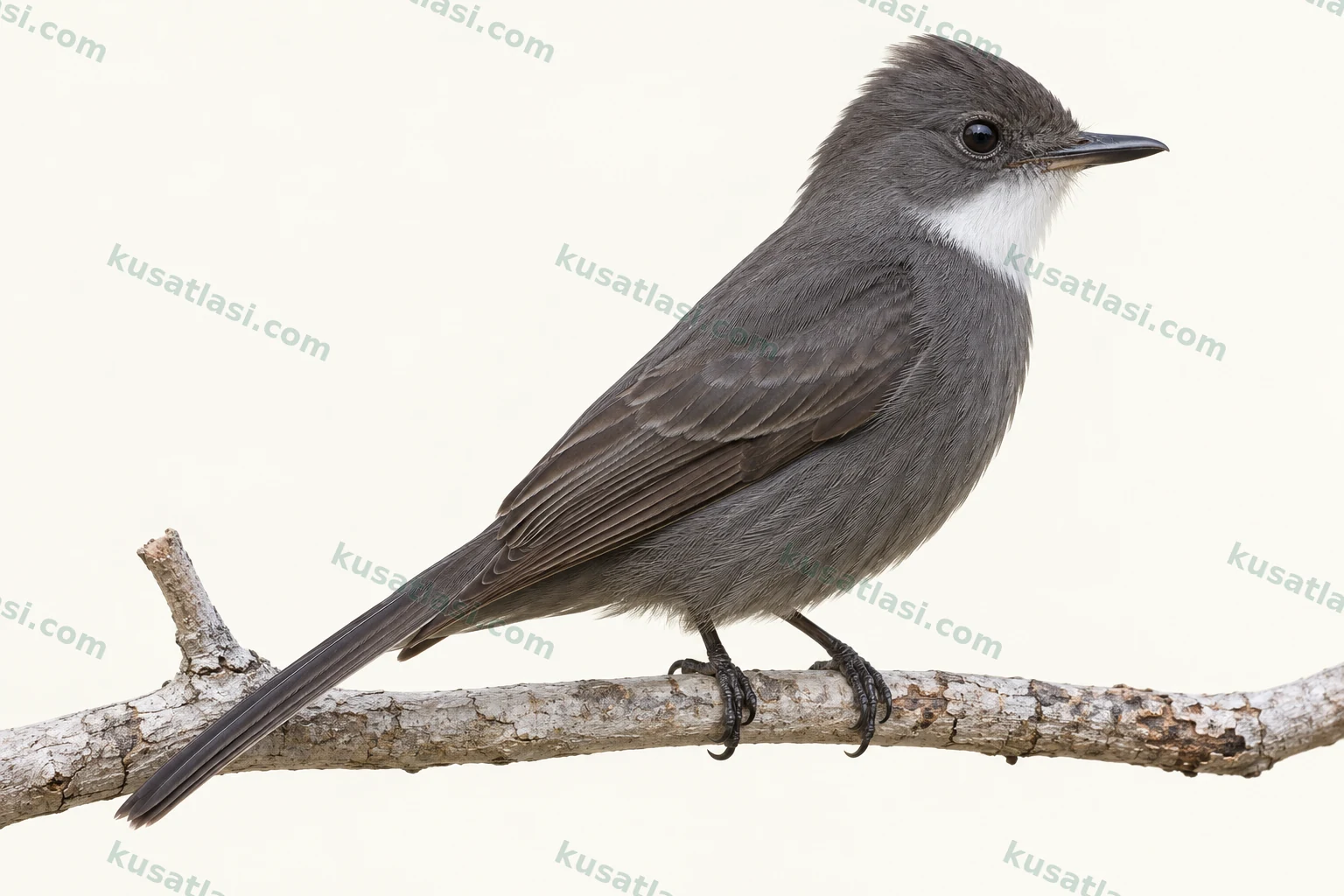
A small pewee with a conspicuous white throat on a dark grey body. Look for it around openings and rocky rises in the forests of the Guiana region.
Biometrics
Length
Male13 cm
Female13 cm
Shared species value
Wing length
Male6.12 cm
Female6.12 cm
Shared species value
Weight
Male8.3–10.5 g
Female8.3–10.5 g
Shared species value
White-throated Pewee
Suriname, French Guiana and nearby northeastern BrazilObservation guide in its natural range
Look for three features together
Do not rely on a single featureLook for the white patch together with the dark breast and head around it.
Watch for short flights from high perches towards airborne insects.
Distinguish the forest region of the Guianas from Central America.
Compare male and female
 FemaleMale
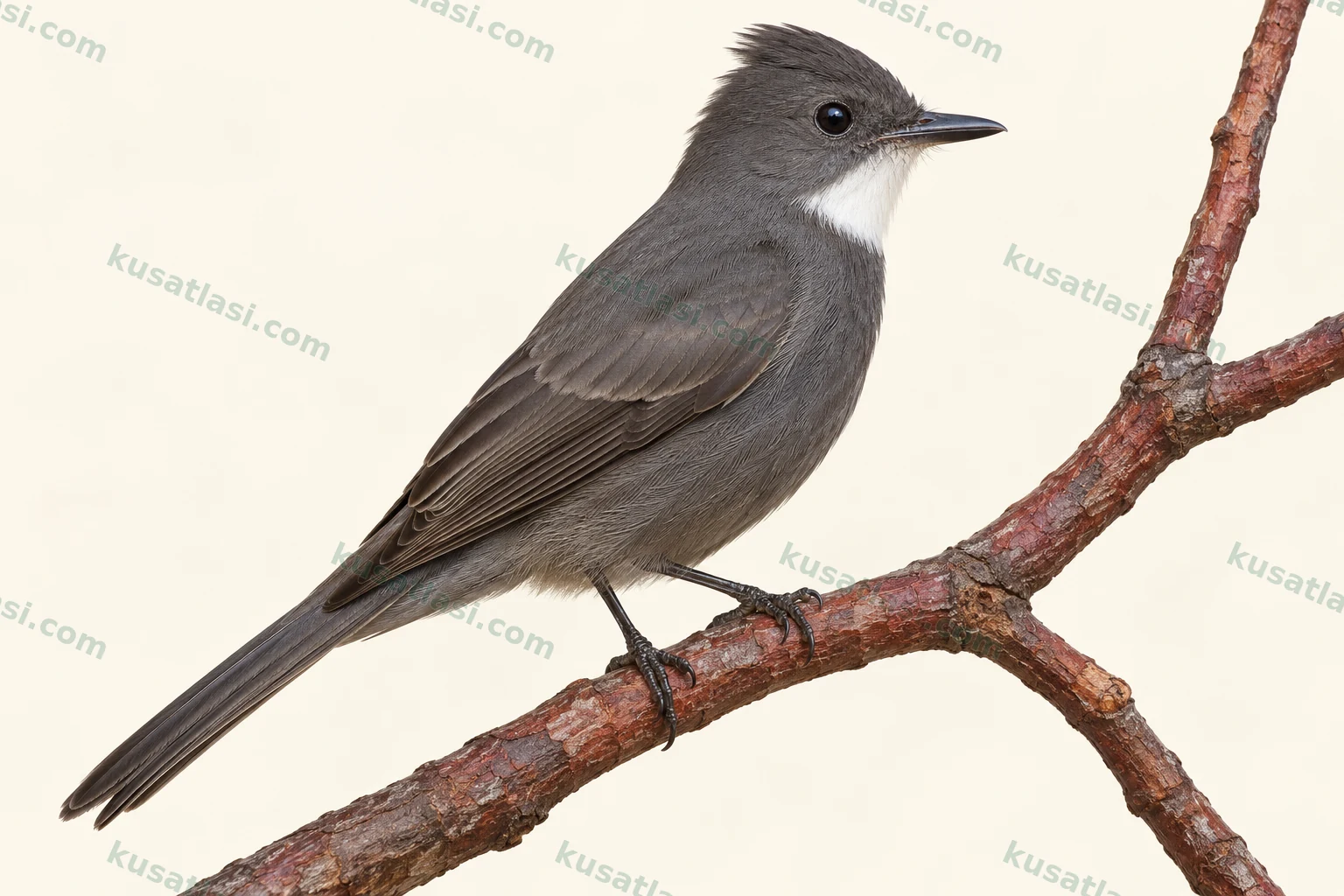
Adult males and females cannot be separated by their basic plumage. A key to the age of young birds was not verified.
Where to look in its natural range?
Quietly watch upper branches around rocky rises and along the edges of natural openings.
Breeding months and a verified migration route were not found. A sighting alone does not establish breeding.
All months: The breeding calendar has not been verified. No verified regional date is given for this month. This does not indicate local absence.
January
February
March
April
May
June
July
August
September
October
November
December
Nest, egg and incubation
Nest structure, typical clutch size, incubation duration and the time the young spend in the nest could not be verified.
The bird gives thin, sharp, short whistle-like sounds. You may hear calls repeated for a long time.
Do not play recordings to attract birds; observe quietly, especially near nests.
Species information
Quick identification
The White-throated Pewee Contopus albogularis is a small tyrant flycatcher of the forests of the Guiana region. The adult's white throat contrasts sharply with its dark grey body. Check the small pale area together with the dark chest and head. A pale chin on another flycatcher in the shade is a different mark. Looking only at the bright area beneath the bill without seeing the chest can mislead, especially in a brief view through leaves.
Consider the throat and body contrast together with the region and the perch used during hunting. The range in northeastern South America also helps with identification. This species is distinct from the dark pewees of Central America.
General appearance and posture
Adult males and females look similar. The dark body and white throat form the main pattern used to identify this species. Look for the even dark colouring on the back and underparts. The same bird may look pale grey in bright daylight and almost black inside the forest. These views do not indicate two forms. The exposure can also make the white patch look larger than it is. Check the actual white throat in more than one photograph when possible.
The bird may be seen high in trees or just below the canopy. When a perched bird makes a short flight after prey and perches again, you have another chance to see its posture. A front view can show the throat more clearly, while a side view can show where it meets the breast. Do not guess colours hidden by leaves. In dark forest, an outline alone does not justify identifying the bird as a White-throated Pewee.
Males, females and young birds
Adult plumage does not reliably separate males and females. Seeing two birds side by side, hearing them call or watching them hunt in turn does not establish which is which. The two adult views on this page illustrate the identification of the same species. Throat patch size and body darkness do not establish sex. Differences in light and camera angle can make these small marks look sexually distinct.
This review could not adequately verify details of moult and a reliable key to distinguish young birds from adults. Pale plumage, a short-looking wing or a fluffed body are not evidence of age on their own. Record a bird's relationship with a parent, visible feeding behaviour and all visible feather areas. If those details are missing, leave its age open. Juvenile marks of another Contopus species do not provide a reliable guide for this one.
Appearance in flight
The most informative flight is a bird leaving its branch, heading for a flying insect and returning to a perch. Follow where it leaves from and where it lands again. In a rear view where the white throat is hidden, dark wings and a small body do not establish the species. A feather catching the sun in quick flight should not be taken for a lasting white mark.
No mark on the upper or lower wing surface was verified as diagnostic in flight by itself. When the bird perches again, compare the appearance of the head and breast. A short flight does not show that the bird never migrates, and one longer flight does not establish regular migration. Hunting flights and seasonal journeys are different behaviours.
Voice and behaviour
It gives short, thin, sharp, whistle-like sounds. Even when repeated for a long time, they may be missed amid forest noise. Consider the height from which the sound comes, a view of the bird in the canopy and the white throat together. A written imitation of one short note does not reliably distinguish it from other forest birds. Repeatedly playing a recording to draw the bird out can disrupt natural behaviour.
It can be seen alone or in pairs. Two birds together do not establish that a nest or eggs are present. Short flights at forest edges and in natural openings can be recorded as foraging. To document care of young, look for separate evidence such as visits to a nest, food carried and a response to chicks. Keep known behaviour distinct from breeding details that have yet to be documented.
Similar species
1. Migratory pewees such as Contopus virens and Contopus sordidulus may show a paler breast and belly. On the White-throated Pewee, look at the dark body around the white throat. The two migratory pewees can also be hard to separate from each other. A pale wingbar alone does not establish a species. Record voice, date and location together.
2. Birds in the Tropical Pewee group are less dark overall. Check how the broad use of Contopus cinereus in older sources corresponds to current taxa. Do not add the entire range of a historical name to this species' map. Pewee posture alone is insufficient without a white throat, dark breast and the forest setting of the Guiana region.
3. Other dark pewees such as Contopus nigrescens and Contopus lugubris differ in range and throat pattern. Similar dark plumage does not mean they live in the same places. A claimed sighting outside the White-throated Pewee's natural range needs verification of the location itself. A photo's title or the uploader's first identification cannot replace comparison of the birds.
Global range
Its natural range is in the forests of the Guiana region of northeastern South America. Suriname, French Guiana and adjoining parts of northeastern Brazil are included in this regional context. Its range does not cover the whole Amazon basin. Specialist field reports from French Guiana describe it as scarce but widespread within the forest block, with a particular association with prominent rises and openings on slopes.
Status within its natural range
The Mamilihpan survey recorded two individuals at the edge of a rocky clearing. The Itoupé report recorded the bird at four sites around 750–800 m. These local findings do not restrict the entire range to that elevation or show uniform density throughout the forest. The report stresses the shape of the terrain as well as altitude above sea level. The association with rocky elevations, slopes and natural openings matters for that reason.
Movements and migration
No verified long-distance migration route or set of separate wintering countries was found. A record at a site in one month does not prove the bird leaves in other months. The calendar helps interpret records from throughout the year. It does not mark breeding months without documentation. The map shows approximate licensed record locations. They are neither precise range boundaries nor measures of population density or nesting sites. A forest patch without a record is not automatically unoccupied.
Breeding habitat
In rainforest, the species is associated with rocky rises, slopes, areas around plateaus and gaps left by naturally fallen trees. This describes observed habitat use without establishing that it nests in each setting. Forest openings on sloping terrain are notable in the French Guiana studies. That association does not establish a benefit from clearing large areas of forest.
Nest site
Nest structure, typical clutch size, incubation duration and the time young birds spend in the nest could not be verified. Crozariol's 2016 review of nesting information also lists this species' nest as undescribed. This older review does not establish that no later record exists anywhere. Without a verified new record, the nest of another pewee should not be attributed to this species.
Daily use of habitat
It uses upper branches and perches near the canopy to catch airborne insects. The edge of an opening can give a better view of brief hunting flights than entering dense cover. Do not pull aside branches or clear the opening to look for a nest. Repeated use of a perch does not indicate a nest on that branch.
What does it eat?
The main verified feeding behaviour is catching insects in the air. Cornell's expert identification account describes the bird taking flying insects on sorties from a perch. Species-specific evidence is insufficient to list all insect groups, their size distribution or their proportions by season. No percentages of bees, butterflies or flies are assigned. If the small item in a bird's bill cannot be identified further, record it simply as insect prey.
How does it hunt?
It waits on a branch, goes after airborne prey and often returns to the same perch. Watching both the departure and the return helps explain how it hunts. Do not assume that each flight succeeds or that the bird swallows food on every return. Capturing prey, carrying it and giving it to a chick are distinct observations. Drawing a bird into the open with bait does not represent natural aerial insect hunting. Watch a suitable forest opening quietly and record the bird's own pattern of using its perches.
Elevation alone does not explain habitat
The Itoupé report gives the elevations at which the bird was found and specifically notes the terrain. Flat forest and a rocky slope with openings are different environments even at the same altitude. A local survey observation does not set the limits of the wider range.
The white throat makes a strong contrast
The small white patch on a dark body can help you identify the bird on a distant branch. The mark is more useful when seen together with the surrounding colours. A pale chin or a sunlit breast is a different pattern. Seeing the same boundary from several angles reduces the risk of misidentifying the bird because of the lighting in one photograph.
The gap in nesting information is documented
The original review of nesting studies lists this species among those with undescribed nests. That marks a gap in research. It does not mean the bird fails to build a nest or breed. A new nest report can fill the gap only if the bird's identity and its behaviour at the nest are confirmed. Eggs of a different tyrant flycatcher nearby or two birds landing on a branch are insufficient by themselves.
Returning to a branch gives another look
When the bird returns to a hunting perch, there is another chance to check the contrast between throat and breast. Cutting a branch or widening an opening is unnecessary. Waiting quietly and watching the departure and return can improve both identification and the feeding observation. One perch recorded on one occasion does not establish the bird's only feeding site for the whole day or the exact boundary of a breeding area.