

World Birds IUCN statusLC · Least ConcernGlobal IUCN. BirdLife v10 (2025); taxon matching AviList 2026 / IOC 15.2; checked: 29.10.2026. The list year is not the species’ assessment date. Source and method · BirdLife OrderPasseriformesPasserines FamilyTyrannidaeTyrannidae
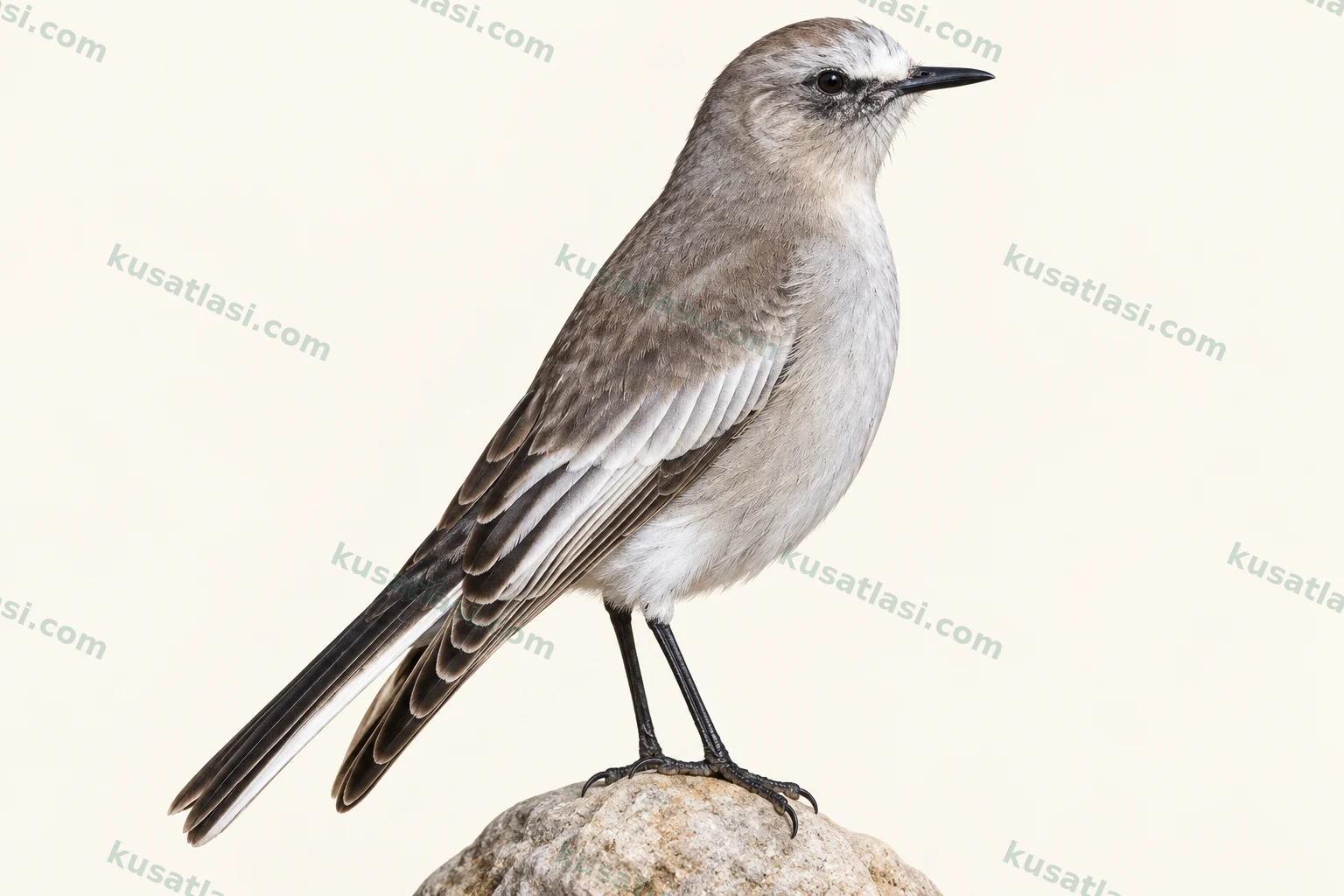
White-fronted Ground Tyrant
Muscisaxicola albifrons
A large ground tyrant of the high Andes; grey body, variable white forehead and long wings with silver-white edges. Search wet meadows with cushion plants.
Biometrics
Length
Male20–22 cm
Female20–22 cm
Shared species value
Wing length
Male15.98 cm
Female15.98 cm
Shared species value
Weight
Male60.7 g
FemaleData unavailable
White-fronted Ground Tyrant
The Peruvian Andes, western Bolivia and far northern ChileObservation guide in its natural range
Look for three features together
Do not rely on a single featureVariable white forehead; this alone is insufficient for sex identification.
Broad silver-white edges on the long feathers.
High-mountain wet meadows and nearby rocky puna.
Compare male and female
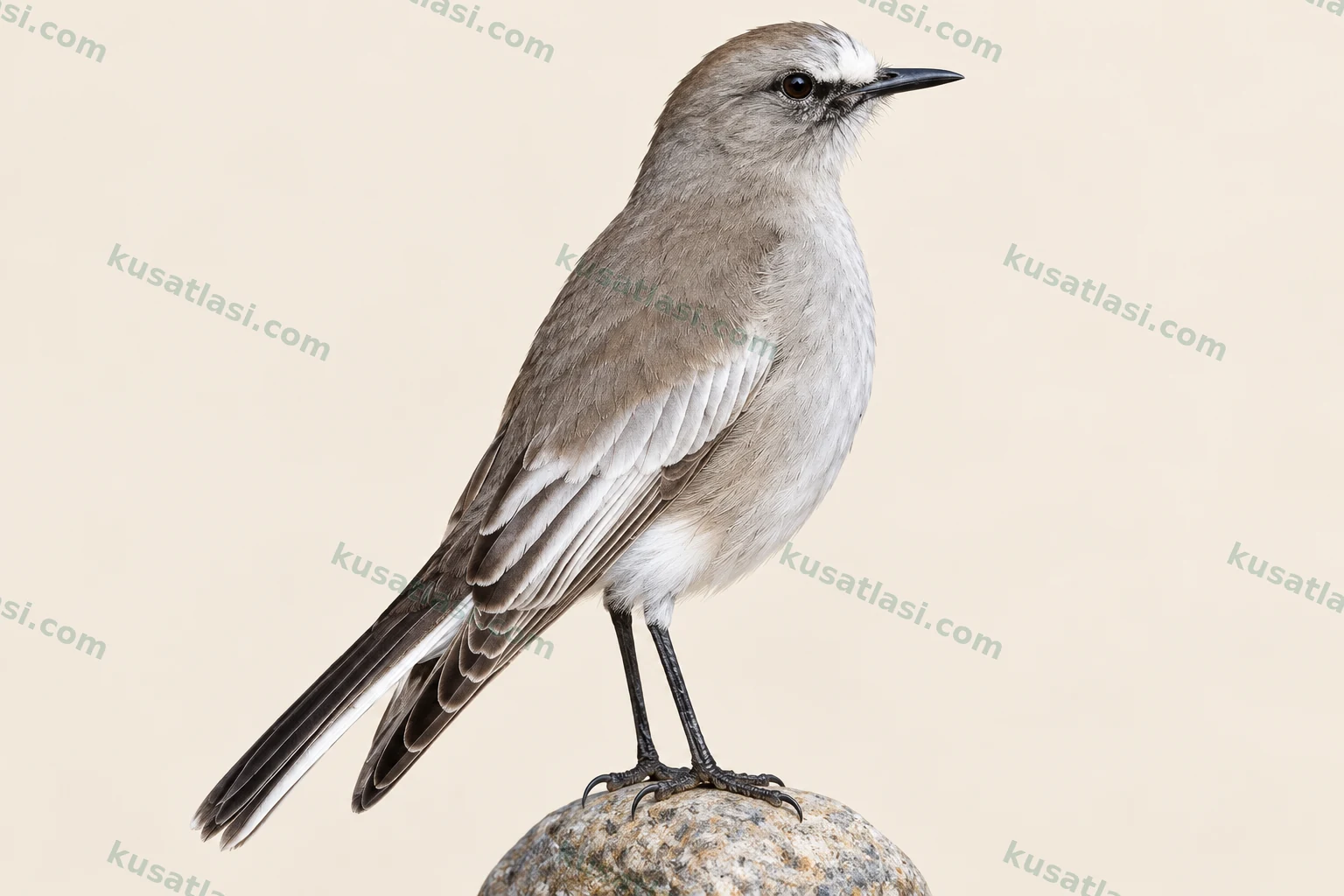 FemaleMale
The Peruvian specialist reports a broader forehead and eyebrow in males; individual variation and unknown age prevent certain sexing from one photograph.
Where to look in its natural range?
Wet meadows with cushion plants and adjoining rocky open areas.
An active nest was documented at Quelccaya in October; one local record does not establish monthly breeding boundaries across the whole range.
January
A nonmigratory high-mountain bird; daily journeys to shelter are not migration. No verified regional date specific to this month was given; this does not mean local absence.
February
A nonmigratory high-mountain bird; daily journeys to shelter are not migration. No verified regional date specific to this month was given; this does not mean local absence.
March
A nonmigratory high-mountain bird; daily journeys to shelter are not migration. No verified regional date specific to this month was given; this does not mean local absence.
April
A nonmigratory high-mountain bird; daily journeys to shelter are not migration. No verified regional date specific to this month was given; this does not mean local absence.
May
A nonmigratory high-mountain bird; daily journeys to shelter are not migration. No verified regional date specific to this month was given; this does not mean local absence.
June
A nonmigratory high-mountain bird; daily journeys to shelter are not migration. No verified regional date specific to this month was given; this does not mean local absence.
July
A nonmigratory high-mountain bird; daily journeys to shelter are not migration. No verified regional date specific to this month was given; this does not mean local absence.
August
A nonmigratory high-mountain bird; daily journeys to shelter are not migration. No verified regional date specific to this month was given; this does not mean local absence.
September
A nonmigratory high-mountain bird; daily journeys to shelter are not migration. No verified regional date specific to this month was given; this does not mean local absence.
October
A nonmigratory high-mountain bird; daily journeys to shelter are not migration. Peru, Quelccaya — October 2014: a documented active nest; this is not a definite breeding calendar for all countries.
November
A nonmigratory high-mountain bird; daily journeys to shelter are not migration. No verified regional date specific to this month was given; this does not mean local absence.
December
A nonmigratory high-mountain bird; daily journeys to shelter are not migration. No verified regional date specific to this month was given; this does not mean local absence.
Nest, egg and incubation
An active nest and two chicks were seen on a rock beneath glacier ice at Quelccaya. Typical egg number, incubation duration and time to first flight could not be verified.
A detailed species-specific description of adult voice could not be verified; chicks calling to an adult bringing food have been documented.
Do not play recordings to attract birds; observe quietly, especially near nests.
Species information
Quick identification
White-fronted Ground Tyrant Muscisaxicola albifrons is an open-country bird of the high Andes of Peru, western Bolivia and far northern Chile. It is a rather large, upright ground tyrant with grey upperparts and whitish underparts. A pale forehead and silver-white edges to its long wings attract attention together. Search wet high-altitude meadows with cushion plants for a bird feeding alone or two together.
Forehead whiteness varies between individuals; absence of a broad white forehead does not immediately exclude the species. Check the pale appearance created by feather edges in flight and on folded wings too. Size, upright stance, wings and the high-mountain setting matter together. One distant white head fragment, especially beside bright stones and snow, is insufficient for reliable identification.
General appearance and posture
The body is plain grey, with a paler off-white underside. Broad pale margins to wing coverts and long flight feathers can make the wing look paler and more silvery than the body. This does not make the whole wing white; dark feather centres must be seen together with pale edges. Some individuals can have a faint brownish nape.
The bird often stands upright on open ground to watch its surroundings. To assess size, compare another bird at the same distance if possible, rather than a nearby stone. It can move between wet meadow and adjacent rocky open slopes. Mountain mist and strong light alter the apparent grey body, so several views and a short flight strengthen identification.
Males, females and young birds
The Peruvian specialist account reports a broader white forehead and eyebrow in males, versus a narrower forehead band and less-developed eyebrow in females. This source alone still does not make every pale area in one distant photograph a reliable sex character. Forehead feathers must be fully visible, individual variation considered and the bird’s known or unknown age taken into account.
Adult body colour in both sexes follows the same grey-and-whitish pattern; neither is assigned an entirely different breast or back colour.
An original scientific paper on juvenile appearance exists, but its detailed plumage description could not be read directly in the present research. Unverified juvenile colours or moult months are therefore not supplied. Young specimens collected in Bolivia in January are mentioned in the later breeding study; those dates do not show egg-laying in the same month in every country.
Appearance in flight
Pale feather edges on the long wings create a washed-out, finely frosted appearance in flight. Cornell identifies this as a useful distinguishing character. Do not expect one entire wing surface to be white: edge pattern, plain grey body and pale forehead are watched together. A flash of light during a quick wingbeat is not a permanent feather patch.
When a bird leaves open meadow and lands on a nearby rock, its posture can be checked again. Individuals flying towards a glacier in the evening were recorded in Peru, but this is not a migration route. Such flight is interpreted only with place and time retained; daytime feeding ground and night shelter can differ.
Voice and behaviour
A detailed, species-specific verified verbal description of adult voice was not found in this research. Calls of related ground tyrants are not transferred here. In the nest study, chicks calling to a food-carrying adult led to discovery of the nest. That observation cannot be used as an adult song template or a sound-volume measurement for the whole species.
Cornell describes solitary or paired foraging; the Peruvian specialist links the bird with wet meadows and cushion plants. In a multisite Bolivian study it was among the birds recorded most abundantly in the high-altitude wetlands examined. This local abundance does not show identical density in every Andean valley. Search the edges of small wet meadows and nearby rocks first.
Similar species
Muscisaxicola flavinucha is smaller, and its warm-coloured nape may not be easy to see in every view. Absence of a visible nape patch alone therefore does not establish White-fronted Ground Tyrant. Relative size, forehead, wing margins and the entire setting are assessed together.
Muscisaxicola griseus is another smaller comparison. A generally grey appearance is shared, so body colour alone is insufficient. Long pale-edged wings, size and forehead white are checked separately. Similar colours do not establish the closest evolutionary relationship either: genetic research shows that head markings can develop similarly in different lineages.
World distribution
The current taxonomic record gives the natural range as the Peruvian Andes south from Ancash, western Bolivia and far northern Chile. Neither Amazonian lowland forest nor every open area of South America belongs to this scope. The Peruvian specialist account emphasises high-mountain conditions. Bolivia’s Cordillera Real wetlands and Peru’s Cordillera Vilcanota are examples of scientific field-study sites.
Status within its natural range
The current global conservation category is Least Concern. The Peruvian specialist describes a generally uncommon bird that can be frequent locally in suitable habitat. High recording numbers in the Cordillera Real study are consistent with such local abundance, not continuous occupation of every mountain slope. Wet-meadow size and quality and adjacent dry rocks are considered together.
There are records above 5,200 metres at the Quelccaya glacier edge. The Peruvian guide’s 3,700–4,900-metre range is not an absolute upper limit overriding those original observations. Modelled areas on the map are not places where elevation is confirmed in every cell, and observation points are neither a complete census nor proof of nests everywhere.
Migration
The scientific genus comparison classifies it as nonmigratory. Migratory relatives in the same genus do not establish long-distance migration in this species. Daily journeys between feeding sites and evening shelter are distinguished from seasonal migration. No verified monthly movement boundaries covering the whole range were found, so no country sequence, distance or regular route is drawn.
Breeding habitat
Wet high-Andean meadows, low cushion vegetation and adjacent rocky open areas are the main environments in which to search. Glacier-edge records are important, but the bird is not portrayed as living solely on bare ice. Vegetated daytime feeding ground need not be the same surface as breeding or night shelter.
Nest site
An active nest was documented in October 2014 at Quelccaya in Peru, on a large rock inside a narrow cavity beneath glacier ice. Two chicks do not establish a typical clutch of two eggs. Later nest remains contained root fibres and mammal hair, possibly vicuña hair; that last identification was tentative. Typical egg number, full incubation duration and time to first flight could not be verified.
Daily habitat use
While feeding alone or in pairs on wet meadow, the bird can also be seen on nearby rocks and at glacier margins. Original observations document use of glacier crevices as night shelters; the number of birds and frequency of communal use remain incompletely understood. Do not enter beneath glacier ice to seek nests: ice movement is dangerous and the bird’s confined shelter can be disturbed. Distant observation is more appropriate for following feeding-to-shelter movements.
What does it eat?
The data compilation classifies the species as a ground-feeding invertebrate predator. At an active Peruvian nest, adults were photographed carrying large arthropods in their bills. These are direct chick-provisioning records, not annual dietary percentages or an inventory of every prey eaten by adults. Presence near a glacier does not mean that food consists only of organisms on ice.
How does it forage?
Cornell describes birds foraging singly or in pairs in marshy meadows and moving into nearby rocky puna. Along cushion-plant clumps and open spaces, the point of actual food intake can be watched. No exact values are given for insect selection frequency, search duration or seasonal prey proportions because verified species-specific measurements were not established.
Prey is bill-carried during nest provisioning; another bird’s regurgitation described in the same paper is not transferred to this species. If a small prey item cannot be identified, retain the description as an invertebrate. Do not obstruct a food-carrying adult or follow it to the nest merely to identify prey.
Similar head markings do not settle relationships alone
Genetic research on ground tyrants did not support some older relationship groups built only from colour and body proportions. White forehead and warm-coloured crown markings can arise similarly in different lineages. This does not make them useless in the field: identification marks and evolutionary relatedness are different questions. Forehead, wings, size and geography are also combined for White-fronted Ground Tyrant.
A wet mountain meadow is a small habitat island
A Bolivian comparison of 40 high-altitude wetlands examined their role as distinct habitats within surrounding dry land. Bird-community diversity is associated with area size and environmental conditions. White-fronted Ground Tyrant is among the frequently recorded species, but a community-level relationship does not imply identical population responses everywhere in this species.
Migration habits differ within the genus
Muscisaxicola includes long-distance migrants and nonmigratory species. The genetic comparison treats White-fronted Ground Tyrant in the nonmigratory group while examining the evolution of migration in other members separately. Two similar ground tyrants on the same mountain in the same season need not follow identical routes through the rest of the year. Migration arrows of a relative therefore cannot be transferred to this bird’s map.