

World Birds IUCN statusLC · Least ConcernGlobal IUCN category. BirdLife v10 (2025); taxon matching: AviList 2026 / IOC 15.2; checked: 29.10.2026. The list year is not the species assessment date. Source and method · BirdLife OrderPasseriformesPasserines FamilyPipridaePipridae
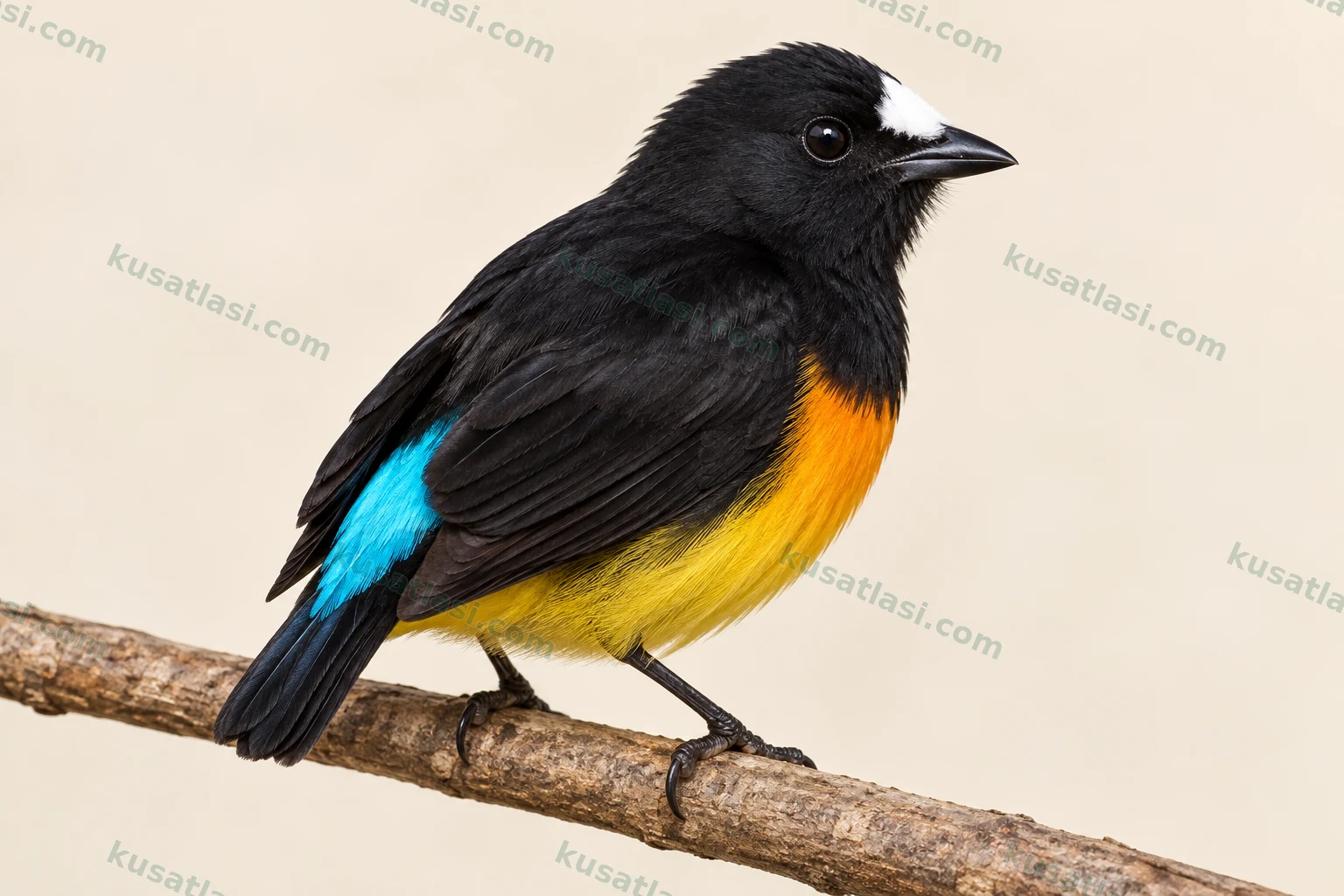
White-fronted Manakin
Lepidothrix serena
A small manakin of humid forest undergrowth around the Guianas and northern Amazonia; the male has a white forehead, blue rump and yellow belly, while the female is green and yellow.
Biometrics
Length
Male9 cm
Female9 cm
Shared species value
Wing length
Male5.28 cm
Female5.28 cm
Shared species value
Weight
Male10.7–12 g
Female11 g
White-fronted Manakin
Southeastern Guyana, Suriname, French Guiana and northern AmazoniaObservation guide in its natural range
Look for three features together
Do not rely on a single featureBlack body, white forehead, blue rump and yellow belly.
Green upperparts and yellowish underparts.
Brown; old white-eyed illustrations are incorrect.
Compare male and female
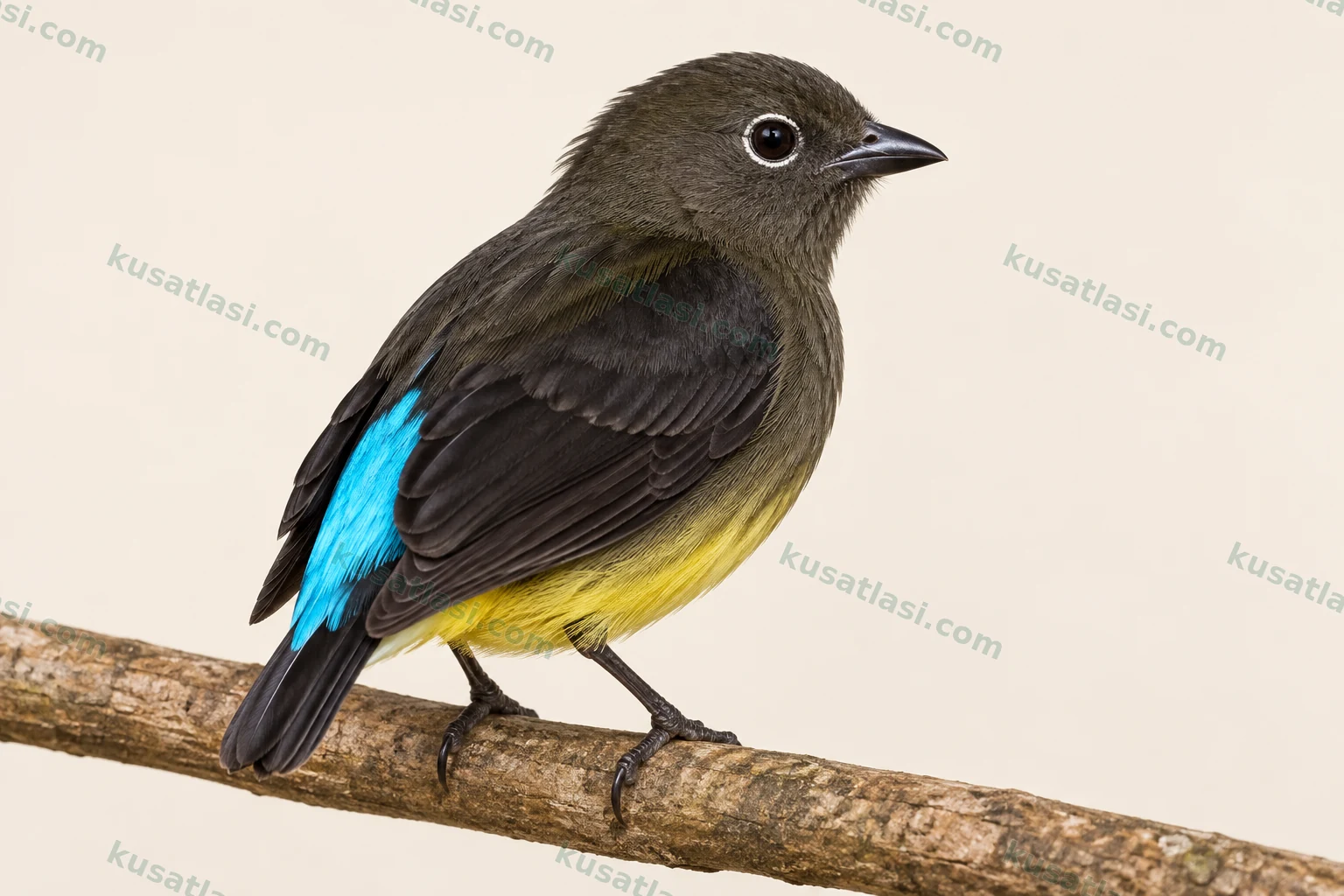 FemaleMale
The adult male is black, white, blue and yellow; the female is green and yellowish. Young males in transitional plumage are not assigned as females from colour alone.
Where to look in its natural range?
Lower branches of humid forest, fruiting shrubs and display perches near the ground.
Local display dates are not an egg-laying calendar; a precise monthly breeding season could not be verified.
All months: Resident; no regular long-distance migration route was found. No verified regional date specific to this month was given; this does not mean local absence.
January
February
March
April
May
June
July
August
September
October
November
December
Nest, egg and incubation
The nest is usually 1–2 metres above the ground, partly concealed externally by hanging moss. Typical clutch size, incubation duration and time to first flight could not be verified.
Soft, throaty, rolling whistles; a descending murmur at the start of a display.
Do not play recordings to attract birds; observe quietly, especially near nests.
Species information
Quick identification
White-fronted Manakin Lepidothrix serena is a very small bird of humid forests in northern South America. The adult male is recognised by its velvety black body, bright white forecrown, blue rump and yellow belly. The female has green upperparts and yellowish underparts. Such different appearances can lead birds using the same feeding shrub to be mistaken for two species.
The male’s white forehead does not cover the whole head; the rear of the head and face remain dark. The blue at the base of the tail is visible only when wing position and viewing angle permit. The yellow belly and the small, warmer, orange-tinged yellow breast patch are separate areas. Colour, patch position and natural geography are assessed together; a small black forest bird is not identified with certainty from a white head patch alone.
General appearance and posture
It is a small, compact, short-tailed forest bird. The bill and feet are black and the eye is brown. Some older guide illustrations showed a white eye, but a scientific comparison using specimen soft-part records and photographs corrected that depiction. The white forehead is not combined with eye colour to suggest a white-eyed bird.
It often remains inconspicuous in rainforest undergrowth. A male calling repeatedly from an open branch relatively close to the ground may be easier to find. Low fruiting shrubs are useful observation points too. The bright male is not a bird constantly moving through the highest canopy; lower branches and shrubs are watched first. The female’s green can be harder to pick out among leaves.
Males, females and young birds
The adult male’s head, back, wings, tail and upper breast are black. The white forehead, blue rump, yellow belly and small warm-yellow breast patch contrast with that dark ground. In some specimens the forehead may show a very faint bluish reflection; this does not mean the whole crown is blue. The dark rear of the head and belly colour should also be seen.
The female differs through grass-green upperparts and paler, more yellowish underparts. The adult male’s black-white-blue pattern is not sought in the female. Other green manakins occur within the natural range, so one green photograph may not suffice. Belly tone, head appearance and the region where the image was taken are checked together.
The Suriname behaviour study separately recognised males acquiring adult plumage and observed them participating in displays. This shows that not all young males have the same colour contrasts as adults. A detailed species-wide monthly moult calendar could not be verified, however. Instead of assigning every female-like bird to the female sex from colour alone, age remains an open possibility.
Appearance in flight
Display flights within the forest are a striking part of this species’ behaviour. In Suriname males were seen making fast, curving passages between branches, sometimes following a horizontal path or descending and rising again. The same study distinguished these movements from foraging flights. Not every short flight need be a courtship display; calls, the branches used and interaction with another bird are followed.
At a display site near the ground, two males can take off and land simultaneously, crossing one another’s paths in the air and exchanging perches. Sometimes the body is held more upright and wingbeats are very rapid. Brief opening and closing of the wings on landing can reveal the blue rump. This helps locate the blue patch; it does not mean the whole wing is blue.
Voice and behaviour
The male’s repeated sound resembles a soft, throaty, rolling whistle, with lower short notes sometimes interspersed. A descending, murmuring sound at the start of a display was also recorded. Cornell’s account says this can recall a frog. Sound resemblance alone does not identify its maker; seeing the calling bird on a low branch makes identification more reliable.
Males can call in nearby but separate areas. A male’s display companion is not always the same individual; the Suriname study observed paired displays with neighbours and other males. Synchronised movement does not prove a permanent family group. Since copulation was not observed in the study, the display’s role in competition and cooperation was not settled.
Similar species
Lepidothrix suavissima is the closest visual comparison. Its male has a more orange belly, an entirely dark upper breast rather than this species’ small warm-yellow patch, and may have a more conspicuous bluish border behind the white head area. The natural ranges differ. Not all Venezuelan records under the old broad species name can be transferred to White-fronted Manakin.
In other manakins with pale-headed males, such as Lepidothrix nattereri, compare the extent of the pale head area and the colour of the lower body. Green females are harder to identify and require a regional species list and several views. Rather than assign an unjustifiably certain name, retain a record showing head, belly and rump separately.
World distribution
The current species naturally occurs in southeastern Guyana, Suriname, French Guiana and northern Amazonian Brazil. In Brazil, the main geography is forest north of the Amazon from around Manaus towards Amapá. This does not mean all Brazil or all Guyana is continuously occupied; the locations of suitable forest and documented records matter.
Status within its natural range
Its current global conservation category is Least Concern. Cornell describes it as a locally common resident of tall rainforest. Being frequent around Brownsberg in Suriname does not imply equal density in every forest on the continent. The older study distinguished Suriname’s coastal forests from higher forests inland; this regional finding is not applied as one elevation threshold throughout the range.
Research around the Rupununi in southern Guyana recorded the species in a narrow humid forest belt and contributed to the western limit known at that time. Records of another manakin about 150 kilometres away do not prove coexistence or hybridisation at one site. The whole coloured area of an old range illustration is not assigned to this species without checking the current species split.
Movements
It is considered resident; no verified regular intercontinental migration route was found. A male visiting neighbouring display areas or a bird moving to a fruiting shrub is not seasonal migration. Geographic records are not joined into a single tracked route through the forest. Map observation points are sampled records, not evidence of breeding in every coloured cell.
Breeding habitat
The understorey of humid, tall rainforest is important. Displaying males are mostly among low and lower-middle branches, and small saplings near the ground can be used in display passages. Brownsberg observations returned to the same areas. Such a display site is not a nest; not every shrub immediately beneath a calling male is expected to contain one.
Nest site
A scientific nest comparison describes nests usually placed 1–2 metres above the ground, partly covered externally by hanging green moss. These moss extensions can conceal the nest’s shape. Nests containing eggs have been reported, but typical clutch size, complete incubation duration and time to first flight could not be verified in the original texts examined; timings from a related manakin are not substituted.
Daily use of space
Foraging and display can use different points. In the Suriname study birds took fruit and insects about 1–6 metres above ground, while males’ frequent calling branches were mostly at 1–5 metres. These are local observation ranges. Males were not seen clearing vegetation from display sites; natural saplings are not cut to improve the view.
What it eats
Small fruits are an important part of the diet, and insects are taken too. Both food types were seen in the direct Suriname field study. Cornell highlights fruit of understorey shrubs. Together these sources prevent presenting the bird as exclusively insectivorous or exclusively fruit-eating. A fruit–insect percentage covering every country and the whole year could not be verified.
How it obtains food
One bird or two together can use feeding points in the understorey. Two individuals in a fruiting shrub are not necessarily a mated pair; feeding together and a breeding relationship are separate observations. Lower branches and fruiting shrubs are watched rather than large open-air flocks above the forest. A small bird within leaves may become visible again after a few movements.
A short passage to obtain food differs from males’ synchronised display flights. A feeding record is made when the point at which fruit or prey is taken can be seen; fast flight alone is not proof of hunting. Since the examined publications do not give consumption frequencies for every plant species, a particular forest fruit is not declared the species’ obligatory main food.
The meaning of a display is not always clear
Displays in which two males took off and landed together, exchanging places, were recorded in Suriname. It was not established that this coordinated movement served cooperation alone. Displays sometimes followed neighbours calling back and forth; a possible female visit was also seen, but copulation was not observed. The researcher discusses these details in terms of competition and attraction of females; observed movement and its explanation do not have the same evidential status.
A brown eye corrected an old illustration
The white eye shown in an old guide passed into later illustrations and a scientific comparison. When new specimen records and photographs showed the eye to be brown, the error was corrected. Repeating an illustration many times does not guarantee biological accuracy. The white forehead, shadow around the eye and the eye’s actual colour should be assessed separately.
One old name encompassed two species
The old Pipra serena account included birds now separated as Lepidothrix serena and Lepidothrix suavissima. The split was not based solely on belly colour: male and female plumage, measurements, vocal-organ structure and sound recordings were compared. Transferring an old locality or measurement record to the current species merely because its name looks similar can therefore be wrong. The original Suriname behaviour observations can be linked to this species through locality and plumage.
The female’s wing was slightly longer on average
The 1994 museum study found a longer mean folded-wing length in females than males. It also states that this statistical difference is insufficient to identify a single bird in the field without measurement. Sex is easier to establish in clearly different-looking adults; for young birds in transitional plumage, relying on an expected size alone is inappropriate.