

World Birds IUCN statusEN · EndangeredGlobal IUCN. BirdLife v10 (2025); taxon matching AviList 2026 / IOC 15.2; checked: 29.10.2026. The list year is not the species’ assessment date. Source and method · BirdLife OrderPasseriformesPasserines FamilyMaluridaeMaluridae
White-throated Grasswren
Amytornis woodwardi
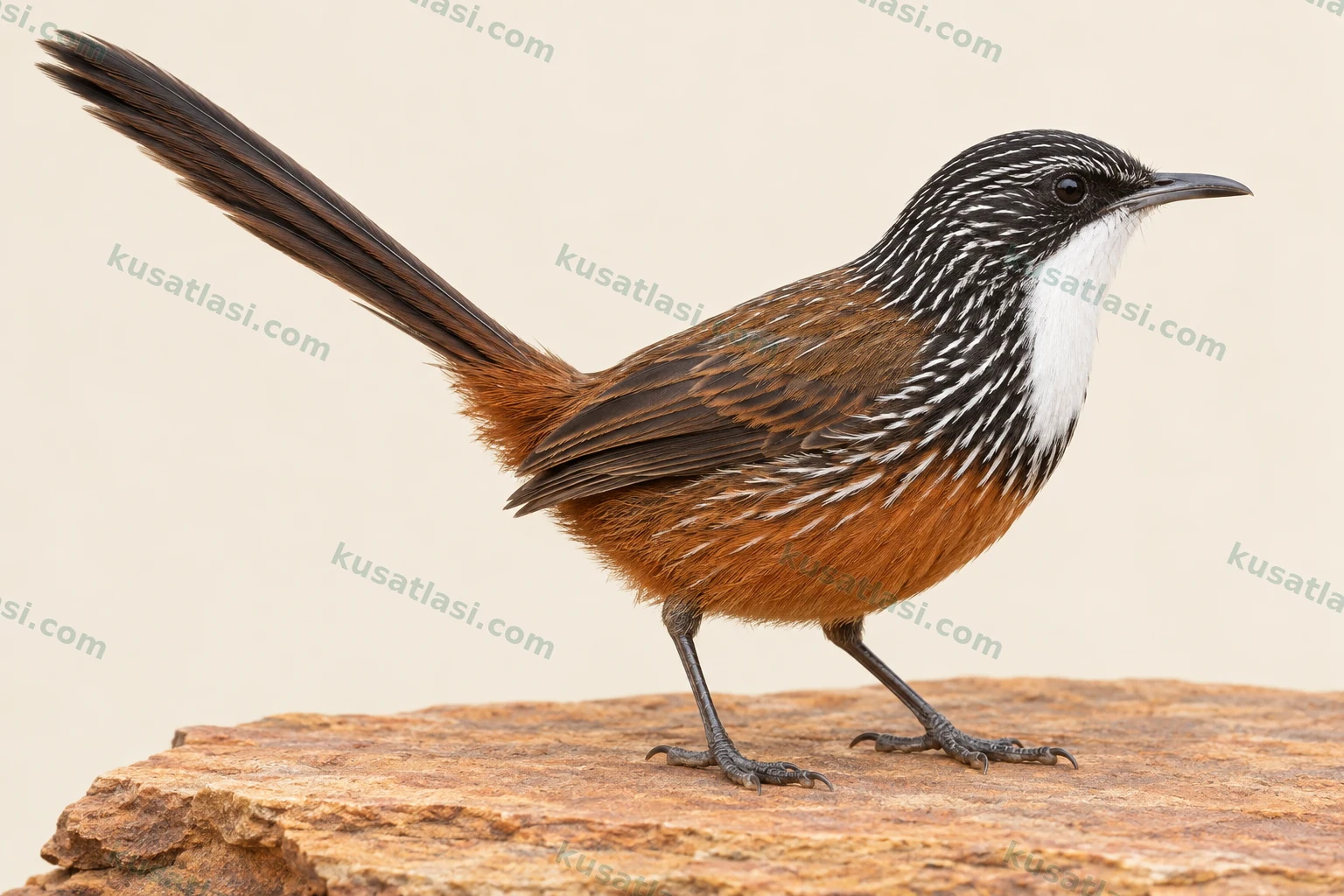
The dark streaked head and back, broad white throat, warm-coloured underparts and long tail identify a bird restricted to the rocky grasslands of Arnhem Land.
Biometrics
Length
Male20–22 cm
Female20–22 cm
Shared species value
Wing length
Male7.45 cm
Female7.45 cm
Shared species value
Weight
Male33–40 g
Female30–37 g
White-throated Grasswren
Sandstone country of western Arnhem Land, AustraliaObservation guide in its natural range
Look for three features together
Do not rely on a single featureLook for the broad white patch together with the dark, streaked head.
Watch the long tail rise at rest and drop in motion.
Look around sandstone and mature grass tussocks in western Arnhem Land.
Compare male and female
 FemaleMale
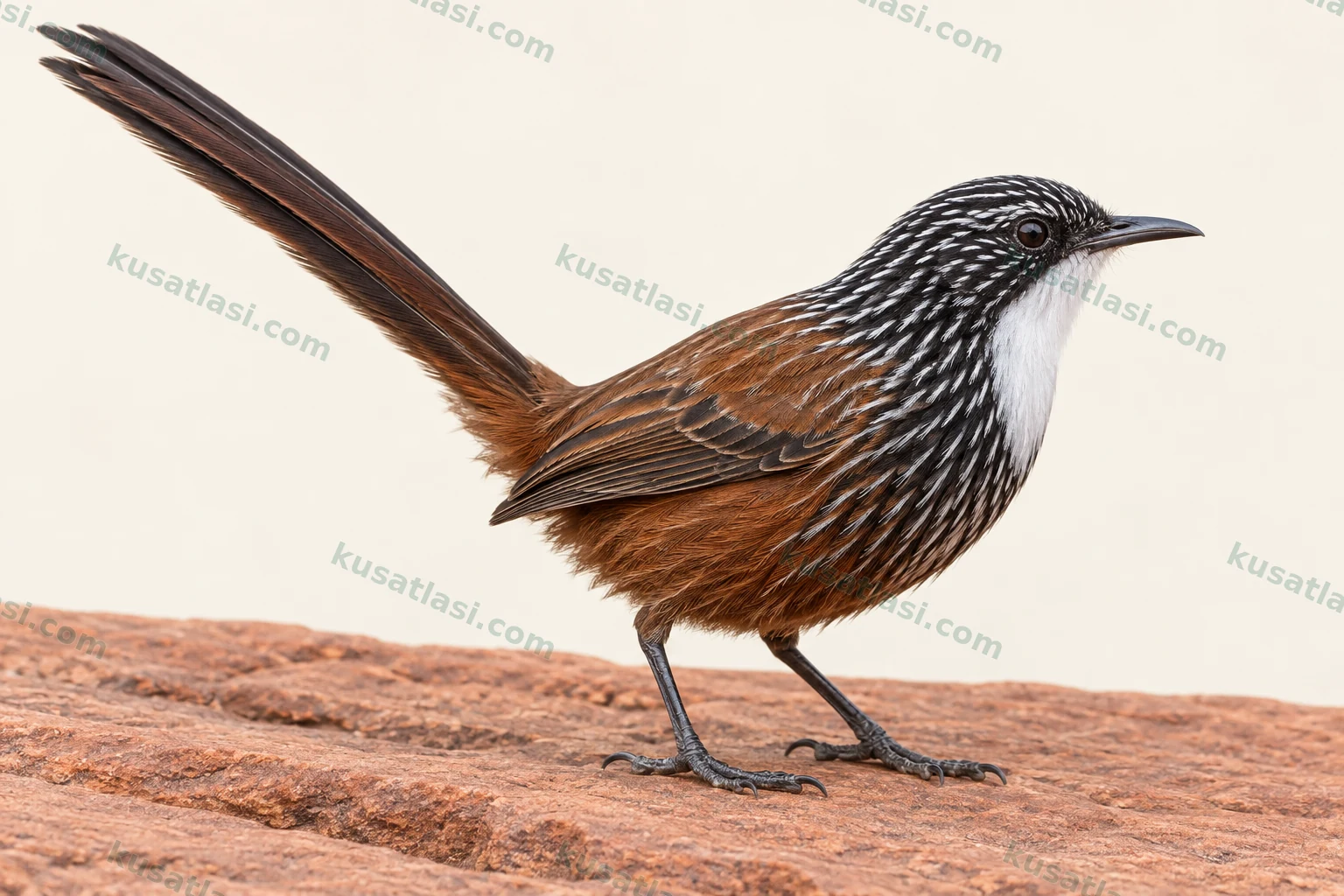
Adult males have more orange-chestnut underparts and females darker chestnut underparts. Sex differences and details of moult in young birds are insufficiently documented.
Where to look in its natural range?
Quietly watch small openings beside rocks without parting the grass tussocks.
This resident species is reported to breed locally from December to June.
January
The species is resident. The long breeding season reported around Arnhem Land extends from December to June. This month falls within the reported breeding season around Arnhem Land.
February
The species is resident. The long breeding season reported around Arnhem Land extends from December to June. This month falls within the reported breeding season around Arnhem Land.
March
The species is resident. The long breeding season reported around Arnhem Land extends from December to June. This month falls within the reported breeding season around Arnhem Land.
April
The species is resident. The long breeding season reported around Arnhem Land extends from December to June. This month falls within the reported breeding season around Arnhem Land.
May
The species is resident. The long breeding season reported around Arnhem Land extends from December to June. This month falls within the reported breeding season around Arnhem Land.
June
The species is resident. The long breeding season reported around Arnhem Land extends from December to June. This month falls within the reported breeding season around Arnhem Land.
July
The species is resident. The long breeding season reported around Arnhem Land extends from December to June. No verified regional date is given for this month. This does not indicate local absence.
August
The species is resident. The long breeding season reported around Arnhem Land extends from December to June. No verified regional date is given for this month. This does not indicate local absence.
September
The species is resident. The long breeding season reported around Arnhem Land extends from December to June. No verified regional date is given for this month. This does not indicate local absence.
October
The species is resident. The long breeding season reported around Arnhem Land extends from December to June. No verified regional date is given for this month. This does not indicate local absence.
November
The species is resident. The long breeding season reported around Arnhem Land extends from December to June. No verified regional date is given for this month. This does not indicate local absence.
December
The species is resident. The long breeding season reported around Arnhem Land extends from December to June. This month falls within the reported breeding season around Arnhem Land.
Nest, egg and incubation
The domed nest is hidden in a grass tussock. A clutch usually contains two eggs. Incubation duration and the time the young spend in the nest have not been verified.
The song has complex trills and twitters. The alarm call is sharper and shorter.
Do not play recordings to attract birds; observe quietly, especially near nests.
Species information
Quick identification
The White-throated Grasswren Amytornis woodwardi is a mostly ground-dwelling bird found only in the sandstone country of Arnhem Land in northern Australia. Look for the fine white streaking on the dark head and upperparts, the broad white throat patch and the warm chestnut-orange underparts together. The bird quickly disappears among rocks and grass tussocks, making it difficult to observe. A glimpse of a long tail alone does not identify it.
Quietly watch the small openings between dense tussocks of spinifex grass. When the bird comes to the edge of a rock or patch of vegetation, look for the white throat and upperpart streaks at the same time. The white forms a distinct patch on the front of the body rather than just a thin line. Dark feathers may look brown in the light without losing their underlying pattern. There is no need to part the grass or probe gaps in the rocks to see the bird.
General appearance and posture
Look for a tail that is long relative to the small body, strong movement on the ground and a streaked head. Fine white feather streaks mark the dark head and back. The white throat extends onto the upper breast, with warmer tones farther down. The rump and tail may show darker chestnut-brown tones. Posture can obscure the boundaries between these colours. A bird leaning forward may hide part of its white front.
A bird holding its tail high has a different outline from one running to another tussock. The tail drops in motion and may look shorter in a photograph. If only the head or part of the body is visible among the tussocks, the incomplete view does not indicate sex. The streaked upperparts, broad white throat patch and long tail support the identification together. The natural range also helps when comparing grasswrens from different parts of Australia. This species occurs in only part of the country.
Males, females and young birds
Adult males and females differ in plumage. In the adult examples in the bird measurement guide based on HANZAB, the male's underparts look more orange-chestnut and the female's darker chestnut. Both sexes have the conspicuous white throat and dark streaked upperparts. The difference in shade can be hard to see in shadow, so check it against a fuller view of the head, throat and body. A dark photograph alone does not show that a bird is female.
The same guide states that too little has been published on the timing and stages of moult in young birds. It also notes that possible sex differences in young birds have not been adequately confirmed. The adult colour comparison therefore cannot be applied to every young bird. Record any feeding relationship observed within a family group. Apparent small size or a shorter-looking tail alone cannot determine exact age. No key is offered that claims to distinguish all stages of development.
Appearance in flight
The movement most often noticed is a quick run between grass tussocks and rocks. The bird also makes short flights. Its long tail and dark streaked body may appear briefly as it moves from a rock to another patch of cover. The white throat may be hidden from behind. Follow up a brief escape view by looking for the front pattern once the bird has settled.
Avoid approaching the bird to startle it into flight. This interrupts its usual use of the habitat, and repeated escape flights could be recorded as normal behaviour. The species is generally resident. Movement between rocks does not provide evidence of long-distance migration.
Voice and behaviour
The voice is often noticed before the bird. Its song consists of complex trills and short twitters, while the alarm call is sharper and shorter. It can be difficult to see which bird is calling among rocks and dense grass. Try to match the sound with the bird in view to avoid confusing it with another bird calling nearby. When you hear the song, quietly watch a clear opening without entering the vegetation.
The birds can occur alone, in pairs or in small family groups. An early field study reported that pairs and larger groups occupied breeding areas. The presence of more than two adults in a group does not establish that every adult directly cares for the young. Later assessments of the research stress this distinction. Record feeding, guarding and simply staying nearby as separate behaviours. A group sighting alone does not demonstrate a system of cooperative care.
Similar species
1. The Carpentarian Grasswren Amytornis dorotheae also has dark streaked upperparts and a long tail. Compare the extent of white on the front, body proportions and natural range together. The distinction between Arnhem Land and suitable habitat farther east can help, but similar streaks alone do not settle the identification.
2. Other dark grasswrens can also move quickly on the ground between rocks and tussocks. Look for the broad white throat and the streaked head and back of the White-throated Grasswren. A nearly black bird or a long tail alone is insufficient.
3. Smaller fairywrens in the same habitat can be confused with it in a brief glimpse of movement. A view of the tail proportions, body size and white throat together with the head streaking makes the distinction easier. Avoid guessing the hidden pattern on a partly obscured bird.
Global range
The species is restricted to the sandstone plateau of western Arnhem Land and surrounding areas in Australia's Northern Territory. Kakadu and Nitmiluk national parks are among the known parts of its natural range. It does not occur throughout Australia. Sandstone surfaces, rocky crevices and suitable grass tussocks together define its habitat more accurately than a territorial or park boundary alone.
Status within its natural range
Its range is fragmented. Suitable cover is unevenly distributed across the rocky landscape. The current global category is Endangered. National or regional categories in earlier government documents come from different dates and assessment systems. An old category cannot stand in for the current global one. Frequent, extensive fires late in the dry season can reduce the mature grass cover it needs. Gaps in local surveys and the bird's secretive behaviour make current population size difficult to establish.
Movements and migration
It is generally resident. Daily movements within a breeding area and dispersal by young birds are distinct from regular long-distance migration. Areas of about 10 hectares in an early study refer to the pairs and groups in that study. They do not establish an identical territory size for every bird. The map shows approximate locations of licensed records within the natural Arnhem Land range. Failure to find the bird at one survey point does not by itself prove that all nearby rock and grass habitat is now empty.
Breeding habitat
Spinifex tussocks occur alongside sandstone pavements, boulders and crevices. Some areas also have scattered shrubs or trees above them. Mature tussocks can provide shelter and nest sites. Areas do not all become suitable again at the same rate after a fire. The vegetation structure, frequency of fire and patches that remain unburnt all matter.
Nest site
The government species account describes a domed nest made of grass, leaves and peeling, paper-like bark. The nest is concealed in a grass tussock. The female usually lays two eggs. December to June is reported as a long breeding season. More than one brood may be possible during that period, but this does not imply that all pairs raise the same number successfully. Incubation duration and the time until the young leave the nest have not been adequately verified. The bird measurement guide also reports that incubation information is unavailable.
Daily use of habitat
It feeds on the ground among tussocks, along rock edges and in suitable open gaps. Entering dense cover to look for the bird can disturb both its natural behaviour and the surroundings of a nest. Leave tussocks closed and rock gaps undisturbed when looking for nesting birds. Quietly watching a suitable opening helps you see a bird pass through of its own accord.
What does it eat?
It feeds on small invertebrates, seeds and other plant material. The field study also lists fragments of stems from grasses and sedge-like plants in the diet. It is therefore described as eating both animal and plant foods. Fixed percentages would require separate measurements by season and location. Nor is it assumed to consume every grass species around the same rocks in equal amounts.
How does it forage?
It searches for food on the ground around grasses and rocks. It moves quickly and stays near cover, so small items it picks up may be difficult to identify. Reaching towards the ground with its bill does not reveal whether it took an insect or a seed. Record the food group separately if you can see it. Using food to draw a family group into the open changes its natural search behaviour. Compare brief foraging movements while leaving the grass cover and rock gaps undisturbed.
Tail movement changes the outline
The long tail is held upright or partly upright at rest and drops during quick movements on the ground. One bird can therefore appear to have different proportions in two views. An apparently short tail in one image of a running bird does not indicate age or sex. More stable plumage features, such as the white throat and streaked head and back, support the identification.
Earlier population estimates differ
Research in the 1990s used suitable habitat area and densities from limited field surveys to produce different population estimates. Later assessments discuss differences in the methods and reliability of those estimates. They cannot be reported as an exact count for today. An earlier study describing the bird as secure does not replace the current Endangered category. The date and assessment scope are part of the information.
A group sighting does not establish care by helpers
It is interesting to see three or four adults around a nest or young bird. To tell which adults help care for the young, record which ones actually bring food. Later research on behaviour treats the earlier observations cautiously for this reason. A group sighting and proven shared care of young are different findings. The behaviour itself needs to be documented.
Fire type and frequency matter
Unburnt patches that allow grass tussocks to mature help maintain the bird's habitat. Conservation documents draw particular attention to frequent, extensive fires late in the dry season. This does not mean that every fire has the same effect or that every area should remain unburnt. Regional fire work by Indigenous communities and park managers is considered alongside habitat structure and how it changes over time.