

World Birds IUCN statusDD · Data DeficientGlobal IUCN. BirdLife v10 (2025); taxon matching AviList 2026 / IOC 15.2; checked: 29.10.2026. The list year is not the species’ assessment date. Source and method · BirdLife OrderPasseriformesPasserines FamilyMeliphagidaeMeliphagidae
White-chinned Myzomela
Myzomela albigula
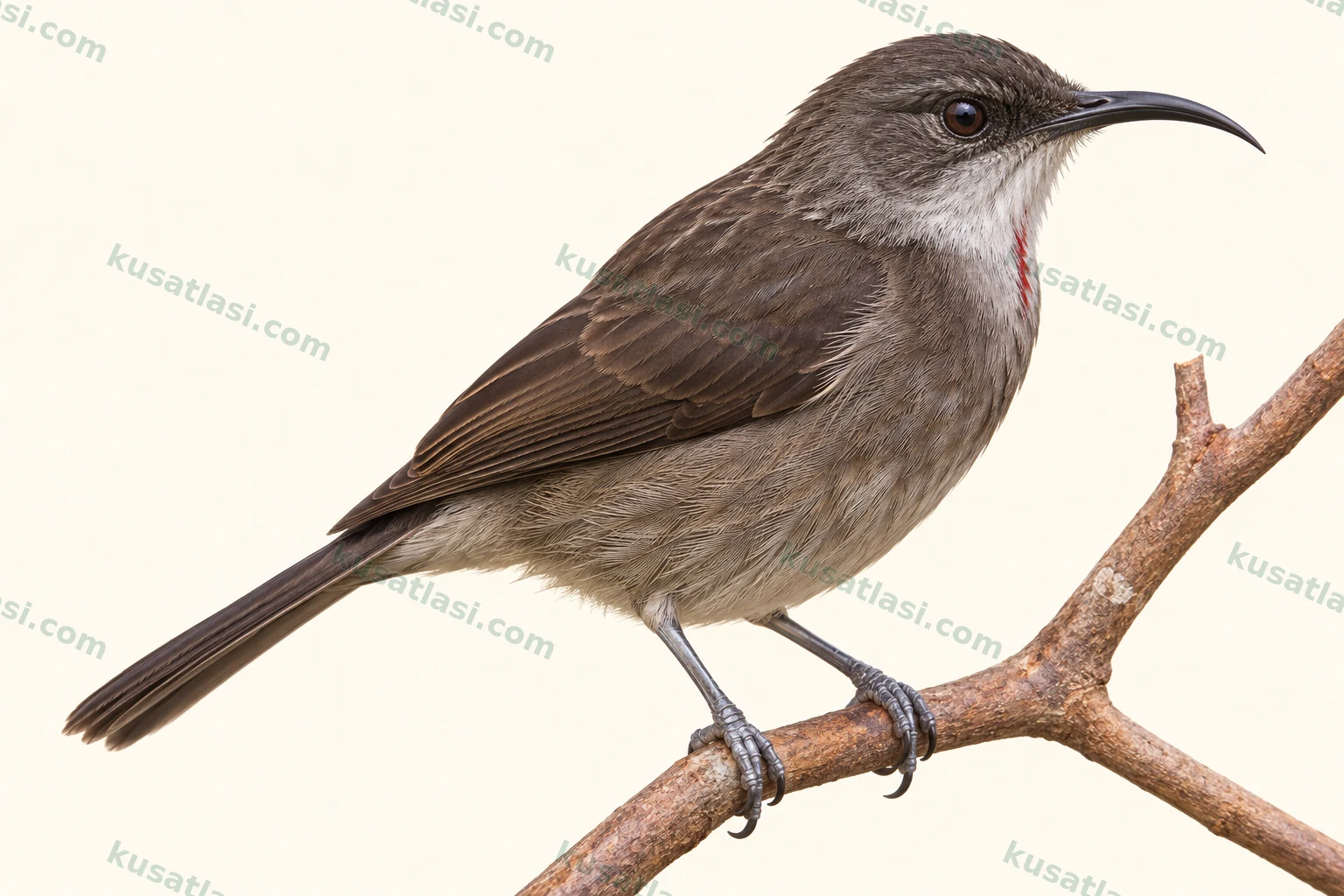
Small plain grey-brown honeyeater of the Louisiades, with faint streaks.
Biometrics
Length
Male13–14 cm
Female13–14 cm
Shared species value
Wing length
Male6.86 cm
Female6.86 cm
Shared species value
Weight
Male16.3 g
Female13 g
White-chinned Myzomela
Louisiades, Papua New GuineaObservation guide in its natural range
Look for three features together
Do not rely on a single featureFaintly streaked underbody; thin reddish throat line.
Rossel males may lack a white throat patch.
Low island forests and woodland.
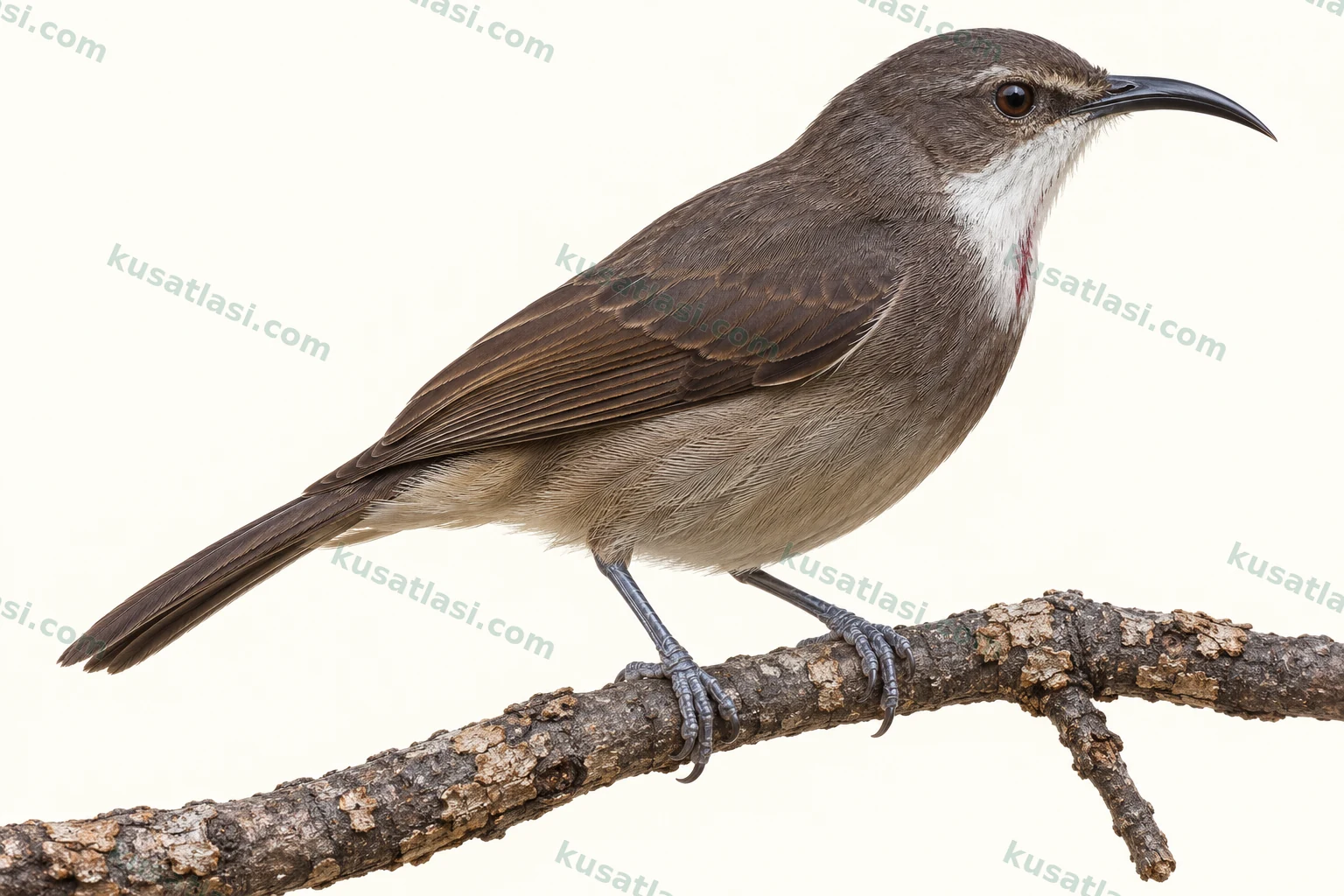
Compare male and female
 FemaleMale
Male larger; the thin red throat line may be clearer. Rossel form darker; juvenile plumage details unverified.
Where to look in its natural range?
Rossel and confirmed small-island woodland around Bonvouloir, Deboyne and Conflict.
Resident island bird; breeding months unverified. No data found for a breeding calendar.
All months: Data unavailable
January
February
March
April
May
June
July
August
September
October
November
December
Nest, egg and incubation
Nest, egg number, incubation and juvenile development unverified.
The specialist guide describes male calls as repeated thin metallic “tink” sounds.
Do not play recordings to attract birds; observe quietly, especially near nests.
Species information
Quick identification
White-chinned Myzomela Myzomela albigula is a small greyish-brown honeyeater of the Louisiade islands off southeastern Papua New Guinea. Assess faint underpart streaks, a slender downcurved bill and the pale throat together. The male's very thin reddish line along the throat can be hard to see. This is not a bright red-headed or wholly red myzomela.
The Rossel form and the small-island pallidior form are accepted within one species. Name and appearance do not agree identically on every island. Both sexes of pallidior have an evident pale throat. Rossel's albigula is darker; the specialist field guide specifically notes that males may lack a white throat patch. Rejecting a bird without a white throat could therefore overlook Rossel males.
General appearance and posture
In paler small-island birds the pale throat may extend below the cheek; the underbody has a pale midline and faint dark streaks. Rossel birds have a darker greyish-brown head and face. The overall impression is a small plain forest bird rather than a vividly coloured honeyeater.
Males, females and young birds
The specialist guide reports larger males and a more marked reddish throat line in males. The fine line is hard to see in cover, so sexing a single bird from its appearance is not always possible. Female pallidior also has a pale throat: the pale area is not male-only. Darker Rossel males must not be confused with paler small-island males.
A detailed juvenile plumage key was not verified in this research. Geographic differences between small-island and Rossel birds are not described as age differences.
Appearance in flight
No reliable field identification pattern specific to the underwing was verified from a source. Reassess a plain brown bird that flies to another branch by the bill and throat pattern when it is visible again.
Voice and behaviour
The specialist field guide describes the male call as successive thin metallic “tink” sounds. The source account reports local frequency on occupied islands but absence on many apparently suitable islands. Search for an island-associated bird, not a species ranging across mainland New Guinea.
Similar species
Myzomela obscura is similarly sized and plain brown, but its mainland and separate island distribution differs. The specialist guide emphasises this species' faint underbody streaking and reddish throat line in comparison. General darkness alone does not reliably separate all dark brown myzomelas.
Myzomela nigrita occurs on other Louisiade islands. Its adult male is more completely black; females may have pinkish-red forehead and chin. However, its island range must not replace the natural range of White-chinned Myzomela's white-throated form on a map. Knowing the island is fundamental information complementing appearance.
World distribution
It is endemic to Papua New Guinea, occurring on Rossel and some small islands and island groups around the Louisiades. Current lists recognise two subspecies: albigula on Rossel, pallidior around Bonvouloir, Deboyne and Conflict. The specialist geographical account also lists dated records from Kimuta, Panapompom and some neighbouring islets. Its range is neither all mainland New Guinea nor every large Louisiade island.
Status within its natural range
Its conservation category is Data Deficient. This is not evidence of low threat; information is insufficient to assess numbers, trends and threats. A 2001 Pacific conservation strategy prioritised research on this bird on Rossel and small islands. Local frequency where it occurs is assessed alongside its restricted, discontinuous island distribution.
Misima appears in some checklists, whereas the 2016 specialist geographical account reports apparent absence there because of locality problems in old records. Until resolved, Misima is not mapped as certain natural range. Rossel and more solid small-island records form the map's verified scope.
Movements
It is classified as resident, with no verified seasonal migration route. Historical dispersal among islands and subspecies on different islands do not prove annually repeated migration. Daily movement distances and their seasonal variation have not yet been measured in detail.
Breeding habitat
It uses island woodland and forest from sea level to about 300 m. The specialist field account mentions different forest types. High mountain forests on nearby larger islands are not included merely because they share the archipelago.
Nest site
The specialist guide records nests and eggs as undescribed. Nest form, egg number, incubation and juvenile development were not verified here either. General honeyeater nest forms are not presented as a discovered nest of this species.
Daily use of space
The specialist ecological source reports nectar and invertebrate searching in forest and scrub. Feeding places within tree cover are tied to small islands. Rossel's larger landmass and tiny islets holding the same species do not mean identical forest structure or density on every island. Reliable measurements of foraging-stratum heights and individual daily area size were not found.
What does it eat?
Nectar and small invertebrates are the confirmed principal food groups. The comparative ecological compilation also records fruit and nectar consumption, but no study documenting detailed food proportions or all regularly used plants was found.
How does it forage?
It seeks food in forest and scrub. A botanical study discusses an old note about a small nectar-feeding bird visiting Calycacanthus insularis flowers on Rossel. Its authors list this myzomela and the local flowerpecker as possible visitors. Since the bird was not identified certainly, this plant cannot be said to be pollinated solely by White-chinned Myzomela; the record points to a flower–bird relationship needing investigation. Calling it a confirmed nectar consumer differs from claiming it as a particular plant's proven sole pollinator.
An old island name can alter the apparent range
Pallidior was described in 1898 under the locality St. Aignan, or Misima. Later museum review established that the female type specimen was actually collected on Kimuta on 13 December 1897. Re-examination of labels and collecting routes underlies the Misima debate. Transferring an old name directly to a new map can identify the wrong island as natural range.
The Rossel specimen anchoring the name
The fundamental museum specimen bearing the name Myzomela albigula is an adult male collected on Rossel on 27 January 1898. Later researchers designated it as the name-bearing specimen. Such a specimen helps compare species identity and name; it does not show numbers on the collection day or the current population.
Conservation first requires filling knowledge gaps
The Pacific conservation strategy prioritised fieldwork on numbers and status on Rossel and small islands. Later research on another Data Deficient Louisiade honeyeater also identifies this species' knowledge gap. Nests or area sizes found for that other species cannot replace information on this myzomela.