

World Birds IUCN statusLC · Least ConcernGlobal IUCN category. BirdLife v10 (2025); taxon matching: AviList 2026 / IOC 15.2; checked: 29.10.2026. The list year is not the species assessment date. Source and method · BirdLife OrderPasseriformesPasserines FamilyMeliphagidaeMeliphagidae
White-fronted Honeyeater
Purnella albifrons
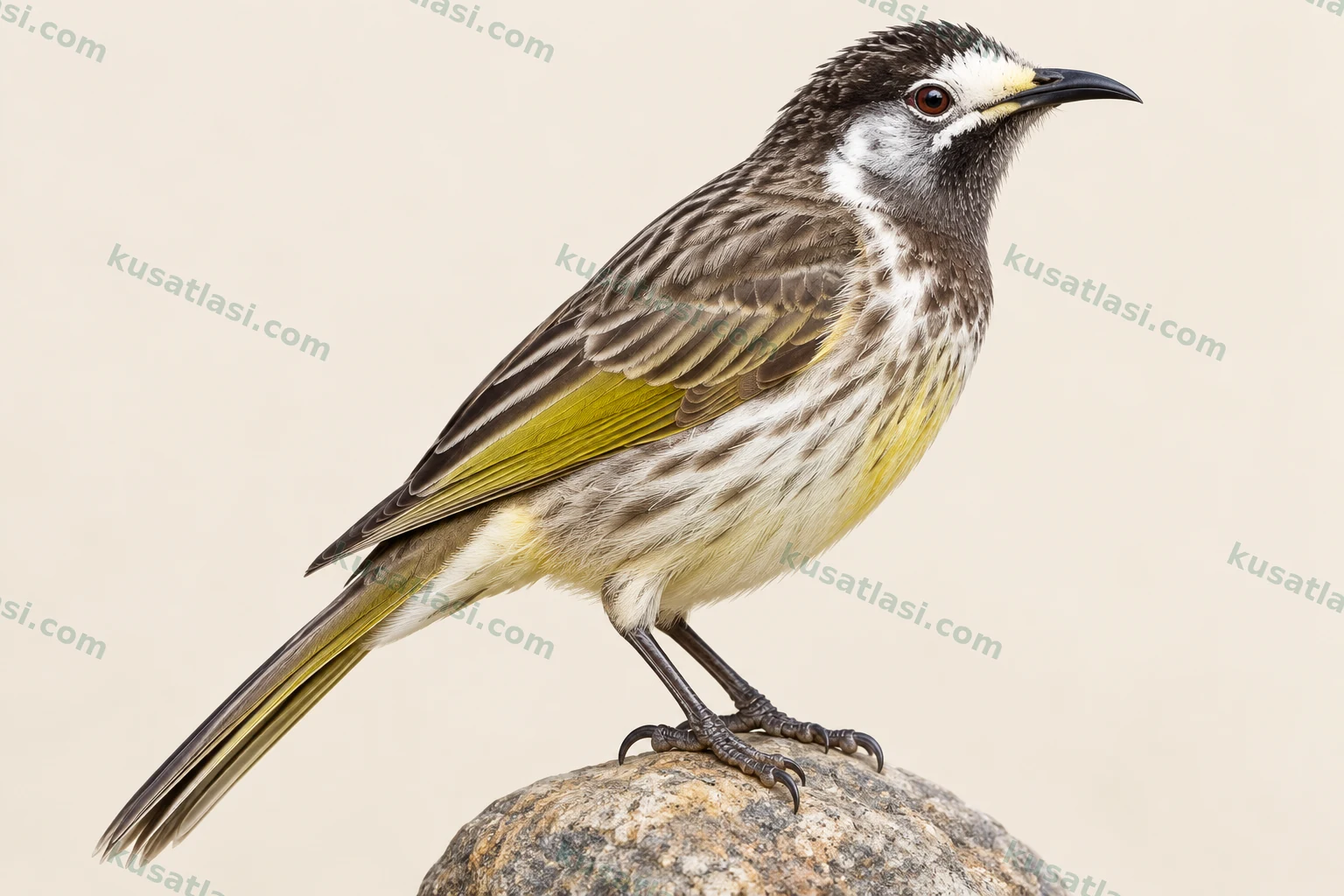
A mobile honeyeater of Australia’s arid scrub and woodland, recognised by its pale forehead and face line, grey cheek, dark breast and yellow wing area.
Biometrics
Length
Male13–19 cm
Female13–19 cm
Shared species value
Wing length
Male8.07 cm
Female8.07 cm
Shared species value
Weight
Male15–22 g
Female12–19 g
White-fronted Honeyeater
Western and southern inland Australia; irregular visits to central-western QueenslandObservation guide in its natural range
Look for three features together
Do not rely on a single featurePale forehead and face line; silvery-grey cheek and long curved bill.
Dark throat and breast, white belly; yellow edges on brown wings.
Flower nectar and small animals; movements linked to food resources.
Compare male and female
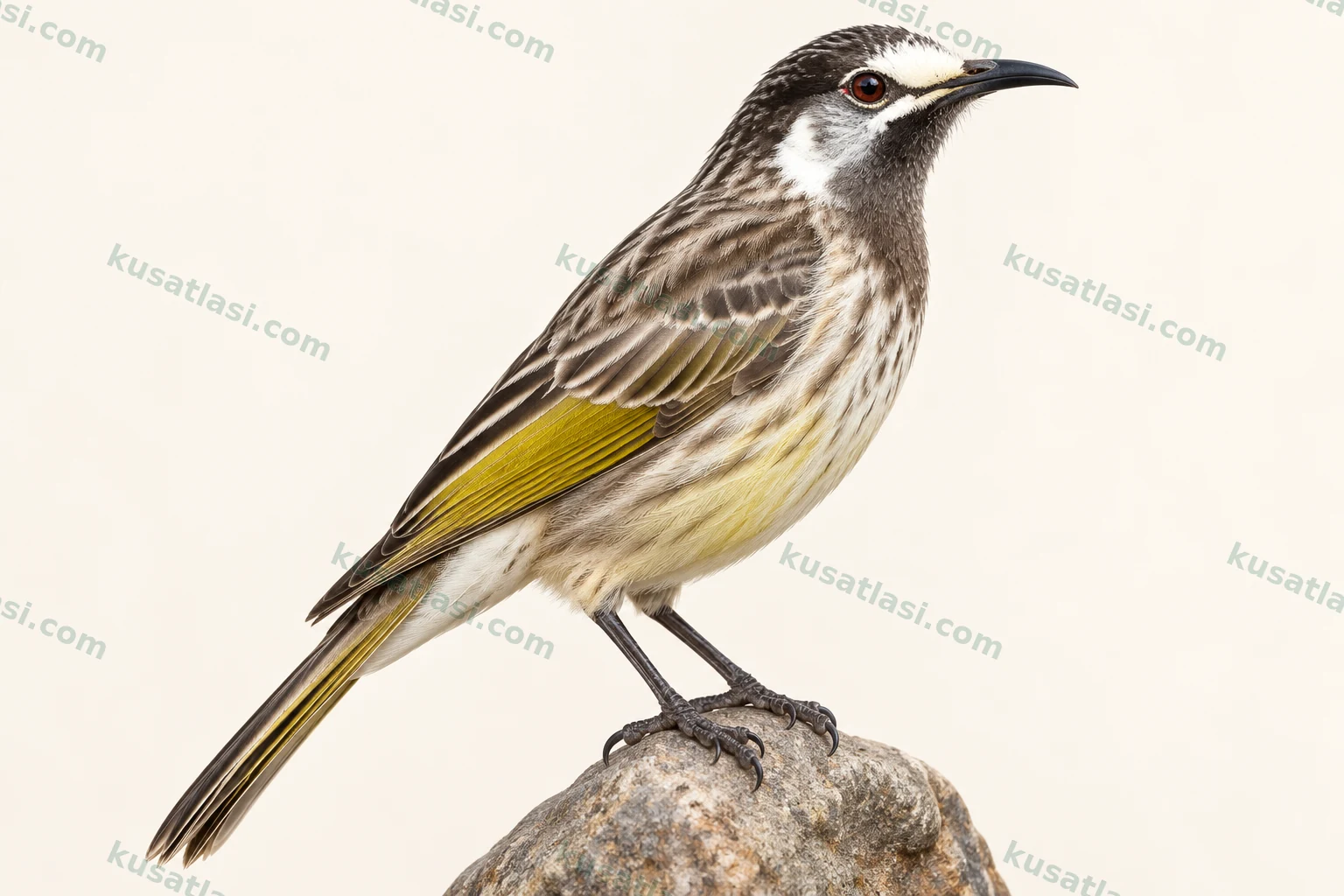 FemaleMale
The plumage pattern is similar in both sexes. Males are generally larger, but measurements overlap; young have paler head and throat and darker eyes.
Where to look in its natural range?
Look in flowering eucalypts and shrubs in arid woodland, checking the white-grey head pattern.
This mobile species follows flowering. The general breeding season and local young-bird record are shown separately.
January
Nomadic with local movements; no single fixed distant migration route has been verified. No verified regional date specific to this month was provided; this does not mean local absence.
February
Nomadic with local movements; no single fixed distant migration route has been verified. No verified regional date specific to this month was provided; this does not mean local absence.
March
Nomadic with local movements; no single fixed distant migration route has been verified. No verified regional date specific to this month was provided; this does not mean local absence.
April
Nomadic with local movements; no single fixed distant migration route has been verified. No verified regional date specific to this month was provided; this does not mean local absence.
May
Nomadic with local movements; no single fixed distant migration route has been verified. No verified regional date specific to this month was provided; this does not mean local absence.
June
Nomadic with local movements; no single fixed distant migration route has been verified. No verified regional date specific to this month was provided; this does not mean local absence.
July
Nomadic with local movements; no single fixed distant migration route has been verified. Around Welford, Queensland — 2019: newly fledged young were seen; one local breeding record.
August
Nomadic with local movements; no single fixed distant migration route has been verified. Australia — general period in the specialist account: general breeding period, which may vary with local conditions.
September
Nomadic with local movements; no single fixed distant migration route has been verified. Australia — general period in the specialist account: general breeding period, which may vary with local conditions.
October
Nomadic with local movements; no single fixed distant migration route has been verified. Australia — general period in the specialist account: general breeding period, which may vary with local conditions.
November
Nomadic with local movements; no single fixed distant migration route has been verified. Australia — general period in the specialist account: general breeding period, which may vary with local conditions.
December
Nomadic with local movements; no single fixed distant migration route has been verified. No verified regional date specific to this month was provided; this does not mean local absence.
Nest, egg and incubation
The female builds an open cup in a low shrub, on a stump or in a spinifex tussock. The specialist compilation gives 1–3 eggs and about 13 days of incubation from the last egg. Both parents feed young; nest-departure duration was not verified.
Calls are sharp and metallic, with more melodic sequences; it may be noisy during breeding.
Do not play recordings to attract birds; observe quietly, especially near nests.
Species information
Quick identification
White-fronted Honeyeater Purnella albifrons is a small honeyeater using flowering shrubs and trees in arid and semi-arid inland Australia. Pale forehead and a white face line extending backwards from beneath the bill, silvery-grey cheek, dark throat and upper breast, and yellow-edged brown wings are identified together. The belly is white, with possible dark flank streaks. Its long downcurved bill suits nectar feeding. This facial arrangement and division of dark and pale underparts are more reliable than a white head patch alone.
It may occur alone, in pairs or with other honeyeaters at a flowering eucalypt. Not all birds together are one species. Seeing the head’s side, bill shape and eye region gives more information than a yellow wing glimpsed in rapid flight. Nomadic movements may produce many birds at a site and none on a later visit; this variability makes plumage as well as geography important in identification.
General appearance and posture
The upperparts range from dark brown to almost black. Pale tips on head and nape feathers form little spots and fine lines. The rump may show rufous streaks on brown. Yellow wing areas relate to dark feathers’ edges; a yellow wing does not make the whole bird yellow. The undertail is grey-brown. Pale spots occur within the dark throat and upper breast; posture may partly hide their boundary with the white belly.
The eye is reddish brown. A small pink-red bare skin patch behind it must not be confused with the eye itself. White around the grey cheek contrasts with the dark head. Bill is black and feet grey. Forehead white stands out from the front, while a side view better shows grey cheek and pale line. Pollen may temporarily adhere to head feathers; such material is not mistaken for a permanent yellow head pattern.
Males, females and young birds
Adult males and females share the basic plumage. Males are generally larger, but measurement ranges overlap. Not every apparently large bird is called male after a brief view. White forehead, grey cheek, dark breast and yellow wing occur in both; expecting opposite colours would cause errors. Two adults bringing nest food fit care by both sexes, but a parent’s sex is not labelled certainly from its role without separate verification.
Young have a less sharply defined face and paler overall appearance. The ABSA guide describes a brown juvenile head and nape, off-white forehead and pale grey-brown chin and throat. The eye is dark brown; pale fleshy gape edges may also help assess youth. Brown and black head feathers mix as age advances. A bird not yet acquiring the adult’s darker throat is not another honeyeater merely for that difference.
Moult also contributes to age assessment. Juvenile appearance changes in the first months after nest departure, while some old flight and tail feathers may remain. Detailed age categories were developed for birds examined in the hand; one distant head patch cannot yield exact age in months. Head colour, wing-feather appearance, pale gape and behaviour are assessed together. Catching birds for identification or approaching a nest to watch young develop is unnecessary.
Appearance in flight
It moves rapidly between flowers, making short foraging flights around trees and shrubs. Aerial insect capture is also documented. The Great Western Woodlands study in Western Australia found this prominent among its animal-prey capture movements. This corrects an impression of nectar-only feeding; not every flight is long-distance migration.
Dark wings and yellow feather edges may draw attention in flight. From below, a warm pale underwing area and greyer trailing edge may be visible; sideways, white belly and dark breast can be seen. Other yellow-winged honeyeaters visit the same flowering trees. Seeing the white-grey-dark face pattern again after landing helps confirm identification. A newly flying young bird’s short low flight does not represent normal adult movement ability.
Voice and behaviour
Its voice includes sharp, metallic short notes and more melodic sequences. It may be noisier when breeding. Different honeyeaters’ calls overlap at the same tree; voice helps locate a bird but is matched to its appearance. Solitary and paired feeding may coexist with mixed gatherings during strong flowering. It also defends food; chasing another bird does not establish permanent hostility between two species.
Variation in flowering through space and time is important to its mobile life. Repeated Bungalbin counts missed it on some visits and recorded it frequently or very frequently when present. This field result does not track where the same birds went, but shows the difficulty of determining a permanent local population in one day. Feeding in a flowering tree does not prove every nearby shrub is a nesting site.
Similar species
1. New Holland Honeyeater Phylidonyris novaehollandiae may be confused because of dark-and-pale body pattern and yellow wing areas. Its adult white eye and small white ear patch matter. White-fronted Honeyeater has a reddish-brown eye, silvery-grey cheek and differently arranged pale forehead and face line. Young New Holland Honeyeaters may have grey eyes; the whole head is compared instead of relying on eye colour alone.
World distribution
It is endemic to Australia. Main areas are arid and semi-arid woodland and scrub in Western Australia, South Australia and western inland New South Wales and Victoria. Scattered records occur in parts of the Northern Territory. Tropical north and humid eastern forests are not core range, nor is Tasmania part of its natural area. It may also occur near southern semi-arid coasts, for example around the Great Australian Bight.
Status within the natural range
The current global category is Least Concern. A 2021 field compilation for central-western Queensland shows irregular but repeated visits and occasional breeding where older accounts treated it as a very rare visitor. Newly fledged young were recorded around Welford in July 2019. This supports breeding at a particular place and time, not continuous year-round breeding across all Queensland.
Movements and migration
It is highly mobile with flowering, nomadic in some regions and more consistently present in others. Movements linked to changing food distribution predominate over a regular intercontinental round trip. Bungalbin visits over several years documented strongly varying local frequency. Increased observer activity may contribute to more Queensland records; more records alone do not measure range expansion. Map sample points and environmental predictions do not show every area occupied in the same season.
Breeding habitat
Mallee scrub of small multistemmed eucalypts, acacia communities and arid open woodland are principal habitats. Flowering trees supply food; low dense cover may provide nests. Roadside or garden sightings do not make it a bird living only in settlements. The compiled general breeding period is August–November, with records outside it in suitable local conditions. Welford’s July 2019 fledgling record is a concrete example of flexibility.
Nest site
The female may build an open cup in a low shrub, on a stump or in a spinifex tussock of stiff-leaved grass. Materials include grass, bark pieces, fine stems and spider silk; softer plant and animal materials line the inside. The foreign specialist compilation reports 1–3 eggs and about 13 days of incubation from the last egg. The female incubates and both parents feed young. No securely verified nest-departure day count is supplied here.
Daily habitat use
It visits flowering trees and shrubs and also seeks insects in the same cover. Non-nectar foraging methods varied among sites in the Great Western Woodlands study. One flower species or height therefore does not define all its habitat. The specialist account records an adult standing over young to shade them in hot weather. Do not approach to see this and interrupt shade or care. Watch from an existing gap at a distance rather than opening vegetation for a photograph.
What does it eat?
Flower nectar is important. It uses eucalypts and various shrubs and also takes insects, spiders and sometimes insects’ sugary secretions. The Queensland field account records feeding at Eremophila and other local plants. Distinguishing nectar from little animals at a visited flower is not always easy; a record assessed as probable nectar is not presented as a directly measured amount.
How does it forage?
It inserts its long curved bill into a flower for nectar and moves to another. It may glean small animals from leaves and catch insects in flight. The Great Western Woodlands spring study shows the importance of aerial capture in non-nectar foraging, not an unchanging year-round dietary percentage. South Australian experiments measured pollen picked up by head feathers being transferred to another flower. Feeding rate and pollen quantity are separate measures; rapid nectar consumption does not automatically mean more pollination.
A good floral fit is not one measure of success
The South Australian study published in 2025 compared three species, including White-fronted Honeyeater, at natural Eremophila maculata flowers. Pollen acquired on head feathers and deposited on the next flower were measured separately, and nectar-taking rate was recorded. Bill–flower fit was related to pollen deposition but not in the same way to feeding efficiency. A bird’s contribution to a plant cannot be reduced to how fast it feeds.
The experiment included eight adults of this species; the result is not an immutable ranking for all plants and Australia. More pollen deposited is not directly measured greater seed production either. The work’s strength is measurable separation of two apparently similar processes: bird feeding and plant pollen transport.
One visit may not explain local frequency
At Bungalbin, the bird was absent from some field visits and very frequent in the same area on others. This matters in a mobile flowering-linked species. Returning in different periods reveals more than treating a quiet day as permanent absence. Repeated records are nevertheless not marked-individual journeys; exact departure and arrival points cannot be inferred for every change.
A young-bird record may change range knowledge
Newly fledged birds around Welford in July 2019 provide concrete evidence of at least occasional Queensland breeding. Seeing adults and seeing newly fledged young are different levels of evidence. Reconstructing laying time from development periods differs from directly observing egg dates. The event safely displayed in the local calendar is therefore the July young-bird record.