

World Birds IUCN statusLC · Least ConcernGlobal IUCN category. BirdLife v10 (2025); taxon matching: AviList 2026 / IOC 15.2; checked: 29.10.2026. The list year is not the species assessment date. Source and method · BirdLife OrderPasseriformesPerching birds FamilyAcanthizidaeAcanthizidae
White-throated Gerygone
Gerygone olivacea
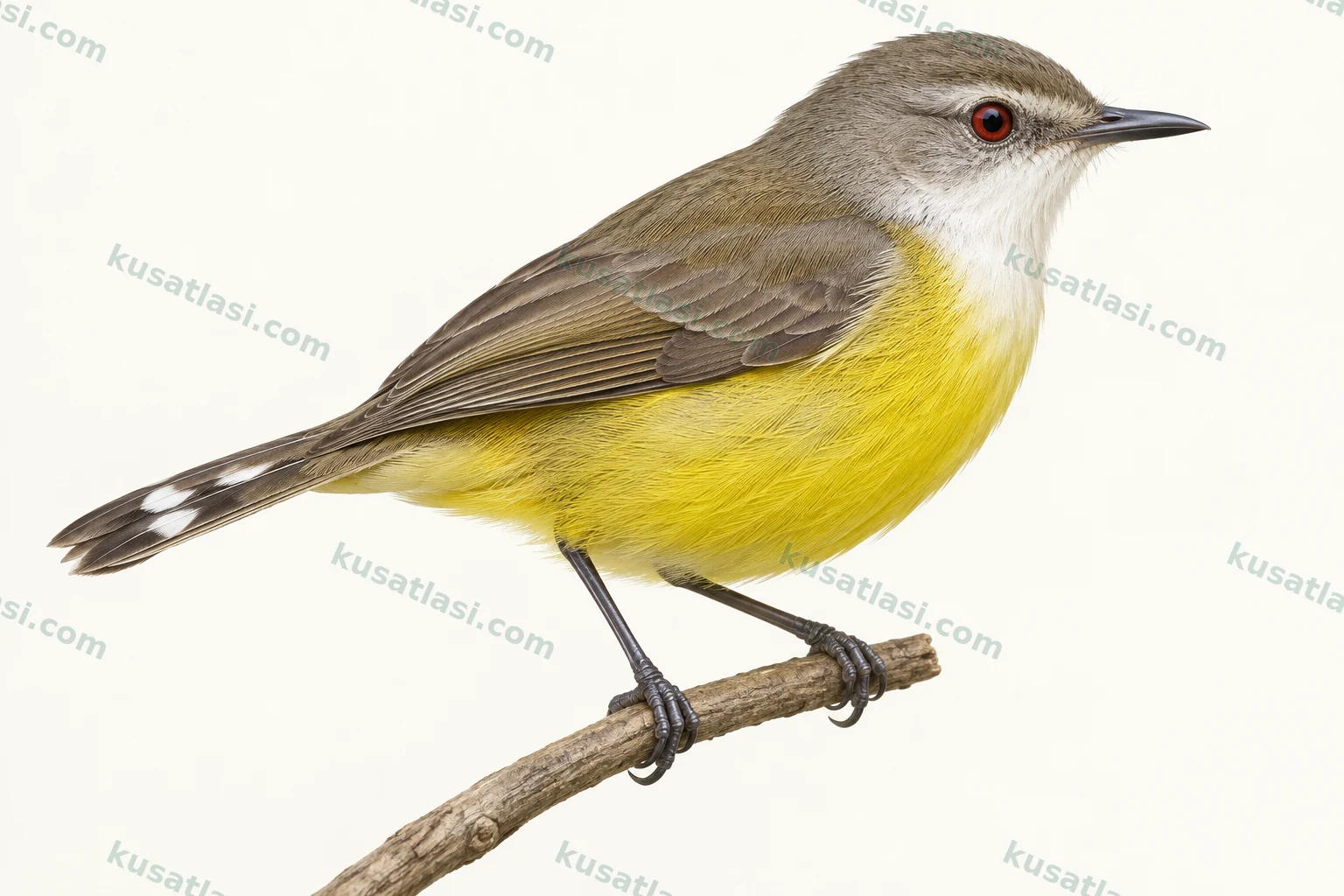
Olive-brown upperparts, a white adult throat, a yellow body and white tail marks. Adults have red eyes. A young bird can have a yellow throat.
Biometrics
Length
Male9–12 cm
Female9–12 cm
Shared species value
Wing length
Male5.65 cm
Female5.65 cm
Shared species value
Weight
Male5.5–8.5 g
Female7.7 g
Male weight is the published range for G. o. olivacea in eastern Australia. The female measurement has a separate source.
White-throated Gerygone
Eastern and northern Australia and southeastern New GuineaObservation guide in its natural range
Look for three features together
Do not rely on a single featureIt is white in adults and can be yellow in young birds. A yellow throat does not identify a female.
The outer feathers have white marks that a closed tail can hide.
Look for a slender dark bill, olive-brown upperparts and yellow underparts.
Compare male and female
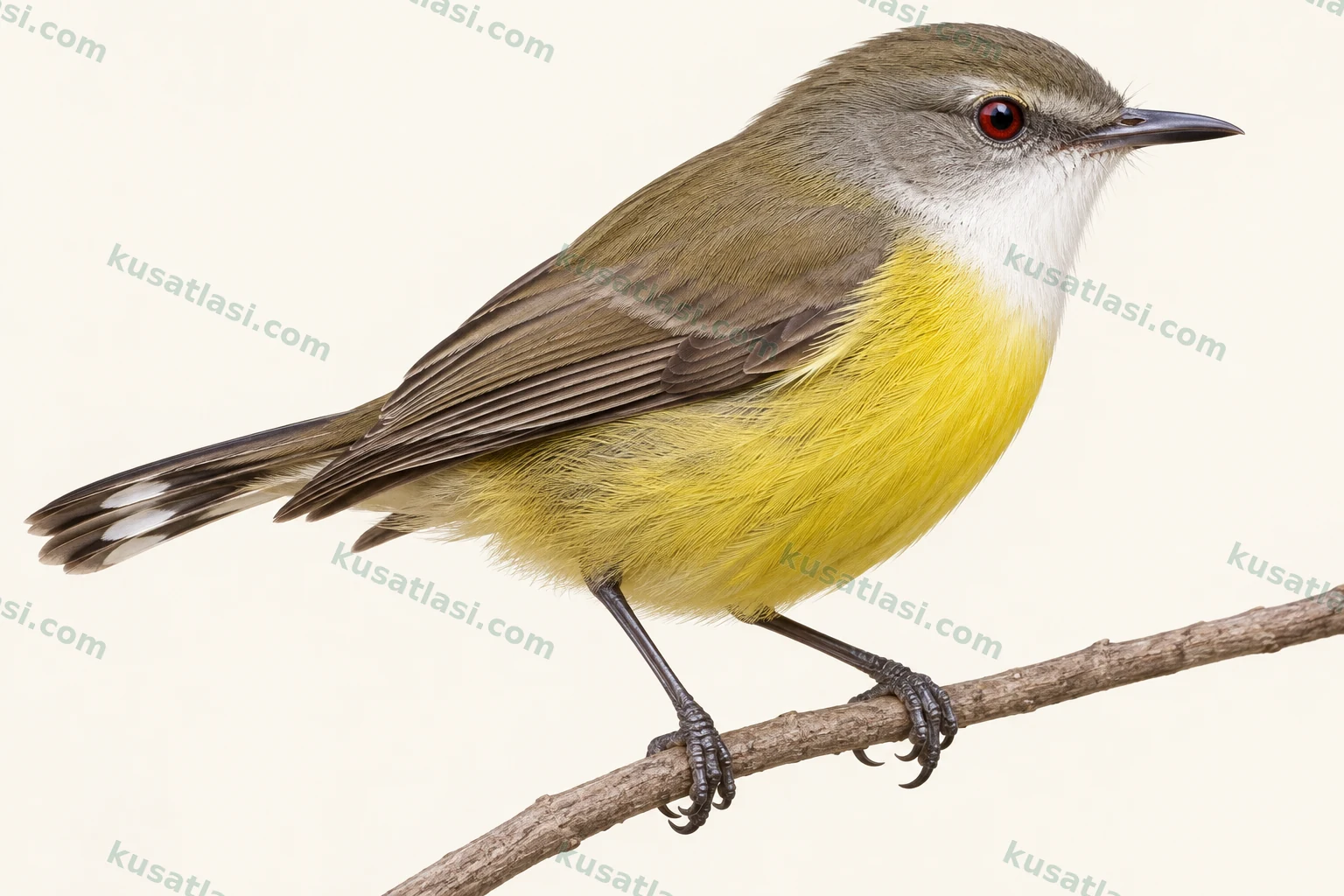 FemaleMale
Adult males and females look alike. Young birds have a yellow throat. Appearance does not reliably distinguish the sexes.
Where to look in its natural range?
Look in open eucalypt forest, woodland and vegetation along waterways.
A general breeding summary for the south gives September–November. Breeding lasts longer in the north. The December eggs from Mernot are a separate regional record.
January
It is resident in the north and partly migratory in the south. Southern populations may move north in winter. No verified regional date was provided for this month. This does not mean the species is locally absent.
February
It is resident in the north and partly migratory in the south. Southern populations may move north in winter. No verified regional date was provided for this month. This does not mean the species is locally absent.
March
It is resident in the north and partly migratory in the south. Southern populations may move north in winter. No verified regional date was provided for this month. This does not mean the species is locally absent.
April
It is resident in the north and partly migratory in the south. Southern populations may move north in winter. No verified regional date was provided for this month. This does not mean the species is locally absent.
May
It is resident in the north and partly migratory in the south. Southern populations may move north in winter. No verified regional date was provided for this month. This does not mean the species is locally absent.
June
It is resident in the north and partly migratory in the south. Southern populations may move north in winter. No verified regional date was provided for this month. This does not mean the species is locally absent.
July
It is resident in the north and partly migratory in the south. Southern populations may move north in winter. No verified regional date was provided for this month. This does not mean the species is locally absent.
August
It is resident in the north and partly migratory in the south. Southern populations may move north in winter. No verified regional date was provided for this month. This does not mean the species is locally absent.
September
It is resident in the north and partly migratory in the south. Southern populations may move north in winter. The specialist account gives this general breeding period for the southern natural range.
October
It is resident in the north and partly migratory in the south. Southern populations may move north in winter. The specialist account gives this general breeding period for the southern natural range.
November
It is resident in the north and partly migratory in the south. Southern populations may move north in winter. The specialist account gives this general breeding period for the southern natural range.
December
It is resident in the north and partly migratory in the south. Southern populations may move north in winter. The Mernot museum record from 1929 documents a clutch of three eggs. It does not provide a calendar for the entire continent.
Nest, egg and incubation
North's historical museum account describes a nest suspended from a branch, made with bark, grasses and spider silk, with a side entrance. It reports clutches of three eggs. The 1929 Mernot museum record also has three eggs. Incubation duration and days to first flight from the nest have not been verified.
The song is a flowing, descending sequence.
Do not play recordings to attract birds; observe quietly, especially near nests.
Species information
Quick identification
The White-throated Gerygone Gerygone olivacea is a small tree-dwelling bird with a slender bill. Olive-brown upperparts contrast with a white throat and vivid yellow body. Assess the adult's red eye, the small pale spot above the base of the bill and the white tail marks together. A white throat alone is insufficient. In a young bird this area can be yellow. Naming a yellow bird glimpsed among leaves by body colour alone can be misleading.
The current English name is White-throated Gerygone and the scientific name is Gerygone olivacea. The bird described in Gould's old account as Gerygone albogularis belongs to the same naming history. The name olivaceus was initially associated with the juvenile appearance. Those historical names are not read as a separate species represented by an adult female. The current classification places the species in Acanthizidae. The broader family placement used on older museum pages is not carried over into current taxonomy.
General appearance and posture
The crown, sides of the head, back and folded wing look olive-brown overall. The plumage does not form a broad glossy black cap or a conspicuous crest. The slender bill is dark and looks in proportion to the small head. Turning the head can make the bill look shorter in a photo. One front view does not allow a reliable comparison with a similar bird with a thicker bill.
The adult's throat is white and the breast and underparts are distinctly lemon yellow. The boundary between throat and breast can be partly hidden when the neck bends. Light reflected from the yellow body may make the white throat look yellowish. Do not confuse that effect with real juvenile plumage. Do not assign a definite age from a narrow shadowed view without seeing the front of the neck from another angle.
In Gould's detailed description, the two central tail feathers are brown. The outer feathers show a white area, a broader dark brown area alongside it and pale colour at some tips. The whole tail is not simply white, nor is white confined to its very tip. Overlapping feathers conceal parts of the marks when the tail is closed. The pattern of the outer feathers can be clearer when it spreads.
The red eye is a useful adult feature. If the eye is too small to see in a distant image, assess the throat, body and tail together rather than searching for a red dot. The bill and feet look dark. The historical account describes variation in foot colour among specimens. No single foot colour is therefore required for identification.
The bird moves agilely among small leafy branches. Gould's observations from the Upper Hunter describe it foraging at different heights from low saplings to tall trees. Turning the head and body at different angles among leaves is a normal foraging posture. A brief perch does not make the same branch a nest site.
A small apparent size difference in a photograph does not establish a bird's sex.
Males, females and young birds
Adult males and females have similar plumage patterns. A white throat does not identify a male and a yellow throat does not identify a female. Gould also noted that the adult sexes are largely alike. The banding account says that appearance or size does not reliably distinguish the sexes. Two adult plates can show different individuals without implying a scientifically unverified female colour pattern.
In young birds, the throat is yellow like the breast. The banding account reports that the eye can be browner, the gape pale and the base of the lower mandible pinkish brown. These age clues can be seen in good light. They do not establish a precise ageing schedule for every individual. A bird whose white throat is not fully developed can be more easily confused with other yellow gerygones.
A developing bird can retain patches of pale yellow feathers on its throat. The change to adult appearance does not mean that every feather and the eye change together. Mixed pale and yellow throat colours in a photograph do not indicate a separate subspecies or a female. Consider the throat, eye, bill and tail together when assessing age and leave uncertain images unresolved.
Appearance in flight
The small body, dark flight feathers and pale marks at the sides of the tail can be visible as it moves between branches. A fleeting view of the yellow underside is insufficient. Seeing the bird again after it lands strengthens the identification. White tail markings do not mean the whole wing is white. Motion views of very similar small birds do not replace examination of the head and throat.
Voice and behaviour
Specialist accounts describe a flowing series of notes that descend in pitch. Gould's own observations also describe active birds calling regularly among leaves. The historical author's opinion of the sound's beauty is not an identification criterion. Rhythm and the appearance of the bird making the sound matter more. Song can be easier to notice in the breeding period. A silent individual does not establish that the species is absent from the area.
Similar species
The Fairy Gerygone Gerygone palpebrosa can be confused particularly with a young White-throated Gerygone that lacks a white throat. Cornell's comparison emphasises the latter's white tail marks, which the Fairy Gerygone lacks. As a closed tail can hide the marks, do not decide from a single view of the throat.
Compare the Western Gerygone Gerygone fusca by its paler, non-yellow underparts. Look together for the White-throated Gerygone's conspicuous yellow body, white throat and tail pattern. This is a comparison with the present-day Western Gerygone's appearance. Historical nesting or development times from different gerygones are not transferred to this species.
Global range
Eastern and northern Australia make up the main natural range. The nominate subspecies extends from northeastern Queensland to New South Wales and eastern Victoria, and also to the Mount Lofty area. Rogersi ranges from the Kimberley in the northwest to northwestern Queensland. Cinerascens is associated with northern Cape York and southeastern New Guinea. These geographical forms do not mean that all of the Australian interior is used to the same extent.
Status within its natural range
The species is not endemic to Australia. Southeastern New Guinea is included in the natural range in the current taxonomy and banding account. The general mapped area is checked against that geography. Colouring an entire country does not show suitable forest habitat or breeding everywhere. Mountains, extensive arid inland areas and other islands are not included simply because they appear in the same map view. Observation records and overall distribution are read separately.
Movements and migration
The specialist museum account describes it as resident in the north and partly migratory in the south. The current taxonomic summary also says that southern populations move north in winter. This does not show that all birds travel the same distance on the same day and along the same line. Gould's old description of residency does not determine movements across the present range. Without verified tracking data, no route linking specific towns is drawn. Overall range and regional seasonal information are presented separately.
Breeding habitat
The specialist museum account lists open eucalypt forests, woodlands and vegetation along waterways. Gould's Upper Hunter observations also describe an association with eucalypts. This preference does not mean every wooded patch has the same nest density. Leaf cover and small branches provide places to look for food each day.
Nest site
In North's original museum catalogue, the nest is an oval structure with a side entrance, suspended from a slender branch. It is made of bark and grasses bound together with spider silk. North reported clutches of three eggs. A Museums Victoria clutch from Mernot dated 19 December 1929 also documents three eggs. A single clutch does not give a fixed egg count for all nests. Species-specific incubation duration and days to first flight from the nest could not be verified. Durations from other gerygones are not used.
Daily use of habitat
The bird forages on small leafy branches of low saplings and tall trees. An individual looking for food need not be close to a nest. Do not touch the hanging nest, bend the branch or remove cover to see the nest. Stay at a distance that allows natural behaviour to continue. A museum egg record is not a reason to collect new eggs.
What does it eat?
Gould's field account describes insects as the main food. The modern museum account also says the bird takes insects and other small arthropods in trees. These animals are not interpreted as a food preference linked to vivid yellow plumage. The general diet accounts are not experiments measuring food weights or precise proportions in each season. Do not assign an insect name if the group cannot be distinguished in the image.
How does it forage?
It moves among fine leafy branches looking for small food items. Gould mentions both low saplings and very tall trees in the same field account. This shows that feeding is not confined to a fixed height. A movement of the bill by a perched bird does not always mean it caught prey. Small prey may be hidden behind a leaf. Record only the movement actually seen. A detailed account of aerial insect catching by the related Western Gerygone is not turned into a measured prey rate for this bird because they look alike.
Two historical names reflected different ages
In Gould's historical naming, olivaceus was associated with the yellow-throated juvenile appearance and albogularis with the white-throated bird. Current taxonomy does not apply these names to separate adult sexes. Finding two names in an old book does not establish two living species. Age-related changes also matter when reading the history of the names.
The tail pattern is more than a white tip
The historical description treats the two central tail feathers separately from the outer feathers. White, dark and pale tip areas can occur at different positions on the same feather. A closed tail hides part of this arrangement. Assess the full pattern revealed when the tail spreads instead of relying on one white dot seen from far away.
A young bird can resemble another species
A young bird without a white throat is more easily confused with other small yellow birds in the same surroundings. The age-related change of throat colour shows why looking only at an adult illustration may not suffice. Adult males and females look alike, so a yellow throat cannot identify a female.
Dated eggs provide regional evidence
The three eggs and December date of the Mernot museum clutch are evidence of breeding at a specific place. Records can fall outside the general September–November southern breeding summary. The date alone does not show that the species breeds in December across the whole continent. Keep the location, year and kind of event together.
A small bird uses different heights in trees
Gould's observations of foraging include low saplings and the tallest trees. A small body does not imply a life close to the ground. It helps to examine the canopy when looking for the bird. The account does not show that it spends equal time or finds the same amount of prey at all heights.