

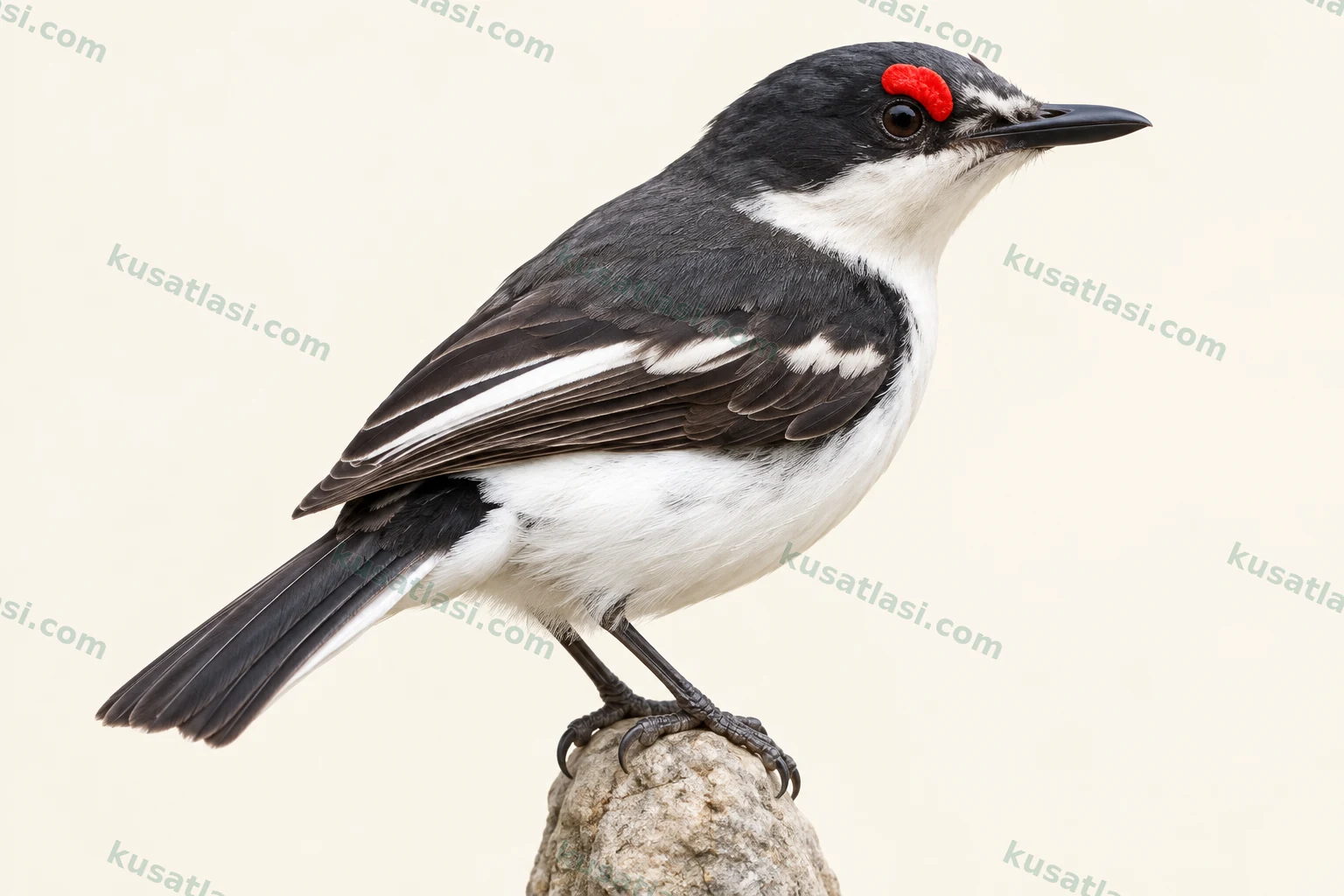
World Birds IUCN statusNT · Near ThreatenedGlobal IUCN. BirdLife v10 (2025); taxon matching AviList 2026 / IOC 15.2; checked: 29.10.2026. The list year is not the species’ assessment date. Source and method · BirdLife OrderPasseriformesPasserines FamilyPlatysteiridaePlatysteiridae
White-fronted Wattle-eye
Platysteira albifrons
A small red-wattled passerine of dry scrub in western Angola and adjacent southwestern Democratic Republic of the Congo; males have a black breast band, females white underparts.
Biometrics
Length
Male13 cm
Female13 cm
Shared species value
Wing length
Male6.09 cm
Female6.09 cm
Shared species value
Weight
Male11.7–12.6 g
Female11.7–12.6 g
Shared species value
White-fronted Wattle-eye
Western Angola and adjacent southwestern Democratic Republic of the CongoObservation guide in its natural range
Look for three features together
Do not rely on a single featureNarrow white forehead line and red eye wattle.
A white band, assessed with the head and breast.
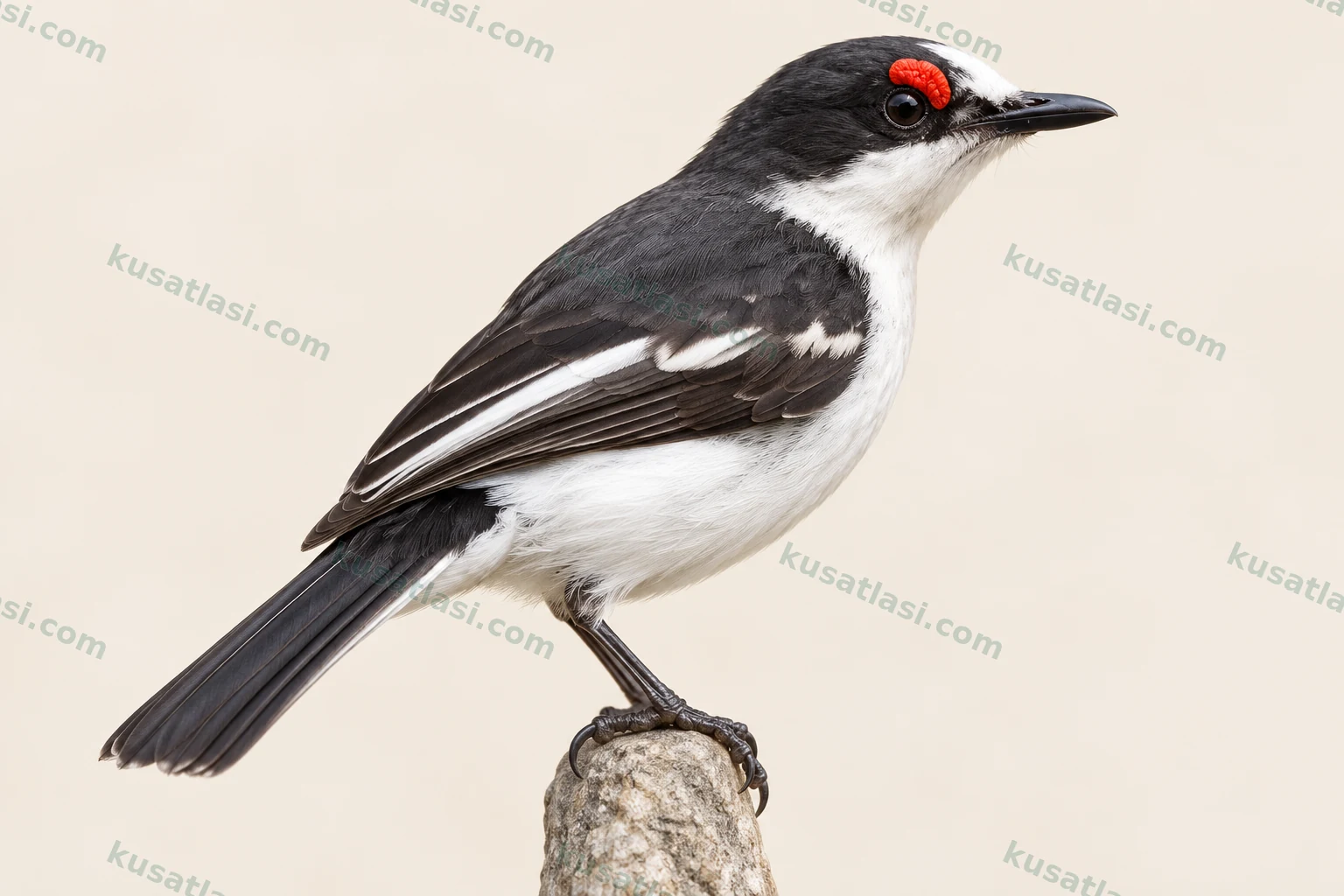
The male has a black breast band; the female has continuously white underparts.
Compare male and female
 FemaleMale
The male has a black breast band and dark-grey upperparts; the female has white underparts and paler-grey upperparts. Young birds are browner and lack the conspicuous eye wattle.
Resident species; the exact egg-laying season has not been verified.
All months: Essentially resident. Dated song records are not breeding evidence. No verified regional date specific to this month was given; this does not mean local absence.
January
February
March
April
May
June
July
August
September
October
November
December
Nest, egg and incubation
Species-specific nest structure, typical egg number, incubation duration and age at first flight could not be verified. August–October in the 2018 specialist guide is only a possibility.
A slightly rough two-part whistle, more melodious whistles and harsh calls; in some duets the female joins with a softer reply.
Do not play recordings to attract birds; observe quietly, especially near nests.
Species information
Quick identification
White-fronted Wattle-eye Platysteira albifrons is a small passerine to look for in dense scrub and riverside woodland of western Angola. Its plump body, short movements within cover and red fleshy growth above the eye attract attention. A narrow white forehead line and white wing band complete the dark-and-pale body pattern. These two white marks are different; seeing only the wing band when the head is hidden behind the wing does not establish identification.
The breasts of males and females are considered separately when identifying the species. The adult male has a black breast band, whereas the female has continuously white underparts. A bird whose breast band is not seen is not necessarily another species. First examine head, wing and back in good light, then consider sex differences. Because the red eye wattle is not exclusive to this species, it is not used as a diagnostic mark alone.
General appearance and posture
The adult male’s upperparts are dark grey. The dark head makes the white forehead line visible; a pale line between bill and eye also helps at close range. The forehead mark is not a broad raised crest. Short neck and compact body may suggest small flycatchers when the bird stands on a thin branch, but the combination of red eye wattle and wing band is different.
The bill looks short and pointed, suited to catching small prey. Turning the head sideways can change the apparent width of the white in front of the eye in a photograph. Leaf shadows falling across feathers can also make a continuous line look broken. Comparing several frontal and side views of the head is more reliable than the play of light in a single frame.
The bird is expected to be noticed in the middle levels of cover. The wing band and breast pattern can be examined while it appears briefly on a branch; its next movement may take it behind leaves. A short disappearance does not show that it has left the area. Rather than entering the scrub, an observer can wait in place for a second view.
Males, females and young birds
The female looks paler grey above and entirely white below. Seeing the front of the breast is therefore valuable for distinguishing adult sexes. A bird seen only from behind is not assigned a definite sex from a small difference in back tone. Light and feather condition change grey; seeing the male’s breast band or the female’s continuously pale underparts provides stronger support.
Young birds are browner and have not yet developed the adults’ conspicuous eye wattle. A young bird should therefore not be sought with every adult male mark. Age assessment does not rely only on failure to see red around the eye; the face may be shaded. The bird’s own wing pattern, body colour and whether it accompanies adults are recorded together. A detailed moult calendar has not been sufficiently verified.
Two birds nearby are not evidence of a nest there. The species may be seen in pairs, and reciprocal singing by partners is directly documented. Hearing song and seeing eggs, chicks or food carrying are different observations. For this little-known breeder, no number describing a care stage is calculated merely from the presence of a pair.
Appearance in flight
Rather than a bird watched for long periods in open sky, it moves over short distances within cover. Its white wing line may be noticed crossing a gap; breast and forehead are easier to examine after it lands. A momentary black-and-white wing also occurs in other wattle-eyes, so another view of the head is awaited. Following where the bird lands makes it easier to complete identification.
Wing angle and distance in a photograph may make the bird look larger or smaller than it is. A species’ daily migration distance cannot be inferred from wing shape.
Voice and behaviour
Researchers examining field recordings from 2003 recorded a two-part, slightly rough whistle and more melodious whistles from males. In some duets the female followed the male about half a second later with a softer reply. This interval is an observation from a study of three pairs, not an unchanging schedule for every pair. Harsh, buzzing and clicking calls are also included in the specialist species account.
In dense scrub, sound can direct attention towards a bird. Other wattle-eyes nevertheless have similar whistles. Vegetation at the sound’s source and the visible bird’s head and breast pattern are assessed together. The specialist Angola guide describes the species as sometimes quiet and inconspicuous; not hearing song does not prove local absence.
Similar species
The male Brown-throated Wattle-eye Platysteira cyanea has a similar black-and-white pattern but darker upperparts. Its female’s brown throat is compared with White-fronted Wattle-eye’s white female underparts. Melodious sounds and duets can resemble each other in the two species, so whistles alone do not separate them.
Black-throated Wattle-eye Platysteira peltata may occur in some of the same areas. The presence of white forehead and wing band, greyness of the upperparts and female throat pattern are used together. A black breast band alone is insufficient. Small black-and-white passerines such as Angola Batis Batis minulla can also mislead through body pattern; actually seeing the red eye wattle provides important support.
World distribution
The principal geography is the coastal lowlands and parallel escarpment belt of western Angola. Dated Angolan studies name scattered places from Soyo at the Congo River mouth in the north to around Gungo in the south. Current AviList and the Cornell species account also include adjacent southwestern Democratic Republic of the Congo in the natural range. The present range should therefore not be cut off at Angola’s border solely from an old list of Angolan endemics.
Status within its natural range
The conservation category is Near Threatened. It is irregularly distributed among suitable patches of cover in western Angola; a continuous population along the entire coast is not expected. Field research in 2005 showed an association particularly with drier forest and scrub. That study did not provide a census of the whole region. No verified single current world population figure was found.
Direct specialist records exist from Conda, Bango and around the Longa River. Kissama National Park and Bimbe are named as observation areas in the Angola guide. A historical record at a place does not guarantee a sighting on the day of a visit. Scrub clearance for farming and charcoal production is important in assessing habitat loss.
Migration and movements
Specialist accounts consider the species essentially resident. No seasonal intercontinental route or regular distant wintering ground is shown. Pairs moving within cover and migration are different behaviours. Recordings from February and October do not prove egg laying in those months. A verified regional egg-laying calendar has not yet been found.
Breeding habitat
It lives in dry scrub, forest edges, riverside gallery forest and around mangroves. Direct Angolan research recorded it in Croton scrub beside the Longa and secondary cover near Conda and Bango. These places do not all have equal moisture, tree height or land use. The wettest tall-trunked forest should not be considered the best habitat everywhere; the species is also associated with drier dense cover.
Nest site
Species-specific nest structure, usual egg number, incubation duration and age at first flight could not be verified. Mills’s specialist guide of 2018 likewise notes the lack of a definite breeding record and gives August–October as an estimate. That estimate is not entered in the calendar as a confirmed egg-laying season. The small cup nests and durations of other wattle-eyes do not replace confirmed values for this species.
Daily use of space
A bird seeking small prey in the middle layer of cover appears briefly between branches and leaves. The boundary between dense scrub and more open trees makes distant observation easier. In the 2010 study, different vegetation types in the same escarpment belt held different bird communities. Conserving only the tallest forest is insufficient; dry patches of cover on the coastal plain also have value.
What does it eat?
It feeds on small insects and other arthropods. Mills’s specialist account names this food group directly, and AVONET also classifies it among invertebrate-eating birds. No detailed species-specific study showing how much of each insect is eaten in different seasons was found. Food percentages, daily prey counts and amounts delivered per chick are therefore not given.
How does it hunt?
It searches among branches and leaves and may move briefly from a suitable perch towards a surface to catch small invertebrates. A surface-gleaning category in a compilation does not mean that every prey item is caught in the air. Short flights seen within mid-level cover may involve both movement and food searching; actual capture and swallowing must be seen separately.
Dense vegetation makes the full hunt difficult to follow. Seeing a bird’s white wing line is not enough to identify its food. Recording prey shape, the bird’s approach and the surface of capture together provides more useful information about its poorly known feeding.
Two sounds from one bird serve different roles
The 2004 paper provided direct recordings of this species’ previously little-known sounds. In the three pairs studied, the males’ slightly rough two-note whistles and more melodious whistles were assessed separately. Some females joined after the male with a softer reply. Reducing all sound examples to a single-word imitation would lose this diversity. Documenting sound and the visible bird together in scrub supports separation from similar wattle-eyes.
Dry scrub is valuable for forest birds too
A survey of 13 sites in Angola’s middle escarpment belt showed that bird communities varied with moisture and vegetation structure. White-fronted Wattle-eye was associated with drier groups rather than the wettest forest sections. This finding shows that tree height alone is insufficient for judging habitat value. Riverine scrub and dry forest patches may matter for this species. The study’s local result is not a single habitat rule for all Africa.
Historical names can conceal the same bird
Sharpe’s museum catalogue of 1879 lists the diagnostic specimen from the Loge River under Platystira albifrons. The currently accepted spelling is Platysteira albifrons. An old genus spelling does not mean a separate Angolan bird has been discovered. Reading historical specimens, new fieldwork and current taxon lists together improves understanding of both identity and distribution.