

World Birds IUCN statusLC · Least ConcernGlobal IUCN category. BirdLife v10 (2025); taxon matching: AviList 2026 / IOC 15.2; checked: 29.10.2026. The list year is not the species assessment date. Source and method · BirdLife OrderPasseriformesPasserines FamilyVangidaeVangidae
White-headed Vanga
Artamella viridis
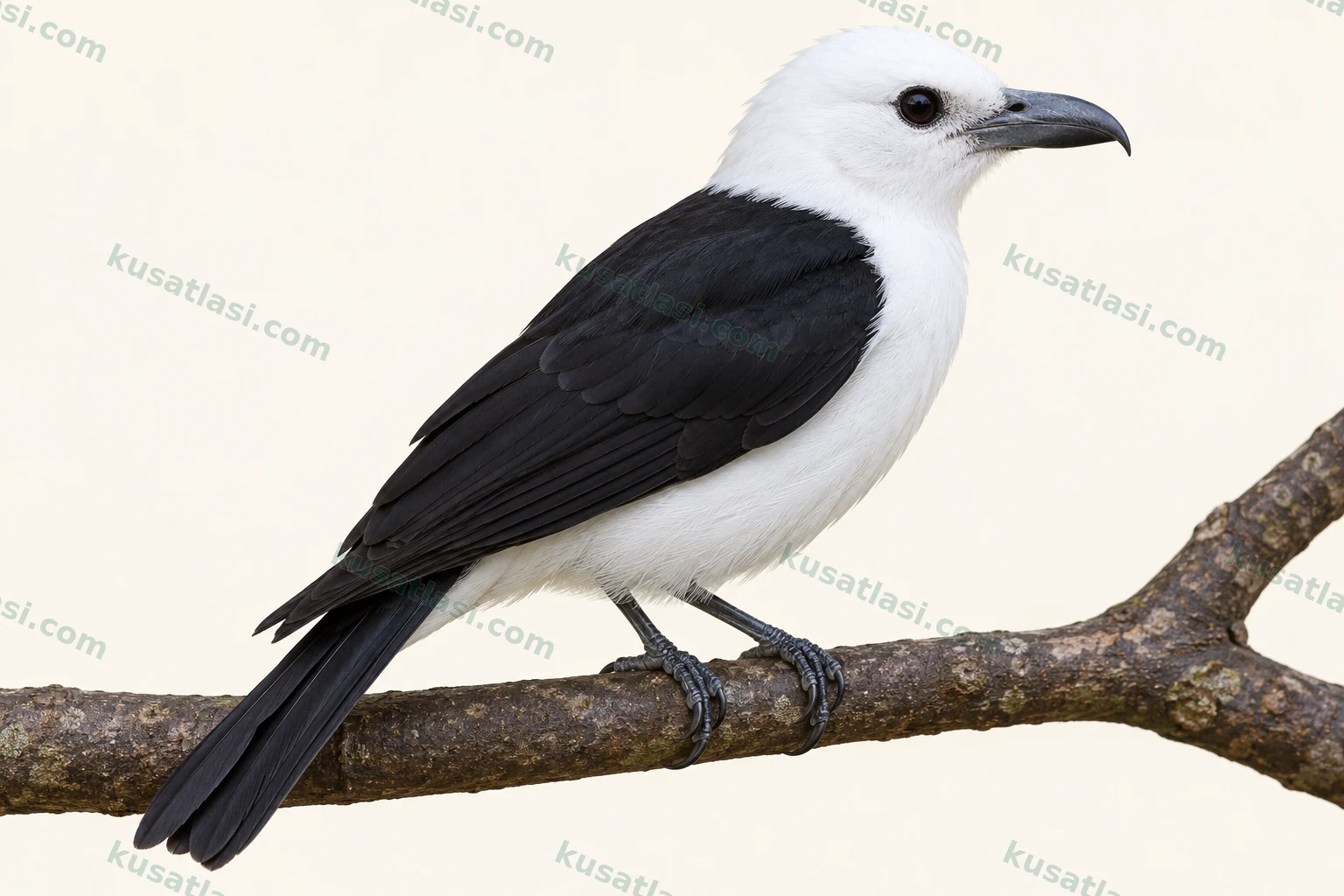
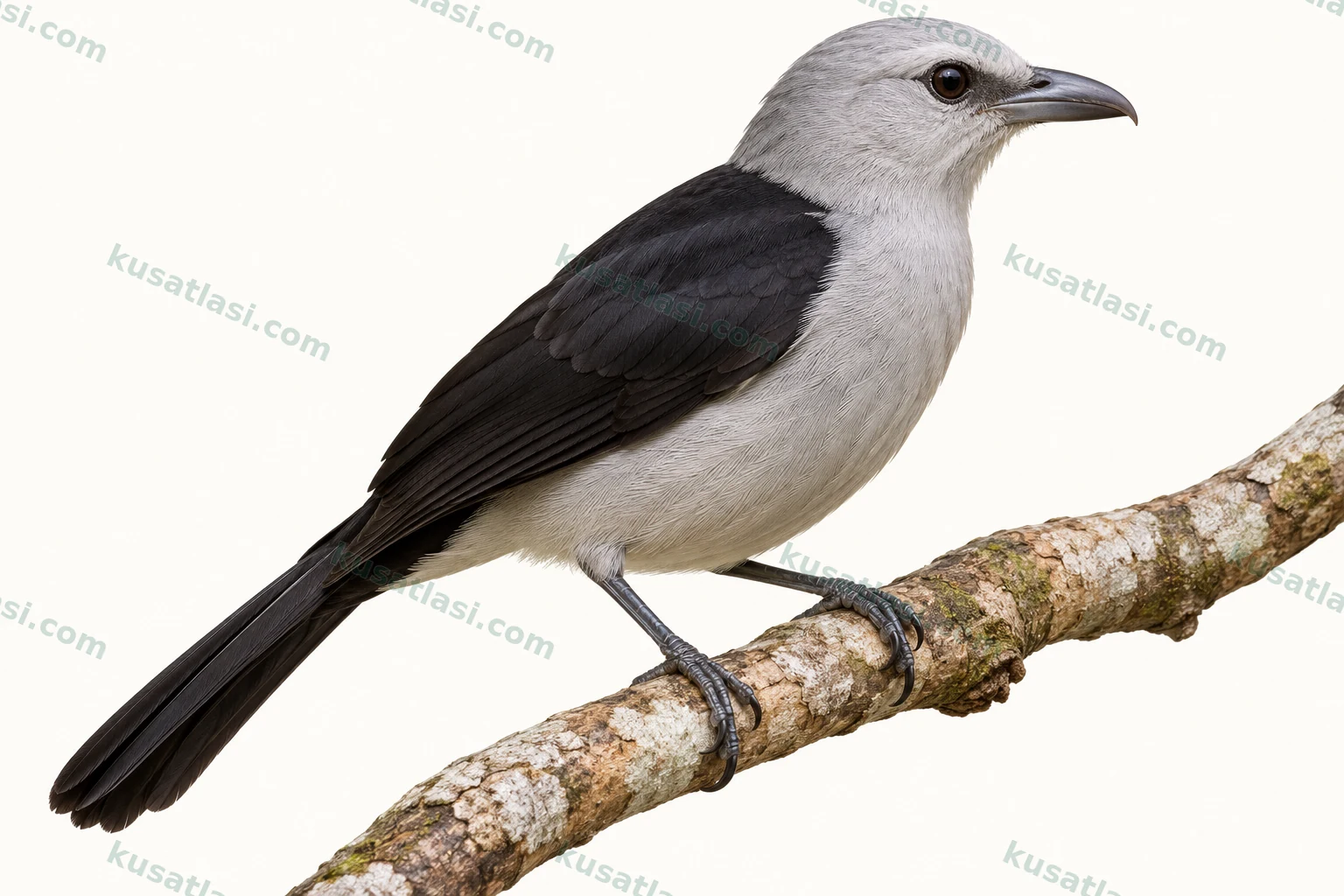
A tree-dwelling bird endemic to Madagascar, with a dark back and a short, strong bill. The male has a white head and the female a pale grey head.
Biometrics
Length
Male20 cm
Female20 cm
Shared species value
Wing length
Male11.78 cm
Female11.78 cm
Shared species value
Weight
MaleData unavailable
Female57 g
White-headed Vanga
MadagascarObservation guide in its natural range
Look for three features together
Do not rely on a single featureWhite head and underparts, with dark back and wings.
The female has a pale grey head. A young male may resemble a female.
The short, strong, bluish-grey bill differs from the long curved bill of Sickle-billed Vanga.
Compare male and female
 FemaleMale
The adult male has a white head and the female a pale grey head. A grey young male can be mistaken for a female.
Where to look in its natural range?
Natural forest, suitable secondary woodland and areas around forest.
These are the regional breeding observation months of the 1999–2000 Ampijoroa study. They do not make one breeding calendar for the whole island.
January
Largely resident, with movements within the forest. No verified regional date was specified for this month. This does not imply local absence.
February
Largely resident, with movements within the forest. No verified regional date was specified for this month. This does not imply local absence.
March
Largely resident, with movements within the forest. No verified regional date was specified for this month. This does not imply local absence.
April
Largely resident, with movements within the forest. No verified regional date was specified for this month. This does not imply local absence.
May
Largely resident, with movements within the forest. No verified regional date was specified for this month. This does not imply local absence.
June
Largely resident, with movements within the forest. No verified regional date was specified for this month. This does not imply local absence.
July
Largely resident, with movements within the forest. No verified regional date was specified for this month. This does not imply local absence.
August
Largely resident, with movements within the forest. No verified regional date was specified for this month. This does not imply local absence.
September
Largely resident, with movements within the forest. No verified regional date was specified for this month. This does not imply local absence.
October
Largely resident, with movements within the forest. No verified regional date was specified for this month. This does not imply local absence.
November
Largely resident, with movements within the forest. Ampijoroa, Madagascar, 1999–2000. Nest building, incubation and chick care were observed in both years.
December
Largely resident, with movements within the forest. Ampijoroa, Madagascar, 1999–2000. Nest building, incubation and chick care were observed in both years.
Nest, egg and incubation
The cup nest is in a tree and contains plant fibres, fine twigs and spider silk. The three nests with verified clutch size had 3–4 eggs. At one nest hatching took 19 days, and the young left that same nest in flight at 22–24 days of age. Both sexes provide care. This is a small regional sample.
Distinctive hollow-sounding whistles, bell-like song and harsh calls.
Do not play recordings to attract birds; observe quietly, especially near nests.
Species information
Quick identification
White-headed Vanga Artamella viridis is a dark-backed, pale-headed vanga that feeds in trees in Madagascar. The adult male has a white head and underparts, while the female's head and breast have a pale grey cast. The short, strong, pale blue-grey bill stands out against the black upperparts. The pale head is one part of the identification. Compare bill shape, back colour, apparent size and the other vangas in the same forest.
The current English name is White-headed Vanga. The original breeding study published in 2001 used Leptopterus viridis, an earlier genus placement for the same taxon. The study examined the distinction between males and females and the identity of helpers through direct observation and, for some individuals, DNA. The breeding habits of similarly coloured vangas cannot be assumed to apply to all pairs of this species.
General appearance and posture
The male's white head and neck contrast sharply with the black back and wings. In suitable light the upperparts may show a greenish sheen, while the flight feathers look a flatter dark colour. The rump has a small pale area. The eye is dark brown and can be distinguished from its narrow dark border. The legs are described as bluish grey. In the shade of foliage, white areas can appear grey and glossy black areas can look brownish.
On a perched bird it helps to assess the bill in proportion to the body. Seen at a distance in the upper branches, a white-headed bird can resemble the larger vanga with a long curved bill. The first impression changes once the short, thick bill can be seen. When feeding among branches the bird may turn sideways or upside down, revealing the colours of the belly and back from different angles.
Males, females and young birds
Adult males and females can be distinguished by head colour. The male's head is white and the female's is pale grey. Her breast also looks pale grey, with a white belly and a possible pale warm tint on the flanks. Seeing the neck and breast together is more useful than looking at a head with its crown in shadow. Both sexes share the black back and strong bill.
Young birds are reported to have a dark crown and broad brown edges to their upperpart feathers. A male approaching adulthood may have a grey head like a female's. In the Ampijoroa study, DNA identified two additional birds with female-like plumage as males. Age therefore needs to be considered before calling a grey-headed bird a female. The dullness of the upperparts, replacement of the wing coverts and behaviour within the family also inform the assessment of age.
A third bird seen beside a nest is not automatically a second female or a helper feeding chicks. First observe what the individual actually does. Carrying nest material, sitting on eggs, bringing food and responding to an approaching animal are distinct behaviours. Head colour helps interpret those observations. In a young bird, it cannot on its own explain the bird's social role. Recognising members of a group over several days gives more reliable information than a single brief encounter.
Appearance in flight
When the wing opens, the dark flight feathers may contrast with pale areas of the underwing coverts. Observe the pale head and lower body together with the dark wing. The shape of the bill may be hard to see during a brief flight between trees. Once the bird perches again, check its head, back and bill to complete the flight impression. Branches and leaves can conceal a surface, leaving its pattern unconfirmed.
Voice and behaviour
The voice includes hollow-sounding whistles and harsh calls that stand out in forest. The Kirindy field guide emphasises the bell-like quality of the song. Matching sounds from high branches to the bird's position can help when its colours are obscured by shade. Other vangas in the same forest also make distinctive sounds, so do not automatically attribute a whistle to this species if its source is not seen.
It may be seen in pairs or in mixed-species feeding groups. The breeding study recorded males chasing neighbouring males at territorial boundaries. Both members of the pair cared for the chicks. Young males accompanying some pairs joined in defence against approaching potential predators, and were not seen bringing food to the chicks. The birds in a group can thus perform different roles.
Similar species
1. Chabert Vanga Leptopterus chabert is smaller, with a black crown and white underparts. The Kirindy guide also points to the blue ring around the eye. In adult White-headed Vanga the whole head is pale. For a young bird or one in shade, also check apparent size and bill shape. The white at the base of the tail in the southwestern form of Chabert Vanga should be distinguished from the overall rump pattern of White-headed Vanga.
2. Sickle-billed Vanga Falculea palliata is much larger and has a long, downcurved bill. Its young may have a shorter bill than its adults, but it still differs in shape from the short, strong bill of White-headed Vanga. When the black-and-white pattern is similar, check size and bill first. A dark wing alone cannot distinguish the two species.
World distribution
The species is endemic to Madagascar. It occurs in several forest types at low and middle elevations, in suitable secondary woodland and in some vegetation adjoining forest. Its wide distribution on the island does not imply that it regularly occupies all open areas of the central high plateau. The map covers its natural distribution in Madagascar. It does not extend it to mainland Africa or other Indian Ocean islands.
Status within its natural range
The global category is Least Concern. Local forest use is assessed separately. The species table from the 2010 surveys around Ranomafana records White-headed Vanga at forest points but not at agricultural sampling points. The study sampled particular places and a particular season, so it does not prove that the species is absent from every agricultural area on the island. A single record at a forest edge also does not show that large agricultural areas can fulfil all the functions of a forest.
Movements
The specialist species account describes it as largely resident. Daily movements between branches or through forest patches differ from seasonal migration between continents. The sources examined gave no island-wide annual migration route tracked with verified dates and distances, and the map shows no such route. The November–December observation window of the breeding study does not imply that the birds leave the island for the rest of the year.
Breeding habitat
Natural forest and suitable wooded surroundings are important. Pairs studied at Ampijoroa also nested in tall trees around the forest station and settlement. This local use does not mean that every isolated tree provides sufficient breeding habitat. The branches used for feeding, the branch supporting the nest and the neighbouring pair's territory are considered together. Partners may share the area around the nest, and encounters at territorial boundaries were also observed.
Nest site
The cup-shaped nest contains plant fibres, fine twigs and spider silk. The 1999–2000 Ampijoroa study found nests 6–19 m above ground. Of three nests with known clutch size, two had three eggs and one had four. In one monitored nest, 19 days were reported from laying to hatching. Its four chicks left in flight at 22–24 days. The partners take part in building the nest, incubating and caring for the young. Those durations were not individually measured at all nine nests.
Daily use of space
The Kirindy study shows how the apparent height of activity within trees can depend on the observation method. Regular count sessions and other observations are kept as separate samples. A bird moving down to a lower branch shows that it is not confined to the topmost foliage. If the birds give warnings or chase an approaching animal near a nest, the observer should move farther away. The field study's capture methods are not advice for ordinary birdwatching.
What it eats
Insects, spiders and other small invertebrates make up a substantial part of its diet. The specialist account also reports occasional small vertebrates and some fruits and seeds. Among the prey items identified in deliveries to chicks in the Ampijoroa breeding study, spiders and caterpillars were prominent. The food given to chicks is not assumed to be the same as the adult's year-round diet in either composition or proportion. An unidentifiable item in the bill should be recorded as such.
How it obtains food
It searches among branches and around bark for small prey. With its short, strong bill it may probe beneath bark and move loose pieces. The specialist account describes searching while hanging upside down and holding large prey with a foot to break it up. These movements should be distinguished from the hunting behaviour of a slender-billed bird on the same branch. The branch it moves to and where it directs its bill can be recorded independently of colour.
The regular counts of the short Kirindy study included 11 height observations for this species. Observations outside the counts showed that it also used higher branches. This small sample does not establish a fixed feeding stratum for every bird in Madagascar. Height while feeding and elevation above sea level measure different things. A branch's height above the ground is not the elevation of a mountain.
Helpers can defend the nest area
In the Ampijoroa study, some additional young males stayed near a pair and took part in defence against approaching animals. They were not observed bringing food to the chicks. The researchers' interpretation of cooperative breeding includes this defensive help. Separating a third bird's presence from the work it actually performs gives a more accurate picture of the species' social life.
A bird that looks like a female can be a male
Whether the head is white or grey is a useful clue for adults. Some additional grey-headed birds in the study, however, were identified as male. Moult and juvenile appearance show why an adult sexing cue cannot be applied identically at every age. The adult female still has a grey head. The age of the observed bird also needs to be considered.
Birds use different heights within the forest
The Kirindy count sessions yielded records on lower and middle branches, while observations outside counts showed use of higher levels. Methods that capture different movements of the same bird through forest can yield apparently different summaries. Recording where and how each observation was made is more useful than giving one fixed height limit.
Nearby nests can belong to separate pairs
The breeding study found pairs' nests close to one another. The pairs' territories and encounters between neighbouring males at their boundaries were nevertheless assessed separately. Seeing several birds around one tree does not prove the whole group lays in one nest. Observing nest building, laying and care is more informative than counting birds alone. Before concluding that two birds using the same branch share the work of caring for chicks, establish which nest each is associated with.