

World Birds IUCN statusLC · Least ConcernGlobal IUCN category. BirdLife v10 (2025); taxon matching: AviList 2026 / IOC 15.2; checked: 29.10.2026. The list year is not the species assessment date. Source and method · BirdLife OrderPasseriformesPasserines FamilyOriolidaeOriolidae
Black-headed Oriole
Oriolus larvatus
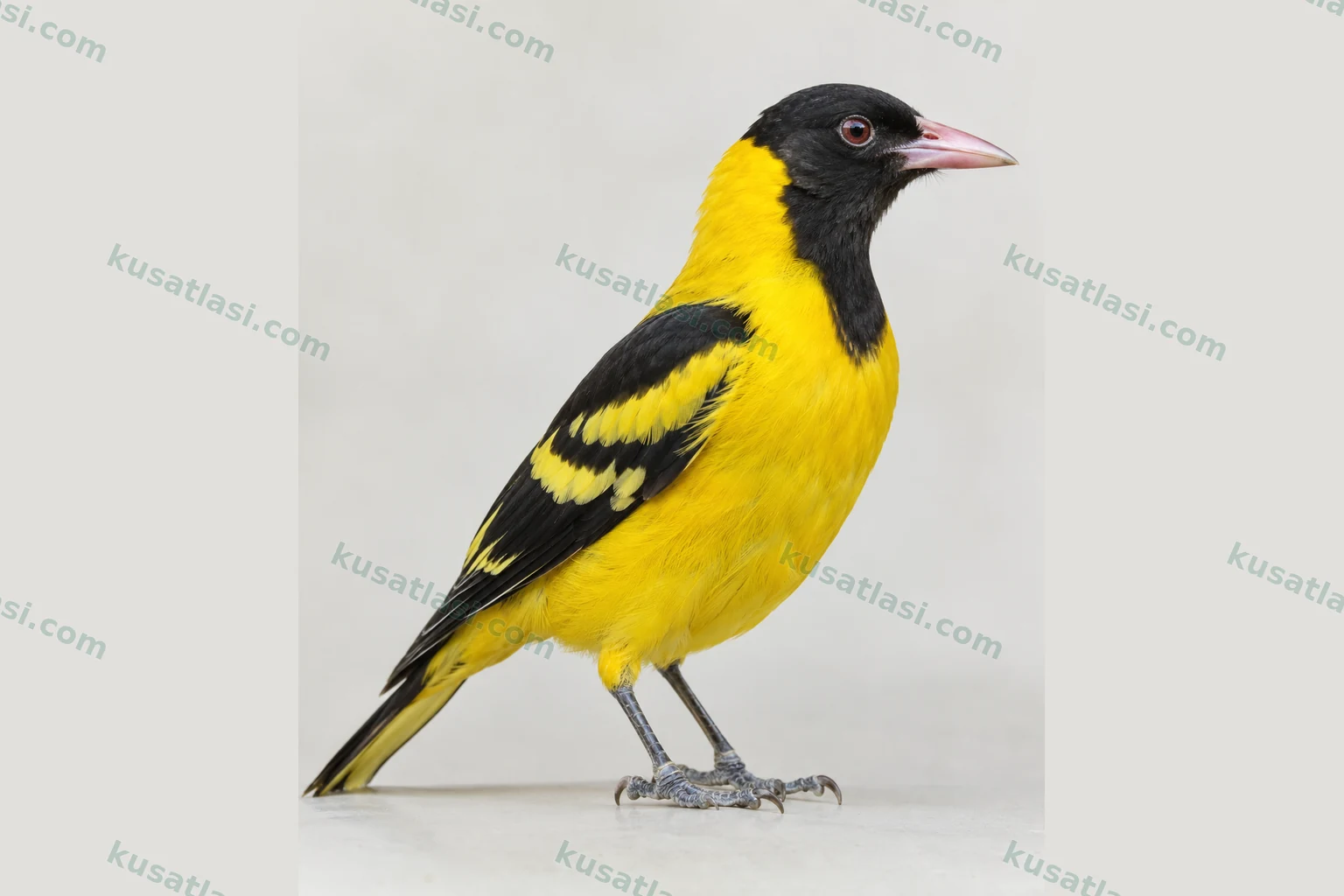
Black hood and throat, yellow body, pink-orange bill. Sexes similar; young birds more streaked and dark-billed.
Biometrics
Length
Male20–22 cm
Female20–22 cm
Shared species value
Wing length
Male13.39 cm
Female13.39 cm
Shared species value
Weight
Male59 g
Female61.3 g
Black-headed Oriole
Wooded areas of eastern and southern AfricaObservation guide in its natural range
Look for three features together
Do not rely on a single featureLook for an area covering crown, cheek and throat together.
Compare with olive back areas and dark wing edges.
Young birds have streaks and dark bills; adult colours alone do not determine sex.
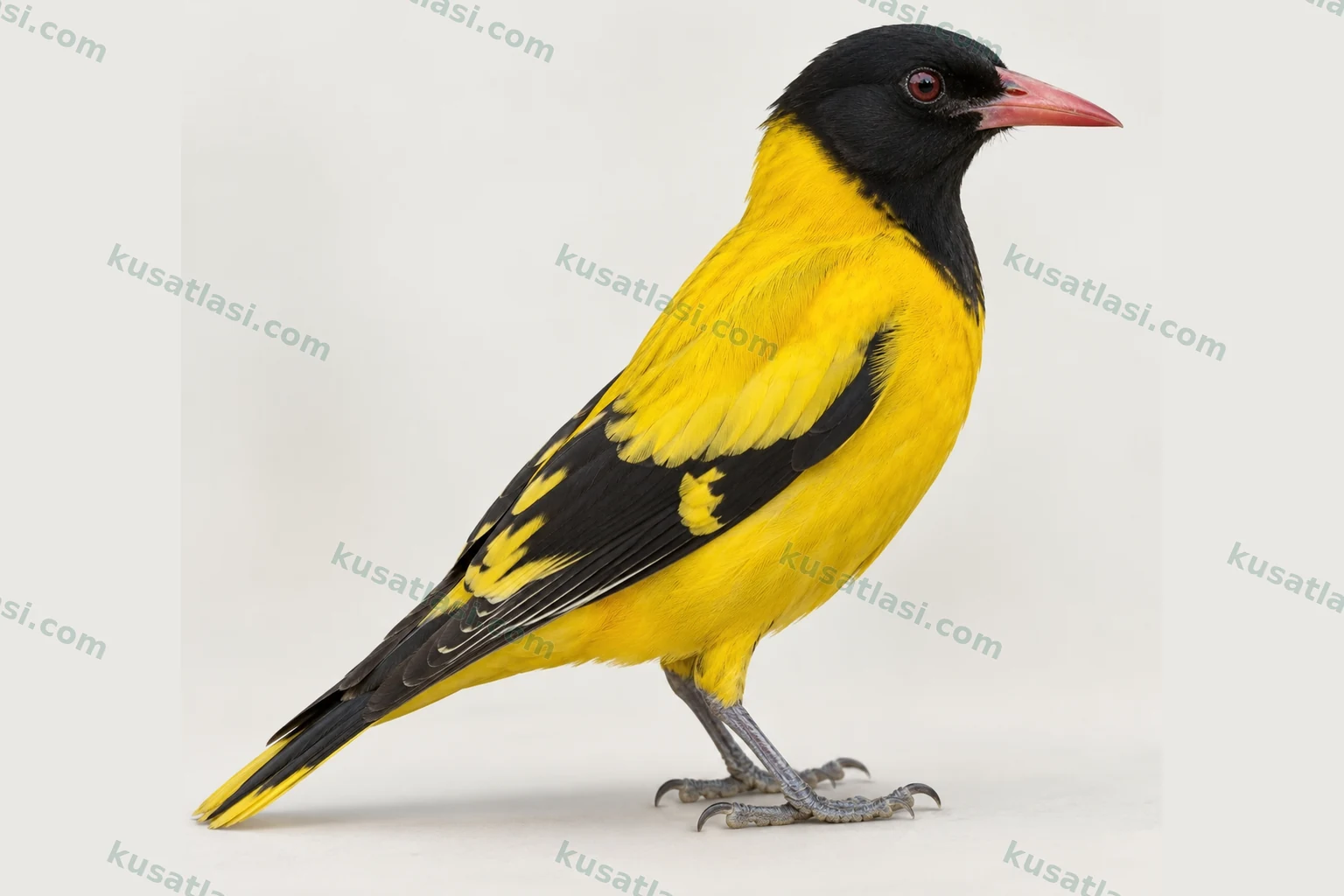
Compare male and female
 FemaleMale
Adult male and female basic plumages are similar; young birds have a dark bill and more streaked appearance.
Where to look in its natural range?
Watch leafy canopies and fruiting branches of mature trees.
Regional egg-laying is distinguished from the atlas’s broader breeding-activity records; the same months are not applied continent-wide.
January
Essentially resident; food-related local wanderings and regional seasonal differences. South Africa, Roberts expert account: Laying period; more concentrated September–December. More southerly atlas regions: Peak breeding activity.
February
Essentially resident; food-related local wanderings and regional seasonal differences. South Africa, Roberts expert account: Laying period; more concentrated September–December.
March
Essentially resident; food-related local wanderings and regional seasonal differences. No verified regional date specific to this month was given; this does not mean local absence.
April
Essentially resident; food-related local wanderings and regional seasonal differences. No verified regional date specific to this month was given; this does not mean local absence.
May
Essentially resident; food-related local wanderings and regional seasonal differences. No verified regional date specific to this month was given; this does not mean local absence.
June
Essentially resident; food-related local wanderings and regional seasonal differences. No verified regional date specific to this month was given; this does not mean local absence.
July
Essentially resident; food-related local wanderings and regional seasonal differences. No verified regional date specific to this month was given; this does not mean local absence.
August
Essentially resident; food-related local wanderings and regional seasonal differences. No verified regional date specific to this month was given; this does not mean local absence.
September
Essentially resident; food-related local wanderings and regional seasonal differences. South Africa, Roberts expert account: Laying period; more concentrated September–December.
October
Essentially resident; food-related local wanderings and regional seasonal differences. South Africa, Roberts expert account: Laying period; more concentrated September–December. Zimbabwe, SABAP breeding activity: Peak breeding activity, not only egg-laying.
November
Essentially resident; food-related local wanderings and regional seasonal differences. South Africa, Roberts expert account: Laying period; more concentrated September–December. Zimbabwe, SABAP breeding activity: Peak breeding activity, not only egg-laying. More southerly atlas regions: Peak breeding activity.
December
Essentially resident; food-related local wanderings and regional seasonal differences. South Africa, Roberts expert account: Laying period; more concentrated September–December. More southerly atlas regions: Peak breeding activity.
Nest, egg and incubation
The nest is a deep cup suspended between slender branch forks. Usually 2–3 eggs are laid; the female incubates for 14–16 days and both parents feed the young. The specialist South African account gives nest departure at 14–18 days, while another expert account gives 14–20 days.
Flowing, rolling whistles; harsher alarm calls. Match to the bird seen.
Do not play recordings to attract birds; observe quietly, especially near nests.
Species information
Quick identification
The Black-headed Oriole Oriolus larvatus is a tree-dwelling bird with an adult black head and throat and mostly yellow body. Its pink-orange or coral-like bill stands out against the black. Look at whether black forms a narrow eye-stripe or a hood covering crown, cheeks, throat and neck together. The adult of this species has a broad hood. A yellow body should not prompt an immediate choice of another oriole; first assess hood boundaries and bill.
Because it usually stays in the leafy canopy, a yellow fragment or whistle may be noticed first. Dark shade among leaves can make a yellow head look black. Wait for a natural head turn: crown and throat visible together make the hood clearer. Matching voice to a seen bird helps. Several species in a tree mean not every whistle necessarily comes from one individual.
General appearance and posture
The adult's bright yellow underparts sharply meet the black head and upper breast. Parts of the back may be olive-green; dark flight feathers have pale yellowish edges. The entire upper surface is therefore not one plain yellow sheet. Pale patches and edges on a folded wing occupy different apparent positions when spread. Yellow tips on outer tail sections also vary in visibility with posture.
A strong bill, prominent head and medium-length tail form oriole proportions. The body may turn horizontal while reaching fruit or more upright when listening. It neither stays motionless on one branch nor constantly feeds in the open. Instead of treating movement behind a branch as disappearance, scan the same leafy tree. Colourful plumage can be surprisingly difficult to see behind leaves.
Males, females and young birds
The adult sexes have similar basic plumage. Black hood and yellow underparts are not male-only features. Small colour differences can mix with light, wear and regional variation. Without reliable sex-specific field measurements, larger-looking birds are not called male or greener ones female. The two adult views do not form a key for sexing every individual from one photograph.
Young birds may lack the adult's neat glossy black hood: the head can be darker olive, throat and breast more streaked. Bill may be dark and eye browner. Streaks with a dark bill help age assessment, but a shaded adult bill alone does not. No definite juvenile judgement is made from a brief view without face, throat and breast together.
Yellow shade and the amount of green above vary across the broad range, not merely between sexes. Choosing subspecies from warm yellow in one photograph without locality is unreliable. Record visible feathers, possible age and place separately, then compare verified regional examples of the same taxon. An incomplete black hood does not by itself make another species.
Appearance in flight
Between trees, yellow body, black head and dark wings may show together. Spreading the tail can reveal outer yellow areas, while a rear view often hides the throat boundary. A yellow fragment does not distinguish similar orioles reliably. Perching before or after flight can give more details than the short flight itself.
A pale edge on a folded wing does not mean the entire spread wing is white. The same feather row presents different surfaces at different angles. Gliding among branches is not measured long-distance migration performance. Similar adult plumages also prevent sexing by yellow brightness alone in flight.
Voice and behaviour
Flowing, rolling whistles often announce an unseen bird; alarm and other calls may sound harsher. Function depends on context. Not every whistle means courtship or a nearby nest. Compare similar orioles' voices too. It may feed alone, in pairs or in mixed bird parties; companions are not automatically mates or offspring.
Searching leafy branches for fruit and small animals explains canopy-oriented observation. Activity around a food tree may change seasonally. The South African atlas did not interpret more dry-season-end reports in some regions as certain population growth: greater visibility after leaf fall and local movements are possible explanations. Many monthly sightings do not remove that uncertainty by proving all birds arrived from elsewhere.
Species that may be confused
1. African Golden Oriole Oriolus auratus: the adult's yellow head has a black mask extending behind the eye, unlike the full crown-and-throat hood here. Dark yellow-edged wings and flowing whistles may resemble it. First check black boundaries; with the head hidden, body yellow alone does not decide.
2. Eurasian Golden Oriole Oriolus oriolus: another yellow-bodied bird possible in Africa. The adult male lacks a black hood; females and young may be greener and streaked. Compare head, throat and wing pattern with young Black-headed Orioles. Neither a possible migration season nor yellow alone completes identification.
World distribution
Its natural range runs from eastern Africa southwards and into some interior areas. Moist woodland, forest edges and river cover are key elements. Neither all Africa nor every desert and open grassland should be coloured as equivalent habitat. Regional forms differ in upperpart tones and proportions, but this page remains Oriolus larvatus, not merged with African Golden Oriole Oriolus auratus.
Status within its natural range
The South African atlas highlights Zimbabwe, eastern Botswana and the moister eastern South African belt; northeastern Namibia is a more limited extension. Reporting rates measure observation frequency, not exact individuals per square kilometre. Use of wooded parks and gardens does not mean every city or garden hosts breeding. It is globally Least Concern; continuous tree cover and mature trees still matter locally.
Migration
Essentially resident, it may make food-related local wanderings and show regional seasonal changes. A ringed young bird recovered 99 km away in Zimbabwe documents movement between two points, not the species' annual migration distance. Summer or dry-season-end reporting peaks do not alone show direction. Records are not joined into an unverified route; compare leaf cover and observation conditions between months.
Breeding habitat
Moist woodland with mature leafy trees, forest edges and riverbanks are main settings. Large-tree parks, gardens and some plantations can be used. They are not equivalent: canopy and suitable branches differ from a few saplings. Tree islands in open grassland may be usable despite unsuitable surroundings; this does not make the whole grassland habitat.
Nest site
A deep cup suspended between slender branch forks is woven from lichens, grass, moss and plant fibres. The South African expert account describes most nests on horizontal branches several metres up. Typically two or three eggs, incubated by the female about 14–16 days; both partners feed the young. That regional account gives nest departure at about 14–18 days, another expert 14–20 days for the same stage. No new midpoint is produced.
Daily habitat use
Much feeding takes place in the leafy canopy. Visiting a fruit tree does not make one tree the whole home range. Nest forks, feeding branches and resting sites have separate functions, especially during breeding. The open cup does not make a convenient observation target. Watch from a natural viewing gap; blocking a builder's return or repeatedly going beneath the tree may affect behaviour.
What does it eat?
It consumes fruits, various invertebrates and some plant foods. The South African expert synthesis lists figs, caterpillars, winged termites and other insects; nectar may also be taken. The list does not show identical availability or proportions everywhere. Seeing it at a flower does not prove nectar-taking; it may seek insects there. Food delivered to young and an adult's entire daily diet are assessed separately.
How does it forage?
It can glean small animals from leaves and branches, reach fruit and briefly pursue flying insects. Mixed parties bring these methods to the same tree, but neighbours do not necessarily share food. Do not confuse bill colour with carried food, particularly reddish fruit obscuring part of the bill. Taking an item, swallowing it and taking it to a nest are separate observations. Brief concentration at a food tree is not permanent population density.
A suspended cup
The nest between slender forks is not a heap of grass on a branch. Fibres and lichens woven around branches support its deep cup. Frequent feeding branches and the nest branch have different functions. Seeing an adult in a treetop does not place the nest there. Watching without opening cover preserves both behaviour and natural branches.
More sightings need not mean more birds
The South African atlas discusses increased visibility after leaf fall and food-related movements as separate possible seasonal explanations. Yellow is hard to see in dense leaves and easier among bare branches. Equal observer effort in summer and winter can still yield different reporting rates. Directly reading population increase from reports confuses numbers with detection. Regular comparable counts are needed to distinguish them.
Brightness is not a sex key
Both adult sexes have black heads and yellow bodies. Calling brightness male may misrecord females as young or another species. Dark bill and streaked juvenile appearance are used together for age. Not every bird must be sexed; a limited adult or possible-young record is more useful than false certainty. Broad regional plumage variation within the same species supports that caution.