

World Birds IUCN statusLC · Least ConcernGlobal IUCN category. BirdLife v10 (2025); taxon matching: AviList 2026 / IOC 15.2; checked: 29.10.2026. The list year is not the species assessment date. Source and method · BirdLife OrderPasseriformesPasserines FamilyOriolidaeOriolidae
African Golden Oriole
Oriolus auratus
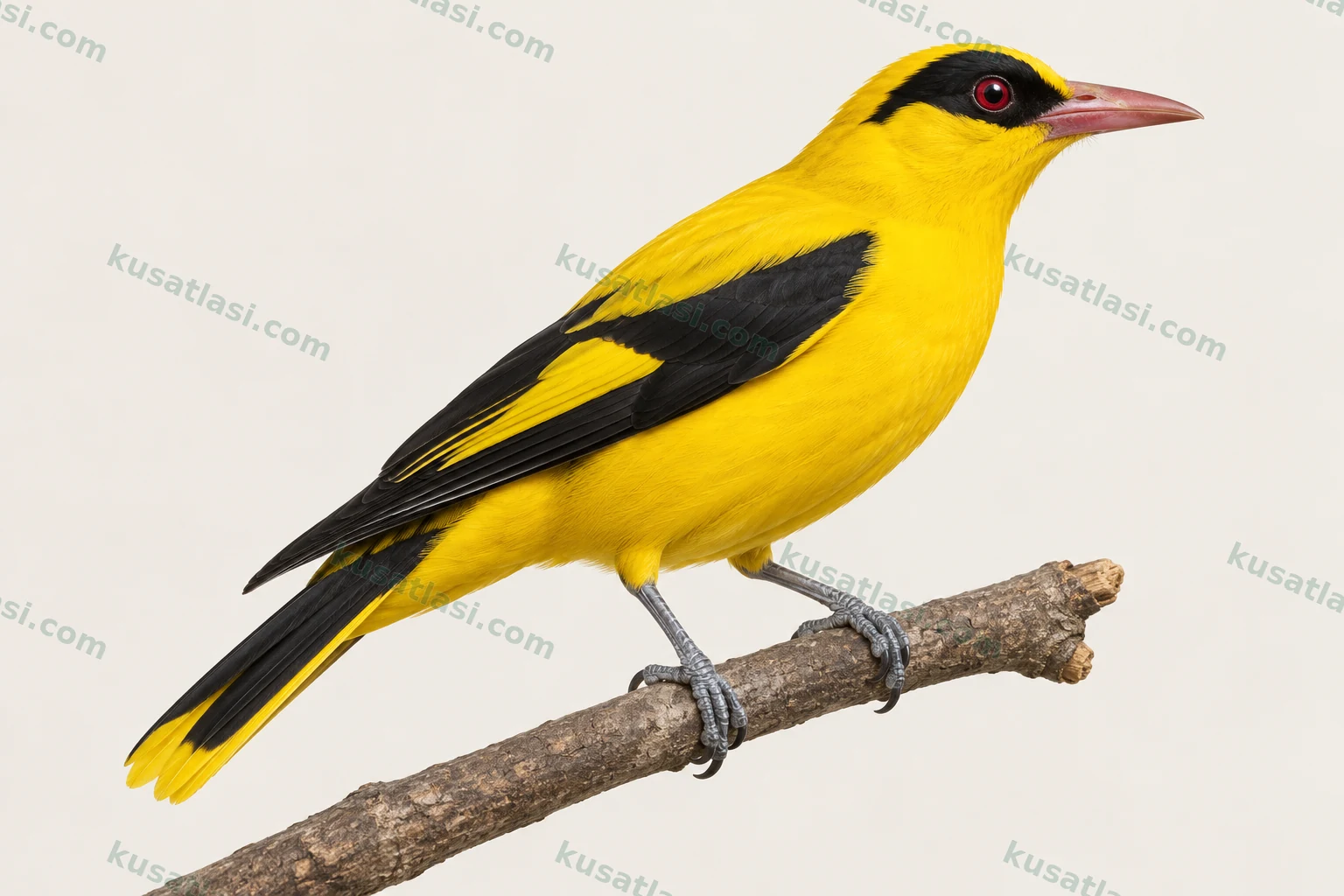
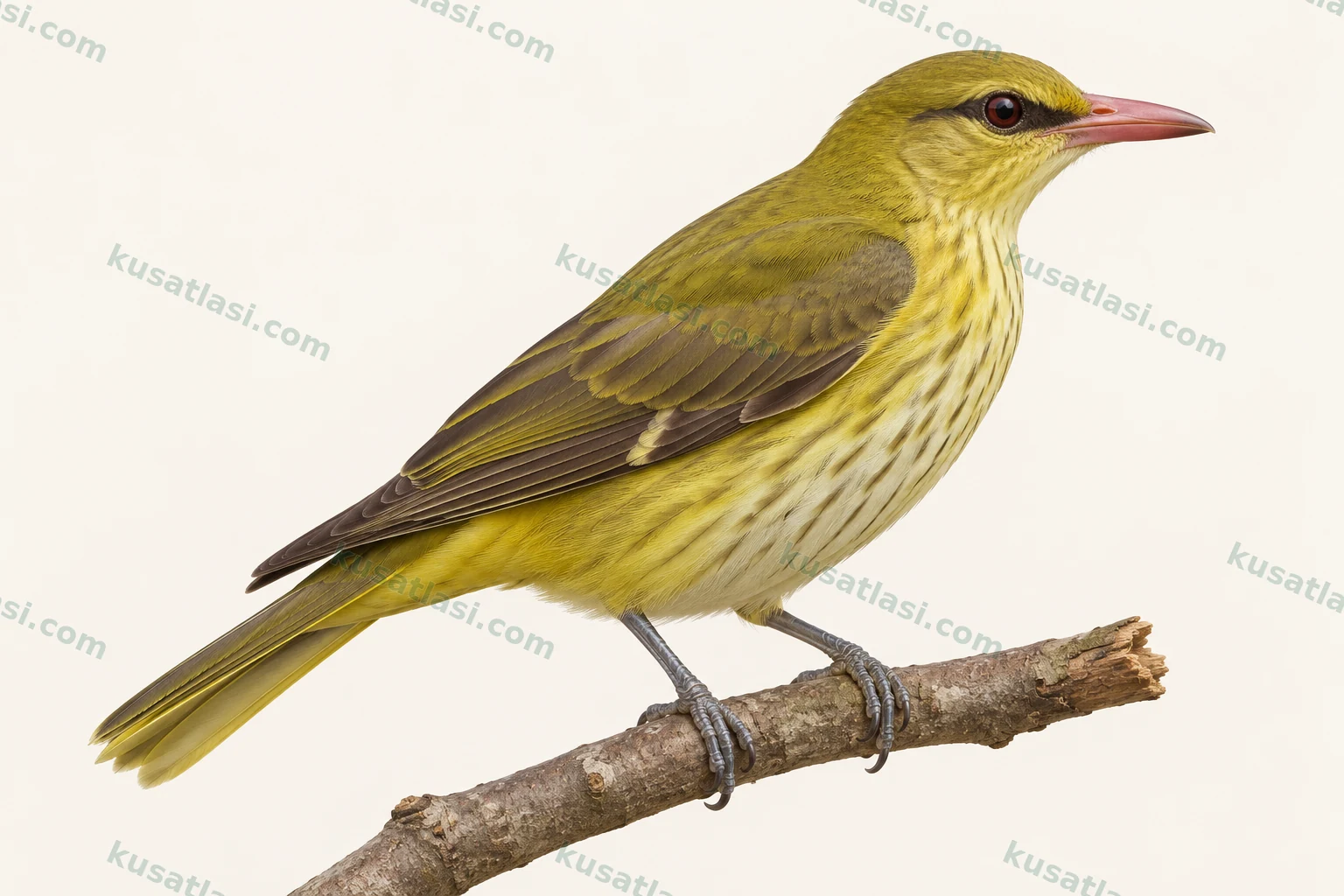
The male has a golden-yellow body, dark wing areas and a black eye stripe extending onto the head side; females and young can be greener with streaked underparts.
Biometrics
Length
Male20 cm
Female20 cm
Shared species value
Wing length
Male13.79 cm
Female13.79 cm
Shared species value
Weight
Male60–62 g
Female70–72 g
African Golden Oriole
Tall-tree belts of sub-Saharan AfricaObservation guide in its natural range
Look for three features together
Do not rely on a single featureDistinguish a narrow eye stripe from a black hood covering the whole head.
Read yellow edges and dark areas on the folded wing together.
Not every greenish streaked bird is female.
Compare male and female
 FemaleMale
The male is bright yellow and black, the female greener and streaked; young may resemble females.
Where to look in its natural range?
Watch birds feeding in broadleaved treetops.
Regional breeding in the Zimbabwe atlas and movement examples from the western region are separate events.
January
It is a partial intra-African migrant; some populations or individuals may remain all year. Zimbabwe, SABAP1: this month is within the reported regional breeding period.
February
It is a partial intra-African migrant; some populations or individuals may remain all year. No verified regional date specific to this month was provided; this does not mean local absence.
March
It is a partial intra-African migrant; some populations or individuals may remain all year. No verified regional date specific to this month was provided; this does not mean local absence.
April
It is a partial intra-African migrant; some populations or individuals may remain all year. No verified regional date specific to this month was provided; this does not mean local absence.
May
It is a partial intra-African migrant; some populations or individuals may remain all year. Western region of the southern African atlas: this is the reported departure period.
June
It is a partial intra-African migrant; some populations or individuals may remain all year. No verified regional date specific to this month was provided; this does not mean local absence.
July
It is a partial intra-African migrant; some populations or individuals may remain all year. No verified regional date specific to this month was provided; this does not mean local absence.
August
It is a partial intra-African migrant; some populations or individuals may remain all year. Zimbabwe, SABAP1: this month is within the reported regional breeding period.
September
It is a partial intra-African migrant; some populations or individuals may remain all year. Zimbabwe, SABAP1: this month is within the reported regional breeding period. Zimbabwe, SABAP1: breeding records concentrate in these months.
October
It is a partial intra-African migrant; some populations or individuals may remain all year. Zimbabwe, SABAP1: this month is within the reported regional breeding period. Zimbabwe, SABAP1: breeding records concentrate in these months.
November
It is a partial intra-African migrant; some populations or individuals may remain all year. Zimbabwe, SABAP1: this month is within the reported regional breeding period. Zimbabwe, SABAP1: breeding records concentrate in these months. Western region of the southern African atlas: arrivals in the breeding area begin.
December
It is a partial intra-African migrant; some populations or individuals may remain all year. Zimbabwe, SABAP1: this month is within the reported regional breeding period.
Nest, egg and incubation
The nest is a woven cup suspended in a branch fork. Usually 2–3 eggs are reported; a specialist account gives 16–17 days of incubation, and both parents feed the young. About 15 days of nest development does not establish a day of independence.
Flowing, flute-like songs and harsher alarm calls are matched with the visible bird’s identity.
Do not play recordings to attract birds; observe quietly, especially near nests.
Species information
Quick identification
African Golden Oriole Oriolus auratus is a songbird of tall-tree habitats in sub-Saharan Africa. The adult male's bright yellow body, black wing areas and black stripe extending from around the eye onto the side of the head are conspicuous. The stripe's extent and the distribution of yellow in the wing are more useful in comparisons with other orioles than yellow colour alone. Greener, streaked females and young cannot be identified with the same adult-male key.
The bird often remains in treetops. Leaf shadows may darken the yellow body and interrupt the black head stripe. A patch of yellow among branches therefore cannot establish the species. Watch the eye area, folded-wing pattern and presence or absence of underpart streaks together. Wait for normal feeding movements rather than moving a branch or calling to keep the bird exposed.
General appearance and posture
The male's back and underparts are golden yellow. A black area starting before the eye and continuing onto the head side behind it forms a distinct mask. The large flight feathers are dark; yellow edges and tips and yellow coverts create a light-and-dark arrangement on the folded wing. The tail centre is darker and the other feathers look yellower. The bill is pinkish-red, the adult iris red and the legs greyish-blue. If eye colour cannot be confidently seen through distant binocular views, it is not made an essential identification condition.
The width of yellow wing edges can vary among geographical forms. The southern notatus form tends to show more yellow in the wing. However, light, feather wear and posture also affect how much yellow is visible; a single tightly framed picture cannot establish subspecies. Photos that do not show the full wing surface at the same angle do not substitute for a measured colour difference. Considering head stripe together with body and wing pattern is more useful for basic species identification.
Males, females and young birds
The female's upperparts are yellow-greenish and her underparts paler yellow. Grey or olive streaks may occur on throat and breast, unlike the adult male's plain, bright yellow underparts. The dark area around the head can also be more olive. Yellow edges remain on the dark folded wing. Rather than assigning a greenish-backed bird to another oriole species on that feature alone, examine breast pattern together with the visible head area.
Young birds may resemble females. Not every bird lacking the bright yellow male appearance is therefore female. Age-related plumage maturation and sex differences are considered separately. If adulthood is unknown, pale colour alone cannot establish sex. If no reliable distinction between female and young is visible, retain that uncertainty in the record; do not add unseen marks to the description.
Two differently coloured birds feeding together in treetops are not necessarily a breeding pair. Small groups and feeding gatherings with other species may also form. Care around a nest is more direct breeding evidence but must be watched without approaching it. Food provision to a young bird can show that it is not yet wholly independent in feeding; leaving the nest does not mean parental care has ended.
Appearance in flight
The contrast between yellow body and dark wing areas can also be seen in flight, but a brief move between trees may not reveal the head pattern. Do not interpret yellow edges on a folded wing as an entirely yellow open wing. Upperwing and underwing are different surfaces; the bird turning can change the pattern seen. A broad black hood and a narrow eye stripe may be better distinguished when it perches again.
A feeding move between trees is not evidence of migration. Seasonal movements within Africa vary regionally and cannot be inferred from one short flight direction. Eurasian Golden Oriole Oriolus oriolus and Black-headed Oriole Oriolus larvatus may occur in the same woodland. When counting flying yellow birds, record head and wing pattern where possible, as well as the yellow-and-black combination.
Voice and behaviour
Flowing, flute-like song and harsher alarm calls are reported. Voice can locate a bird hidden in leaves but must be matched with the visible individual for identification. Some oriole calls may give a similar impression. Comparing a sound with a human word is only a memory aid; it does not describe the sound's full local and individual variation.
It may feed alone, in pairs or in small groups, and also joins mixed bird gatherings. Several individuals at a fruiting tree do not establish permanent flock membership or attachment to the same nest. It can be quieter and overlooked outside breeding; fewer records should not directly be read as all birds leaving the region. Tree leafing, food, actual movement and ease of detection are separate factors.
Similar species
1. The adult male Eurasian Golden Oriole Oriolus oriolus is similar with its yellow body and dark wings. In good views compare the extent of dark head pattern and yellow arrangement on the folded wing; African Golden Oriole's dark eye stripe extends more conspicuously onto the head side. Females and young are not separated by yellow or green tone alone. Seasonal visitors may occur in the same region.
2. In adult Black-headed Oriole Oriolus larvatus, the black head and throat cover a much larger area than the stripe on African Golden Oriole's yellow head. If leaves hide the head, this distinction cannot be seen. Wait for natural movement to expose it rather than identifying the species from yellow body alone. Do not apply an adult black-head rule to young birds.
World distribution
Its natural range is in sub-Saharan Africa. The current taxonomic list treats northern auratus and southern notatus geographical forms as separate regional belts. The northern belt extends eastwards from West Africa; the southern includes suitable woodlands from Angola to central Mozambique. These names do not turn the whole continent into continuous forest: habitat selection among open dry environments and dense lowland forests matters.
Status within its natural range
The southern African atlas highlights miombo, tall-tree areas around the Okavango, mopane and riverine woodland as regional examples. A record in a mapped area named Kalahari does not mean preference for bare dry ground; tall wooded patches inside that region may be used. The current global category is Least Concern. Local tree loss and miombo fragmentation can still affect occupied areas; the global label does not imply constant abundance everywhere.
Seasonal movements
Intra-African movements vary among populations. The southern African atlas describes some western populations as largely migratory and northeastern ones as partly resident. Individuals remaining in Zimbabwe in the dry season have also been recorded. The western example of arrivals from November and departure in May is not applied unchanged to every northern population. Passage records, egg-laying and year-round presence are separate events. The map model shows potential distribution; an observation cell alone is not a verified migration stop or nest. No fixed route is drawn because a shared sequence of countries was not verified.
Breeding habitat
Tall, well-developed broadleaved woodland and riverine tree belts are the main environments. Miombo and other deciduous woodlands are prominent in the south. Open thorn savanna and a closed patch of tall trees do not provide the same breeding support. Seeing the bird in a garden or wooded settlement does not mean it has lost all its natural woodland requirements. A feeding tree and safe nest support may be different parts of the same landscape.
Nest site
The cup nest, woven from grass and fine plant material, is suspended in a branch fork; spider silk may help bind the material. Specialist accounts usually report 2–3 eggs, with 2–5 in broader records. Incubation is given as 17 days in one regional study and 16–17 days in another specialist compilation, durations whose source scope for African Golden Oriole is specified. Both parents take part in feeding the young; a report of at least about 15 days of nest development is not a definite day of independence.
Daily habitat use
It mainly forages in treetops, but may descend lower or to the ground. Fruiting trees and insect-bearing leafy branches are different centres of use. A mixed gathering does not show that every species uses the same prey or tree equally. Standing beneath the nest or opening the branch fork may disrupt natural care. Watching normal feeding direction and adult food-carrying from afar gives a better observation than repeatedly exposing the bird's position.
What does it eat?
Fruit and small invertebrates are important foods. Specialist accounts include insects, larvae, caterpillars and flying ants or termites; fruiting trees such as Euclea are also used. Seeing it at a fruit tree does not mean a fruit-only diet, and carrying a caterpillar does not mean an insect-only diet. Food is assessed according to season and woodland opportunities; a regional prey list is not a fixed percentage for the whole continent.
How does it forage?
It gathers food from leaves and branches and may catch a flying insect in a short pursuit when conditions suit. Striking some prey, such as caterpillars, against a branch before swallowing is reported. Repeated bill movements on a branch do not mean a successful capture each time. Record the food type when actual prey or fruit is visible; do not guess the identity of a small item hidden behind leaves.
A small gathering may form at a fruiting tree, but this does not show that every individual eats the same amount. A caterpillar carried to a nest is not the adult's whole daily food sample either. Separating foraging from provision to young helps explain the functions woodland provides. Instead of using food to attract the bird to a particular branch, follow its own branch choices, searching time and visible prey handling.
A Kalahari record does not mean preference for bare sand
A broad habitat name for an atlas region does not reduce every small habitat within it to one type. African Golden Oriole's presence in the northern Kalahari is understood together with tall-tree mosaics there. Observe the actual tree structure used rather than relying on a country or region name. This distinction retains local details hidden by the broad view when interpreting habitat from maps.
Different movement patterns on the same continent
Seasonal western arrival and departure and birds remaining in Zimbabwe in the dry season are different regional behaviours of one species. Combining them into one migration arrow erases a real difference. A quiet bird being less easily noticed can also affect the record curve. Dates, regions and, where possible, marked individuals are evaluated together to understand movements; a less-heard month alone is not an absence month.
Suspended cups and photographic identity
A woven cup attached to a branch fork describes this species' nest structure. Yet identifying a photograph of a similar nest as African Golden Oriole solely by shape is insufficient. An example image on a specialist page may be labelled with another oriole's name; the image's own identity must be read separately. Verified nest-structure text and the species identity of a photograph are separate evidence.
The bright male does not represent the whole species
The male's yellow-and-black appearance is memorable; the greenish upperparts and streaked underparts of females and young can create a different first impression. This is a basic age and sex difference. Requiring the adult-male plate pattern of every bird in the field misses an important part of the species. If views are inadequate, record observed marks and uncertainty rather than adding a definite sex or subspecies.