

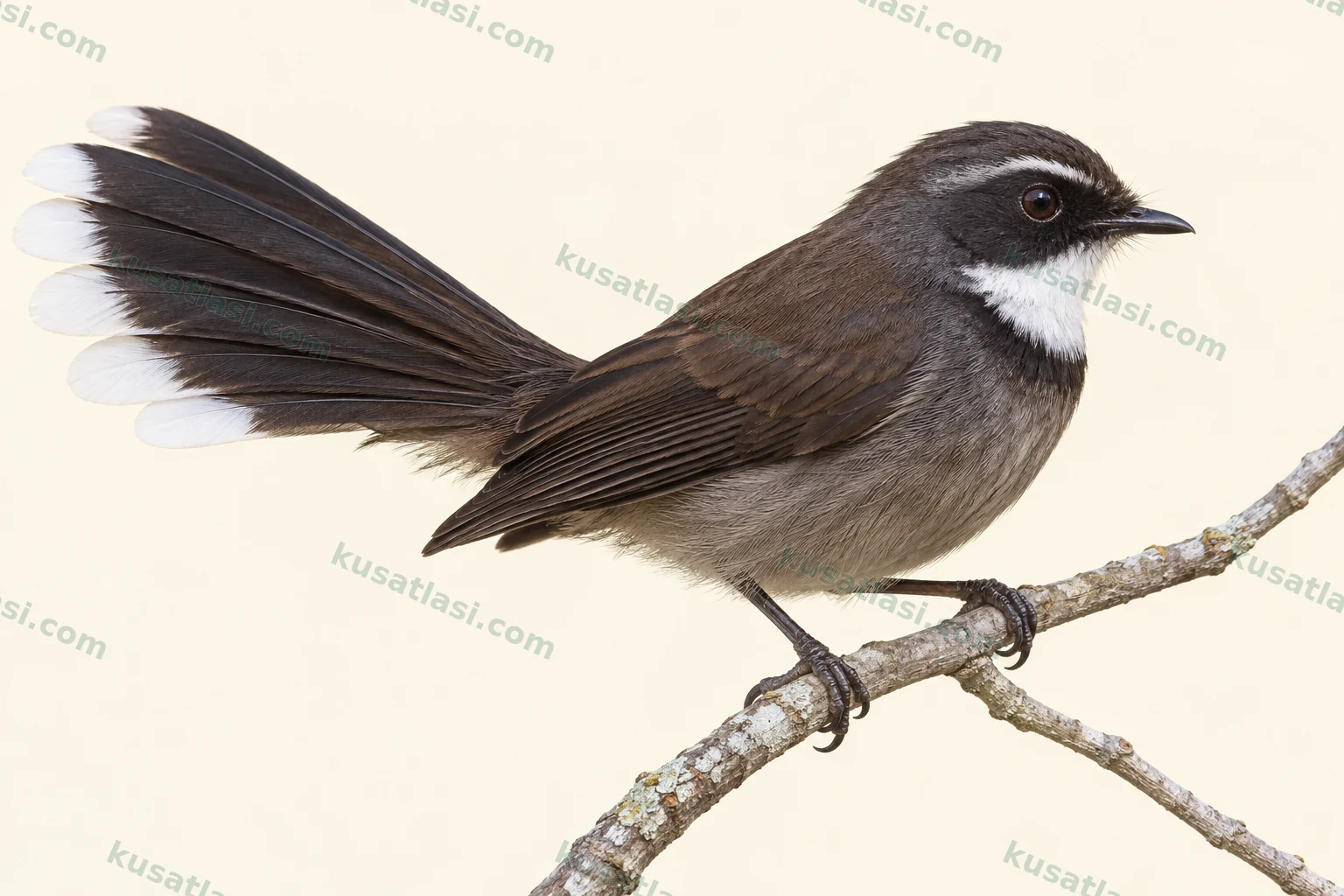
World Birds IUCN statusLC · Least ConcernGlobal IUCN category. BirdLife v10 (2025); taxon matching: AviList 2026 / IOC 15.2; checked: 29.10.2026. The list year is not the species assessment date. Source and method · BirdLife OrderPasseriformesPerching birds FamilyRhipiduridaeRhipiduridae
White-throated Fantail
Rhipidura albicollis
Identify the white throat and eyebrow and the long tail that opens like a fan, taking regional plumage differences into account.
Biometrics
Length
Male17–21 cm
Female17–21 cm
Shared species value
Wing length
Male7.84 cm
Female7.84 cm
Shared species value
Weight
Male9 g
Female13 g
White-throated Fantail
Wooded habitats in the Himalayas and South and Southeast AsiaObservation guide in its natural range
Look for three features together
Do not rely on a single featureLook for the white throat and thin pale line above the eye together.
Look at the pale tips of the long tail as it opens like a fan.
Compare the folded wing pattern with those of similar local fantails.
Compare male and female
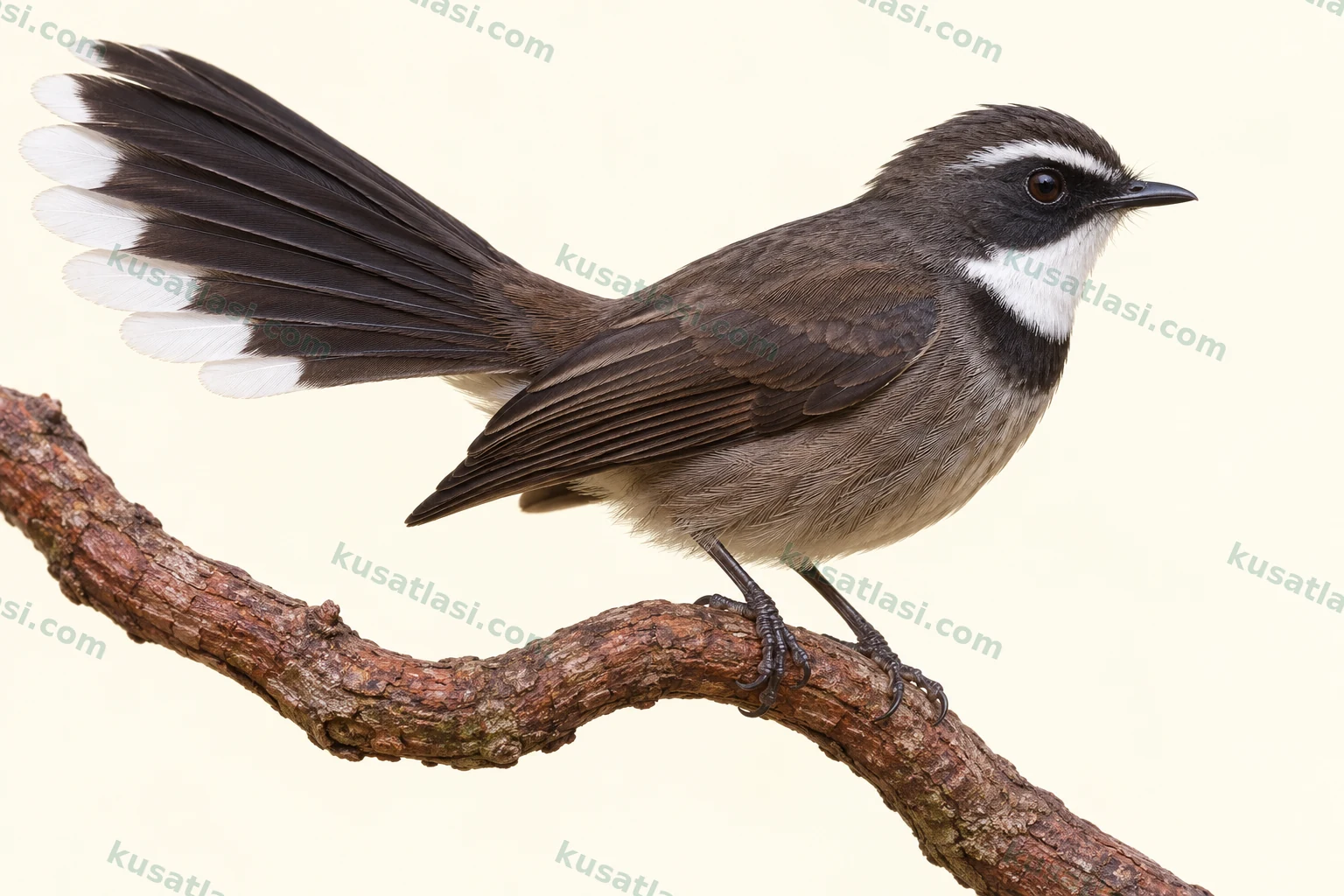 FemaleMale
No reliable sexing key across the entire range or detailed juvenile stages have been verified. Darkness or tail fanning alone is insufficient.
Where to look in its natural range?
Watch shaded lower branches, stream valleys and short hunting sallies.
Most populations are resident. Movements with changes in elevation are reported in some mountainous areas.
All months: Populations are resident or make local movements between elevations. No shared breeding calendar has been verified. No verified regional date is given for this month. That does not imply local absence.
January
February
March
April
May
June
July
August
September
October
November
December
Nest, egg and incubation
The official regional park account reports a small cup nest on a low branch and 2–4 eggs. Incubation duration and the time the young spend in the nest have not been adequately verified.
The song is melodic, complex and rapidly repeated. Match the sound to the bird you see and its regional appearance.
Do not play recordings to attract birds; observe quietly, especially near nests.
Species information
Quick identification
The White-throated Fantail Rhipidura albicollis is a small, active insect hunter of wooded habitats in South and Southeast Asia. The long tail opens like a fan. Its pale throat and the white line above the eye also stand out. The closed tail looks slender and long, and the spread tail looks broad. The contrast between the dark body and pale throat does not distinguish it from every other fantail. Check the head and folded wing patterns too.
Birds around the Himalayas are recognised by their dark, slate-grey body. The species has several subspecies across its range, which need not all have the same shade of grey or pattern below. In a wooded stream valley, start by watching a bird that makes short flights between lower branches and often fans its tail. Match the region and plumage pattern for the taxon in question. Do not treat every detail of a single photo from another region as a requirement.
General appearance and posture
The long tail is conspicuous in proportion to the small body. The white tips and edges stand out more clearly when the tail is spread. Only a narrow pale edge may be visible when it is closed. A tail feather passing in front of the body or a branch can obscure the actual boundary of the pattern. It is better to wait until the bird fans its tail again than to try to count lines from one view. Look for the junction of the white throat with the head and the thin line above the eye together.
In darker northern forms, the back and the body below the throat can be similarly dark. In comparisons with other fantails, check whether the wing coverts have conspicuous pale spots. The white throat may look smaller in shade and broader in bright sunlight. One side of the eyebrow can disappear when the bird turns its head. A side view and, if possible, a front view help distinguish the actual pattern from differences caused by posture and light.
Males, females and young birds
This review could not verify a reliable way to distinguish adult males and females across the entire range. A tail spread more widely in a photo does not make the bird a male. If one bird looks darker, first consider the light, posture and geographic form. The two adult plates allow comparison of adult appearance. The different perches shown do not indicate that the sexes occupy different habitats.
Details distinguishing every stage of juvenile moult were also not adequately verified. A pale bird is not automatically young or female. When birds occur in family groups, direct behaviour such as feeding can add information. Merely sitting on the same branch does not prove a parent–offspring relationship. Keep age or sex uncertain in the record if there is no reliable indication. Start with the pale throat, line on the head and tail shape.
Appearance in flight
While hunting, it can make short, agile flights from lower branches after small flying insects. The long tail can open during a turn and look broad. It need not remain fully fanned. Landing, turning and flying straight offer different views. It is difficult to establish the species when only the pale tail tips are visible in a short flight. Once it lands, check the throat and eyebrow again.
Short flights between trees are distinct from regional or seasonal movements. Changes in elevation are reported in some mountainous parts of the range. A single flight between branches does not demonstrate them. Watch the bird’s natural movements without driving it into the open or playing recordings to draw it closer.
Voice and behaviour
The official Himalayan park account highlights a lively, complex, rapidly repeated melodic song. One sequence of written syllables cannot represent the voice across the whole range. Another fantail nearby may make similar sounds. After hearing the sound, look for the head and tail pattern to link it to the same bird. If the narrow throat mark is not visible, the melodic song alone is insufficient for a definite identification.
While actively feeding, it moves among low branches and shrubs, catching small insects in short sallies. It may be seen alone or in pairs and can join mixed-species feeding groups at some times. Joining a group does not mean that birds of the same species form pairs there. Fanning the tail is conspicuous, but not every spread is a courtship display. Watch the short flights and returns to perches without pulling apart vegetation.
Similar species
1. The White-browed Fantail Rhipidura aureola can be confused with it because of its similar fan-shaped tail. Compare the pale line on the head, pale spots on the wing coverts and pattern below together. Neither a white throat nor a spread tail alone distinguishes the two species. If the view is brief and the wing pattern is hidden, leave the identification open.
2. Older sources may include Rhipidura albogularis within Rhipidura albicollis. Current taxonomy separates them. The spotted breast and pale belly described under the former broad concept should not be attributed to all White-throated Fantails. Check the region and the taxon covered by the scientific name in the source together.
3. Other regional Rhipidura species can also have a fan-shaped tail or pale throat. Check the head, folded wing and underparts separately, using geography as additional context. Knowing the way the bird moves is not enough to separate similar species confidently.
Global range
The species occupies a broad area in South and Southeast Asia, from the Himalayan region through northeastern India and neighbouring areas to suitable forests in southern China and Southeast Asia. Current subspecies records include the Malay Peninsula and some mountainous parts of Sumatra and Borneo. This broad list does not imply equal abundance in every country, at every elevation or in every forest patch.
Status within its natural range
Subspecies differ by region in distribution and appearance. The Great Himalayan National Park account focuses on wooded habitats in the Sainj and Tirthan valleys. The elevation and habitat given for the park do not stand for the species’ entire continental range. Records from the Malay Peninsula and Borneo do not prove that the same northern population migrates there annually. There are natural local forms. Forest structure and intact streamside habitats affect how readily the bird can be found locally.
Movements and migration
The species is generally considered resident. Seasonal changes in elevation are reported in some mountainous areas. These accounts can coexist. A local population can move downslope while birds elsewhere remain throughout the year. There is no single migration month, route or distance given for all subspecies. Licensed records on the map show approximate locations of observed birds. They do not establish a seasonal boundary across Asia. A single sound or isolated record also does not confirm a breeding area.
Breeding habitat
Wooded and shrubby habitats form the species’ natural environment. The Himalayan park account highlights broadleaf forests, shaded valleys and vegetation around water. The areas used by other subspecies need not lie at the same elevation. Places with low branches suitable for hunting and continuous vegetation are important.
Nest site
The official park account describes a small cup nest on a low branch. Plant fibres and binding materials such as spider silk are used. The same account gives 2–4 eggs. This institutional account applies in its regional context and is not a new measurement study of all subspecies. This review could not adequately verify incubation duration or the time until the young leave the nest. Durations under the older broad species concept are not silently transferred to separate species.
Daily use of habitat
The bird moves through the lower branches and scans places where small prey occurs. Leaving a branch in a short hunting flight and perching again is part of its daily feeding. Do not bend branches, pull open dense plants or attract adults with recordings to look for a nest. Keep enough distance to avoid interrupting natural behaviour and care of the young.
What does it eat?
Its diet is based on small insects and other small invertebrates. AVONET classifies it among forest birds that eat invertebrates. The official park account also describes it searching for small insects. A broad database class does not give the share of each insect group in the diet. Unless the capture can be seen, it is unsafe to assume that every small flying animal belongs to the same prey group.
How does it hunt?
It moves among lower branches, watches for nearby prey and makes short sallies after small flying insects. This differs from the feeding of a swift that remains airborne for long periods. Tail fanning and quick turns can be conspicuous, but they do not establish that the bird deliberately frightens prey every time it opens its tail. That function would require direct, species-specific evidence. When recording foraging, watch the perch, hunting sally and return separately. Do not remove vegetation along the bird’s path.
One tail, different views
The long tail looks like a narrow line when closed and a broad fan when spread. These are two postures of the same bird. The pale tips can appear to vary in width as the tail opens and closes. A narrow tail in one photo and a broad tail in another do not establish a species or sex difference. In addition to the behaviour, check the throat, eyebrow and folded wing pattern.
Check the former species concept
Rhipidura albogularis was previously included within the White-throated Fantail. Current lists treat it separately. When older sources use one scientific name for the pale-bellied, spotted-breasted form and the dark-bodied northern form, match each account to current taxonomy. Combining descriptions without knowing the date and population can place traits on the same bird that do not occur together.
How to read information about mountain habitats
The account of valleys and elevations from the Himalayan park describes the surroundings of observations in that region. It does not establish that all those conditions also apply to a subspecies in the Malay Peninsula, Sumatra or Borneo. It helps to record the region together with the appearance of a widespread bird. The movements or breeding records from a single park do not establish a fixed calendar for all of Asia.