

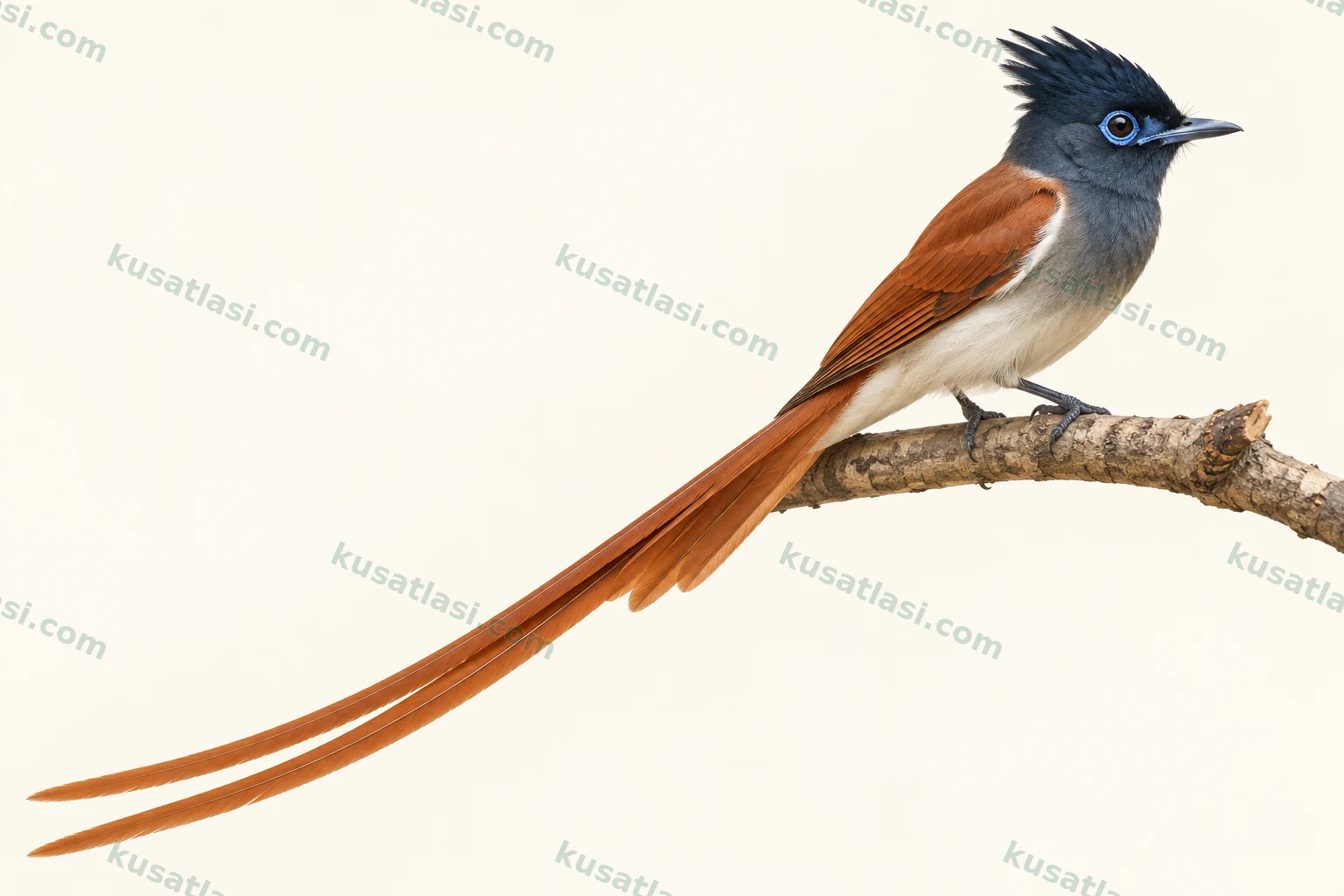
World Birds IUCN statusLC · Least ConcernGlobal IUCN category. BirdLife v10 (2025); taxon matching: AviList 2026 / IOC 15.2; checked: 29.10.2026. The list year is not the species assessment date. Source and method · BirdLife OrderPasseriformesPasserines FamilyMonarchidaeMonarchidae
African Paradise Flycatcher
Terpsiphone viridis
An active crested insectivore with grey underparts; males occur in rufous and white forms, with long central tail streamers that females lack.
Biometrics
Length
Male18 cm
Female18 cm
Shared species value
Wing length
Male7.94 cm
Female7.94 cm
Shared species value
Weight
Male10–20 g
Female13.5–14.5 g
Female weight is the recorded range for T. v. suahelica in North Nandi Forest, Kenya; it is not a species-wide limit.
African Paradise Flycatcher
Suitable woodland of sub-Saharan Africa and southwestern ArabiaObservation guide in its natural range
Look for three features together
Do not rely on a single featureLook for the dark crown and, with a good view, the blue eye-ring.
The breast and belly are grey; a rufous back alone does not identify the species.
Elongated central feathers are a seasonal feature of the adult male.
Compare male and female
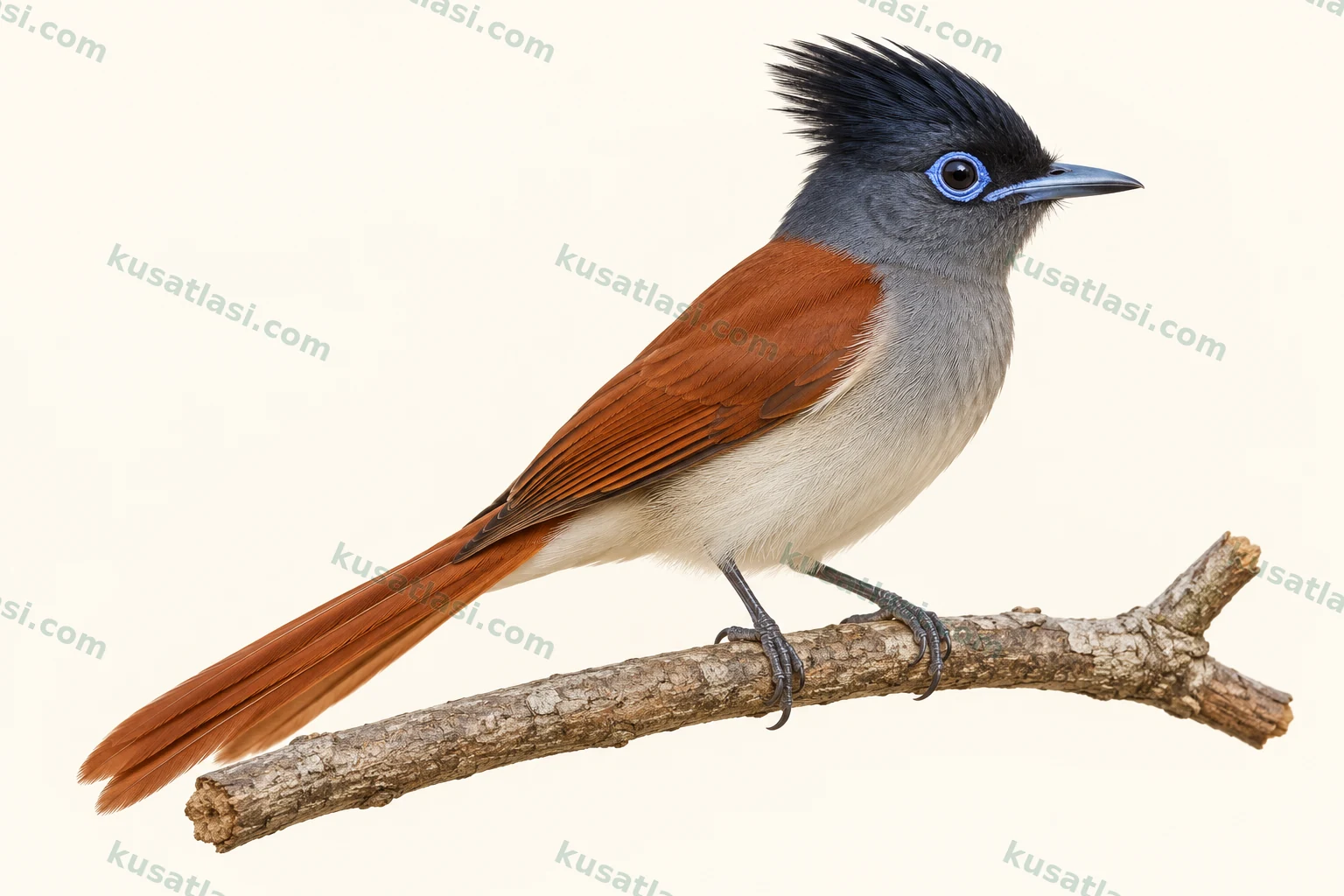 FemaleMale
The male’s long central tail streamers are seasonal. Females have a smaller crest and young birds have greyer heads. White male plumage is not interpreted as a juvenile appearance.
Where to look in its natural range?
Watch natural openings in riverside woodland; do not obstruct flights associated with care around the nest.
A regional breeding example from the southern African atlas is shown; the same calendar is not applied to the resident Arabian population.
January
Residency or seasonal movement varies with subspecies and region. Southern African atlas, eastern region: nest and breeding records, more pronounced in November–December.
February
Residency or seasonal movement varies with subspecies and region. Southern African atlas, eastern region: nest and breeding records, more pronounced in November–December.
March
Residency or seasonal movement varies with subspecies and region. Southern African atlas, eastern region: nest and breeding records, more pronounced in November–December.
April
Residency or seasonal movement varies with subspecies and region. No verified regional date specific to this month was supplied; this does not mean local absence.
May
Residency or seasonal movement varies with subspecies and region. No verified regional date specific to this month was supplied; this does not mean local absence.
June
Residency or seasonal movement varies with subspecies and region. No verified regional date specific to this month was supplied; this does not mean local absence.
July
Residency or seasonal movement varies with subspecies and region. No verified regional date specific to this month was supplied; this does not mean local absence.
August
Residency or seasonal movement varies with subspecies and region. No verified regional date specific to this month was supplied; this does not mean local absence.
September
Residency or seasonal movement varies with subspecies and region. Southern African atlas, eastern region: nest and breeding records, more pronounced in November–December.
October
Residency or seasonal movement varies with subspecies and region. Southern African atlas, eastern region: nest and breeding records, more pronounced in November–December.
November
Residency or seasonal movement varies with subspecies and region. Southern African atlas, eastern region: nest and breeding records, more pronounced in November–December.
December
Residency or seasonal movement varies with subspecies and region. Southern African atlas, eastern region: nest and breeding records, more pronounced in November–December.
Nest, egg and incubation
Both adults build a small cup nest. The southern African account gives one–four eggs, 11–19 days of incubation by both sexes and 10–16 days of development in the nest; the Arabian account gives two–three eggs, 12–14 days of incubation and 14–16 days in the nest in a separate regional context.
The voice includes harsh short calls and more musical flowing series; voice alone does not determine colour form or sex.
Do not play recordings to attract birds; observe quietly, especially near nests.
Species information
Quick Identification
The African Paradise Flycatcher, Terpsiphone viridis, is a small conspicuously crested bird feeding actively among trees and scrub. Assess dark head, grey underparts and, in most forms, rufous-brown upperparts together. An adult breeding male may grow two central tail feathers into narrow streamers. Females lack them; searching only for long tails overlooks females and young. Mainly white male forms also occur, so one rufous scheme does not cover the species.
African Paradise Flycatcher identifies this taxon, not all African monarch flycatchers. Grey underparts, crest shape, wing and tail patterns must be combined. Warm back colour alone can mislead in shaded edges. If head or underside was unseen, keep clear which marks actually support identification.
General Appearance and Posture
The dark adult head and crest show blue gloss in suitable light. A clear blue eye-ring and blue-grey bill help close views; the broad-based bill tapers to the tip. Shade may remove gloss without another species being present. Raised or lowered crest changes head shape. Combine crest, underparts and tail rather than one momentary posture.
In rufous forms, warm brown back and wings differ from grey breast and belly. White males have another pattern within the same taxon, not automatically an age or disease sign. Subspecies vary too; one region's photograph does not represent every feather throughout Africa and Arabia. State the anatomical location of each colour.
After a short perch wait it may enter an air gap and return to cover, with the slim tail prominent behind. Watch crest and underpart pattern as well as tail length. Leaves can hide tail feathers and motion blur is not a real feather edge. Waiting for another natural passage gives better detail.
Males, Females and Young Birds
Adult male central streamers are a strong clue, but not equally developed in every season. Females generally have a smaller crest, paler brown upperparts and no elongated central feathers. Grey underparts matter in both sexes. A hidden tail cannot sex a bird alone; assess visible plumage, season and completeness of view.
Young may have greyer heads, less prominent crests and browner upperparts. This is not a daily-age chart. Features overlap with adult females, so female-like is preferable when view is insufficient. White adult male forms are not assigned to youth. Colour form, age and sex are separate judgements.
Food delivery to nestlings or fledglings can show family association, but does not replace plumage-based sex assessment. Both adults care according to regional accounts. Approaching to identify visitors may alter care frequency. Watch far enough for safe normal entries and exits.
Appearance in Flight
It sallies from a branch for insects and returns to another perch. Male streamers stand out in openings, partly hidden in cover. White or rufous upper appearance depends on light and angle. Seeing grey underparts with the dark head is stronger than one colour fragment.
A short branch flight is not migration. Regional atlases describe seasonal arrivals of some southern populations, but an individual's distant origin needs its own tracking evidence.
Voice and Behaviour
Sounds include harsh short repeated calls and more musical flowing series, not necessarily with the same role. When woodland birds call together, link the sequence to the seen individual. Without crest or tail views, do not infer colour form or sex from voice alone.
It feeds actively in open woodland, riverine forest and scrub and may join other insectivores. Group members are not necessarily one family or nest. Southern seasonal populations and resident southwestern Arabian harterti do not share one annual pattern. One region's calendar cannot represent the entire species.
Similar Species
Trochocercus cyanomelas appears smaller and shorter-tailed in forest. Adult males combine dark head and crest with pale underparts and white wing area; female crest and wing white are less prominent. Compare the full rufous or white upperpart and grey underpart pattern of the African Paradise Flycatcher. A crested dark head alone does not separate them; habitat and wings help.
Rufous-vented Paradise Flycatcher, Terpsiphone rufocinerea, has rufous underparts in appropriate shared geography. Grey below and a more prominent crest help the African species. A rufous back alone cannot distinguish them: the underside must actually be seen. Wait for another view rather than completing hidden belly or undertail in a photograph.
Global Distribution
It inhabits suitable woodland and waterways across much of sub-Saharan Africa. Western, central, eastern and southern populations need not have identical colours or movements. Southwestern Arabian harterti also belongs to the native range, in suitable valleys of southwestern Saudi Arabia, Yemen and southern Oman. Its restricted regional range does not make the whole species Arabian-endemic.
Status Within Its Native Range
Global Least Concern does not mean occupancy of every forest or immunity to local habitat loss. The southern African atlas highlights moist eastern and riverine woods, not equally suitable dry western open country. Arabian accounts emphasise vegetated valleys near water. These examples do not colour entire countries as continuous habitat.
Migration
Southern granti and plumbeiceps show seasonal movements, with atlas arrivals and departures varying by subspecies and location; some northern birds stay longer. The resident Arabian group does not inherit that timetable. One ringing link does not route every individual. Months show stated regional breeding examples, not verified individual migration lines.
Breeding Habitat
Riverine woods, forest edges, vegetated valleys and suitable gardens may form nesting surroundings. Use of the continuous interior of lowland rainforest differs from use of woodland with openings. Southwestern Arabian leafy valleys near water matter; trees alone do not make every dry valley suitable. Read local records with actual cover.
Nest Site
Both adults build a small cup with fine twigs and bark; spider silk and lichens may be used. The southern African specialist account gives one–four eggs, 11–19 days incubation by both sexes and 10–16 days nest development. Arabia gives two–three eggs, 12–14 incubation and 14–16 development regionally. Do not combine ranges into a mean; departure is not full independence.
Daily Space Use
Leafy branches and intervening air gaps provide food. One nest does not prove all nearby gardens equally valuable. Pruning, opening scrub or standing at a nest can change use. Watching from a distant gap while adults deliver food normally is less intrusive than close images.
What Does It Eat?
Insects are principal, with flies, moths, termites and other insects in regional accounts; spiders also occur. If a small flying item cannot be identified, do not give an exact name. Variety does not imply equal daily proportions across subspecies. Prey in a vegetated valley and a forest edge may differ in accessibility.
How Does It Hunt?
It may wait briefly and sally to aerial prey, also taking food from vegetation. Broad-based bill and active short flights fit insect feeding, but every branch change is not a capture. Record actual capture, swallowing or delivery separately when seen.
Mixed feeding parties do not prove following every other bird's catches. Shared insect abundance can gather species. Note feeding height and surface, separating nest deliveries from adult meals. Insect or other bait complicates assessment of natural feeding.
Not Every Bird Has Streamers
The male's two central tail feathers are famous, but females lack extensions and male appearance varies seasonally. Do not exclude short-tailed birds from a long-tailed illustration. Combine crest, grey below and upper colours. A leaf-hidden feather is not proven absent.
Arabia Has Its Own Context
Harterti occupies southwestern Arabian vegetated valleys. Saudi mass, habitat and breeding ranges apply to that group. Southern African seasonal arrival does not apply to all Arabia. Maintaining species and subspecies scope improves colour and seasonal maps.
Both Adults Build the Small Nest
Regional accounts describe both contributing fine plants, spider silk and lichens. Carrying material is breeding behaviour, not egg date or incubation start. One month's construction cannot set exact laying dates for the whole month. Feeding and departure are separate calendar events.
Limits of a Regional Atlas
The atlas links date and region to seasonality, not a live track of the entire map. Arrival months do not define another subspecies' year, and few records are not certain absence. Observations, model and native-range descriptions are different evidence. Habitat and observer visitation frequency are not the same measurement.