

World Birds IUCN statusDD · Data DeficientGlobal IUCN. BirdLife v10 (2025); taxon matching AviList 2026 / IOC 15.2; checked: 29.10.2026. The list year is not the species’ assessment date. Source and method · BirdLife OrderApodiformesSwifts and hummingbirds FamilyApodidaeApodidae
White-fronted Swift
Cypseloides storeri
A dark-bodied swift of southwestern Mexico with white forehead, spot behind the eye and chin pattern; migration status and many breeding details are not yet established.
Biometrics
Length
Male14 cm
Female14 cm
Shared species value
Wing length
Male13.66 cm
Female13.66 cm
Shared species value
Weight
Male39 g
FemaleData unavailable
White-fronted Swift
Southwestern Mexico — Guerrero, Michoacán, Jalisco and ColimaObservation guide in its natural range
Look for three features together
Do not rely on a single featureWhite across the forehead, a pale spot behind the eye and extensive white chin are assessed together.
Dark sooty brown, without a broad white neck ring.
Rapid wingbeats and short glides; alone or in mixed swift groups.
Compare male and female
 FemaleMale
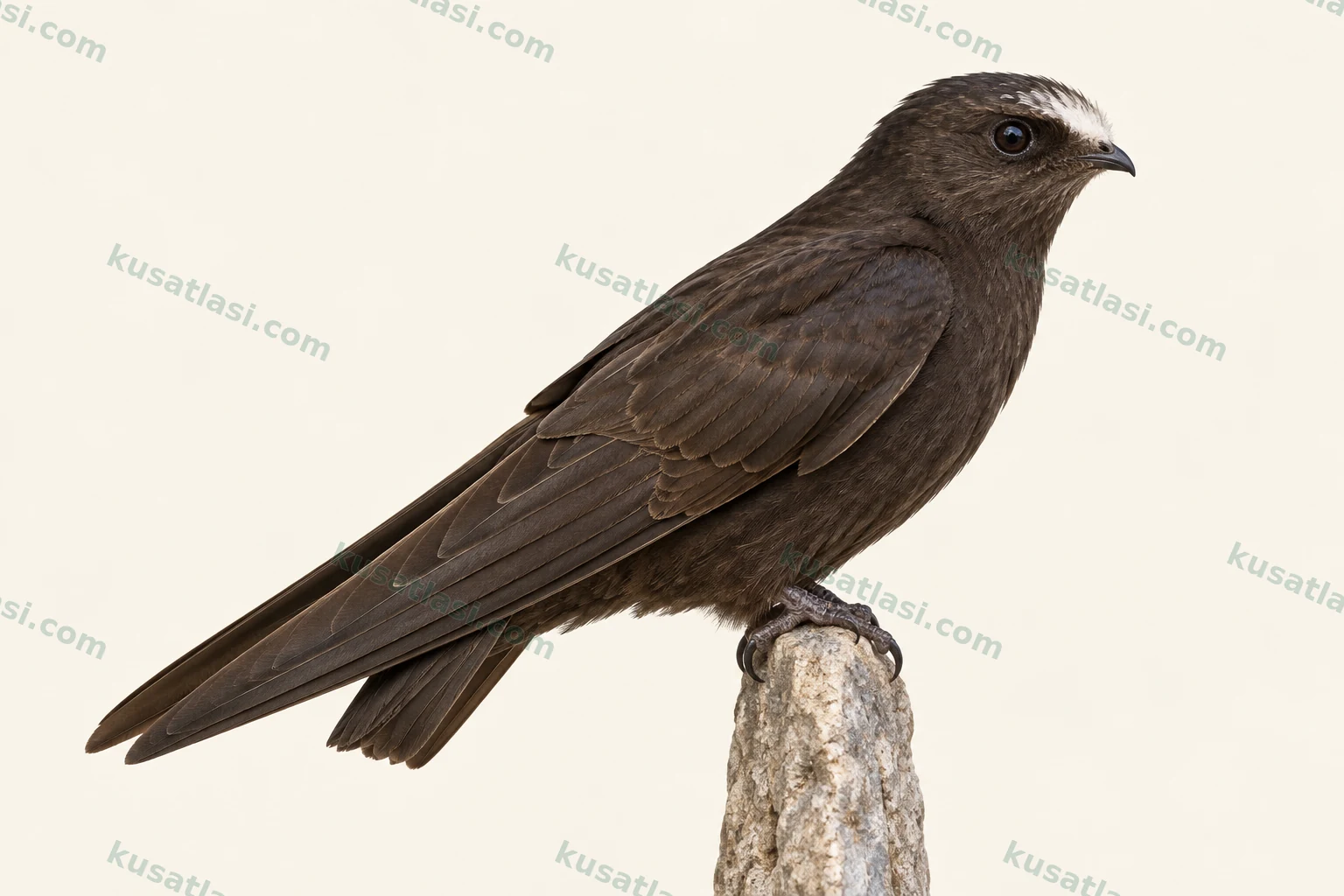
The original small sample showed no conspicuous male–female colour difference. Details of juvenile and sex-related plumage changes remain insufficiently known.
Where to look in its natural range?
Waterfall valleys around Tacámbaro; examine the three pale facial marks from several angles in flying birds. Low coastal records also exist.
Dated direct nest and young-bird records are shown; the exact egg-laying season is unknown.
January
Regular migration and residency have not been established; Mexican records come from different times of year. No verified regional date specific to this month was given; this does not mean local absence.
February
Regular migration and residency have not been established; Mexican records come from different times of year. No verified regional date specific to this month was given; this does not mean local absence.
March
Regular migration and residency have not been established; Mexican records come from different times of year. No verified regional date specific to this month was given; this does not mean local absence.
April
Regular migration and residency have not been established; Mexican records come from different times of year. No verified regional date specific to this month was given; this does not mean local absence.
May
Regular migration and residency have not been established; Mexican records come from different times of year. No verified regional date specific to this month was given; this does not mean local absence.
June
Regular migration and residency have not been established; Mexican records come from different times of year. Tacámbaro, Michoacán — 2022: two nests and adults attending them; one small chick was directly seen.
July
Regular migration and residency have not been established; Mexican records come from different times of year. Tacámbaro, Michoacán — 2022: two nests and adults attending them; one small chick was directly seen. Michoacán — museum record: a recently fledged young bird was recorded; its age was not calculated.
August
Regular migration and residency have not been established; Mexican records come from different times of year. No verified regional date specific to this month was given; this does not mean local absence.
September
Regular migration and residency have not been established; Mexican records come from different times of year. No verified regional date specific to this month was given; this does not mean local absence.
October
Regular migration and residency have not been established; Mexican records come from different times of year. No verified regional date specific to this month was given; this does not mean local absence.
November
Regular migration and residency have not been established; Mexican records come from different times of year. No verified regional date specific to this month was given; this does not mean local absence.
December
Regular migration and residency have not been established; Mexican records come from different times of year. No verified regional date specific to this month was given; this does not mean local absence.
Nest, egg and incubation
A rock-roofed niche in a waterfall’s splash zone holds a shallow cup of wet moss and pine needles. One small chick was seen in one nest; exact egg number, incubation duration and age at first flight are unknown.
Specialist comparison of the 2016 recordings describes regularly spaced calls, more muffled than Black Swift’s, with similarities to the closely resembling White-chinned Swift.
Do not play recordings to attract birds; observe quietly, especially near nests.
Species information
Quick identification
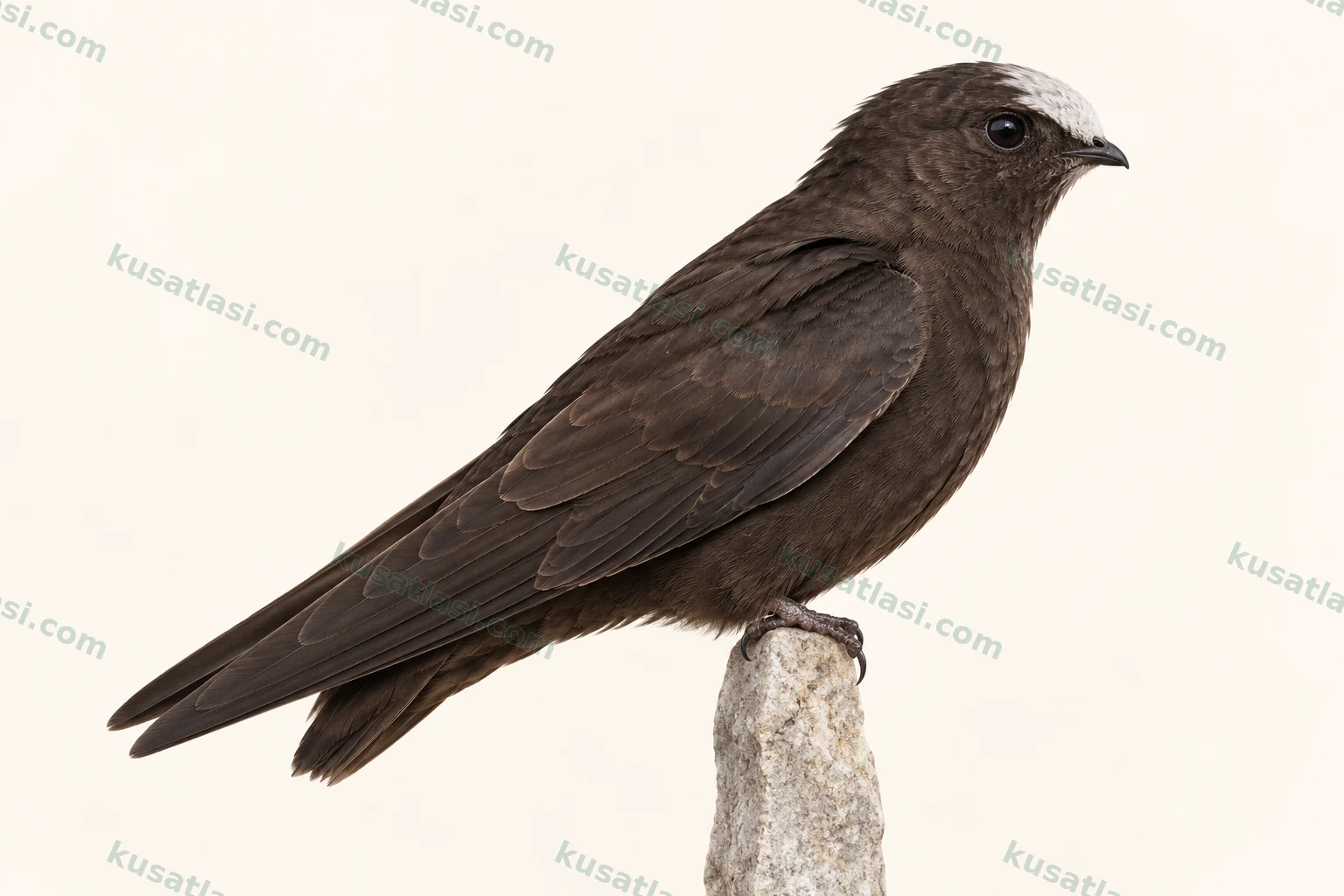
White-fronted Swift Cypseloides storeri is a dark-bodied swift with pale facial marks from southwestern Mexico. White feather edges across the forehead, the pale area between bill and eye, the white spot behind the eye and white chin matter together. These marks may not all be visible at once on a flying bird. Its name should not suggest a wholly white head or breast; most of the body is dark brown-black.
Identification is difficult. A brief pale glimpse on the forehead of a dark swift passing rapidly overhead is insufficient. Views showing the front and sides of the head from several angles are assessed with wing-to-body proportions and tail shape. Adult photographs in the 2024 nest study showed brighter, clearer facial marks than some older guide illustrations. A bird’s actual feather pattern is not rejected merely because it fails to match a faintly printed old picture.
General appearance and posture
The overall colour is dark sooty brown; the underparts may be slightly paler than the upperparts. The shoulders and some wing feathers look blacker. Pale tips to the forehead, area in front of the eye, chin and upper-throat feathers produce a fine frosted whiteness over the face. The spot behind the eye is part of this pattern. The white is not a broad continuous neck ring or a large white belly patch.
The living bird’s eye has been reported as dark brown. Bill and feet are dark. Long wings accompany a tight, relatively slender body. Adults gripping a vertical surface and resting beside a nest were directly observed at rocky nesting sites. Handling the bird or climbing to the nest rock is unnecessary to see normal behaviour; binoculars or a telescope can be used from a safe position opposite the waterfall.
The tail may not show an obvious deep fork in flight. One field description reports a tapering tail that did not spread during the observation. Changes in wing angle may also alter the appearance of the tail tip; successive views are compared rather than imposing an unchanging geometric shape from one frame. This detail is used with the facial patterns of other dark swifts.
Males, females and young birds
No conspicuous sex-related colour difference was seen in the two males and one female examined in the original description. This small sample does not show that every variation with sex and age is resolved. Separate unverified patterns, such as a white forehead for males and a dark one for females, are not invented. Sex that cannot safely be determined in field observations remains unspecified; species identification comes before sexing.
Age-related changes in young birds’ plumage are not known in detail. The 2017 review includes a recently fledged specimen collected in July among the breeding evidence. That record does not show that every young bird has the same feather pattern in a particular month. The small chick directly seen in its nest in 2022 and a flying juvenile are not the same developmental stage; time until flight cannot be calculated from one chick.
One nest was inaccessible and its interior unseen, while a single small chick was observed in the other. The two nests are therefore not assumed to contain equal numbers of eggs or chicks. An adult attending a nest shows care behaviour but does not by itself reveal the day of incubation. Unknown age and sex details are not filled with descriptions of a closely related species.
Appearance in flight
Field observations describe rapid wingbeats followed by short, direct glides. Some observers compared the appearance to Chaetura swifts but considered the bird slightly larger. This general flight resemblance does not make the species identical. The relatively conspicuous head carriage, appearance of the wing base and tail angle are checked on the same individual over several passes.
The white forehead is easier to see from in front in suitable light, while the white chin is more reliably visible at head level. The chin’s white contrast may weaken in a photograph taken directly from below. Seeing the pale forehead and spot behind the eye on the same bird provides important support. Flight speed or passing near a waterfall alone does not establish identification.
Voice and behaviour
A specialist review of recordings made at Tacámbaro in 2016 describes calls as more muffled and more regularly spaced than Black Swift’s. The acceleration into rapid chattering heard in Black Swift does not occur in the same way in those recordings. The voice is described as less harsh than Chestnut-collared Swift’s. Because there are also vocal similarities to White-chinned Swift, appearance and geography matter together.
It may hunt alone or in mixed groups with other swifts. In the 2022 research, three White-fronted Swifts were directly identified in a gathering seeking winged termites. Not every bird in the same flock belongs to this species; large White-naped Swifts were also recorded. Evening arrival near a waterfall or rest beside a nest does not mean continued flight throughout the night.
Similar species
White-chinned Swift Cypseloides cryptus is among its closest visual lookalikes. White-fronted Swift has broader white along the middle of the forehead; the pale spot behind the eye and extensive white chin and upper throat provide support together. White-chinned Swift’s white is generally restricted to a smaller area immediately below the bill. A momentarily pale-looking chin is not enough to distinguish them.
Black Swift Cypseloides niger may look larger and longer-winged; its pale-fronted individuals allow confusion if only one head mark is used. The rufous neck pattern of an adult male Chestnut-collared Swift Streptoprocne rutila is important, but is not equally conspicuous at every age and in both sexes. White-naped Swift Streptoprocne semicollaris is larger and has a different pale neck pattern. Comparison within a flock is more meaningful when the birds are at the same distance.
World distribution
The natural range is restricted to the mountains and nearby coastal lowlands of southwestern Mexico. Documented specimens and images come from Guerrero, Michoacán, Jalisco and Colima. The Sierra Madre del Sur and surrounding mountains, deep valleys and waterfalls are important. It is endemic to Mexico; the broad ranges of other Central or South American swifts are not transferred to this page.
Although the first specimens came from mountains, there are winter images from low-elevation Jalisco and documented observations from Colima’s coastal lowlands. All records should therefore not be confined to an altitude band of 1500–2500 metres. Some Oaxaca images have been discussed cautiously; unverified possibilities are not counted as definite natural range or breeding grounds.
Status within its natural range
The conservation assessment is Data Deficient. This does not mean the species is safe or has disappeared; it means there is insufficient information to calculate its risk reliably. The 2017 specialist review explicitly states that frequently quoted population figures lack a sound census foundation. A modelled map area or flock photograph is not a census of the entire population across the continent.
The direct nest research published in 2024 provided new information about the species’ life, but only two nests do not explain its whole breeding range. Difficulty searching for nests at waterfalls and identifying dark swifts in flight are considered together when interpreting the scarcity of records.
Migration and movements
It has not been established whether the species is resident or a seasonal migrant. Records in January, May and summer support the possibility of year-round occurrence in southwestern Mexico; they do not show that the same individuals remain at the same point every season. Movements between mountains and coastal lowlands may relate to weather, but that explanation is not a verified tracking result. No known wintering country, distance or migration line was found.
Breeding habitat
Verified nests are at two waterfalls near Tacámbaro in Michoacán. One waterfall has more open tree and scrub surroundings, the other is beneath closed pine-oak cover. A vertical rock wall, the splash zone of flowing water and a protective rock overhang are important together for a nest. The surroundings where a flying bird feeds and its actual nest recess are separate places.
Nest site
The nest examined in 2022 was a shallow cup made mainly of wet moss and a few pine needles. It lay in a rock crevice on a small horizontal support beside falling water; the rock roof protected it from water falling directly from above. A single very small chick was seen inside. The second nest’s interior was not checked because it was inaccessible. Exact egg number, incubation duration and age at first flight have not yet been verified.
One chick in a nest does not necessarily prove that only one egg was laid. Durations from other species of the same genus cannot serve as measured breeding values for this one. Because the researcher could not see the entire area at three other waterfalls, failure to find nests was not interpreted as certain absence. An observer likewise does not take an obstructed view behind water as proof that the species is absent.
Daily use of space
Flying insects are sought above forest, woodland and more open valleys. Evening hunting and rest near waterfalls have been directly recorded. Approaching the narrow rock recess can disturb the bird and create danger on slippery surfaces. Rather than opening up the nest site or going behind the water, watch normal arrivals and departures from a safe distance.
What does it eat?
It feeds on small invertebrates caught in the air. No detailed study giving year-round food proportions for this species was found. The 2024 nest paper nevertheless offers a specific hunting record: on the evening of 29 June 2022, three White-fronted Swifts were observed hunting winged termites in a valley south of Tacámbaro. This was directly observed prey at a particular place and date; it does not show that all food throughout the year consists of termites.
How does it hunt?
It searches for flying prey with wingbeats and short glides. The termite-hunting record was at treetop level; other feeding flights need not all be at that height. Each bird in a mixed swift group must be identified separately. A large swift’s prey is not recorded as the diet of a neighbouring White-fronted Swift.
An adult attending a chick in the nest is part of care, but the composition of food brought to that nest was not measured in detail. There is no need to attract a bird closer through an experimental feeding attempt to identify small flying insects. Normal hunting direction, height and pale facial marks can be watched together from afar.
The diagnostic specimen was found on a misty night
The original species description of 1992 relates that, during years of fieldwork in Guerrero, a bird was found gripping a towel at a camp on a misty night. Initially thought to be a Black Swift, that specimen later looked different in museum comparisons. Further specimens from a Michoacán collection were included in the examination. The event shows that even a species subsequently described can long go unnoticed among birds of very similar appearance.
Nest information followed the description by thirty years
The species was scientifically named in 1992; direct nest details appeared in a 2024 paper based on observations from 2022. Only one of the two nests could be seen inside. This new information changes the older judgement that the nest was unknown; it does not simultaneously resolve egg number and developmental durations. Scientific knowledge advances with new observations, while remaining gaps are identified separately.
Old illustrations may make the face too faint
Horvath’s adult photographs at the nest show conspicuous white forehead, spot behind the eye and extensive white chin. The research discusses the possibility that some old guides relied on low-contrast museum photographs. A live bird in good light and a photograph of a preserved museum specimen may not show the same contrast. Knowing where the white lies is therefore more valuable than copying only the darkness of the colour in an illustration.
Lack of data is a conservation category
Data Deficient does not say threats are absent. Few records, difficult identification in flight and inaccessible waterfall nests limit reliable assessment. The 2017 review questioned the sound basis of the large population numbers being repeated. Finding a new nest is a valuable development; even so, that discovery does not replace a population census throughout the range. Photographs and dated field records help reduce gaps in conservation assessment.