

World Birds IUCN statusNT · Near ThreatenedGlobal IUCN. BirdLife v10 (2025); taxon matching AviList 2026 / IOC 15.2; checked: 29.10.2026. The list year is not the species’ assessment date. Source and method · BirdLife OrderPasseriformesPasserines FamilyMonarchidaeMonarchidae
White-collared Monarch
Symposiachrus vidua
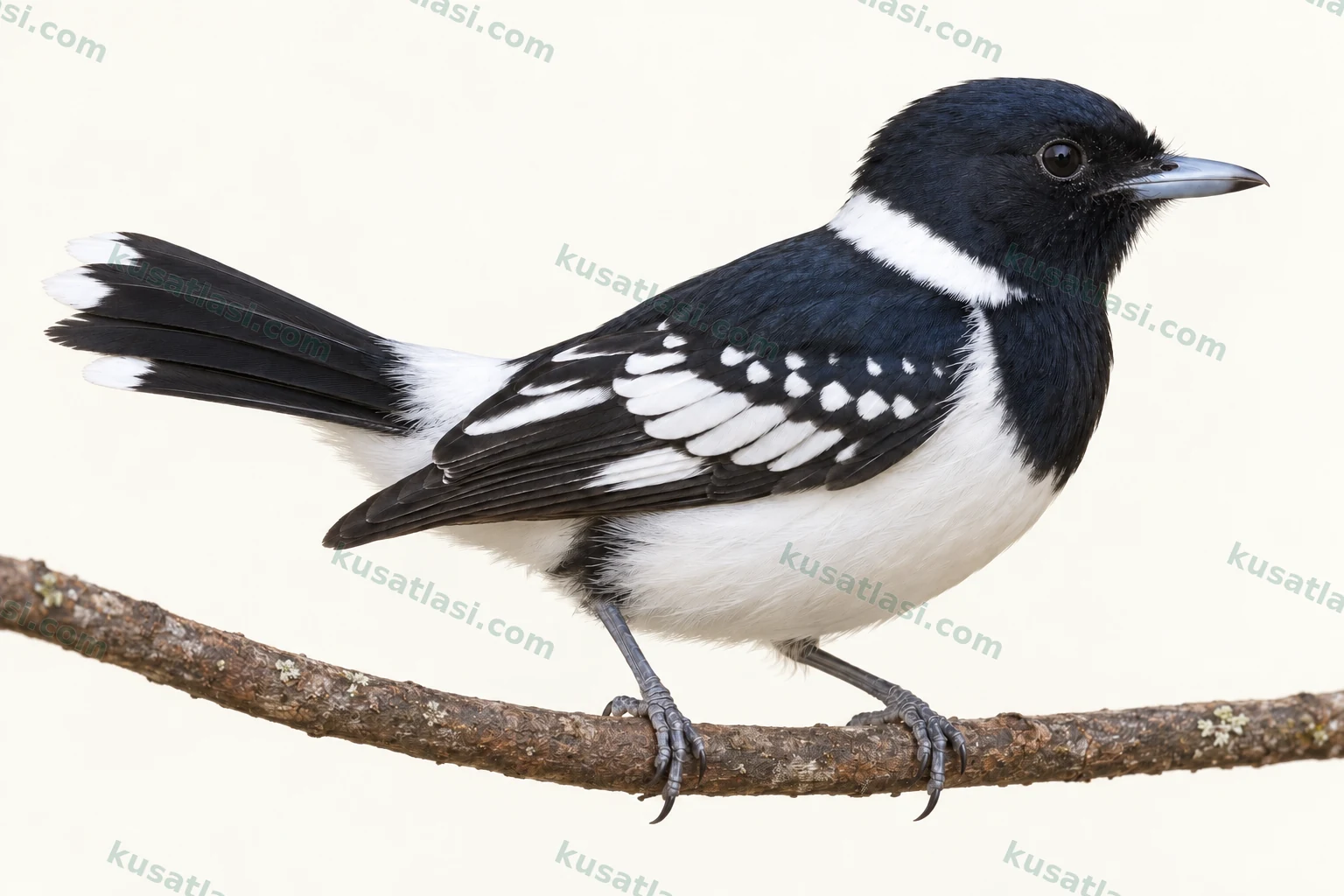
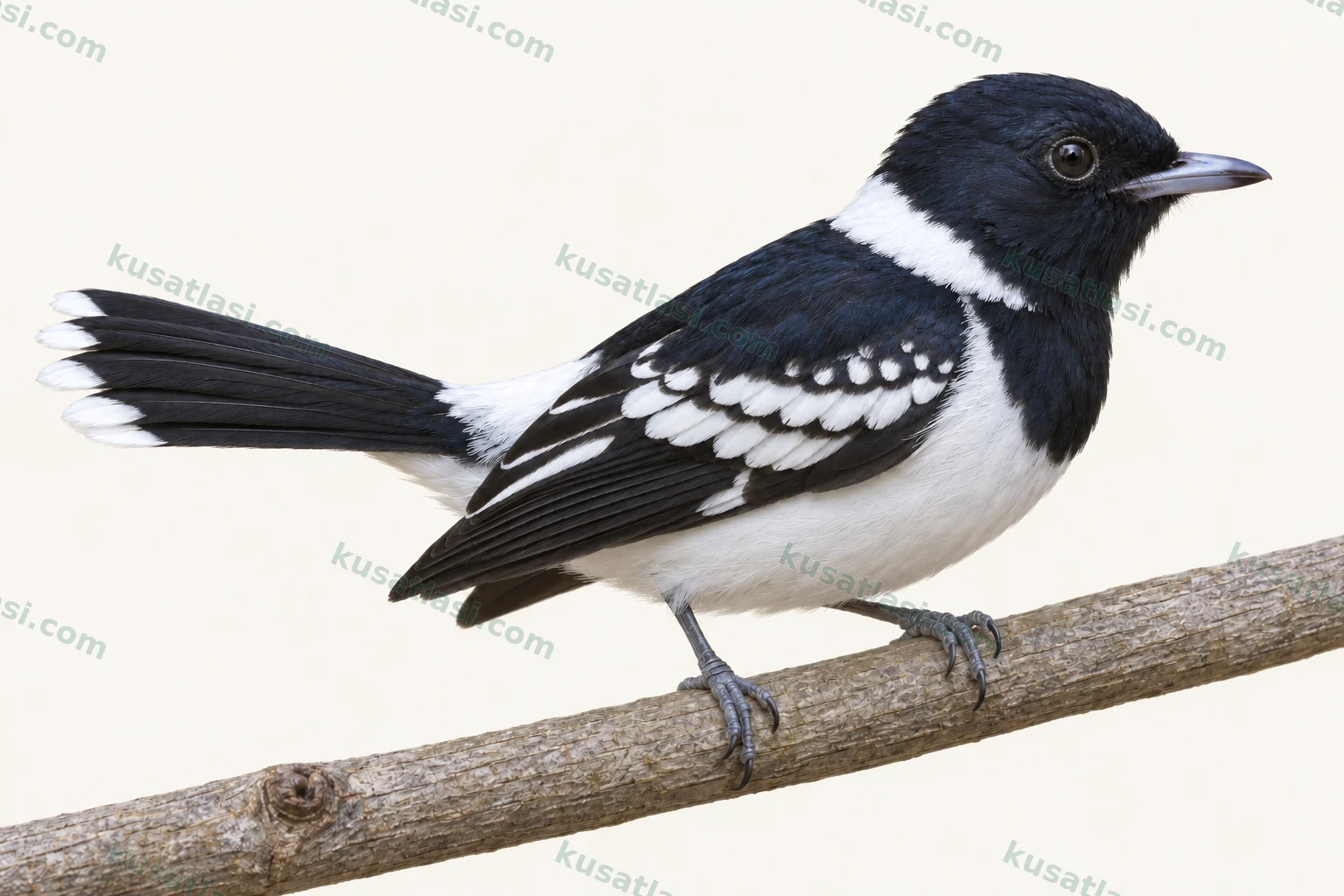
Dark cheek and head; a white collar at the neck sides and pale scaling on dark wings. Endemic to Makira and Ugi.
Biometrics
Length
Male15 cm
Female15 cm
Shared species value
Wing length
Male7.57 cm
Female7.57 cm
Shared species value
Weight
Male16–19.5 g
Female16–18 g
White-collared Monarch
Makira and Ugi, Solomon IslandsObservation guide in its natural range
Look for three features together
Do not rely on a single featureSee how the white relates to the neck sides and nape rather than the cheek.
Assess pale pattern and dark feather edges together.
Compare male and female
 FemaleMale
Island forms are not sex differences. The sources did not provide a complete field key to sex and age.
Where to look in its natural range?
Humid forest and wooded secondary cover, from canopy to understorey.
Resident. Species-specific breeding months were not verified.
All months: Resident. Monthly breeding status could not be verified. No verified regional date is given for this month. This does not imply local absence.
January
February
March
April
May
June
July
August
September
October
November
December
Nest, egg and incubation
Nest structure, egg number, incubation and young development duration were not verified.
A detailed species-specific voice key was not verified. Match natural calls to the bird you see.
Do not play recordings to attract birds; observe quietly, especially near nests.
Species information
Quick identification
The White-collared Monarch Symposiachrus vidua is a small black-and-white forest bird of Makira and Ugi in the Solomon Islands. The adult's dark head and cheek are framed by a white collar reaching the sides and back of the neck. White wing areas combine with dark feathers to give a scaled appearance. Seeing the collar's actual position matters more than simply noticing black and white.
The Makira bird does not have a white cheek. This matters against white-cheeked relatives: a pale neck side can be mistaken for the cheek as the bird turns. Follow the area behind the eye to the nape. If a branch hides it, do not supply unseen white by assumption. Island identity and plumage marks are assessed together. An island name cannot identify a poorly seen bird with certainty.
General appearance and posture
The historical specimen description gives a white lower back and rump, blue-black head and upper back, and white belly. These colour areas are read alongside the dark cheek and patterned wing described in recent research. The blue sheen changes with light. Looking black in a dark forest photograph does not establish another species. A pale lower back does not mean the whole back is white.
The combination of pale wing-covert marks and dark edges matters. At a distance these can merge into one broad patch. Without seeing feather boundaries there is no need to estimate the number of scales. First establish whether the pale area belongs to the wing, neck or lower back. Posture changes its apparent size. Patch width in one image is not a precise measured difference between birds.
Males, females and young birds
The historical adult male specimen has been matched to the current taxon. It cannot supply all female and juvenile details. The primary studies examined did not provide a complete field key to sex and young plumage. A dark or pale photograph alone does not establish male, female or young.
Makira and Ugi forms are included in one species in the current list. Island-form differences are not turned into sex differences. Results from Makira samples in modern genetic research do not explain every Ugi bird's appearance or behaviour. Leaving age or sex uncertain does not devalue the species record. With sufficient species marks, those two fields can remain open separately.
Appearance in flight
Dark wings and pale areas can contrast in flight, but collar and cheek easily disappear during a small bird's quick forest crossing. A spread-wing image may not show the entire perched pattern in the same way. Without identifying the visible surface, upperwing scaling is not described as a certain underwing mark.
A black-and-white bird flying among branches is not identified by that alone. Compare head, neck and lower back when it reappears naturally. Another bird may also have joined the group. A limited island range does not make the species flightless. A scientific hypothesis about crossing seas is not a proven rule explaining daily flight within forest.
Voice and behaviour
The Makira field study recorded the species as a conspicuous core member of mixed-species foraging flocks. This description belongs to that research setting. Not all birds sharing a branch in such a flock are monarchs; check each bird's plumage separately. Feeding together does not prove shared nest care or a pair bond.
The primary sources examined did not give a species-specific account safely distinguishing all vocal types. No single syllable sequence is therefore made a certain voice key. Associate a natural call with a visible individual, without assuming that another forest bird's sound comes from this monarch. Repeated playback to bring it close also makes the flock's natural movement harder to assess.
Similar species
Against Solomon monarchs such as Symposiachrus barbatus, cheek white and wing pattern matter together. The Makira form of the White-collared Monarch has dark cheeks. This comparison does not mean all relatives share one island. Without the actual photographic island, the entire archipelago inhabited by similar birds is not one observation locality.
Makira's Monarcha castaneiventris megarhynchus has been recorded in the same forest flocks. Compare its chestnut underparts, indicated by its name, with this species' pale underparts. Do not fill in a colour hidden by shade or branches. Two small black-headed birds in one group need not be the same species. Collar, cheek, wing and underparts are assessed together.
Global range
The natural range is limited to Makira, formerly San Cristóbal, and nearby Ugi in the eastern Solomon Islands. It is not represented as occurring throughout the archipelago. Match historical specimen localities to modern island names. San Cristóbal and Makira are not two separate range centres. A similar monarch recorded on another island of the same country does not become this species' record.
Status within its natural range
The current taxonomic list gives Near Threatened status. Records from several Makira forest sites do not mean the total population is known. Being easy to find locally and having a narrow natural range are separate matters. Changing forest use may affect links between suitable island habitats. Dated local results of one study are not current global population totals.
Movements and migration
It is a resident island bird, without a verified long-distance seasonal route. Historical dispersal between islands discussed in genetic work is not present-day annual migration. A forest flock's short progress is not evidence of a sea crossing. Joining Makira and Ugi records with a line does not trace a tracked individual. The map therefore gives the natural island setting and verified records separate meanings.
Breeding habitat
Humid island forest and wooded secondary vegetation are parts of its habitat. The Makira study found higher local density in moderately altered areas. This does not show that complete forest clearance is beneficial or that every monoculture supports safe breeding. Feeding observations and direct nesting records are assessed separately.
Nest site
Species-specific nest structure, usual egg number, incubation and young development durations could not be verified. Nest details of related monarchs were not transferred here. An unidentified carried object is not called nest material. Food carrying and nest building are different behaviours.
Daily habitat use
The study classification describes use of forest levels from canopy to understorey. Joining a mixed flock does not imply dependence on the highest branches alone. Do not open branches or damage cover to follow it. Wait at a suitable distance for the birds' natural movement.
What does it eat?
It is classified among forest birds feeding on invertebrates, particularly insects. This field-study feeding group does not identify every prey or its proportion. No detailed species-specific insect list was verified, and other monarchs' menus do not fill the gap. If a small item in the bill is unrecognizable, do not name a definite prey.
How does it forage?
It can use different forest levels while foraging in mixed flocks. Research shows that relatives with similar body structures can differ in foraging behaviour between islands. Wing shape therefore does not establish a single hunting method. Record movement separately from successful capture: reaching along a branch may not mean food was taken. Moving with other species does not show that all share the same prey. Baited observation does not represent natural forest feeding.
Similar birds need not forage alike
Solomon Islands research compared body structure and foraging at community level. The simple relationship weakened when close relatedness was taken into account. This limits prediction of all a monarch's behaviour from its bill or wing. Direct behaviour observations take the place of inference from appearance alone.
Island history is not a migration calendar
Genetic family trees may not establish the exact order in which birds reached islands. Gene flow between populations can affect interpretation of the tree. Models of Makira's isolation do not mean that present birds migrate across particular seas every year. Historical dispersal and seasonal movement occur at different scales.
Local abundance does not justify forest loss
The higher density in moderately modified Makira cover was observed in that place and study. Increased feeding opportunities were discussed as one possible explanation, not the sole proven cause. Further alteration does not therefore mean the bird will always increase.
An old name is not a new bird
The historical specimen was described as Piezorhynchus vidua; the currently accepted genus is Symposiachrus. San Cristóbal is also the historical name of Makira. Old names do not establish a second bird or island. Scientific name, specimen locality and current taxon are matched together. An old record alone does not determine today's population size or conservation status.