

World Birds IUCN statusLC · Least ConcernGlobal IUCN category. BirdLife v10 (2025); taxon matching: AviList 2026 / IOC 15.2; checked: 29.10.2026. The list year is not the species assessment date. Source and method · BirdLife OrderApodiformesSwifts, hummingbirds and allies FamilyApodidaeApodidae
White-collared Swift
Streptoprocne zonaris
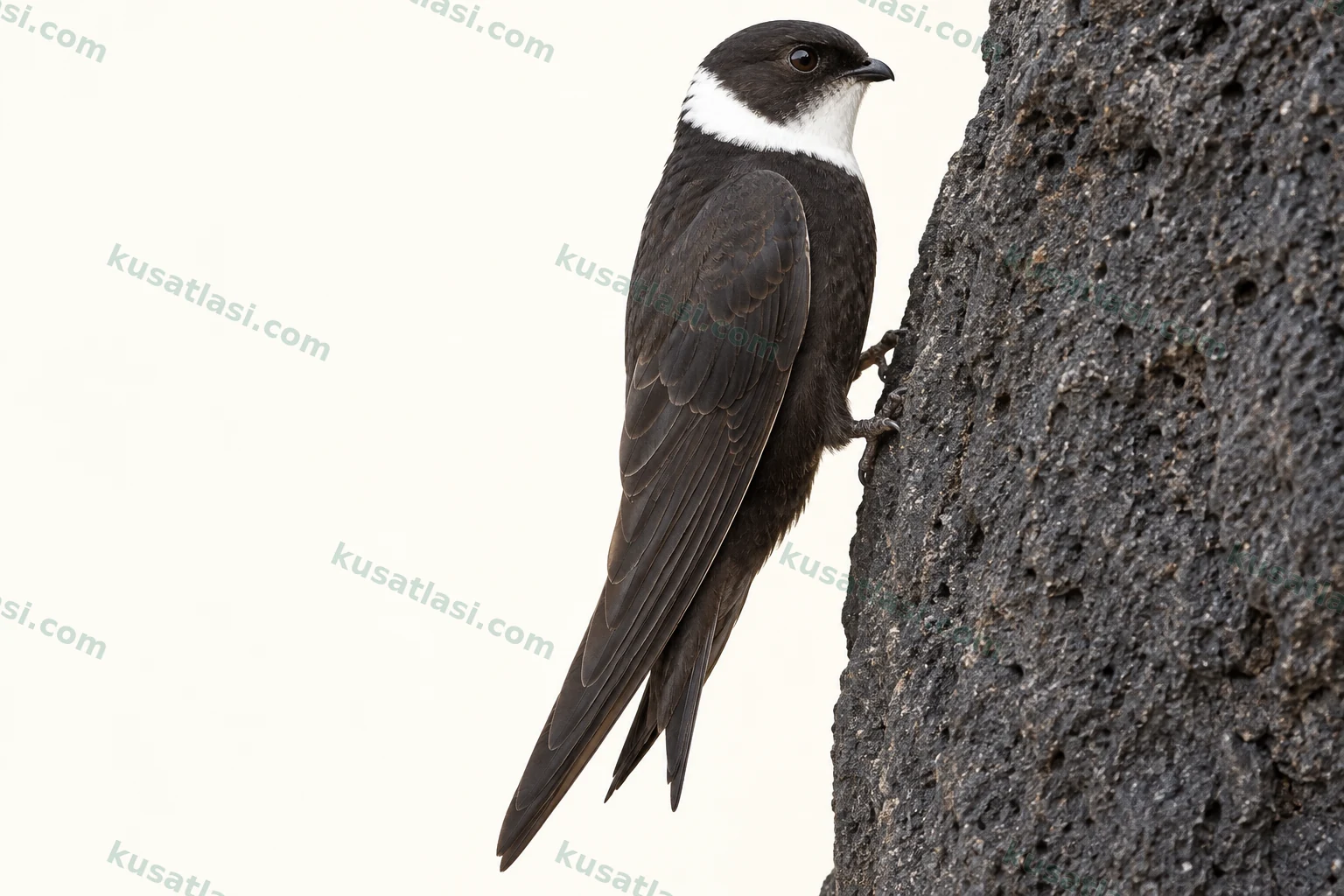
A large dark-bodied swift with a complete white neck collar and a tail that looks forked at a suitable angle.
Biometrics
Length
Male22 cm
Female22 cm
Shared species value
Wingspan
Male45–55 cm
Female45–55 cm
Shared species value
Weight
Male90–125 g
FemaleData unavailable
White-collared Swift
Mexico, Central America, the Antilles and South AmericaObservation guide in its natural range
Look for three features together
Do not rely on a single featureCheck whether the white joins across the nape, sides and front.
Remember that a closed or worn tail can hide the fork.
Compare male and female
 FemaleMale
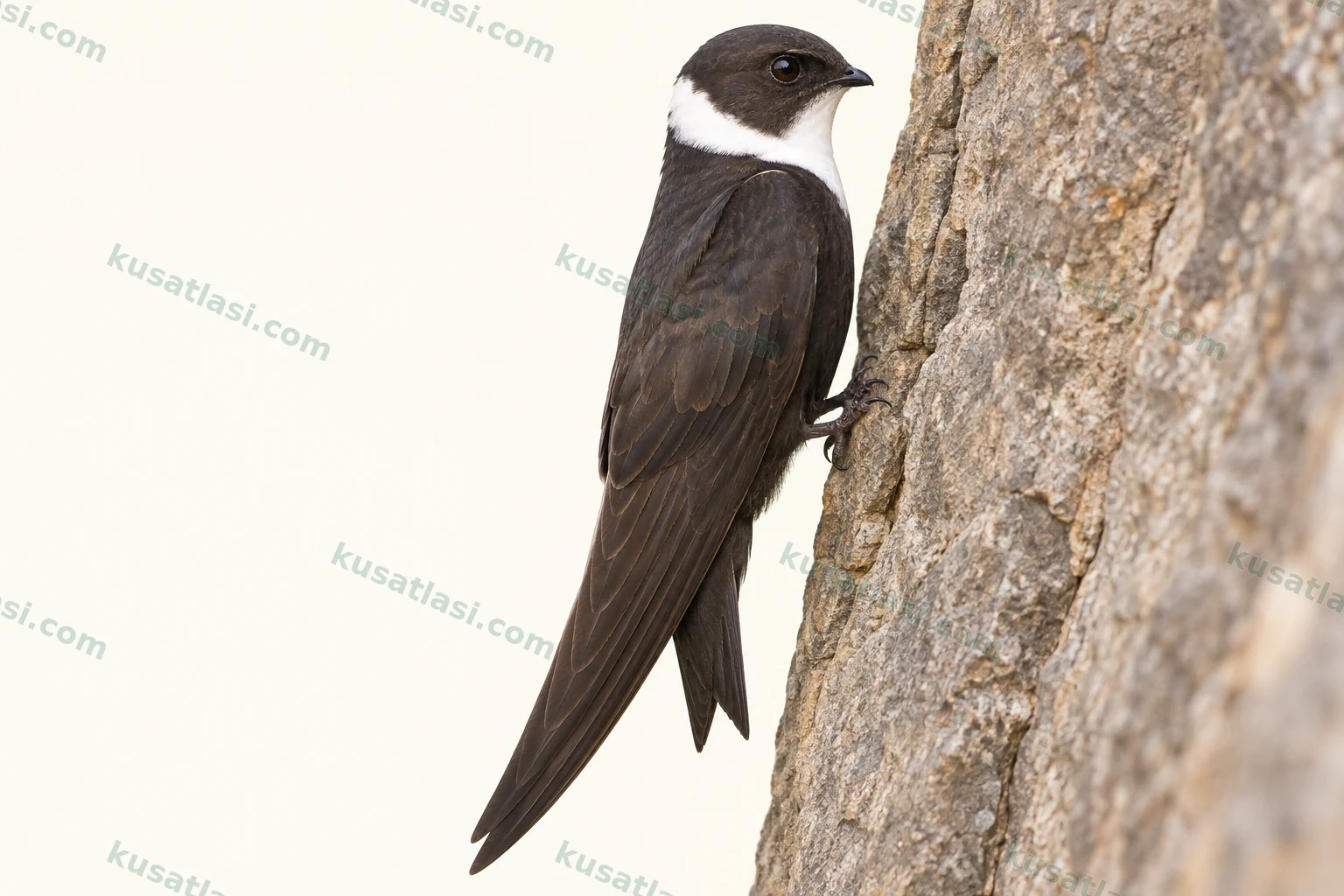
No reliable male–female colour difference usable at a distance was found.
Where to look in its natural range?
Around caves and waterfalls; over forests and open areas while feeding.
Breeding timing is regional; separate field records are available for Costa Rica and southeastern Brazil.
January
Regional movements; breeding months are not the same throughout the range. No verified regional date is given for this month. This does not imply local absence.
February
Regional movements; breeding months are not the same throughout the range. No verified regional date is given for this month. This does not imply local absence.
March
Regional movements; breeding months are not the same throughout the range. No verified regional date is given for this month. This does not imply local absence.
April
Regional movements; breeding months are not the same throughout the range. Egg laying in the Costa Rican study.
May
Regional movements; breeding months are not the same throughout the range. Egg laying in the Costa Rican study.
June
Regional movements; breeding months are not the same throughout the range. No verified regional date is given for this month. This does not imply local absence.
July
Regional movements; breeding months are not the same throughout the range. No verified regional date is given for this month. This does not imply local absence.
August
Regional movements; breeding months are not the same throughout the range. No verified regional date is given for this month. This does not imply local absence.
September
Regional movements; breeding months are not the same throughout the range. No verified regional date is given for this month. This does not imply local absence.
October
Regional movements; breeding months are not the same throughout the range. Egg laying in the southeastern Brazilian study.
November
Regional movements; breeding months are not the same throughout the range. Egg laying in the southeastern Brazilian study.
December
Regional movements; breeding months are not the same throughout the range. No verified regional date is given for this month. This does not imply local absence.
Nest, egg and incubation
A platform on a damp rock ledge. The Costa Rican study gives two eggs, 25–27 days of incubation and 43–51 days to fledging.
High screams and rapid chattering sounds; confirm which bird in the flock is calling.
Do not play recordings to attract birds; observe quietly, especially near nests.
Species information
Quick identification
The White-collared Swift Streptoprocne zonaris is a large swift recognized by the white collar around its dark body and its powerful flight. The collar is not merely a small pale throat patch: the white joins the front, sides and back of the neck. The tail tip looks forked at a suitable angle. Size, collar and tail are assessed together; the speed of a single dark bird passing high overhead does not establish its species.
Many individuals may circle while feeding. Other swift species can join them, so the first white-collared bird seen does not identify the rest of the flock. Each bird's neck pattern must be seen separately. From the front, a complete collar and a white area confined to the breast can look similar. Watching the nape and neck sides as the bird turns reduces this uncertainty.
General appearance and posture
The contrast between the dark body and white neck is useful at a distance in flight. Against a bright sky, however, the whole underside can darken and hide the collar. Conversely, strong reflections can make the white look too extensive. Following several turns of the same bird helps separate lighting effects from the real pattern. Neither collar thickness nor wing length can be measured reliably from a very distant view.
Resting and nesting places include caves and rock cavities around waterfalls. A bird approaching such a place is not equivalent to an ordinary songbird using a rock ledge. An observation of a swift staying airborne for a long time is kept separate from a record of entry into a particular nest. Not every bird entering a cave is assumed to be incubating: the same place may also be used for roosting.
Males, females and young birds
These sources provide no reliable colour difference between males and females that can be used at a distance. Collar width or a slightly larger appearance does not establish sex. Two birds at different distances in the same flock cannot be compared directly for size. Adult plates should not be interpreted as evidence of an unverified male–female colour difference.
The white collar alone is insufficient to recognize a young bird either. Breeding studies followed the development of the nestling's feathers and collar in the nest. White therefore does not prove that the bird is an adult that has already bred. Establishing the age of a flying individual requires the condition of developed feathers and the circumstances of observation. Approaching a nestling to determine its age is unnecessary.
Growth monitoring in Costa Rica shows that nestling mass does not increase in a straight line throughout development. A decrease may occur before fledging; this cautions against treating every decrease as illness. Wild young are nevertheless not handled for weighing or removed from the nest. A growth pattern from scientific monitoring cannot diagnose the health of every young bird seen at a distance.
Appearance in flight
Long wings and powerful, agile flight are among the first features to notice when searching for the species. The tail fork is visible only when the tail is spread at a suitable angle. Kirwan's Atlantic Forest comparison notes that separating the two similar species becomes harder with closed tails, and that moult or wear can make the tail of zonaris look squarer. One apparently straight tail tip therefore does not automatically exclude the species.
The complete white collar is not always visible from below or far away either. A natural view near eye level showing the side of the neck is more useful. A hidden nape in a photograph does not prove an absence of white feathers there. If the collar's completeness and tail shape cannot be seen together, the record may remain uncertain. Compare several natural views rather than forcing a definite identification from one frame of a fast bird.
Voice and behaviour
High screams and rapid chattering sequences may come from the flock. Cornell notes that these sounds can sometimes recall parrots. That comparison is not an identification: the calling bird must be seen and its body pattern checked. Matching sound to an individual is especially important when several species occur at a cave entrance.
Some collective movements around caves and waterfalls may involve roosting, others breeding. Counting birds gathering at an entrance does not directly give nest or pair numbers. Do not enter narrow, slippery nesting entrances to follow birds. Watching entries and exits from a natural distance protects both safety and the birds' continued use of the site.
Similar species
The complete white collar matters in comparison with Streptoprocne biscutata, whose collar is interrupted at the sides. Kirwan stresses that this difference is not easy to see during ordinary high flight. A squarer or more forked tail may help, but is not conclusive by itself because of wear and closed tails. Both species can occur in the same flock, so the identification of one bird is not applied to the others.
Streptoprocne semicollaris carries its white especially as a thick nape band. Cornell also describes its very large appearance and association with the mountains of western Mexico. In zonaris, look for the collar extending to the front and sides of the neck. White on the nape seen only from the side is not equivalent to a full neck collar; geography, size and the complete pattern are assessed together.
Global distribution
The natural range extends from Mexico through Central America, the Antilles and a large part of South America. Within this broad region it can occur from mountains to coastal lowlands; not every part of each country is used at the same density. South and Central American breeding studies took place in different climates. Suitable nesting waterfalls in one region do not show that every valley at the same elevation holds a colony.
Status within its natural range
Foraging birds can travel over forests, clearings and settlements. Their nest or roost may lie in another valley; a feeding record is not marked as a separate nest record. The study of Hispaniola shows that even a species considered widespread and resident there can have poorly documented breeding sites. Frequency of daily sightings and detail of nesting knowledge are not the same thing.
Movements and migration
No single fixed migration route is drawn for the whole range. Local movements and regional seasonal changes are assessed in their environmental context. Costa Rican spring laying is not placed in the same months in southeastern Brazil. The map shows the natural region and approximate verified observation points; points in different countries are not joined into one bird's journey. An out-of-range wandering record does not automatically establish regular breeding there.
Breeding habitat
Wet rock cavities, caves and waterfall surroundings are important for breeding. The Costa Rican study examined nests on damp horizontal ledges; in southeastern Brazil both caves and sites behind waterfalls were used. Seeing a bird feeding over open land does not mean it lays in a tree there. Nest sites and the aerial feeding environment are considered separately.
Nest site
A low platform may be made from materials such as mud, roots and moss. The clutches followed in Costa Rica contained two eggs. In three nests, incubation measured 25–27 days and fledging 43–51 days. The Brazilian study's development period of 41–51 days belongs to another region. One successful nest with three young does not mean every clutch contains three eggs.
Daily habitat use
Not every cavity used for roosting necessarily holds a nest. Watch entering and leaving birds from a distance, without shining lights at nests. Water levels and floods can change nesting conditions. Going behind a waterfall to see a colony is dangerous and may obstruct the birds. The observation point must leave their natural entrance route open.
What does it eat?
AVONET classifies the species among birds feeding on small airborne invertebrates. Flying insects form the basis of this feeding method, but each item caught by a particular flock cannot be identified at a distance. Food deliveries observed during breeding research do not provide a fixed daily menu for the whole range. As food quantity, weather and surroundings change, the same bird may change where it hunts.
How does it hunt?
It catches small airborne prey through broad turns and rapid passes. Repeated circling over an area may relate to feeding, but a capture is not assumed on every turn. Species in a flock of several swifts must be followed separately. Flight height alone does not distinguish them reliably. Lights or food used to attract insects alter natural feeding observations; watch the bird's own choice of aerial movements.
The same breeding, in different seasons
Laying was observed from mid-April to mid-May in Costa Rica, whereas it began in late October–early November in the southeastern Brazilian study. These field results are read with their different hemispheres and rainfall conditions. Fitting a widespread species into one country's calendar can misrepresent its breeding.
A nest and an individual's age are different
Marín recorded the use of the same nest site over many years. Long use does not prove that the same adult was present throughout. Recapturing a ringed bird provides stronger individual evidence. Site fidelity, years of nest use and the bird's age are recorded separately.
What three young show
Biancalana's Brazilian study documented a successful nest with three young. This does not invalidate the usual two-egg records; it documents a difference. Explanations of how more crowded nests arise are not established until tested against direct evidence. Young counted and eggs present at the start are not identical numbers either.
Seeing the collar is not always easy
The neck pattern separating similar Streptoprocne can be hidden in fast flight viewed from below. Kirwan's comparison clearly shows the importance of good light and a suitable angle. Closed tails or worn feathers weaken supporting marks too. A recognizable species cannot necessarily be identified in every sighting; an uncertain record can be completed by a better natural view. Recording the surface and mark actually visible helps later comparison. An unseen nape is not the same record as a nape seen to be dark.