

World Birds IUCN statusVU · VulnerableGlobal IUCN. BirdLife v10 (2025); taxon matching AviList 2026 / IOC 15.2; checked: 29.10.2026. The list year is not the species’ assessment date. Source and method · BirdLife OrderPasseriformesPasserines FamilyCorvidaeCorvidae
White-throated Jay
Cyanolyca mirabilis
Small dark blue jay of Mexican mountain forests, with a black-and-white head pattern.
Biometrics
Length
Male23–25 cm
Female23–25 cm
Shared species value
Wing length
Male10.6 cm
Female10.6 cm
Shared species value
Weight
Male49.9–54 g
FemaleData unavailable
White-throated Jay
Guerrero and Oaxaca, southwestern MexicoObservation guide in its natural range
Look for three features together
Do not rely on a single featureDark blue body; black head and white throat and facial border.
Humid mountain forests in Guerrero and Oaxaca.
Pairs and small groups; sometimes mixed feeding flocks.
Compare male and female
 FemaleMale
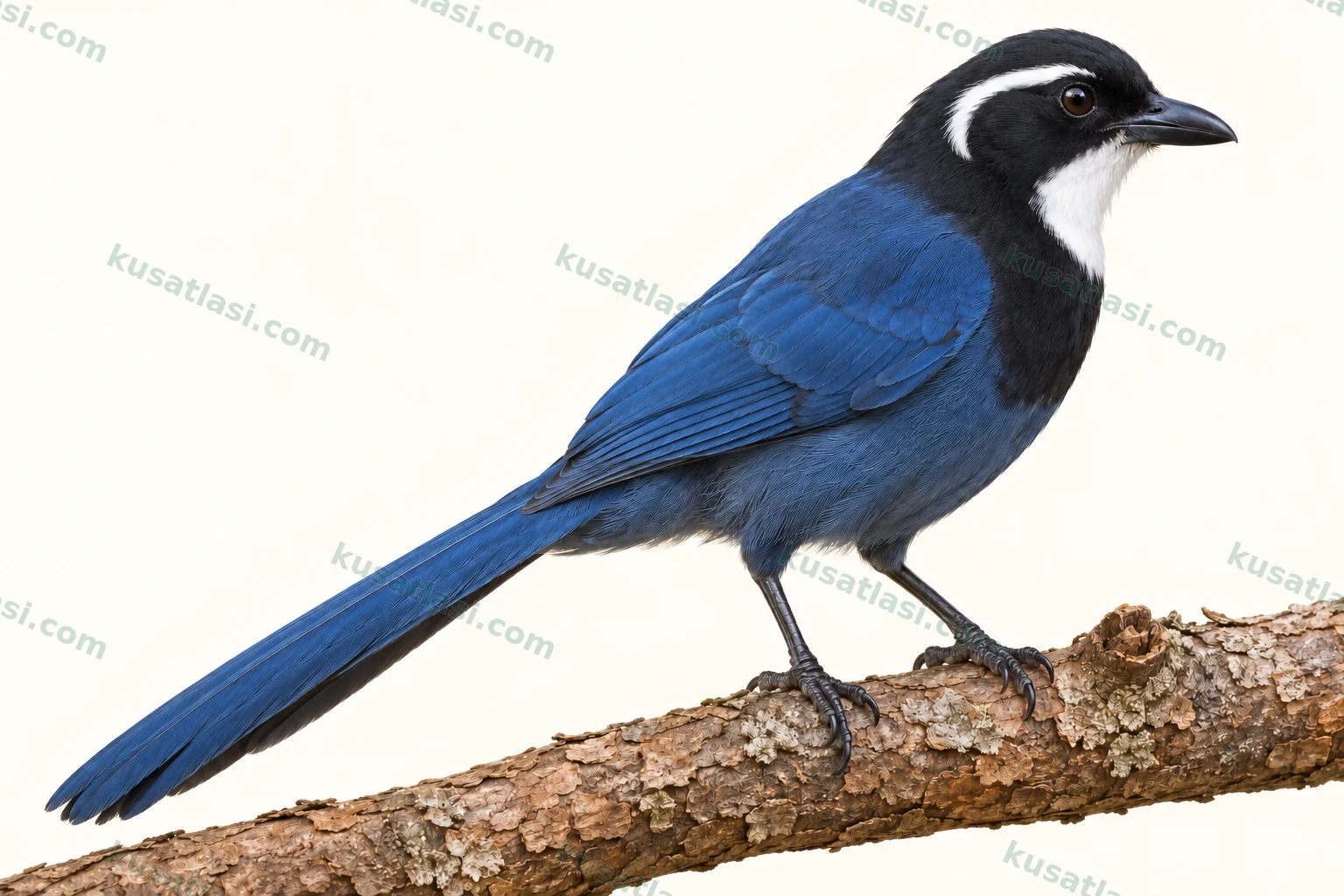
A reliable detailed sex and juvenile plumage key was not verified in this research.
Where to look in its natural range?
Humid pine–oak forests of Omiltemi and the Sierra Madre del Sur.
Resident mountain-forest bird; dated breeding records differ regionally. Historical local breeding records; no definite shared calendar for every month.
January
Data unavailable
February
Data unavailable
March
Data unavailable
April
Mexico: Omiltemi: an older specialist compilation records nests with eggs in April–June.
May
Mexico: Cerro Teotepec: May–June nesting records.
June
Data unavailable
July
Mexico: Cuapango: dated breeding records during June–July.
August
Data unavailable
September
Data unavailable
October
Data unavailable
November
Data unavailable
December
Data unavailable
Nest, egg and incubation
Regional nests-with-eggs records exist; nest structure, typical egg number and incubation duration were not verified.
Often located first by voice in dense forest; an exact syllable sequence was not verified from an original source in this research.
Do not play recordings to attract birds; observe quietly, especially near nests.
Species information
Quick identification
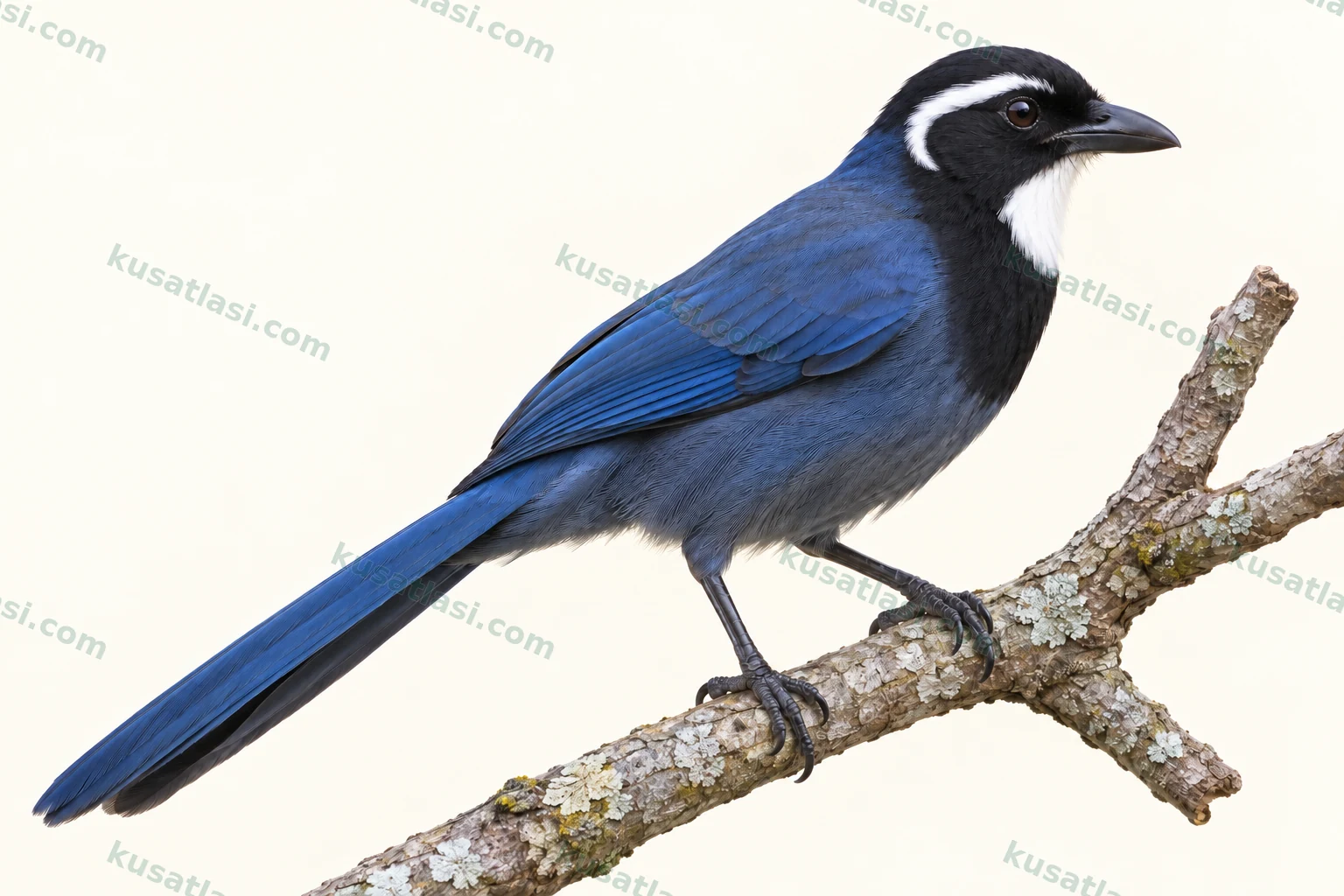
White-throated Jay Cyanolyca mirabilis is a small jay endemic to mountain forests in southwestern Mexico. Its dark blue body, black head and neck, white throat and thin white border around the face identify it together. A black area on the upper breast bounds the white throat below. Dense foliage conceals it, so sound often gives the first clue; larger blue jays may occur alongside it, making a view of the caller important.
It moves in pairs or small groups. Sometimes it feeds in mixed flocks with the larger Aphelocoma unicolor. The most conspicuous blue bird in a flock is not necessarily this species. Examine the smaller individual with the white throat and black-and-white head pattern separately from its larger, more uniformly coloured companions.
General appearance and posture
The overall tone of the upperparts and underparts is dark greyish blue. The white is not a pale belly covering all the underparts; its throat and facial arrangement matter. The face, crown and nape are dark. Do not identify it from a small glimpse of the head before establishing the pattern: look for the white facial border, throat and black upper-breast band together on one bird.
Direct observations around Omiltemi recorded pairs and small groups of 3–4 birds. Other specialist records report 6–8 individuals joining mixed flocks. These examples show social movements, not a flock of one unchanging size throughout the day. Birds may forage at different forest levels and disappear among dense plants.
Two birds appearing successively in dense cover do not reveal their entire relationship. Individuals coming to the same branch to feed may later move to different branches. After checking the visible bird's head pattern, do not assume that hidden birds in the flock belong to the same species. Assess the small blue individuals in a mixed flock separately.
Males, females and young birds
This research could not verify a detailed field key to male, female and juvenile plumages from original sources. Darkness on a male plate or posture on a female plate is therefore not described as a sex distinction by itself. The existence of male and female museum specimens does not mean every bird is easily sexed by appearance.
Breeding records include nests with eggs at Omiltemi and breeding signs at Cuapango. A third or fourth bird in a small group is not necessarily a juvenile or an adult nest helper. Detailed parental roles and a verified juvenile development period were not found for this species; the family systems of related jays do not replace its own evidence.
Appearance in flight
The generally dark blue body and wings may also be seen when the bird changes branches. However, this source search did not verify a special pattern reliably separating the species from an underwing view alone or a distant dark silhouette. Seeing the face and throat is more useful. When a bird reappears after passing behind a branch, use the head pattern to check whether it is the same individual.
It is a resident bird associated with humid mountain forest. Moving through trees with a mixed flock is not evidence of a long seasonal migration. No verified intercontinental flight route was found for this species.
Voice and behaviour
It is often located by voice first in dense forest. Cornell's specialist account stresses sound as a locating clue before its appearance is clear. Pairs and small groups forage within cover at different heights. Associations with larger blue jays occur, but the voices and behaviour of the two species are not interchangeable.
Older Omiltemi observations show that it was not recorded in only one untouched vegetation community. Records also came from disturbed pine–oak woodland and wetter forest patches without pines. These observations show local variety in habitat use. They do not mean that a slope converted to farmland and stripped of tree cover retains the same function.
Similar species
Aphelocoma unicolor is the priority comparison because it may join the same mixed flocks. It is larger and more uniformly dark blue, lacking White-throated Jay's conspicuous white throat and black-and-white head pattern. Examine each bird's head and throat rather than the flock's blue colour alone. Their association does not mean the two names denote one species.
Cyanolyca nanus is another small blue jay of Mexican mountain forests. An older specialist guide describes its throat as paler bluish grey and the side of its face as dark. Look for the more striking black-and-white pattern around White-throated Jay's white throat. The current scientific epithet is nanus; nana in older guides does not denote a third species. General mountain-forest appearances overlap, so small size alone is insufficient.
World distribution
It is endemic to Mexico, restricted to mountain forests in Guerrero and Oaxaca in the southwest. The main geography is the Sierra Madre del Sur in Guerrero and Sierra de Miahuatlán and Sierra de Yucuyacua in Oaxaca. Omiltemi, Cerro Teotepec and San Miguel Suchixtepec are important places in scientific and specialist records. Not every intervening plain or coast is mapped as natural breeding habitat.
Status within its natural range
Its conservation category in the current checklist is Vulnerable. Its restricted, fragmented forest range matters for conservation. The older BirdLife compilation reports locally frequent birds around Omiltemi and Teotepec but fewer records at some Oaxaca sites. These dated observations are not precise current counts. A 2020 Atoyac avifaunal study also records it among resident mountain-forest birds. Regional forest loss, agricultural conversion and logging make conserving this limited range harder.
Movements
It is regarded as resident year-round. Failure by older observers to find it in some months raised the question of possible local movements; studies in suitable habitat in different months nevertheless supported residency. Possible small local movements must therefore not be confused with regular long-distance migration. Some Guerrero records are higher, whereas Oaxaca records concern different mountain belts; those differences do not show one bird migrating between the regions.
Breeding habitat
It uses humid pine–oak and montane evergreen forests. The specialist checklist gives a main elevation belt of 1,800–3,500 m; the older compilation also has dated Guerrero examples down to 1,525 m. Oaxaca records in that compilation are mostly around 2,000–2,600 m. These different scopes are not merged into one rigid lower limit for the whole region.
Nest site
Nests with eggs were reported at Omiltemi in April, May and June. Cerro Teotepec has May–June nesting records and Cuapango June–July breeding records. Detailed nest structure, typical egg number and incubation duration were not verified in this research. Nests and periods of other jay species were not inserted here.
Daily use of space
While feeding it moves through different forest levels, staying hidden among dense plants. It may progress through tree cover with mixed flocks. Omiltemi observations in both pine–oak and wetter forest patches show that forest structure and retained cover matter alongside tree species. Leaving the same elevation belt in place does not compensate for clearing the forest for agriculture.
What does it eat?
Feeding details are limited. Large comparative ecological compilations classify it as a predominantly invertebrate-eating tree bird; this broad category is not a directly measured species-specific stomach-content list. Reliable detailed sources did not verify which insects, how much fruit or what other food it consumes. Acorn caching known in other jays and fixed dietary proportions are therefore not assigned to this species.
How does it forage?
Cornell's specialist account reports foraging at all forest levels, usually concealed in dense cover. Pairs or small groups sometimes join mixed feeding flocks that include larger blue jays. This association shows a shared feeding environment, not that every species takes identical prey. The comparative compilation's tree-foraging category and field reports of searching at different heights provide complementary information about the same bird's habitat.
Local frequency does not widen a restricted range
The older BirdLife compilation describes small groups seen daily around Omiltemi. The same bird can remain confined to a few mountain regions and exposed to habitat loss. A visitor finding several groups at a suitable spot does not show that it ranges across Mexico or is unthreatened. Local encounter frequency and global geographic extent are different measures.
Mountain life may predate present-day competition
A 2023 study of Cyanolyca evolution notes that White-throated Jay occupies a similarly high elevation belt despite not living alongside Cyanolyca cucullata. The authors discuss whether its mountain-belt preference could predate present-day competition with close relatives. This is a scientific interpretation of the past, not a single experiment proving its elevation choice.
Forest conservation can involve local communities
A 2011 conservation study in Guerrero treats this species among the region's important, restricted-range birds. It proposes assessing protected places together with local communities' land management, rather than merely naming them on a map. Protecting pine–oak and humid mountain-forest patches from agricultural and logging pressure is a concrete habitat need for White-throated Jay.
A small jay can hide among larger neighbours
It sometimes joins the same feeding flock as Aphelocoma unicolor. While the larger neighbour is easy to see, the small bird may remain amid dense leaves. Identifying only a flock's most conspicuous bird does not count all its species; the small white-throated individual must be found separately.