

World Birds IUCN statusLC · Least ConcernGlobal IUCN. BirdLife v10 (2025); taxon matching AviList 2026 / IOC 15.2; checked: 29.10.2026. The list year is not the species’ assessment date. Source and method · BirdLife OrderPasseriformesPerching birds FamilyCorvidaeCorvidae
White-naped Jay
Cyanocorax cyanopogon
Brazilian corvid with white nape and underparts, brownish upperparts and a broad white tail tip.
Biometrics
Length
Male35 cm
Female35 cm
Shared species value
Wing length
Male14.17 cm
Female14.17 cm
Shared species value
Weight
Male110–160 g
Female110–160 g
Shared species value
White-naped Jay
Brazilian Caatinga and CerradoObservation guide in its natural range
Look for three features together
Do not rely on a single featureThe body is not entirely blue; back and wings are brownish.
See the white nape and broad pale tail tip together.
Compare male and female
 FemaleMale
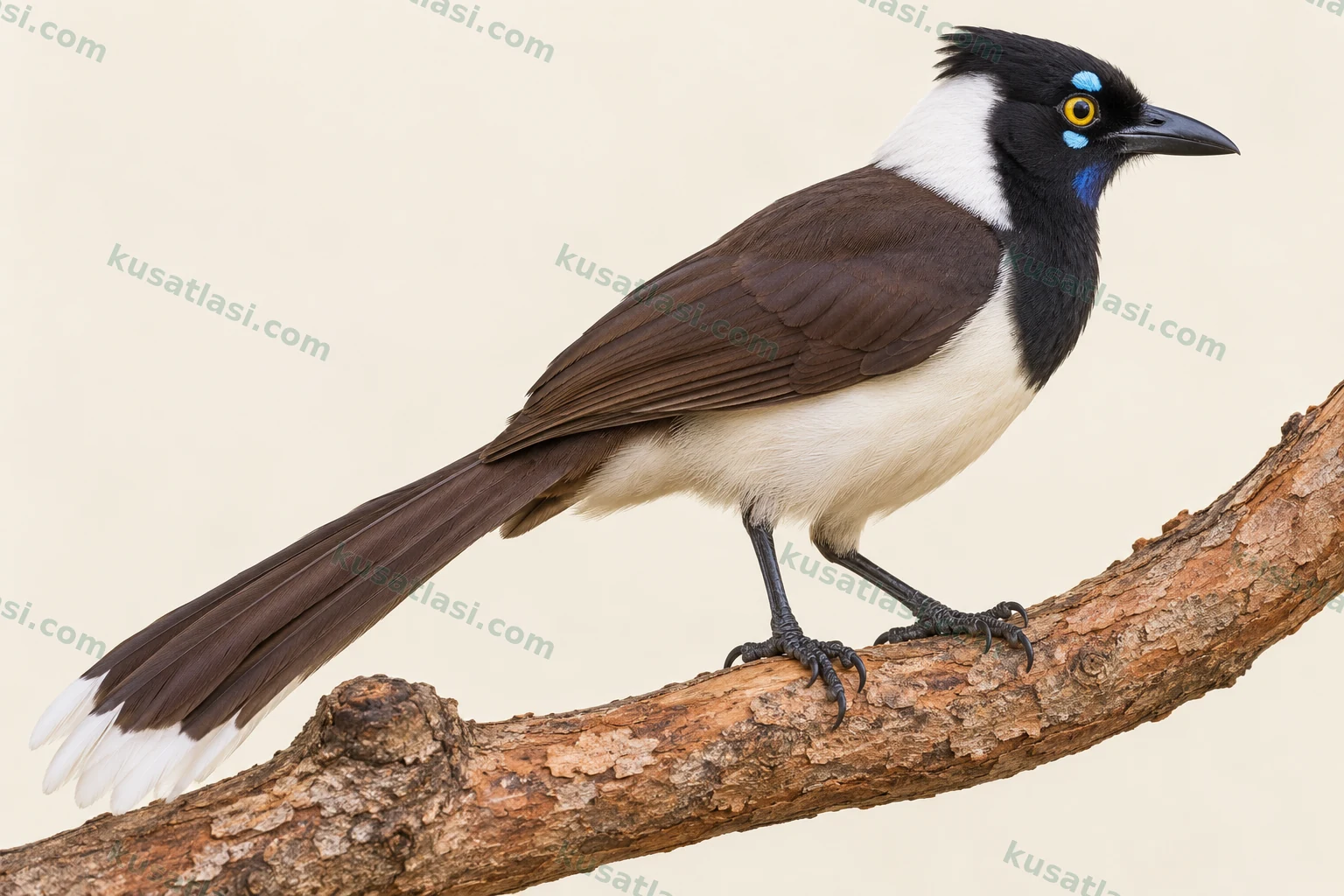
Adults look similar; young birds may have more limited blue marks on the head sides.
Where to look in its natural range?
Dry scrub, wooded savannas and areas surrounded by natural cover.
Verified species-specific breeding months were not found; months of feeding research are not a breeding season.
All months: Resident, with local feeding movements. No verified regional date is given for this month. This does not imply local absence.
January
February
March
April
May
June
July
August
September
October
November
December
Nest, egg and incubation
Old verbal reports of nests and two eggs are not a verified typical value; incubation and development durations were not found.
Wide repertoire with metallic and melodic calls; match the caller visually.
Do not play recordings to attract birds; observe quietly, especially near nests.
Species information
Quick identification
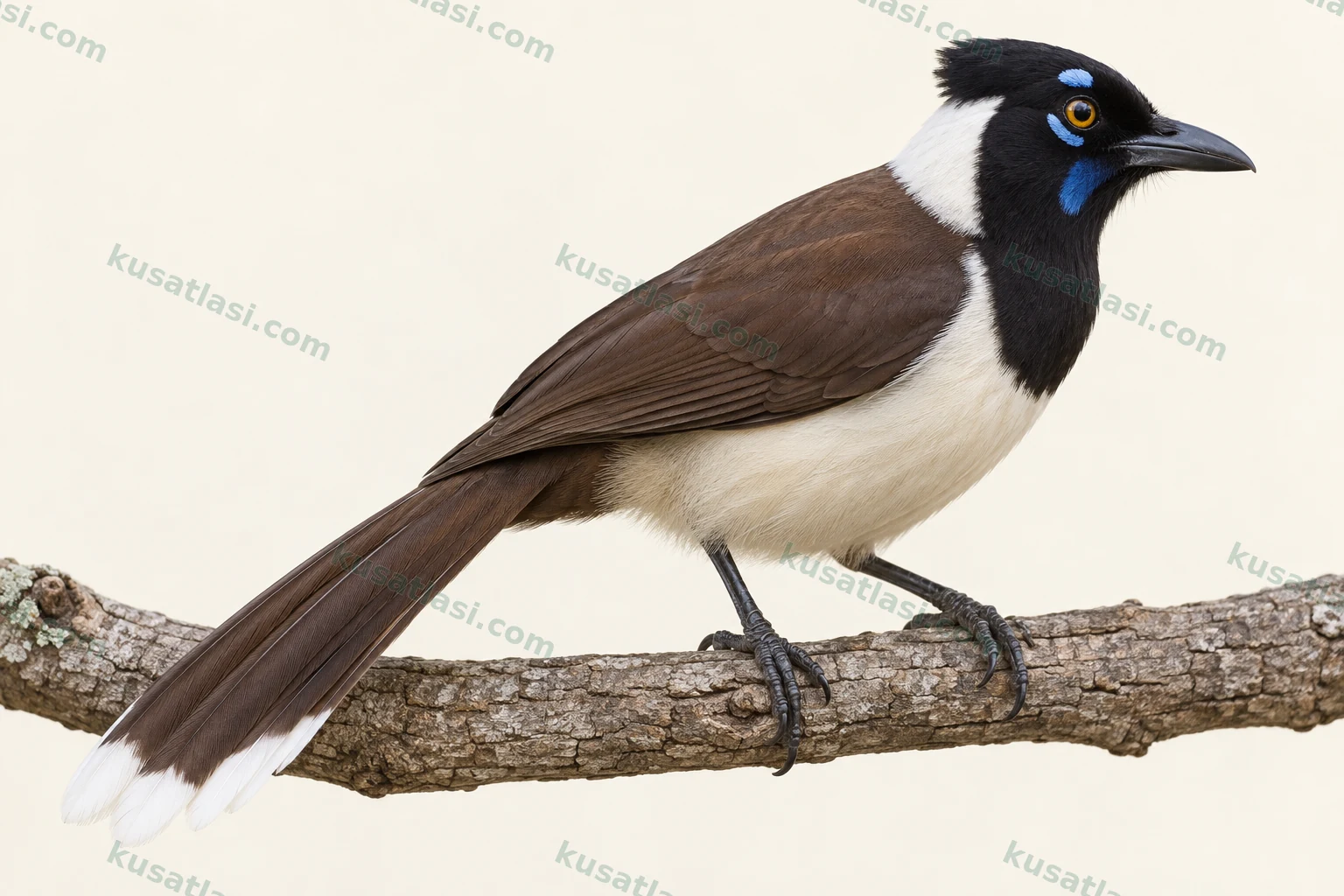
The White-naped Jay Cyanocorax cyanopogon is a corvid of Brazil's open woodland and scrub. Blackish head and throat, white nape, pale underparts and broad white tail tip are recognized together. The word “blue” in its Turkish name does not mean the entire body is blue. Back and wings are dark brownish, while the small blue marks on the head sides occupy more limited areas.
White-naped Jay refers to the same scientific taxon. The nape alone is insufficient: true upperpart colour, underparts and tail tip must be seen on the same bird. A photograph of a related dark-blue-backed species is not accepted as this bird's appearance merely because its neck looks whitish. Natural geography is checked with record identity.
General appearance and posture
Forehead and crown are dark, with dark brown-black head sides and throat. Small blue spots around the eyes and a blue cheek line may be visible. The pale nape lies between the dark head and brownish upperparts. Underparts are whitish, the eye bright yellow and bill and feet dark. Shade, posture and overlapping feathers can alter how clearly these areas show.
The pale tail tip may appear narrower with the tail closed and broader when spread. That alone does not distinguish sex or subspecies. Raised head feathers also change cap height. Image comparisons require similar angles and natural light.
Males, females and young birds
Adult males and females look similar. Apparent size of the pale nape or brightness of blue beside the eye is not a certain sexing key. Marks may seem different in width on a leaning bird and an upright one. While following natural behaviour of several birds, keep unverified sex information separate.
Young birds may have smaller blue areas around the eyes and a narrower, duller cheek line. Failure to see blue in one image is not proof of youth; shade among leaves can hide small patches too. Distinguish truly observed marks from unseen areas when judging age, without creating an exact monthly plumage calendar for every juvenile stage.
Research on hybridization with a related species described museum specimens of intermediate colour. This does not justify calling every unusually coloured bird a hybrid. Wear, juvenile appearance and normal variation must be considered first. Detailed assessment of a museum specimen does not give a distant field view the same evidence level.
Appearance in flight
The white tail tip can help on a flying bird. Yet separation from related species remains incomplete if the nape and upperwing are not seen too. Upper and lower wing surfaces are not described as one pattern. A flight showing only a broad pale tail tip is not a record with all head and body characters verified.
Recheck the brownish back and pale nape when the bird lands naturally. Flight direction describes movement at that moment; crossing one opening does not prove seasonal migration. Birds flying one after another do not alone demonstrate the group's breeding structure. Movement and plumage pattern are separate identification observations.
Voice and behaviour
The specialist account describes metallic, melodic calls and a wide repertoire. Because it can mimic other birds, the caller should be seen where possible. A written imitation does not carry a recording's full rhythm and tone. Match voice to head, nape and body identity rather than naming it from one short note.
The central Brazilian feeding study followed groups of different sizes. Birds gathering around food are not necessarily the same individuals nesting cooperatively. Record the bird taking food and the bird waiting nearby separately. Adding a group's count to another count elsewhere that day without tracking identities may count individuals twice.
Similar species
The Plush-crested Jay Cyanocorax chrysops is the main comparison. Examine its more pronounced crest, bluish nape, blue upperparts and yellowish underparts together. Add the White-naped Jay's brownish upperparts and white underparts to the comparison. One head area can be insufficient given normal variation and possible intermediate appearances.
Possible contact at some range edges means locality does not replace identification. The two intermediate specimens in the 2019 study were interpreted as hybrids through detailed plumage comparison. This limited result does not mean all groups are hybrid or that species boundaries have vanished. Uncertain observations are recorded with their uncertainty intact.
Global range
Its natural range is in Brazil. Northeastern and interior Caatinga scrub and Cerrado wooded savannas form the main geography. The current taxon record refers to the interior plateaus of eastern Brazil. A broad country name does not make all Amazon forest or the entire continent a continuous range of this species.
Areas of possible contact with Cyanocorax chrysops are assessed separately in research. A border-area record does not establish overlap of the species' entire ranges. Locality, scientific identity and date are considered together. Unverified migration corridors are not drawn between regional study sites.
Status within its natural range
Its global category is Least Concern. Feeding on a human-influenced campus does not prove that removing all natural vegetation is harmless. The 2026 Caatinga study associated the species with plots dominated by natural cover. This local result does not support expecting the same success in every degraded area.
Movements and migration
The specialist account treats it as resident. Feeding groups commonly move between trees and openings; this is not a tracked seasonal long-distance migration route. Without a fixed route and distance for the whole population, no such line is drawn on the map. Monthly occurrence frequency alone does not prove breeding or migration.
Breeding habitat
Listed habitats include dry scrub, wooded savanna, stream margins and regenerating woodland. Feeding in an area does not establish an active nest there. A contact boundary with related species cannot be fixed from the vegetation name alone; local bird identity must also be verified.
Nest site
The older specialist account's description of an untidy nest about three metres high and at most two eggs rests on verbal reports; it explicitly says scientific confirmation is needed. Two eggs are therefore not made a certain typical value. Reliable direct incubation and young-development durations and breeding months across the range were not found.
Daily habitat use
Feeding has been recorded on the ground and in tree layers. A settlement or campus surrounded by natural cover does not show that every dense urban area is used in the same way. Follow feeding trees, resting branches and possible nests as separate sites. Assess natural arrivals and departures from a distance instead of disturbing birds by following them to establish a nest.
What does it eat?
The Pontal do Araguaia research recorded insects, spiders and earthworms, along with fruit, flowers and seeds. Ants were frequent items and termites were taken in large numbers in some samples. Human food scraps were used too. This describes work around a particular campus in 2006 and 2010, not an invariant daily menu for all Brazil.
How does it forage?
Ground searching, taking items from plants and bill processing can be observed. Food is sometimes held with help from a foot. Swallowing small prey immediately and removing a piece of large fruit are different behaviours. Record visible handling separately from actual food identity; not every distant bill movement receives the same prey name.
Unsuccessful approaches to other birds' nests in the study are not records of successfully eating eggs or young. Scrap use is not advice to feed birds regularly. Offering food while studying natural items can change behaviour and distort the local diet's interpretation.
Interpret intermediate colours carefully
The 2019 study assessed two museum specimens as hybrids between White-naped and Plush-crested Jays. This plumage comparison updates the older claim of no hybrids. Yet unusual colour in one blurred photograph does not give the same result. Age, wear and viewing conditions remain separate considerations; every pale nape is not an intermediate bird.
Adaptability does not make natural cover unnecessary
The central Brazilian campus feeding study examined a human-influenced site surrounded by natural areas. The 2026 Caatinga work also found the species in plots dominated by natural cover. Results from two settings do not mean all settlements have the same qualities. Using scraps does not replace habitat protection.
A big bill does not prevent every danger
In 2018 a boa catching and eating this species in a tree was directly documented in Bahia. A strong corvid can also be another animal's prey. One event does not make that snake the species' leading cause of death; retain the event's place and date. Alarm calls alone do not establish predator identity unless the predator is actually seen.
A reported egg does not change the evidence level
It matters that the old nesting information is identified as verbal. Such an account can guide new research but does not replace a directly monitored nest series. A related species' incubation period cannot fill the gap. Diet or hybrid research does not mean all breeding details were also measured in the same work. Do not pursue and disturb birds to locate a nest; record natural care movements from a distance.