

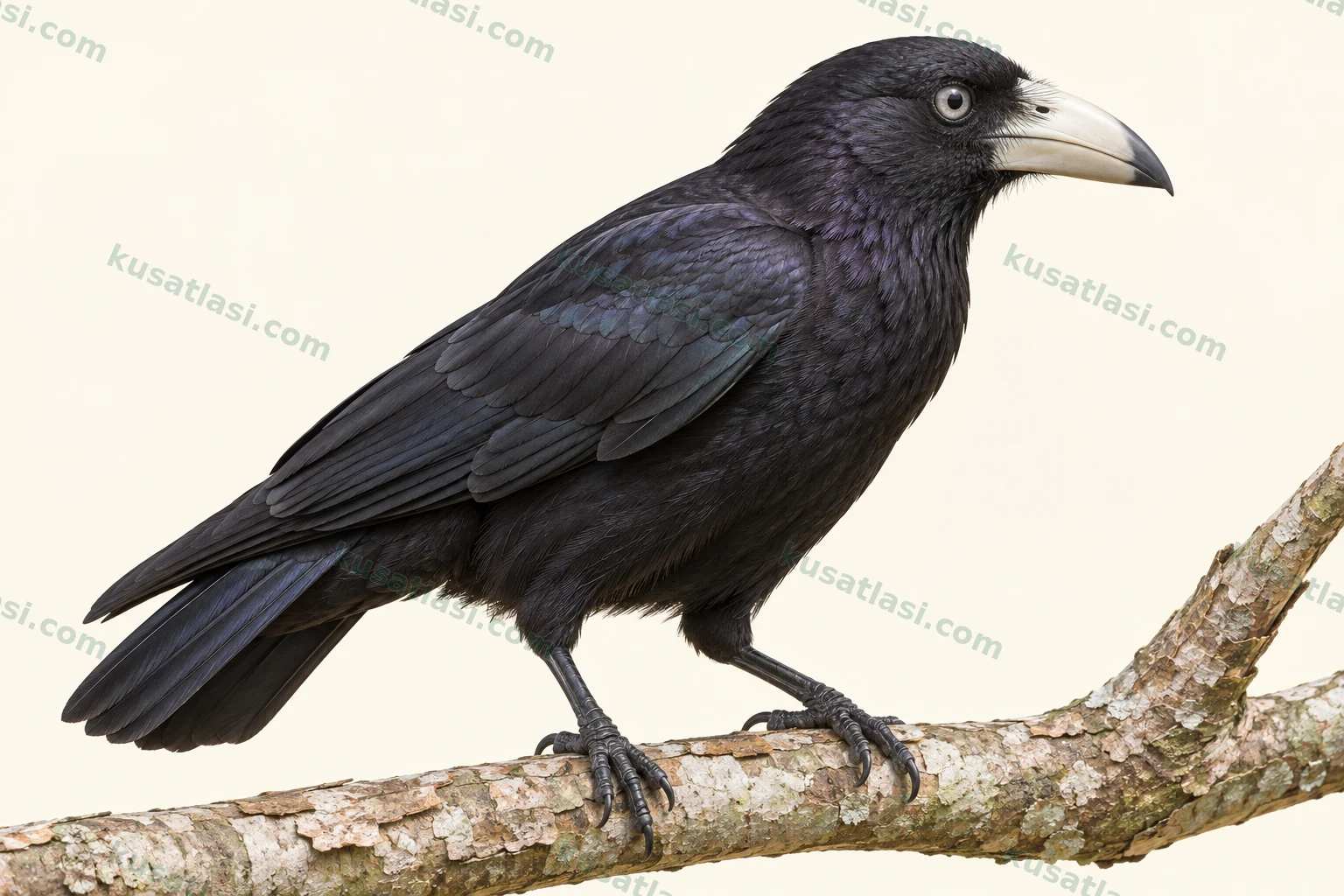
World Birds IUCN statusLC · Least ConcernGlobal IUCN category. BirdLife v10 (2025); taxon matching: AviList 2026 / IOC 15.2; checked: 29.10.2026. The list year is not the species assessment date. Source and method · BirdLife OrderPasseriformesPasserines FamilyCorvidaeCorvidae
White-billed Crow
Corvus woodfordi
Powerfully built crow of Solomon forests; short tail and large pale dark-tipped bill are assessed together.
Biometrics
Length
Male40–41 cm
Female40–41 cm
Shared species value
Wing length
Male27.13 cm
Female27.13 cm
Shared species value
Weight
Male615 g
Female555–568 g
White-billed Crow
Solomon Islands — Choiseul, Isabel and GuadalcanalObservation guide in its natural range
Look for three features together
Do not rely on a single featureLarge arched ivory bill with a visible dark tip.
Assess large head and short tail relative to the body together.
Current range includes Choiseul, Isabel and Guadalcanal; do not mix neighbouring crows’ records.
Compare male and female
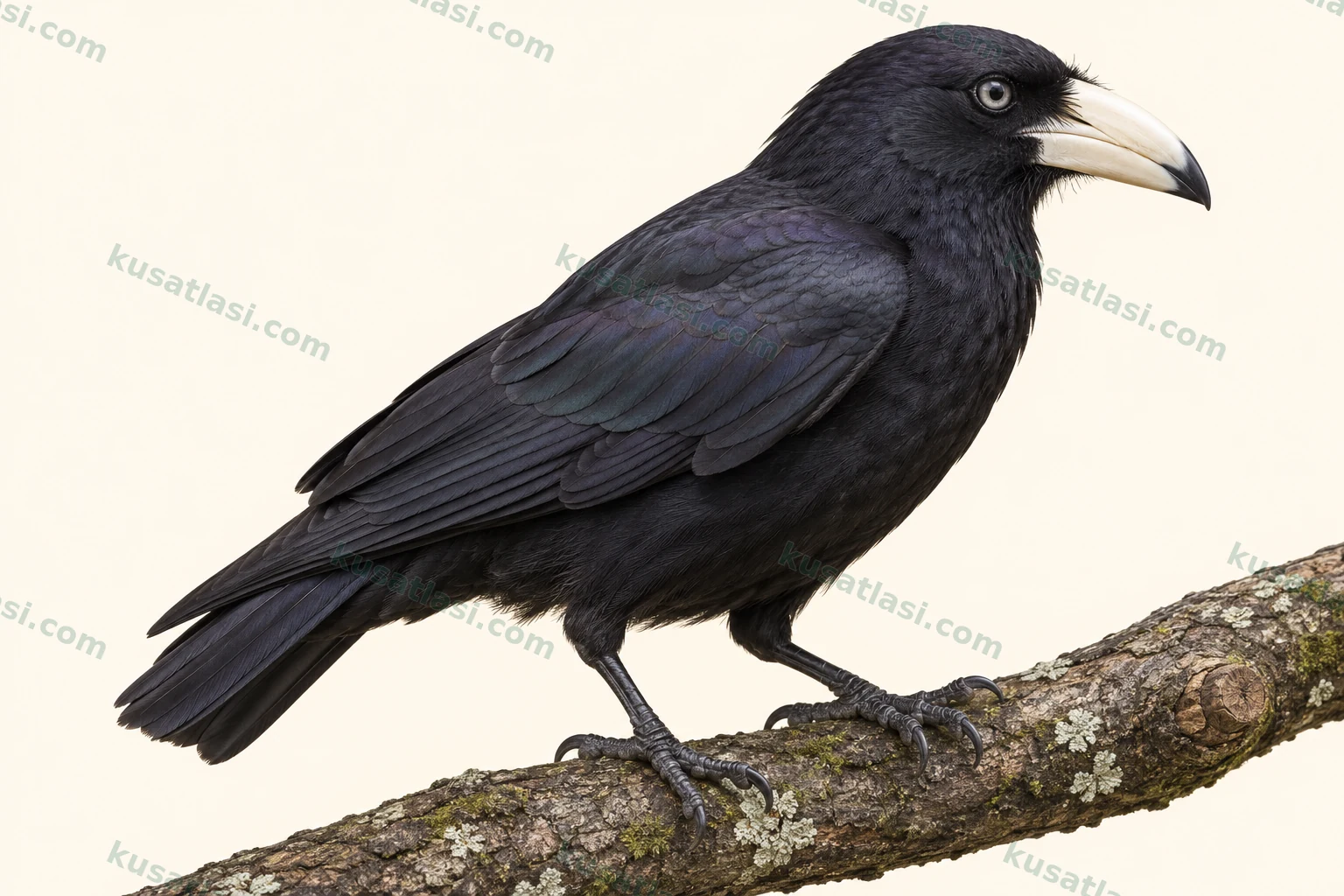 FemaleMale
The specialist account describes similar adult sexes; juvenile plumage is not described in detail.
Where to look in its natural range?
Lowland and montane rainforest; upper branches and tree crowns.
Resident; breeding-season interpretations from few individuals were not used as a definitive all-island calendar. Resident; daily forest movements are not a distant migration route.
All months: Data unavailable
January
February
March
April
May
June
July
August
September
October
November
December
Nest, egg and incubation
Species-specific nest structure, egg number, incubation and young development durations were not verified here.
Broken crow-like calls and harsh rasping sounds; check the caller visually too.
Do not play recordings to attract birds; observe quietly, especially near nests.
Species information
Quick identification
The White-billed Crow Corvus woodfordi is a powerfully built, short-tailed crow of particular Solomon Islands forests. Its large pale ivory bill with a dark tip stands out against dark plumage. Assess the large head, conspicuously arched upper bill and short tail relative to the body together.
General appearance and posture
Glossy dark feathers can reflect greenish or purplish tones at different light angles. The bill contrasts clearly with the dark body; its dark tip matters. Dark bristle-like feathers over the pale bill are not a pattern on the bill surface.
The tail looks short and broad-ended; perspective and spreading change its outline. A side view on a branch shows head-to-bill proportions better. From the front the large bill can look shortened; that photographic difference does not prove another species or subspecies.
Males, females and young birds
The foreign specialist account describes adult males and females as similar. A pale bill or stronger gloss does not reliably sex them. Position and distance affect how large a bird on a branch appears.
The consulted account does not describe juveniles in detail. Eye colour or bill development in other Corvus species is therefore not imported as an age-in-days key. Record an unusual group member's plumage, but leave its age open if uncertain.
Light and photographic sharpness can mislead about eye colour. Rather than relying on one eye shade, seek the powerful pale bill, short tail and dark body together. A foot or eye detail unseen on the actual bird is not an observed fact just because a drawing shows it. A study plate is different from evidence in nature.
Appearance in flight
Passes near the canopy may show the short tail and strong body proportions. The pale bill can be visible in good light, but is not expected on every distant flying black crow. The specialist account says the bird often stays near upper tree layers and within cover.
No flight pattern giving definite identification from one particular wing surface alone was verified here. Dark wings merging in shade may conceal feather rows. A large-billed silhouette is assessed with the actual island and visible tail proportions.
Voice and behaviour
Cornell describes broken crow-like calls and harsh rasping sounds. A forest call helps locate the bird, but written syllables alone do not identify it conclusively. Link the sound with a bird seen in the tree layer it comes from.
Concealment in upper branches means few sightings need not indicate few birds. Equally, a small group is not an entire island population.
Similar species
The Bougainville Crow Corvus meeki is a separate crow in nearby geography, compared by its dark bill. For the White-billed Crow, the pale dark-tipped bill and natural island range matter together.
A brief view may confuse it with other dark birds in Solomon forests. Try to see the strongly curved bill and short tail on the same individual. A different bird carrying a pale object should not appear white-billed in a photograph.
Global range
The currently accepted natural range covers Choiseul, Isabel and Guadalcanal in the Solomon Islands. It is not portrayed as one general Solomon crow spanning the entire chain continuously. Some sources use Guadalcanal Crow, but this work follows AviList's Corvus woodfordi concept. Corvus meeki of Bougainville and neighbouring islands is separate; its records do not enlarge this map.
Status within its natural range
The global-list snapshot places it in Least Concern. A narrow island range still requires attention to forest condition and local loss. Detectability of a bird feeding hidden in the canopy depends on observation conditions. A small group by one trail does not show the same abundance on other islands or measure the whole population. The category is not a new island census.
Movements and migration
The specialist account treats it as resident; a regular long-distance route was not verified. Daily forest movements or local movements of young groups do not prove yearly seasonal migration between islands. Preserve each map observation's date. Joining points does not replace research tracking the same individual. Assess each record in its own island and forest context.
Breeding habitat
It uses lowland and montane rainforest. Cornell mentions forests up to 1,250 m; lower forests and hills are prominent in the specialist description. This upper observation limit does not mean every bird lives at the same altitude. Forest interior and edge records may concern different parts of one landscape.
Nest site
Nest structure, egg number and incubation remain unknown in the accessible specialist account examined. A breeding-season interpretation from the reproductive condition of a few females is not a definitive monthly calendar for all islands. Nest bowls or day counts from neighbouring crows are not inserted as facts. A bird calling on a branch is not nest evidence.
Daily habitat use
Foraging is mostly in upper branches and tree crowns, where cover can hide the bird. The specialist account also reports feeding around nearby coconut plantations. This does not make every open plantation equivalent to natural forest. Watch its own movements quietly from an edge without opening the branch cover.
What does it eat?
The specialist account includes insects and various fruits, with beetles among the insects. This mixed diet is described as neither exclusively carnivorous nor exclusively fruit-eating. Hidden canopy feeding can make a detailed menu difficult. No fixed food percentage for every natural island and season was verified.
How does it forage?
It may forage alone, in pairs or small groups on upper branches and in tree crowns. Seeing an object taken in the bill gives clearer feeding evidence than merely seeing a perched bird. Do not guess plant or insect identity when it cannot be distinguished. A large bill alone does not explain every prey-catching method. Separate the place reached, searching movements and actual swallowing. Watch existing fruiting trees from a suitable distance instead of placing artificial food in the forest.
An island name does not narrow the whole range
Some English pages say Guadalcanal Crow, others White-billed Crow. This work matches both to accepted Corvus woodfordi. The current AviList concept includes Choiseul, Isabel and Guadalcanal, so other verified islands are not removed merely because a common name mentions one island.
A pale bill makes dark bristles clearer
The specialist description distinguishes dark bristle-like feathers near the bill against a pale background. These are separate feather structures, not dark veins drawn inside the bill. Check the dark tip and head-to-body proportions together. Front and side photographs may give the same curved structure different apparent lengths.
Hidden feeding birds are difficult to count
An upper-branch forager may remain among leaves. Hearing it without seeing it, or losing it during a short pass, does not show absence. Conversely, one call does not reveal the number of individuals. Local observation conditions and cover are assessed with the bird count.
Other crows' tool use is not assigned here
Not every interesting crow behaviour is verified in every Corvus species. This page does not assign tool use or a special problem-solving ability to the White-billed Crow merely because it has a large bill or shares the genus. Describe feeding movements in their own context. Species-specific evidence separates suggested behaviour from actual observation.
Two food sources in the canopy
The specialist account includes insects and fruit. A crow on a fruiting branch is therefore not necessarily exclusively fruit-eating, nor is one catching an insect exclusively carnivorous. Observe food actually taken: a fruiting tree does not prove every bill movement at that moment takes fruit.