

World Birds IUCN statusLC · Least ConcernGlobal IUCN category. BirdLife v10 (2025); taxon matching: AviList 2026 / IOC 15.2; checked: 29.10.2026. The list year is not the species assessment date. Source and method · BirdLife OrderPasseriformesPasserines FamilyCorvidaeCorvidae
White-necked Raven
Corvus albicollis
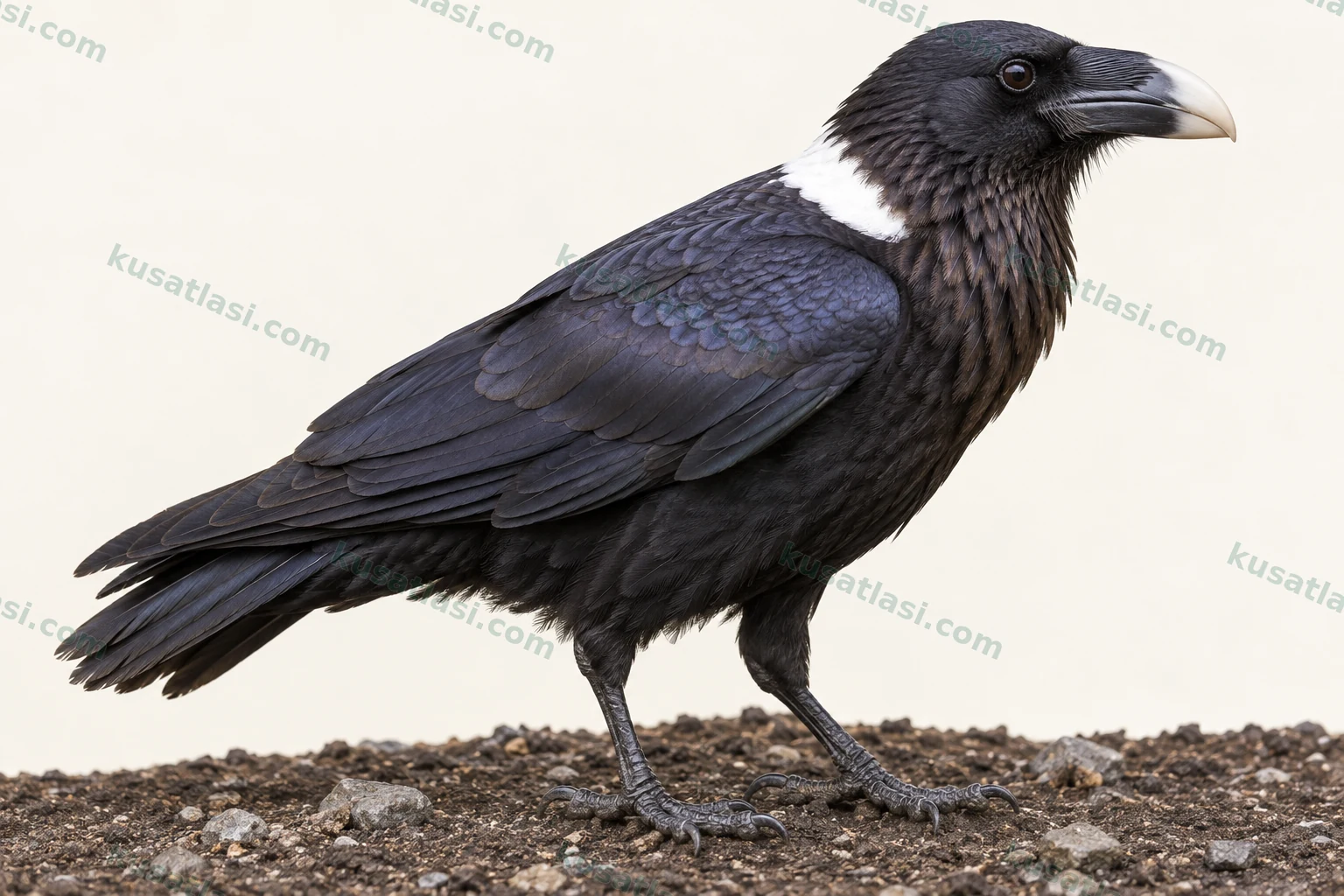
Black-bodied African raven with white nape, a powerful pale-tipped bill and short tail.
Biometrics
Length
Male50–56 cm
Female50–56 cm
Shared species value
Wing length
Male41.71 cm
Female41.71 cm
Shared species value
Weight
Male865–900 g
Female931–1157 g
White-necked Raven
Rocky eastern and southern AfricaObservation guide in its natural range
Look for three features together
Do not rely on a single featureWhite lies on the rear neck, not a broad white breast.
Very powerful and arched, with a pale tip in adults.
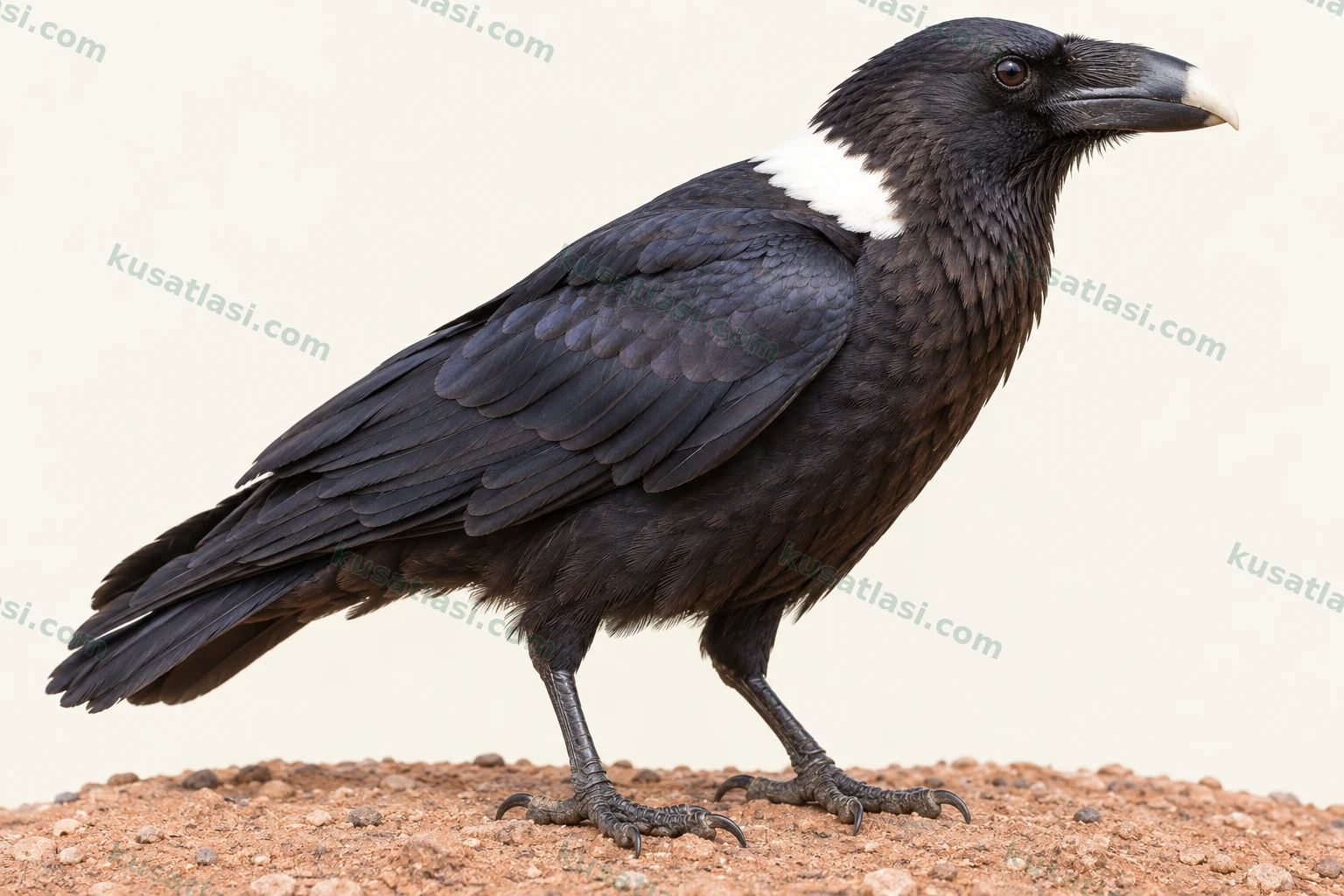
Compare male and female
 FemaleMale
Adults are similar. Distant size differences do not establish sex.
Where to look in its natural range?
Rocky hills and cliffs, with adjacent open feeding areas.
South African laying July–November, especially September–October; atlas breeding records August–December.
January
Generally resident, with local feeding and possible elevation movements. No verified regional date is given for this month. This does not imply local absence.
February
Generally resident, with local feeding and possible elevation movements. No verified regional date is given for this month. This does not imply local absence.
March
Generally resident, with local feeding and possible elevation movements. No verified regional date is given for this month. This does not imply local absence.
April
Generally resident, with local feeding and possible elevation movements. No verified regional date is given for this month. This does not imply local absence.
May
Generally resident, with local feeding and possible elevation movements. No verified regional date is given for this month. This does not imply local absence.
June
Generally resident, with local feeding and possible elevation movements. No verified regional date is given for this month. This does not imply local absence.
July
Generally resident, with local feeding and possible elevation movements. South Africa: egg-laying records.
August
Generally resident, with local feeding and possible elevation movements. South Africa: egg-laying records. Southern African atlas: breeding records.
September
Generally resident, with local feeding and possible elevation movements. South Africa: egg-laying records. Southern African atlas: breeding records.
October
Generally resident, with local feeding and possible elevation movements. South Africa: egg-laying records. Southern African atlas: breeding records.
November
Generally resident, with local feeding and possible elevation movements. South Africa: egg-laying records. Southern African atlas: breeding records.
December
Generally resident, with local feeding and possible elevation movements. Southern African atlas: breeding records.
Nest, egg and incubation
Stick bowl on rock, usually four eggs, range 2–5; about 21–26 days’ incubation. A 38-day departure is a single observation.
Harsh powerful corvid calls, also higher cracked and deep notes.
Do not play recordings to attract birds; observe quietly, especially near nests.
Species information
Quick identification
The White-necked Raven Corvus albicollis is a large corvid of rocky eastern and southern Africa. Black body, white rear-neck area and a powerful pale-tipped bill work together. The white is not a full breast bib. A frontal view can hide the nape; check the rear neck during a natural turn.
The short round-ended tail and broad wings add flight marks. Walking ground foraging is also seen. White alone does not name it: placement, bill, tail and geography count together. The English White-necked Raven is this taxon, not a collection of other white-necked corvid records.
General appearance and posture
Most of the body is black. The bill's strongly arched upper profile and head look powerful. The pale adult bill tip helps. In profile, white lies between head and black back. A head turned to rock or body can hide it without proving absence.
Rock-perching and flight silhouettes are not the same angle. Raised neck feathers change head–body proportions. Gliding wing spread varies with air currents.
Males, females and young birds
Adults look similar. Specialist size descriptions are not fully identical, so a large-looking distant bird is not given certain sex. Two companions can differ in feathers, posture and distance without being different sexes.
Young may be browner with a narrow pale breast band, unlike the Pied Crow's broad white breast. Check nape, bill and body together. A pale line alone does not move the bird to another taxon. Age can remain open.
One nest's care observation is not a fixed species-wide division of labour. The southern African example of female-only care is kept within its observation scope. Watch entries and exits from afar rather than altering parents by approaching. A brief absence does not mean no care.
Appearance in flight
Strong flaps and gliding can alternate. Broad wings and short rounded tail shape the bird. Nape white may show above or sideways while the view below is nearly all dark. Unseen white from below does not alone exclude it.
The southern African atlas warns of confusion with Cape Crow underneath. Bill and head profile need a later natural view. Do not rush a broad-winged black silhouette. Direction is useful to note but one flight establishes neither seasonal route nor regular distance.
Voice and behaviour
Calls are harsh and powerful; the specialist guide also distinguishes higher cracked calls and deep notes. Different sounds need not be different species. With visual matching, record bill, nape and voice together. A written imitation of a short distant call is no certain key alone.
Pairs, families or larger food gatherings occur. Feeding or roosting crowds do not prove all breed together in one nest. Repeated birds around one rock and birds at separate sites are counted separately. Ground feeding does not locate the nest there.
Similar species
Corvus albus has much broader white on the breast. Here it lies mainly on the rear neck. A frontal youngster's narrow band needs careful scope checking. Black-and-white crow does not distinguish them. Add bill shape.
Corvus capensis is all dark with a slenderer bill. In similar underflight, do not invent hidden nape white or its absence. Corvus crassirostris has a larger bill and different head–neck proportions. Similar names do not mean equal measurements or shared range.
Global range
Rocky hills, cliffs and adjacent open ground in eastern and southern Africa form its core. The southern African account describes Kenya and Tanzania through Malawi and Zimbabwe to Lesotho, Eswatini and South Africa. Not all land in those countries is continuous habitat; rock and food-site distribution matter.
The atlas includes near-sea-level southwestern coast and Lesotho at about 2,500–3,000 m. Calling it only a high-mountain species is incomplete. These are dated atlas scopes. A point does not fill every neighbouring plain.
Status within its natural range
Global status is Least Concern, not every local group increasing or every threat negligible. Rocky nest protection and potential poisoned-bait harm are assessed locally. Old atlas population discussion is not today's precise total.
Movements and migration
Mostly resident, it moves between feeding areas. More winter records in some southern areas were explained as possible local elevation shifts. Other regions lack the same pattern, so no continental route is drawn. Approaching food differs from seasonal distant migration.
Breeding habitat
Rock faces and inaccessible ledges matter for nests, while feeding also uses nearby open ground. Settlement records do not prove every building suitable. A rock-perched bird and one carrying food to an active nest are separate observations.
Nest site
A large stick bowl occupies a ledge or cavity, lined with grass, hair or wool. The southern African account gives usually four eggs, range 2–5, and about 21–26 days' incubation. A 38-day departure is one observation, not a fixed development period for every population.
Daily habitat use
Ground food and high nests or roosts can be in different places. Climbing to nests risks disturbance and human safety. Regular distant watching distinguishes care from perching. A food gathering does not itself establish several active nests.
What does it eat?
The specialist account includes invertebrates, small vertebrates, fruit, grain and carrion, with feeding on Aloe flowers also recorded. A broad animal-and-plant list does not give fixed daily proportions. Availability and region vary, without a single percentage menu for the species.
How does it hunt?
Ground walking and bill processing are seen. Repeatedly dropping a tortoise from height to break its shell is documented, not every bird's method for all food. Carrion feeding and live capture remain distinct.
Many tortoise remains near one Karoo nest are a substantial local record, not daily intake without accumulation time. Broken shell alone does not identify the predator without more behaviour. Other corvids' prey records are not transferred here.
The nape mark is not visible from every angle
White behind the neck can hide below or in front. Wait for natural turns rather than flushing. Bill, tail and actual white placement count together.
Tortoise remains are not a day's menu
The Karoo example in the 2023 review reported remains of more than 80 tortoises near an active nest. This is strong local prey impact, not 80 captures in a day. Different corvid events remain separate. Large Pied Crow numbers are not this raven's daily totals.
Visiting differs from predation evidence
The 2025 KwaZulu-Natal Cape Vulture nest study recorded 47 raven visits. Photographic presence is interpreted as possible predation pressure, not egg consumption at every visit. Camera intervals can miss behaviour. Cautious interpretation does not become a definite attack count.
Residents can still move
Food and roosting groups need not share one nest. Some southern winter reports suggest local height changes while others do not. Resident does not mean motionless on one rock all year. Breeding dates and feeding movements stay distinct. July–November laying versus August–December general breeding is not a contradiction: egg deposition and broader reproductive activity are different periods.