

World Birds IUCN statusVU · VulnerableGlobal IUCN. BirdLife v10 (2025); taxon matching AviList 2026 / IOC 15.2; checked: 29.10.2026. The list year is not the species’ assessment date. Source and method · BirdLife OrderPasseriformesPerching birds FamilyPicathartidaePicathartidae
White-necked Rockfowl
Picathartes gymnocephalus
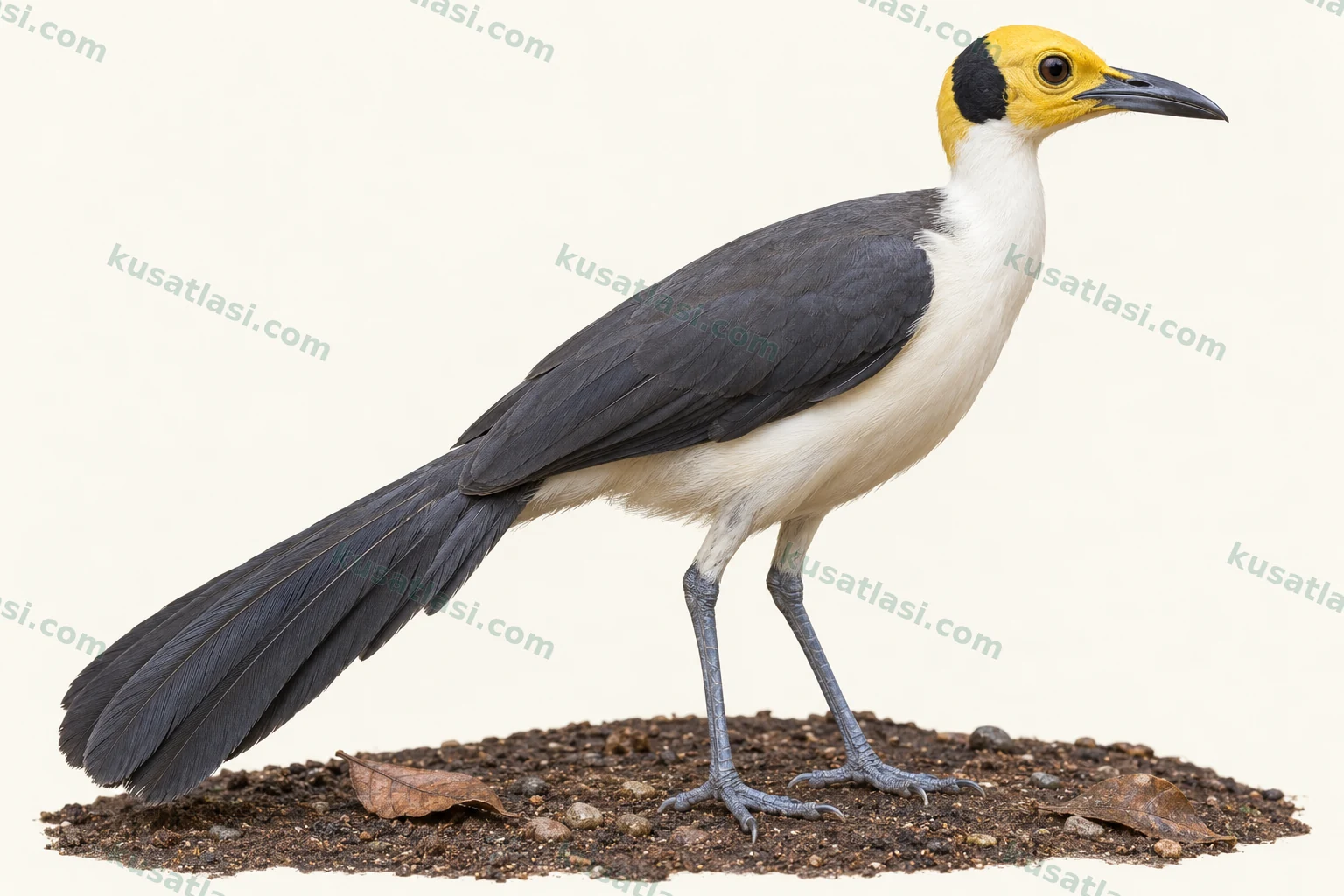
A bare head patterned yellow and dark, a pale neck, dark grey back, long legs and tail.
Biometrics
Length
Male33–38 cm
Female33–38 cm
Shared species value
Wing length
Male16.22 cm
Female16.22 cm
Shared species value
Weight
MaleData unavailable
Female166–226 g
White-necked Rockfowl
The Upper Guinea forests of West AfricaObservation guide in its natural range
Look for three features together
Do not rely on a single featureLook for the dark patches beside the bare yellow skin.
Assess the long legs and tail together with the pale underparts.
Compare male and female
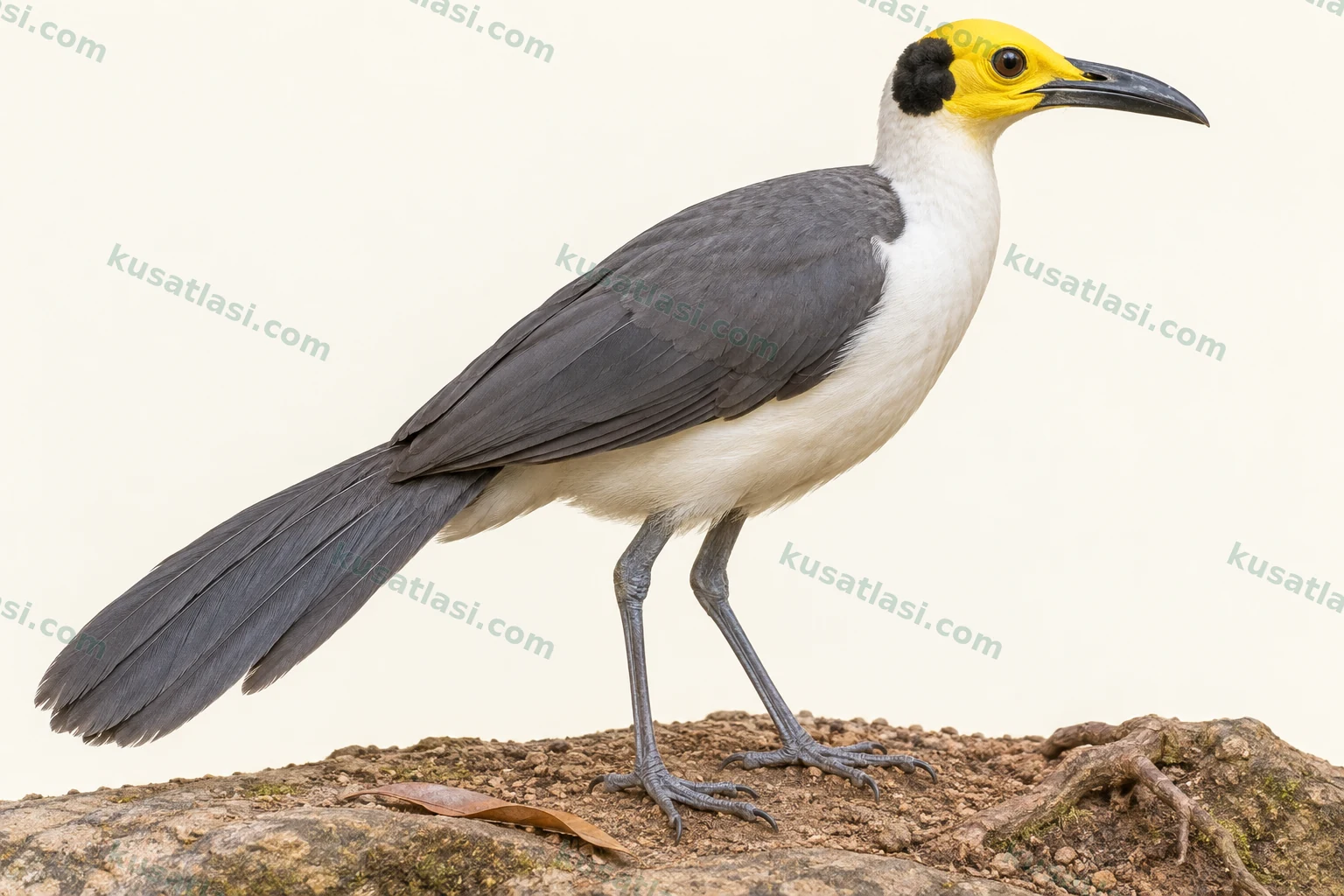 FemaleMale
Adult sexes look alike. The extent of the head pattern does not determine sex with certainty.
Where to look in its natural range?
The forest floor, large rocks and sheltered rock overhangs.
Resident. Sierra Leone and Ghana breeding periods are not combined into one shared calendar.
January
Resident; daily movements are not a migration route. No verified regional date specific to this month was given; this does not imply local absence.
February
Resident; daily movements are not a migration route. No verified regional date specific to this month was given; this does not imply local absence.
March
Resident; daily movements are not a migration route. Reported egg-laying period in Ghana.
April
Resident; daily movements are not a migration route. Reported egg-laying period in Ghana.
May
Resident; daily movements are not a migration route. Reported egg-laying period in Ghana.
June
Resident; daily movements are not a migration route. Reported egg-laying period in Sierra Leone. Reported egg-laying period in Ghana.
July
Resident; daily movements are not a migration route. Reported egg-laying period in Sierra Leone. Reported egg-laying period in Ghana.
August
Resident; daily movements are not a migration route. Reported egg-laying period in Sierra Leone. Reported egg-laying period in Ghana.
September
Resident; daily movements are not a migration route. Reported egg-laying period in Sierra Leone. Reported egg-laying period in Ghana.
October
Resident; daily movements are not a migration route. Reported egg-laying period in Sierra Leone. Reported egg-laying period in Ghana.
November
Resident; daily movements are not a migration route. Reported egg-laying period in Sierra Leone. Reported egg-laying period in Ghana.
December
Resident; daily movements are not a migration route. Reported egg-laying period in Sierra Leone. Reported egg-laying period in Ghana.
Nest, egg and incubation
A nest of mud and plant material attached to rock. In the Sierra Leone study, two eggs were most frequent; incubation averaged 20 days and the nestling period 25 days.
Usually silent; low, brief contact notes may be heard.
Do not play recordings to attract birds; observe quietly, especially near nests.
Species information
Quick identification
The White-necked Rockfowl Picathartes gymnocephalus is a long-legged, long-tailed bird of the West African forest floor. Dark patches on either side of its bare yellow head contrast with the pale neck and underparts. The upperparts are dark greyish. Identify it by the pattern of the bare head and the proportions of the whole body, rather than yellow alone. The Turkish name's reference to a magpie does not place it in the magpie family: current classification places it in Picathartidae.
The arrangement of the yellow skin beside the dark patch behind the eye is particularly useful. If only the pale neck is visible and the head pattern cannot be checked, identification remains incomplete. Forest light can make white look cream and grey look brownish. Rather than interpreting this as a new colour form or sex difference, look again at the same area when the bird naturally turns its head.
General appearance and posture
Long legs hold the body well above the ground; the neck and tail also contribute to its slender appearance. These proportions can look different as the bird bends to investigate food. A resting view with the neck drawn in and a feeding view with it extended should not suggest different species. Leaves or rocks covering part of the legs can also limit assessment of posture.
The pale neck and breast contrast with the dark back and tail. Pale areas can have a slight lemon tint; do not expect every bird to have entirely pure-white underparts. The bare head surface and the body's feathers are different structures. Yellow skin on the head is not yellowing body plumage. This distinction also determines which parts of an illustration and a real bird should be compared.
Males, females and young birds
Adult males and females look alike. The extent of yellow on the head, an apparently long neck or a larger-looking body alone does not reliably establish sex. Do not label two adults near the same nest male and female merely from their posture. Observing nest care records behaviour; the sex of the bird performing it needs separate confirmation.
Thompson's Sierra Leone study describes young approaching nest departure as broadly resembling the adult pattern, but with a paler bare head. The underparts can also show a lemon tint. This does not make every pale-looking bird in particular light a juvenile. Feather development and direct nest context provide stronger age evidence than the intensity of a single colour.
A young bird leaving the nest may not have reached all adult dimensions. Before treating a small-looking individual as another species, check the head and body pattern. Equally, small apparent size does not automatically prove youth: distance and framing change perceived size. There is no need to approach or move a bird near a nest to assess its age.
Appearance in flight
The long tail and pale underparts can help even in a brief flight. In a distant view where the head looks small, however, the boundaries between yellow and dark areas can disappear. Tail length alone does not establish identification in such a record. Waiting for the next natural posture of a bird leaving the forest floor can reveal the head pattern missed in flight.
Powerful hops at ground level can create the impression of prolonged flight. Distinguish actual flight from leg-powered leaps in observation notes. If a rock or branch hid part of the movement, do not assume uninterrupted flight.
Voice and behaviour
The bird can remain silent during most encounters; low, brief contact notes may be heard. Knowing only the direction of a sound in the forest does not provide the certainty of seeing the bird. Calls of other nearby species may enter a recording. If recording sound, note the visible bird's behaviour and the time together; playback is unnecessary to reach an unseen bird.
It can move across the forest floor in pairs or small groups. Rocks matter for roosting as well as nesting. An evening return to a rock does not prove that the bird is entering a nest with eggs. Several individuals together do not mean that each belongs to a separate breeding pair. Keep feeding, resting and breeding observations distinct.
Similar species
Its grey-necked relative Picathartes oreas lives in Central African forests and has blue, red and black areas on the bare head. Do not confuse that with the yellow-and-dark head pattern of the White-necked Rockfowl. Geography helps comparison, but a country name alone does not complete identification without seeing the actual head pattern.
A long-tailed forest bird walking or hopping on the ground is not necessarily a rockfowl. Other birds with feathered heads may have a pale neck or dark back. Examine bare-head colour patches, a slender body, long legs and pale underparts together. If a rock hides the head, retain that missing feature in the observation notes.
World distribution
Its native range is associated with West Africa's Upper Guinea forests. Guinea, Sierra Leone, Liberia, Côte d'Ivoire and Ghana form parts of this region. Treating all these countries as one uniformly occupied, continuous habitat is misleading. Forest cover, suitable rocks and local records must be considered together. A national boundary does not establish presence everywhere within it. Keep the dates of a current observation and a historical colony record separate too.
Status within its natural range
The current taxonomic record lists it as Vulnerable. Research spanning three breeding seasons around Gola examined the long-term status of particular colonies. Local stability there does not establish the same condition for the whole West African population. A rock outside forest does not offer all the conditions of a nesting rock within forest; loss of surrounding feeding habitat also matters.
Movements and migration
It is a resident forest species; no verified long-distance seasonal migration route is drawn. Moving to a feeding site or roosting rock is daily habitat use. Two mapped records from different years are not linked as the journey of one bird. Differences in rainfall-related breeding periods between Sierra Leone and Ghana do not prove regular migration between those countries.
Breeding habitat
Areas with large rocks in mature forest and suitable secondary forest are important. Assess feeding ground and cover around rocks together. Not every rock in a forest containing colonies is used. Distance to the nearest stream varied widely in the Gola study; do not assume the same distance for every nest.
Nest site
The cup nest of mud and plant material is attached to a rock face, beneath a sheltered overhang or within a cave. In the Sierra Leone breeding study of 1990–1996, two eggs were most frequent, incubation averaged 20 days and the nestling period averaged 25 days. These are dated regional field results; the same number of days is not expected at every nest.
Daily use of space
It feeds on the forest floor and can rest in suitable rocky areas. Do not enter beneath a rock, climb an overhang or block the bird's access to see a nest. Observe from a distance that does not change arrivals or departures. Even an apparently empty nest should not be removed: being unused at that moment does not rule out later use.
What it eats
Invertebrates are important in its diet; recorded foods include insects, spiders and earthworms. Small frogs and lizards are also recorded, but their particular association with feeding young is not generalized to the entire adult diet. One observed prey item gives no daily food proportion. Foods brought by adults at different times around the same colony should be recorded as separate observations.
How it finds food
It searches on the ground and on surfaces close to it. It can exploit small animals disturbed by advancing army ants; this does not mean that it always eats the ants themselves. If prey is hidden where the bird bends into leaf litter, do not assume a successful capture. Moving rocks or leaves to expose the bird disrupts its natural feeding area. Wait for it to continue its own movements; do not gather birds at one point with food.
A West African member of a small family
Current classification places this bird in Picathartidae. A reference to magpies in its Turkish common name does not place it among the corvids. Its close relative Picathartes oreas has different head colours. Distinguishing similar posture from scientific relationship makes names and appearances easier to compare accurately.
One colony does not represent the whole population
Long-term research around Gola compared local colonies with historical records. This is valuable for conservation, but findings from one area are not a census of the entire native range. Observed active nests and estimated population expectations are also different quantities; a model estimate is not a direct count of birds.
Lifespan is not measured by an assumption
Thompson's breeding study assessed the population effects of observed nesting success under different possible lifespans. Discussing the possibility of long life does not establish a maximum lifespan. Avoiding a definite age derived from a hypothesis keeps measured results distinct from the possibilities a study seeks to explain.
Rock and forest are protected together
The rock nest is striking, but the forest floor used for feeding belongs to the same life cycle. Protecting only the nesting ledge does not remove the need for surrounding habitat. Colony visitors should avoid obstructing access and follow local conservation rules. Gola conservation work is a practical example of addressing forest and neighbouring communities together. An easily visible nest does not make approaching it harmless. Increase the distance if birds are seen waiting without being able to enter.