

World Birds IUCN statusLC · Least ConcernGlobal IUCN category. BirdLife v10 (2025); taxon matching: AviList 2026 / IOC 15.2; checked: 29.10.2026. The list year is not the species assessment date. Source and method · BirdLife OrderPasseriformesPasserines FamilyStenostiridaeStenostiridae
African Blue Flycatcher
Elminia longicauda
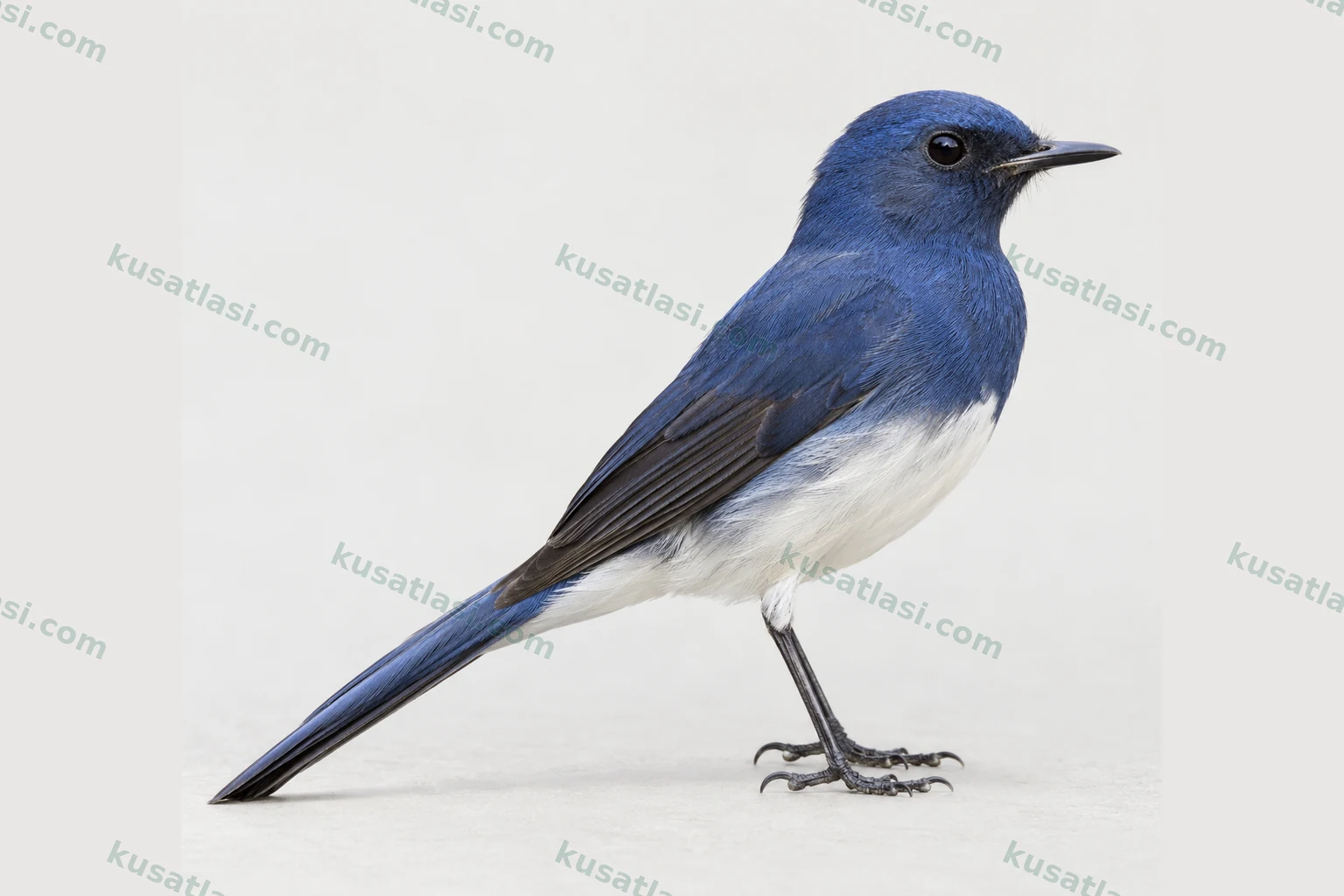
This slender woodland bird is recognised by its small crest, blue head and breast and frequently fanned long blue tail. Adult males and females share the same basic plumage pattern.
Biometrics
Length
Male15–18 cm
Female15–18 cm
Shared species value
Wing length
Male6.69 cm
Female6.69 cm
Shared species value
Weight
Male7–10 g
Female9.8–12 g
African Blue Flycatcher
Suitable woodland from Senegal and The Gambia through central Africa to western Kenya, northwestern Tanzania and northern AngolaObservation guide in its natural range
Look for three features together
Do not rely on a single featureThe spread tail has no broad white area; fine pale feather tips in young birds are assessed separately.
The head and breast are blue, while the lower body is paler grey-blue. The crest may lie flat depending on posture.
It makes short feeding sallies among leafy branches and may join mixed feeding parties.
Compare male and female
 FemaleMale
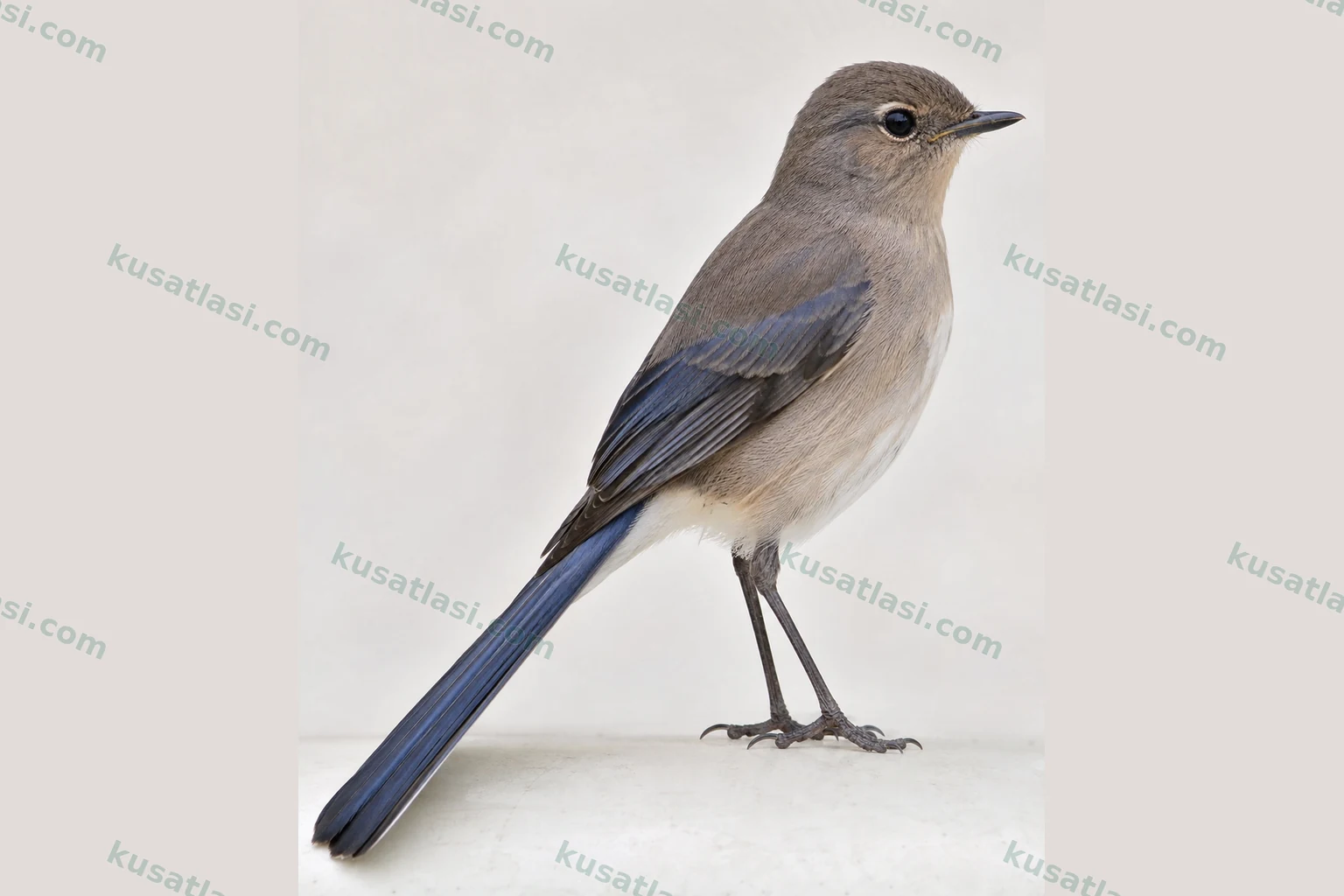
Males and females share the same basic blue appearance. Small differences in brightness are not a certain sex key independent of lighting and geographic form; young may have greyer upperparts and pale feather tips.
Where to look in its natural range?
Watch riverine woodland, forest edges and shaded gardens from the existing path. Check tail colour when it opens; do not open the scrub to see the bird.
The species is basically resident. The specialist account reports East African breeding examples in March–August and October–December; those same months are not required in western and central Africa. This calendar is a local example, not a monthly probability of presence.
January
The species is basically resident; regional rainfall and woodland conditions matter. This month falls outside the main breeding examples of the East African specialist account; it does not mean absence or no breeding elsewhere. This is not a shared egg-laying calendar for western and central Africa.
February
The species is basically resident; regional rainfall and woodland conditions matter. This month falls outside the main breeding examples of the East African specialist account; it does not mean absence or no breeding elsewhere. This is not a shared egg-laying calendar for western and central Africa.
March
The species is basically resident; regional rainfall and woodland conditions matter. This month falls within the March–August/October–December breeding examples given for East Africa in the specialist account. This is not a shared egg-laying calendar for western and central Africa.
April
The species is basically resident; regional rainfall and woodland conditions matter. This month falls within the March–August/October–December breeding examples given for East Africa in the specialist account. This is not a shared egg-laying calendar for western and central Africa.
May
The species is basically resident; regional rainfall and woodland conditions matter. This month falls within the March–August/October–December breeding examples given for East Africa in the specialist account. This is not a shared egg-laying calendar for western and central Africa.
June
The species is basically resident; regional rainfall and woodland conditions matter. This month falls within the March–August/October–December breeding examples given for East Africa in the specialist account. This is not a shared egg-laying calendar for western and central Africa.
July
The species is basically resident; regional rainfall and woodland conditions matter. This month falls within the March–August/October–December breeding examples given for East Africa in the specialist account. This is not a shared egg-laying calendar for western and central Africa.
August
The species is basically resident; regional rainfall and woodland conditions matter. This month falls within the March–August/October–December breeding examples given for East Africa in the specialist account. This is not a shared egg-laying calendar for western and central Africa.
September
The species is basically resident; regional rainfall and woodland conditions matter. This month falls outside the main breeding examples of the East African specialist account; it does not mean absence or no breeding elsewhere. This is not a shared egg-laying calendar for western and central Africa.
October
The species is basically resident; regional rainfall and woodland conditions matter. This month falls within the March–August/October–December breeding examples given for East Africa in the specialist account. This is not a shared egg-laying calendar for western and central Africa.
November
The species is basically resident; regional rainfall and woodland conditions matter. This month falls within the March–August/October–December breeding examples given for East Africa in the specialist account. This is not a shared egg-laying calendar for western and central Africa.
December
The species is basically resident; regional rainfall and woodland conditions matter. This month falls within the March–August/October–December breeding examples given for East Africa in the specialist account. This is not a shared egg-laying calendar for western and central Africa.
Nest, egg and incubation
The small open cup nest is built in a fork or along a branch, and one–two eggs are reported. The female incubates, and both parents may feed the young. The specialist account gives at least 14 days of feeding at the nest and about three weeks of care after fledging. No verified incubation day count was found, and it has not been derived from the feeding period.
The voice includes a long, complex mixture of high-pitched twittering and chattering notes and short ringing calls. A written sound description alone does not provide certain identification.
Do not play recordings to attract birds; observe quietly, especially near nests.
Species information
Quick Identification
The African Blue Flycatcher, Elminia longicauda, is a slender woodland bird recognised by its striking blue body, small crested head and long tail that is frequently spread like a fan. Head, back, throat and breast are blue; the belly is paler, appearing greyish blue. The dark area between eye and bill gives the front of the face a small masked appearance. When the tail opens, do not consider only its silhouette: its dark feathers with blue edges can show different shades with the lighting, but do not form a broad white tail area. The crested head, long blue tail and colour becoming paler from breast to belly should be assessed together.
Its English name is African Blue Flycatcher and its accepted scientific name is Elminia longicauda. Current classification places it in Stenostiridae. The word flycatcher in its name does not put it in the same family as true muscicapid flycatchers such as Muscicapa adusta. Different bird lineages catching insects in woodland can evolve similar hunting methods; similarity in appearance and behaviour does not by itself prove close relationship.
General Appearance and Posture
Despite its long tail, the bird looks small and lightly built. Body length should not be judged only by the end of the tail.
The dark bill is broad at the base and tapers to a fine tip. Fine feathers around the bill may be visible at close range; they should not be confused with a long moustachial stripe. The eye is dark brown and the legs are dark. Crest feathers can look more raised or flatter with posture. The absence of a visible crest in one photograph therefore does not exclude the species by itself. Dark flight feathers have blue edges, so a generally blue appearance may dominate the closed wing.
The central tail feathers are longer. As the bird spreads and closes its tail, different amounts of the dark feather centres and blue edges become visible. The whole tail may darken in shade, whereas blue is more apparent in good light. Following the same bird in several postures helps establish identification. In a brief encounter where the long tail looks like a single line, the colour detail needed for comparison with the white-tailed similar species may be missing.
Males, Females and Young Birds
Adult males and females share the same basic blue plumage pattern. The specialist account notes that females may be slightly duller, but this small difference is not an unequivocal sex character independent of shade, photographic colour settings or geographic form. Two entirely different adult colour schemes should not be expected. A bird is not assigned male or female in the field simply because it looks bright or pale. Sex labels on illustrations likewise do not make every observed individual reliably sexable from a photograph.
Young resemble adults but can have greyer upperparts. Off-white tips may occur on wing and tail feathers. These fine tips are not the same as the broad white tail appearance of White-tailed Blue Flycatcher. A single pale tip should not lead to a different species identification. Age assessment examines the whole tail, upperpart tone and overall feather condition together; without a verified detailed moult calendar, neither month nor age class is fixed with certainty.
Two geographic subspecies are recognised. Colour-intensity differences are reported between the western nominate form and teresita, which extends east and south from Cameroon; teresita is generally paler. This variation makes it particularly unsafe to assume that every pale blue bird is female or young. Colour tone alone is insufficient to select a subspecies from a photograph: locality and comparable imaging conditions must also be known.
Appearance in Flight
The slender body, long tail and overall blue colour help during short flights. The specialist description calls the flight undulating. During feeding it may make a brief sally from a perch, and tail movement helps reveal a bird followed among branches. Nevertheless, the flight path of a distant small blue bird is not sufficient for certain identification. Crest and tail colour should be checked after the bird lands again.
The tail fan is not equally wide at every moment of flight. Feathers spread during a turn or landing can look narrower in straight flight. No detailed upperwing or underwing identification key is created without verified sources. Blue edges on the closed wing do not mean that the whole spread wing is uniformly blue. A dark silhouette instead of blue is particularly normal against the light; that view is unsuitable for comparing colours.
Voice and Behaviour
The song is a long mixture of high-pitched twittering and chattering notes flowing at variable speed. Cornell describes the call as a ringing two-part sound. Written syllables serve only as reminders and do not establish identification as if the bird had been heard. Several small woodland songbirds may call together, so the source of the sound should be checked by seeing the bird or comparing reliable recordings.
African Blue Flycatchers may occur in pairs or small groups and join mixed-species feeding parties. Moving together alone does not show that all members of a group are related or helping at a nest. While feeding, the bird may fan its tail, hold its wings slightly lowered and move among leafy branches. Crest and tail are more conspicuously spread during display; seeing the same posture during daily foraging does not necessarily mean courtship.
Similar Species
White-tailed Blue Flycatcher, Elminia albicauda, is the most important comparison. The African Blue Flycatcher's tail is blue and dark-toned, unlike the other species' clearly white tail area. White on the throat can also help. Sources interpret contact between the two ranges differently, so locality alone does not replace identification. When the tail is spread, check especially whether there is a broad white area or merely fine pale feather tips on a young bird.
Crested, active woodland birds such as African Paradise Flycatcher, Terpsiphone viridis, may come to mind after a brief silhouette view. Rather than give a certain name to an individual whose details were unseen, record the head, whole tail and body colour. The African Blue Flycatcher's continuous blue head-and-breast appearance and fan-like blue tail are sought together. A long tail, crest or insect-catching behaviour alone is insufficient.
Global Distribution
The African Blue Flycatcher inhabits western and central sub-Saharan Africa and adjoining eastern areas. The western nominate form extends from Senegal and The Gambia to Nigeria. Sources give teresita a range from Cameroon to western Kenya, northwestern Tanzania and northern Angola. This broad sequence of countries does not imply occurrence in every intervening open landscape or town. Suitable tree cover and locally connected forest areas are the meaningful units of distribution.
Gallery forests along rivers, moist woodland and some mangroves are among the environments used in different regions. Its occurrence in East African mountains does not mean that all western populations occupy the same elevation. The coloured model on the map is a general prediction produced from observations, not a complete natural-range boundary or verified breeding polygon. Observation points are also a sample of records. One marker does not demonstrate a permanent population or a nest at that place.
Status Within Its Native Range
The specialist assessment places the species globally in Least Concern. It may be common in some suitable places and less frequently encountered elsewhere. This does not mean equal numbers in every region or that woodland loss is unimportant. Occurrence in a park or garden also does not show that fully open farmland provides the same living conditions. Gardens and cultivated areas should be considered with their surrounding woodland connections.
Colour differences between the two geographic forms are interpreted together with range information. No subspecies label is given in boundary areas without reliable locality and good views. Scientific names must represent the correct species when current records are assessed; records of the white-tailed similar species are not silently added to this one. Brief, unclear or unphotographed observations are not presented at the same evidential level as verified area information.
Migration
The species is generally considered resident. As verified evidence for a long-distance route repeated annually between continents has not been used, no such line is added to the map. Residency does not mean that all individuals spend their lives on one branch or in one tiny area. Movements associated with food, rainfall and local vegetation may occur, but their direction and distance cannot be drawn without detailed tracking data. Changes in local records between months do not prove collective migration; observation effort and visibility must also be considered.
Breeding Habitat
Woodland is the species' main environment. Forest with dense foliage, riverine gallery forest, moist woods and the margins of forest clearings are suitable places to search. Mangroves and wooded savanna are also used in some regions. This variety does not mean independence from vegetation. A record around a garden or field often needs to be considered with nearby trees and shaded feeding areas.
The specialist account reports an elevational range from sea level to 2,400 metres in East Africa. This is not a common preference curve showing that all regions use the same elevation. The local conditions of western lowland river woods and eastern montane forests should be considered separately. Their breeding calendars are not reduced to one rainy season for all these environments.
Nest Site
The nest is a small, neatly made open cup. Forks or sheltered positions along a branch are used; the specialist account reports examples up to five metres above ground. Fine grass, plant fibres, bark fragments and other soft plant materials help it blend with its surroundings. This does not mean every nest has the same height or materials. Opening branches or forcing a bird off its nest to see it is inappropriate.
Daily Space Use
The bird searches for prey with short movements among leafy branches and sometimes sallies into the air to catch insects. Joining mixed feeding parties brings it into contact with birds sharing different tree layers. Shaded branches near water can also offer good views. Observers should wait on an existing path without interrupting the bird's movements. Waiting for it to return to an open branch, rather than following into dense scrub to see crest and long tail, helps both identification and undisturbed observation.
What Does It Eat?
The African Blue Flycatcher feeds mainly on small invertebrates. The specialist account lists flies, ants, termites, beetles and other insects and their larvae, as well as spiders. This is not a table of equal prey proportions in every region. AVONET's classification as an invertebrate-feeding species supports the broad diet, but supplies neither precise prey percentages nor an unchanging year-round menu.
In leafy woodland, prey identity, life stage and availability may vary with local conditions. One photograph of a bird carrying an insect does not alone define the staple food of the whole population. Similarly, searching plants for prey does not mean that plant material is its principal food. The verified species account emphasises small animal prey.
How Does It Hunt?
The bird may watch from a branch and make short sallies, taking prey around leaves and branches, from the air and occasionally from the ground. Fanning the tail and holding the wings slightly lowered are parts of its active feeding appearance. Without experimental evidence, none of these postures is declared compulsory for each capture, and tail-fanning is not given a certain function.
It may be seen joining mixed-species groups. Being together does not prove continual stealing of other species' prey or always following them. To understand feeding, record the perch, direction of the sally and place from which prey was taken. Adults delivering food to a nest should be watched from a distance without blocking their routes. Baiting, forcing prey into view or approaching a branch holding young for better images is not recommended.
The Word Flycatcher in Its Name
Despite the name, this blue bird belongs to Stenostiridae in current classification. Genetic research published by Pasquet and colleagues in 2002 did not support grouping Elminia with the monarch birds alongside which it was then considered. This is a useful example of why blue colour, a crest or hunting movements alone cannot establish relatedness. The limited genes and samples used in that study do not mean that all of the bird's behaviour has been genetically explained.
Details Revealed by the Open Tail
A long tail appearing narrow in one photograph and fan-shaped in another need not indicate different species. The same bird opens and closes its feathers. The amount of blue edges and dark feather centres visible also varies with posture and light. Before comparing fan shape with the white-tailed similar species, check for a broad white area. Fine pale tips in young birds are not equivalent to that area.
A Small Cup Nest and Care
The specialist account reports one or two eggs. The female incubates and both parents may feed the young. The same account describes feeding at the nest for at least 14 days and care after fledging for about three weeks. These are development details from the specialist compilation. A verified day count for incubation was not found; incubation duration is not calculated from the period of feeding in the nest. Table averages such as 1.6 eggs also do not mean a fractional egg exists in an individual nest.
What Does a Group Tell Us?
Several African Blue Flycatchers may be seen together. Group size does not establish that all individuals are related or that all help at the same nest. Nest care requires direct behavioural records. This distinction allows an accurate description of an active feeding group: birds feeding together can be recorded without presenting unknown kinship as established fact. The same care is needed when considering sex from the intensity of blue colour.