

World Birds IUCN statusLC · Least ConcernGlobal IUCN category. BirdLife v10 (2025); taxon matching: AviList 2026 / IOC 15.2; checked: 29.10.2026. The list year is not the species assessment date. Source and method · BirdLife OrderPasseriformesPasserines FamilyPycnonotidaePycnonotidae
White-throated Greenbul
Phyllastrephus albigularis
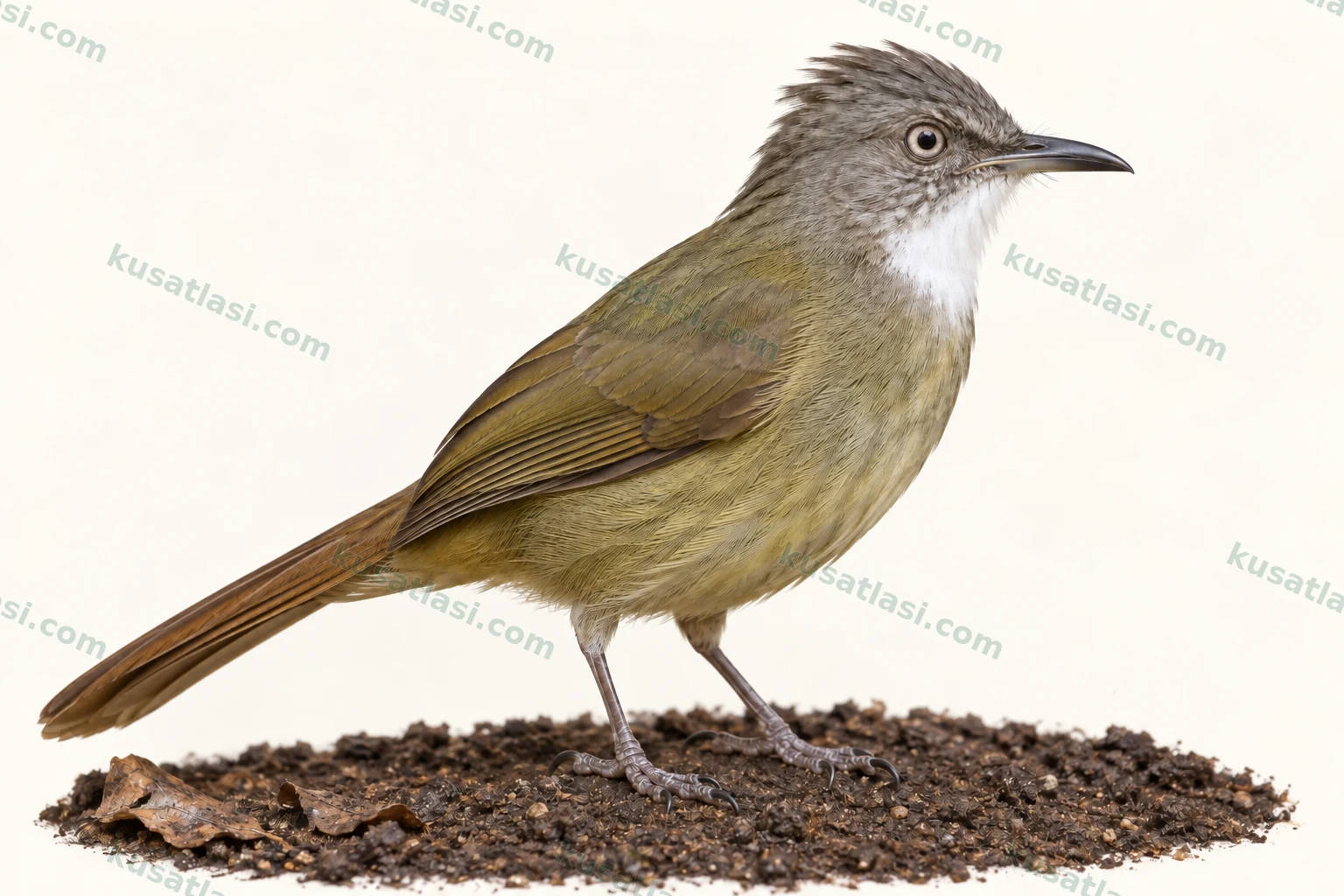
A long-billed greenbul of forest undergrowth, with a bright white throat, grey face, pale eye and unspotted grey-green wing.
Biometrics
Length
Male17 cm
Female17 cm
Shared species value
Wing length
Male7.61 cm
Female7.61 cm
Shared species value
Weight
Male24–31 g
Female17–28 g
White-throated Greenbul
West and Central African forests, within the current albigularis conceptObservation guide in its natural range
Look for three features together
Do not rely on a single featureCheck the white throat contrasting with the grey face and breast, together with the pale eye.
Small wing movements do not identify it alone. The wings have no pale spots.
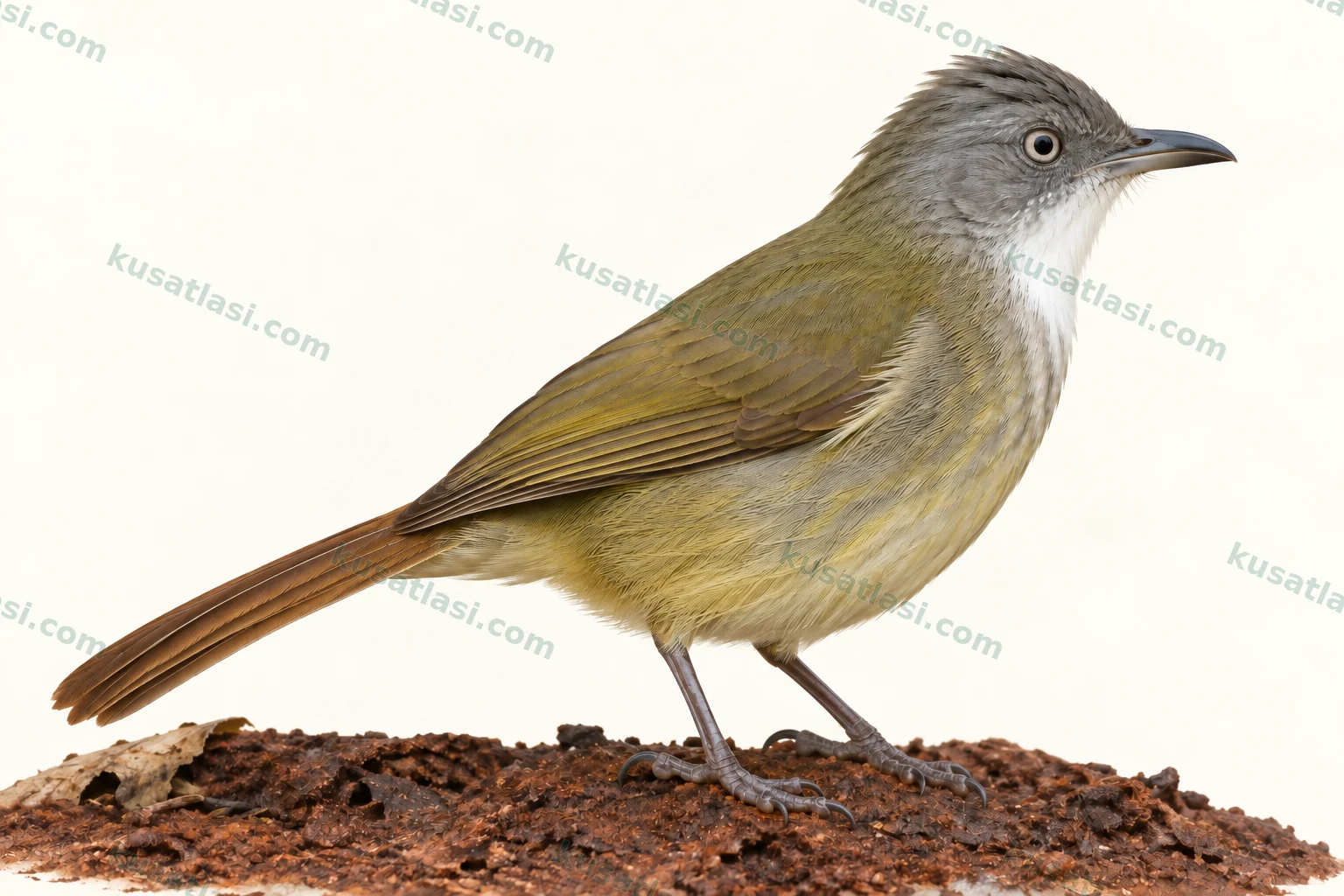
Compare male and female
 FemaleMale
A reliable distant key to adult sex or all juvenile age stages was not verified.
Where to look in its natural range?
Forest undergrowth, streamside forest and edges of regenerating secondary forest.
Resident. The southwestern Nigerian study recorded breeding signs in June and September.
January
Regional breeding signs in southwestern Nigeria. No verified regional date is given for this month. This does not imply local absence.
February
Regional breeding signs in southwestern Nigeria. No verified regional date is given for this month. This does not imply local absence.
March
Regional breeding signs in southwestern Nigeria. No verified regional date is given for this month. This does not imply local absence.
April
Regional breeding signs in southwestern Nigeria. No verified regional date is given for this month. This does not imply local absence.
May
Regional breeding signs in southwestern Nigeria. No verified regional date is given for this month. This does not imply local absence.
June
Regional breeding signs in southwestern Nigeria. Breeding signs in the Nigerian study.
July
Regional breeding signs in southwestern Nigeria. No verified regional date is given for this month. This does not imply local absence.
August
Regional breeding signs in southwestern Nigeria. No verified regional date is given for this month. This does not imply local absence.
September
Regional breeding signs in southwestern Nigeria. Breeding signs in the Nigerian study.
October
Regional breeding signs in southwestern Nigeria. No verified regional date is given for this month. This does not imply local absence.
November
Regional breeding signs in southwestern Nigeria. No verified regional date is given for this month. This does not imply local absence.
December
Regional breeding signs in southwestern Nigeria. No verified regional date is given for this month. This does not imply local absence.
Nest, egg and incubation
Breeding signs are recorded in secondary forest. Nest structure, typical clutch size and development durations were not verified for this account.
Short, sharp, lively calls resembling ‘chup-chup-chur’. Watch the appearance and confirm the calling bird.
Do not play recordings to attract birds; observe quietly, especially near nests.
Species information
Quick identification
The White-throated Greenbul Phyllastrephus albigularis is a small bird with a relatively long bill, living in African forest undergrowth. The bright white throat contrasts with the grey face and breast. The back and wings are grey-green and the underparts yellowish. A well-seen pale eye helps identification. In shade, the white throat may be all that shows of the head and breast. Check the bill, eye and body on the same bird.
It may make small movements of its wings and tail as it moves through vegetation. It occurs with other species or in small groups of its own kind. Not all greenish birds in a forest flock are the same species. Seeing the position of the white throat, unspotted wings and grey face together is more reliable than treating one short wing movement as diagnostic. Do not combine features of nearby birds.
General appearance and posture
The Upper Guinea field comparison describes the throat as sharply contrasting with the grey head and breast. Yellow can increase on the lower breast and belly, but it differs from the strong yellow of the yellow-throated Phyllastrephus icterinus. Loose crown feathers may give a slight crested impression. Do not assume a separate permanent long crest. Watch different natural postures.
Males, females and young birds
No plumage mark allowing certain distant sexing of adults was verified for this account. Darker grey, the apparent extent of the white throat or greater activity in one bird does not establish male or female. Individuals of a group can be in different light. Comparable angles and lighting help, but uncertainty is retained without a reliable sexing key.
A definite visual key to every young age stage was not verified either. A bird whose pale eye cannot be seen clearly is not automatically young. Consider branch shade and image resolution. In the Nigerian study, breeding status was assessed through brood patches on captured adults. That scientific examination is not a visual key giving the sex of every distant adult or age of every plain bird.
Appearance in flight
Wing and tail movements can help locate it in dense vegetation. The white throat and pale eye are harder to see in short flights. Wait for the bird to stop again to examine head and body. A supposed facial pattern is not added to a greenish silhouette when the central identification marks were not seen. Other greenbuls taking off from the same flock are followed individually.
Ixonotus guttatus may also attract attention by moving its wings, but the White-throated Greenbul lacks that species' pale wing spots. Similar movements do not replace feather patterns. If the entire wing cannot be seen, look for a clearer natural posture rather than concluding that it is unspotted.
Voice and behaviour
The current specialist account describes a sharp, lively sequence resembling “chup-chup-chur”. Such a short transcription does not convey every detail of the real sound. Watch the bird's appearance and confirm that the call comes from the same individual. Echoes and several birds calling together can change the apparent order of notes. A bird not actually seen calling is not assigned a nearby call.
It is recorded in forest undergrowth and at edges, including disturbed forest cover. The Upper Guinea field study also notes use of streamside forest and frequent small groups of its own species. Joining mixed flocks does not mean all foraging is always in them. Researchers not seeing it together with another greenbul in one region does not prove the species exclude each other everywhere.
Similar species
Against Phyllastrephus icterinus, assess the white throat, greyer head and breast and less strongly yellow underparts together. The pale eye supports the comparison when clearly seen. Possible occurrence of both in one forest does not justify assuming a throat pattern absent from a short, incomplete view. Grey and green shades respond to light, so back colour alone should not decide identification.
Criniger calurus can cause confusion through its white throat. The White-throated Greenbul looks smaller and does not show that species' conspicuously puffed throat and eye-surround pattern in the same way. Pale wing spots are central against Ixonotus guttatus. Shared movements are insufficient. Examine head, throat and wing patterns together. Angola's Phyllastrephus viridiceps is a separate species under current classification. Its duller throat and different voice are not combined into this account.
Global range
The current natural range extends from southwestern Senegal through western and central African forests to far southern South Sudan and Uganda. Southwards, it covers parts of the Republic of the Congo and Democratic Republic of the Congo. This broad account does not imply equal use of every forest in every country. Streamside forest patches and undergrowth can be important places to find it in some regions.
Status within its natural range
A study in two regenerating secondary forest patches in southwestern Nigeria directly examines the species. Breeding and moult status were assessed through measurements and examination of captured birds. This local work provides neither one population density for all Africa nor a compulsory continent-wide breeding calendar. Occurrence in a forest patch does not make adjacent completely cleared land equivalent habitat.
Movements and migration
It is considered resident. No regular long-distance migration route was verified. Moving through forest with a mixed flock is daily foraging. The former Angolan form viridiceps is treated as a separate species in current sources, so its geography is not added to this map. Approximate observations are read within the current taxonomic scope. Not all records under an older broad name are automatically transferred into the same natural range.
Breeding habitat
It uses undergrowth, forest edges, streamside woodland and regenerating secondary forest. The Nigerian study found breeding signs in such secondary patches. Vegetation alone does not establish nesting in every patch. A breeding sign, a nest and a food transfer represent different levels of evidence.
Nest site
Detailed information on nest structure, typical clutch size and incubation duration matching the current species concept was not verified. A breeding sign in a captured adult gives neither the nest location nor the young's development time. Measurements of relatives or information from the newly split Angolan species are not transferred into these gaps. Looking for a hidden undergrowth nest must not interrupt parental care. Observe from afar instead of waiting near the nest.
Daily habitat use
It occurs in dense lower and middle foliage, sometimes descending to the ground. Wing and tail movements and short calls help locate it among plants. Entering bushes to force the bird into the open can disrupt natural searching. If a narrow remnant streamside forest strip is used, preserve that cover and observe from the edge.
What does it eat?
An invertebrate-based diet is given in the ecological overview. This greenbul searches in forest leaves and vegetation. The examined sources do not verify detailed prey species or daily percentages, so particular insects are not said to form its whole diet. Perching on a fruiting branch in the same forest does not establish fruit consumption unless it is actually seen eating. Other greenbuls' food lists do not fill this species' gaps.
How does it forage?
It moves through lower and middle vegetation, searching in groups of its own kind or mixed flocks. Sometimes reaching the ground does not mean all its feeding happens there. Wing and tail movements and actual prey capture can be recorded separately. Seeing an animal taken into the bill provides strong feeding evidence even in a short watch. The Nigerian breeding–body condition relationship is not a diet analysis identifying prey species.
The Angolan form is now treated separately
Current taxonomy accepts Phyllastrephus viridiceps as a distinct species. Copying the White-throated Greenbul's old broad map can therefore produce a wrong range. Even where a name appears the same, check which forms the source includes. The split also requires checking which bird group measurement samples belong to.
Similar movement is not a similar pattern
Wing-flicking also occurs in other greenbuls. Equating this bird's unspotted wing with the movements of a spotted species misleads identification. A natural pause lets the head and wing be examined on the same bird. Adding appearance to behaviour strengthens comparison.
A breeding sign does not describe a whole nest
The Nigerian study recorded brood patches in this species in June and September. That is an indication of regional breeding activity. It does not give every nest's start date, egg number or full annual limits. The months must be read in the study's place and period. The same calendar is not assumed elsewhere.
Breeding and body condition were studied together
In the same study, White-throated Greenbuls showing breeding signs scored lower on the body condition measure than non-breeding birds. The association helps discuss breeding's energy requirements. It does not show that every individual is unhealthy or that the difference occurs everywhere. Keep the measured relationship separate from its possible biological explanation. Moult and signs of breeding are different records too, and can be assessed separately on the same individual.