

World Birds IUCN statusLC · Least ConcernGlobal IUCN category. BirdLife v10 (2025); taxon matching: AviList 2026 / IOC 15.2; checked: 29.10.2026. The list year is not the species assessment date. Source and method · BirdLife OrderPasseriformesPasserines FamilyPycnonotidaePycnonotidae
White-throated Bulbul
Alophoixus flaveolus
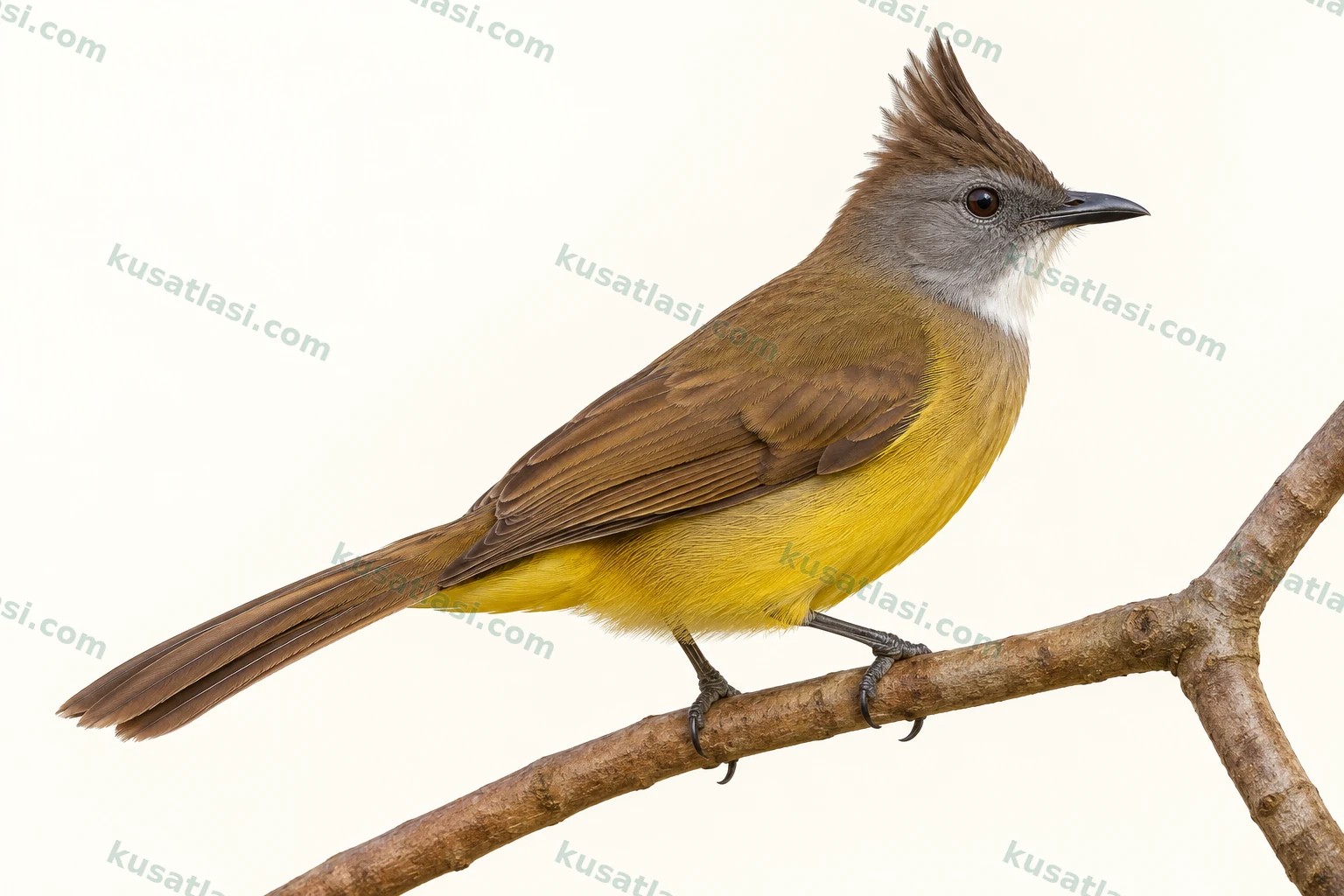
In Himalayan foothill forests and nearby Southeast Asia, look for a slender raised crest, grey face, olive-brown upperparts and yellow underparts. The white throat is not visible in every posture.
Biometrics
Length
Male21–22 cm
Female21–22 cm
Shared species value
Wing length
Male10.08 cm
Female10.08 cm
Shared species value
Weight
Male38–54 g
Female38–48 g
White-throated Bulbul
Nepal to northeastern Myanmar; western Yunnan, southeastern Myanmar and western ThailandObservation guide in its natural range
Look for three features together
Do not rely on a single featureSlender crown feathers that can rise and a grey face.
Olive-brown upperparts and yellow underparts.
The head angle can hide the white patch. It is not enough for identification on its own.
Compare male and female
 FemaleMale
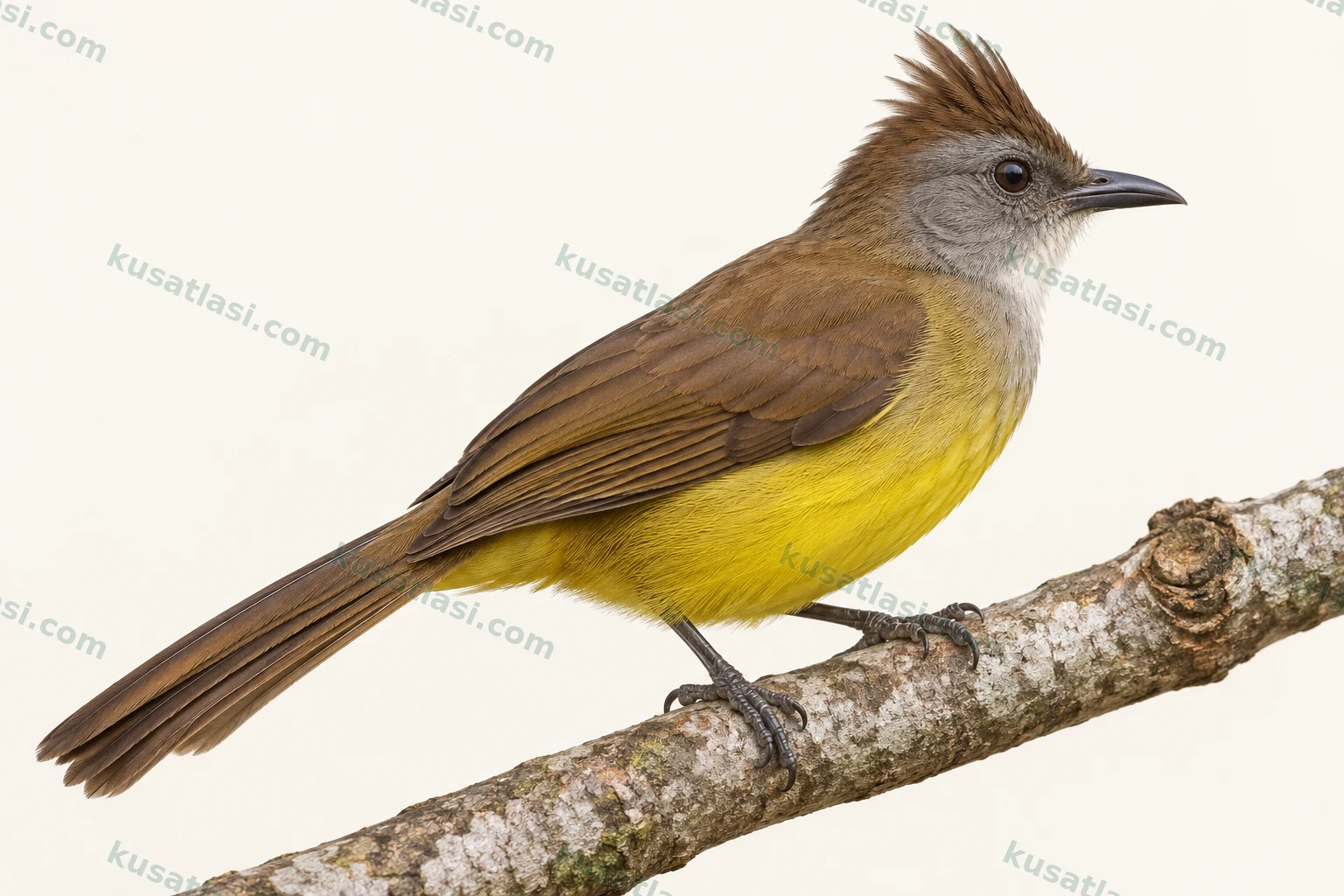
The sources do not provide a reliable detailed field key for age or sex. Female or juvenile descriptions of other species are not transferred.
Where to look in its natural range?
Wooded lower and middle foothills and dense scrub around small trees.
Historical July–August records of nests with eggs are from Darjeeling and Sikkim. They do not establish a calendar for the whole range.
January
Resident. Local movements related to elevation are reported. No annual route was verified. No verified regional date was given for this month. This does not imply local absence.
February
Resident. Local movements related to elevation are reported. No annual route was verified. No verified regional date was given for this month. This does not imply local absence.
March
Resident. Local movements related to elevation are reported. No annual route was verified. No verified regional date was given for this month. This does not imply local absence.
April
Resident. Local movements related to elevation are reported. No annual route was verified. No verified regional date was given for this month. This does not imply local absence.
May
Resident. Local movements related to elevation are reported. No annual route was verified. No verified regional date was given for this month. This does not imply local absence.
June
Resident. Local movements related to elevation are reported. No annual route was verified. No verified regional date was given for this month. This does not imply local absence.
July
Resident. Local movements related to elevation are reported. No annual route was verified. Historical Darjeeling and Sikkim records report nests with eggs, with limits to verification in the source.
August
Resident. Local movements related to elevation are reported. No annual route was verified. Historical Darjeeling and Sikkim records report nests with eggs, with limits to verification in the source.
September
Resident. Local movements related to elevation are reported. No annual route was verified. No verified regional date was given for this month. This does not imply local absence.
October
Resident. Local movements related to elevation are reported. No annual route was verified. No verified regional date was given for this month. This does not imply local absence.
November
Resident. Local movements related to elevation are reported. No annual route was verified. No verified regional date was given for this month. This does not imply local absence.
December
Resident. Local movements related to elevation are reported. No annual route was verified. No verified regional date was given for this month. This does not imply local absence.
Nest, egg and incubation
A shallow, tightly woven nest of dry leaves and roots lies between branches of a small tree. Historical records mention 2–3 eggs. A life-history compilation gives 13 days of incubation. Time to first flight was not verified.
Noisy nasal calls can help locate the group. Match the sound to the bird in view.
Do not play recordings to attract birds; observe quietly, especially near nests.
Species information
Quick identification
The White-throated Bulbul Alophoixus flaveolus is found in forests of the Himalayan foothills and nearby Southeast Asia. Look for the raised, slender crest feathers, grey face, brown and olive upperparts and yellow underparts together. Its English name is White-throated Bulbul. The white throat that gives it its name is not visible in every posture. It can be hidden when the bird lowers its head or feathers from the cheek cover the area. A large, permanently fluffed white throat patch is not required for identification.
The current name is Alophoixus flaveolus. Older scientific works used the combinations Criniger flaveolus and Trichophorus flaveolus. These names belong to this bird’s naming history. The traits of other bulbuls listed under the same former genus do not all apply to this species. In particular, descriptions of females or young birds of related species are not assigned to this bird simply because they appear next to it in the text.
General appearance and posture
Brown and olive tones vary across the adult’s upperparts, between the back and the various surfaces of the wing feathers. The historical museum description gives an olive-yellow cast to the upperparts and a slightly rufous area above the tail. The greater coverts and flight feathers are brown, with olive outer edges that connect the folded wing visually to the back. The general brown appearance in the modern field account and the detailed feather description in the older work describe the same bird at different levels. A single photograph’s colour does not establish a new colour or a subspecies.
The long crown feathers can rise into a crest. The forehead and crown are not the same colour as the vivid yellow underparts. The grey face is particularly apparent around the ear and along the sides of the head. The old museum account notes fine pale streaks on some facial feathers. These should not be magnified into a large white cheek patch at a distance. A flattened crest does not mean the bird lacks the feature. Wait for the bird to raise its head to see both the crest and the border of the throat more clearly.
The throat is white, and the pale area near the cheeks can have a grey cast. Yellow predominates on the remaining underparts, with more olive tones possible on the sides. The white throat and yellow breast are different feather areas. Yellow may look pale in shade, and strong sunlight can erase the boundary of the white throat in a photograph. Identify the bird using the pale throat, grey face, crest feathers and underparts on the same individual.
The tail can show brown and rufous tones, with more olive edges near the base. The museum account describes a pale lead-coloured bill and pale flesh-coloured feet. These historical colour notes were not inferred from photo settings. The shape of the bill and proportions of the head are easier to follow in poor light than small differences in shade. If part of the tail is hidden behind a branch, do not assign a white tip or colour band to the hidden area.
Males, females and young birds
The sources reviewed do not provide a reliable, detailed field key for age or sex. Females are therefore not assigned a different throat colour, young birds are not required to lack yellow on the belly, and males are not required to have a longer crest. Describe visible feather areas as seen. If the sex has not been confirmed, do not call a bird male merely because it looks larger or more active.
The female description for another species following this bird in the old museum catalogue is not a description of its female. When one book covers several similar species, check the heading and specimen identity carefully. Developmental stages of the related Puff-throated Bulbul are not transferred to this species as a guide to young birds. Keep any age information recorded with a photograph or in research. If none is available, retain the uncertainty.
Appearance in flight
When a moving bird is visible only briefly, look at the yellow underparts, dark wing and body proportions. Waiting to see which branch it lands on makes it easier to compare the face and crest. The museum description gives yellow underwing coverts and dark brown undersides to the flight feathers, with paler inner edges. This is not interpreted as a distinctive white wing stripe visible from every angle. A blurred flight image is insufficient for a firm identification of species or sex.
Voice and behaviour
The modern field account describes a noisy forest bird that moves in groups. Repeated nasal calls may help locate a group behind the forest cover. Do not assign every nearby call to the species before linking the sound to a bird in view. The source does not confirm a syllable sequence, so no new transcription is given. Wait for the bird to move naturally rather than playing calls to draw it towards a nest or exposed branch.
Similar species
The Puff-throated Bulbul Alophoixus pallidus can be very similar, but its natural range overlaps only to a limited extent. In the modern comparison, its white throat is more conspicuous, its underparts darker and its general appearance a darker brown. Look at the grey face, yellow underparts and frequently concealed throat of the White-throated Bulbul together. A photograph showing only a pale throat is insufficient. Use locality and more than one feather area to identify it.
World distribution
Its regional range extends from the Himalayan foothills to northeastern Myanmar, and from southwestern China through southeastern Myanmar to western Thailand. The current taxonomic list recognises two subspecies. Flaveolus ranges from Nepal to northeastern Myanmar. Burmanicus ranges from western Yunnan to southeastern Myanmar and western Thailand. The range is not extended to all forests in China, Thailand or India. Other bulbuls from the Malay Peninsula and Borneo are not included.
Status within its natural range
Historical museum records include Nepal, Darjeeling, Bhutan, Assam, the Khasi region and Sylhet. Older political names are not treated as present-day national boundaries. Match each specimen’s identity to the current taxon. Finding the bird in one valley does not establish nesting in the neighbouring open plain. Changes in forest cover and elevation can affect local chances of encountering it. A mapped cell does not show that every patch of land is occupied.
Migration
Referenced movement classifications describe it as resident, with possible local movement in relation to elevation. No verified annual long-distance route is drawn. Historical July–August nest records from Darjeeling and Sikkim are not a breeding calendar for the whole range. A month when an individual was seen is distinct from a nest with eggs. Joining points recorded in different months does not establish the route a bird actually took.
Breeding habitat
Look in wooded lower and middle foothills. Historical breeding records in Darjeeling and Sikkim are associated with dense scrub containing small trees. These local records do not mean all yellow-bodied bulbuls nest at the same elevation or in the same plant species. A tree where a feeding group settles does not become the centre of a breeding area without an observation of a nest with eggs.
Nest site
The records compiled by Hume describe a shallow, tightly woven nest between branches in a small tree. Dry leaves were bound with roots, and the interior was lined with fine roots and fern pieces. Reported nests with eggs contained two or three. A modern life-history compilation gives an incubation record of 13 days, which is not presented as a fixed duration measured afresh in all regions. Time to first flight was not verified.
Daily habitat use
Observe by waiting for the group to move naturally through dense foliage. Parting branches or entering a thicket to look for a nest changes both the view and the birds’ behaviour. The historical source can explain nest structure. Approaching a nest or seeing its eggs today is unnecessary for identification. Two birds returning to the same tree are not conclusively labelled a pair unless their nest roles and sexes are independently established.
What does it eat?
The referenced functional diet data classify this species among birds that eat fruit. This does not mean it eats only fruit throughout the year or that a particular plant is an obligatory food. The sources reviewed do not give annual proportions of food types, so no specific fruit, insect percentage or diet for young birds is added. Stomach contents from related bulbuls are not a measurement of this species’ diet.
How does it forage?
When watching a bird feeding in a leafy forest layer, note whether the item taken in its bill can actually be seen. Landing on a fruiting branch does not prove it swallowed the fruit. A group changing trees does not prove the previous tree has run out of food. Follow the birds together with their cover, movements and sounds. Do not put out food or fruit to study their natural choices. Keep the branch and surrounding forest cover intact. Distinguish food seen during observation from the broad feeding category in the compilation.
The white throat can be hidden
The white area in the name is not a badge the bird has to display at all times. The angle of the head and nearby feathers can conceal the throat. A dark photograph in which the area is hidden does not rule out the species. Look again at the boundary when the same bird lifts its head. Reading the crest, face and yellow underparts together helps avoid relying on the name alone.
A shallow nest of leaves and fine roots
A historical nest report from Darjeeling describes dry leaves tightly bound with roots. The lining contained fine dark roots and fern pieces. This account is more informative than simply calling the nest a cup. The historical collection record does not prove that every present-day nest uses the same plants. Relate the local materials to the specimen observed.
Records of two and three eggs
The Darjeeling account cited by Hume reports three eggs, and several Sikkim nests had two fresh eggs. The compilation describes dark reddish spots on a pinkish ground. Hume explicitly wrote that he did not have the opportunity to verify these eggs himself. The historical report is therefore not presented as a series recently rechecked in the field. Its source limitation remains visible.
An old genus name and the same species today
Trichophorus and Criniger belong to the scientific naming history of this bird. Museum and nest records can be understood when the old name is matched with the current Alophoixus identity. Treating the different species described under the adjacent heading as another name for this bird would assign its female appearance or range to the wrong taxon. Read the heading, specimen locality and publication context along with the name.