

World Birds IUCN statusLC · Least ConcernGlobal IUCN. BirdLife v10 (2025); taxon matching AviList 2026 / IOC 15.2; checked: 29.10.2026. The list year is not the species’ assessment date. Source and method · BirdLife OrderPasseriformesPasserines FamilyPycnonotidaePycnonotidae
White-headed Bulbul
Hypsipetes thompsoni
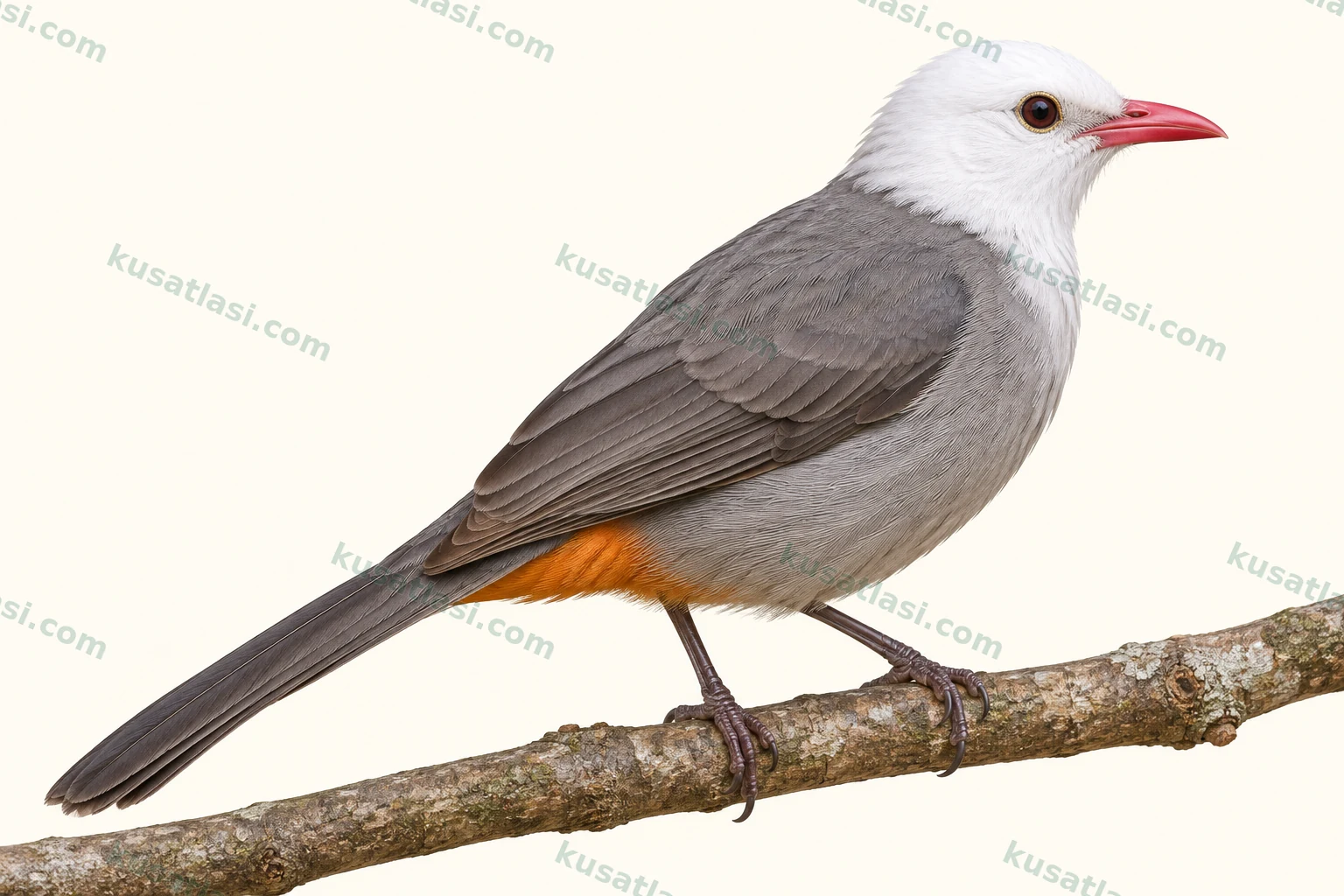
White head and neck, plain grey body, rose-red bill and chestnut-orange undertail; no long untidy crest.
Biometrics
Length
Male20 cm
Female20 cm
Shared species value
Wing length
Male9.02 cm
Female9.02 cm
Shared species value
Weight
Male41.8 g
FemaleData unavailable
White-headed Bulbul
Mountain forests of eastern/southern Myanmar and northwestern ThailandObservation guide in its natural range
Look for three features together
Do not rely on a single featureExtensive white; a bare area around the eye and a red eyelid rim.
Ashy grey, with a chestnut-orange undertail; the body is not inky black.
Narrow downcurved red bill; a rather long forked tail.
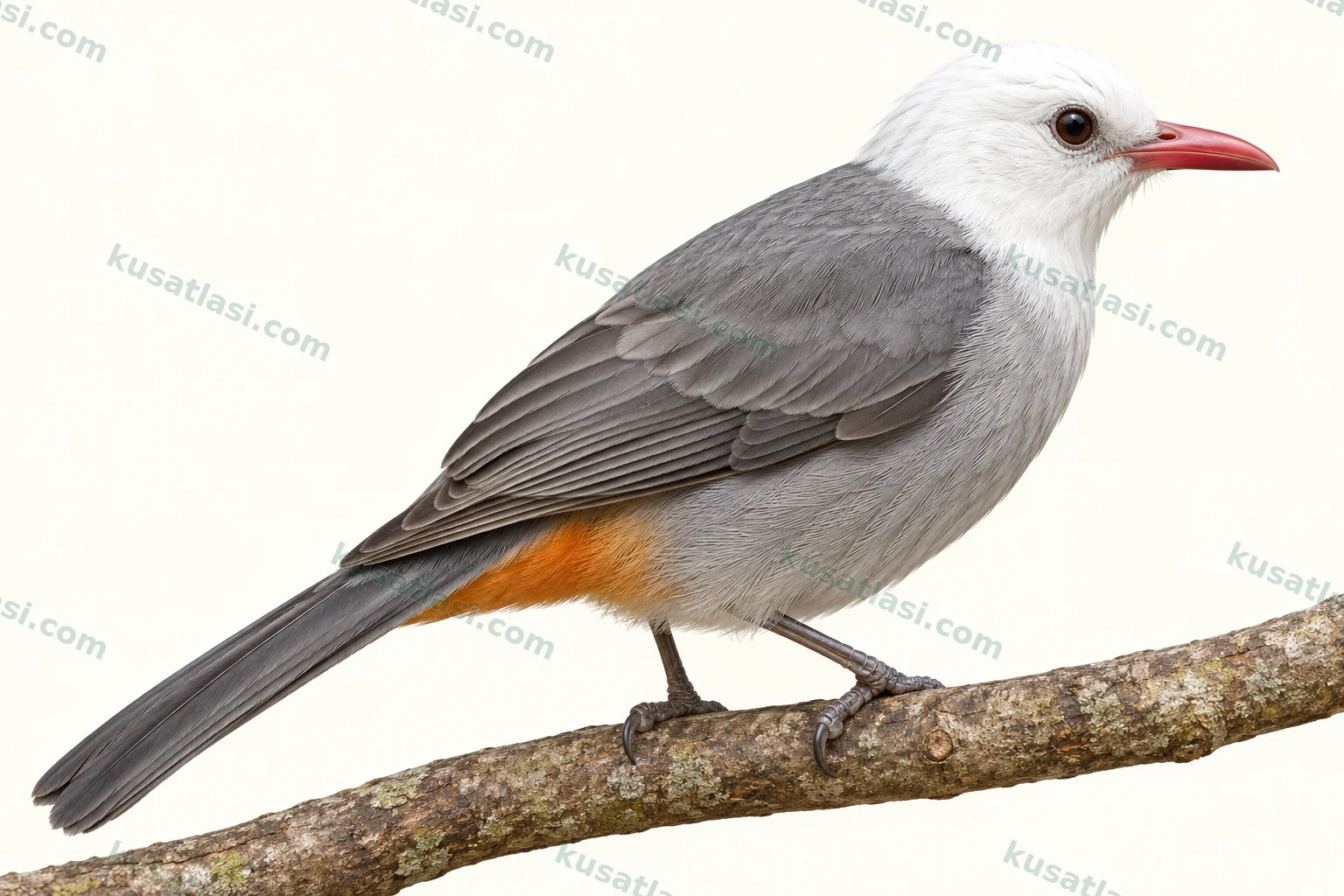
Compare male and female
 FemaleMale
Adult males and females are similar; a brighter white head or warmer undertail is not a reliable sex character.
Where to look in its natural range?
Open mountain forest, forest edges and secondary vegetation; lower slopes outside the breeding season.
A dated Myanmar specialist account describes April breeding around Shan and Karen; a precise monthly calendar for the whole range has not been verified.
January
Generally resident; it may descend lower outside the breeding season. No verified regional date specific to this month was given; this does not mean local absence.
February
Generally resident; it may descend lower outside the breeding season. No verified regional date specific to this month was given; this does not mean local absence.
March
Generally resident; it may descend lower outside the breeding season. No verified regional date specific to this month was given; this does not mean local absence.
April
Generally resident; it may descend lower outside the breeding season. Myanmar, around Shan and Karen; an old dated account: a regional breeding description, not generalised to the whole range.
May
Generally resident; it may descend lower outside the breeding season. No verified regional date specific to this month was given; this does not mean local absence.
June
Generally resident; it may descend lower outside the breeding season. No verified regional date specific to this month was given; this does not mean local absence.
July
Generally resident; it may descend lower outside the breeding season. No verified regional date specific to this month was given; this does not mean local absence.
August
Generally resident; it may descend lower outside the breeding season. No verified regional date specific to this month was given; this does not mean local absence.
September
Generally resident; it may descend lower outside the breeding season. No verified regional date specific to this month was given; this does not mean local absence.
October
Generally resident; it may descend lower outside the breeding season. No verified regional date specific to this month was given; this does not mean local absence.
November
Generally resident; it may descend lower outside the breeding season. No verified regional date specific to this month was given; this does not mean local absence.
December
Generally resident; it may descend lower outside the breeding season. No verified regional date specific to this month was given; this does not mean local absence.
Nest, egg and incubation
The dated Myanmar account describes a grass cup nest set in a bank. Typical complete clutch size, incubation duration and time to first flight lack sufficient verified support; timings are not taken from other species.
In flocks it gives harsh, chattering calls recalling a parrot; song consists of repeated squeaky two-note phrases.
Do not play recordings to attract birds; observe quietly, especially near nests.
Species information
Quick identification
The White-headed Bulbul Hypsipetes thompsoni is a white-headed, grey-bodied bulbul of mountain forests in Myanmar and northwestern Thailand. Its white head and neck contrast sharply with the ashy-grey body. The chestnut-orange area beneath the tail and rose-red bill are important parts of identification. A white head alone is insufficient: white-headed forms of another bulbul can occur in the same surroundings.
There is no long, untidy crest. At close range, the bare area around the eye and the red eyelid rim attract attention. That redness does not mean the coloured part of the eye is red. Identification is stronger when white head, grey body, coloured undertail and uncrested head are assessed together.
General appearance and posture
The white covers the head and neck but does not extend equally onto the back, sides of the neck and breast. Upperparts and underparts are largely ashy grey. The wing coverts are grey, while the longer flight feathers and tail may look darker brownish grey. The body is not inky black. A grey area becoming darker in shade, or a photograph being processed with excessive contrast, does not alter the actual plumage pattern.
The chestnut-orange undertail area is a warm and conspicuous colour against the grey body. It is not the whole set of tail feathers: these are the coverts beneath the base of the tail. They may be easier to see when the bird turns sideways or raises its tail. A slight warm wash in the pale grey lower-belly feathers should not be confused with the broad undertail patch.
The bill is slender, narrow and downcurved, not a thick seed-cracking bill. Bill, legs and feet have been described in red-coral tones. The bare skin around the eye and the red eyelid rim are separate structures. The first detailed description stated that the eye was pale yellowish. In a close view, these small but distinct anatomical differences can be examined instead of treating the head as merely a white ball.
The tail is rather long and forked. Perched or moving between branches, the bird can appear as a pale head above a plain grey body. The depth of the fork varies with whether the tail feathers are closed or spread; failure to see the notch in one photograph does not show that it is another species. The rounded crown feathers differ from the more untidy, pointed crown of white-headed Black Bulbul forms.
Males, females and young birds
Adult males and females share the same basic plumage pattern. The older detailed description states that they look similar and differ very little in size. A brighter white head or warmer undertail is not used as a definite male character. Light, feather condition and photographic settings can affect these tones.
If the sex of the observed individual cannot be determined reliably from colour alone, uncertainty is retained.
The full details of age-related plumage development in young birds have not been verified in reliable sources for this work. No age at which the white head is completed, or supposedly obligatory juvenile patch, is therefore invented. Instead of treating a bird whose head is incompletely visible as young or female on that view alone, the visible species characters are recorded. Family relationships and interpretations of age require additional evidence.
Appearance in flight
When moving between branches, the contrast between white head and grey body remains; dark flight feathers and the rather long tail can also attract attention in a brief view. The warm undertail area may be invisible in distant flight, however. A poorly seen feature is not assumed to be present; when the bird perches again, head, body and undertail are examined together.
No special open-wing patch that identifies this species on its own in the field has been verified. A generally grey or dark wing occurs in many forest birds. The place where flight is observed, the perched appearance of the same individual and any connection to its voice support identification.
Voice and behaviour
When moving in a flock, it can give harsh, chattering calls recalling a parrot. Its song, by contrast, is described as repeated squeaky two-note phrases. A call and regular song need not sound alike. Alongside the sound, check the grey body, white head and seasonal elevational context; a similar tone alone does not establish the species with certainty.
Outside the breeding season it may descend to lower slopes and some low-lying areas. A mountain-breeding bird seen lower down is therefore not automatically misidentified. Seeing a small group also does not mean all its birds belong to a single family. The same food-rich patch may bring different individuals together; a family interpretation requires further evidence such as adult–young interactions.
Similar species
White-headed forms of Black Bulbul Hypsipetes leucocephalus are the most important comparison. Those forms have a much darker body, dark undertail and a more untidy crown. In White-headed Bulbul, plain grey body and chestnut-orange undertail should be seen together. Relatedness does not mean every white-headed individual is the same species.
Mountain-forest bulbuls such as Ixos mcclellandii may also occur in the same surroundings; their head and body patterns differ from this species’ extensively white head. Identification is not based only on flock movement or a general bulbul sound in the forest. The extent of head white, grey body tone and position of the undertail colour are verified on one individual.
World distribution
Its natural range is centred on mountain forests in eastern and southern Myanmar and northwestern Thailand. Shan and the northwestern Thai mountains around Chiang Mai and Mae Hong Son appear in dated scientific and specialist accounts. It is not described as a widespread bulbul throughout Southeast Asia. Indian, Chinese or Vietnamese records of other species with similar names are not automatically added to this taxon.
Status within its natural range
The current taxonomic list gives the global category Least Concern. That assessment does not mean the bird is abundant in every forest. Its association with open forest, forest edges and suitable fruiting surroundings can affect regional detectability. Uncertain records farther north in old dated books are not transferred to the map as newly verified natural range.
The map’s broad framework is restricted to the Myanmar and northwestern Thailand mountain belt supported by the sources read. A retained modelled cell does not, on its own, prove a nest or adult was seen in it. A verified observation, a general range account and a breeding record are different types of evidence. Nor is a month with no records declared a month when the species is certainly absent from that region.
Migration and movements
It uses mountain and hillside forests in the breeding season and may descend lower outside it. This is an elevational movement, not a regular intercontinental migration route. The same start month, distance or single descent line has not been verified for every individual. The timing of small flocks seen lower down is assessed only in the context of their recorded place and date.
Breeding habitat
It is associated with open forest and forest edges in mountainous country. Specialist accounts mention secondary vegetation, scrub and clearings. Using such surroundings does not mean a completely treeless area is equivalent for breeding. Slope, vegetation and food-providing plants are considered together; elevation alone does not describe all the features of a habitat.
Nest site
A dated specialist account for Myanmar describes April breeding around Shan and Karen, a grass cup nest set in a bank and pale pink eggs with red spots. This old regional information is not expanded into a claim that the entire range nests in the same month or only at the same location. The introduction of a later scientific paper mentions open-cup and cavity use for the species, citing another specialist account; this does not mean that the paper directly followed bulbul nests.
Typical complete clutch size, incubation duration and time to first flight have not been verified with sufficient support in this research. Two-week developmental periods from other bulbuls are not transferred to this bird. Rather than open vegetation on a bank to see a nest or eggs, watch the birds’ movements from a distance.
Daily use of space
Elevational movement outside the breeding season shows that it does not remain only around the same nest all year. Individuals seen at forest edges and in open woodland may use nearby fruit sources. A food plant, roost and nest need not be in the same place. Frequent use of a fruiting tree does not prove that a nest is certainly below or above it.
What does it eat?
It is a predominantly fruit-eating bulbul. The specialist data account lists fruit and nectar food categories. This classification does not show that every meal throughout the year consists of the same food. Because detailed regional consumption proportions for particular fruit species have not been verified, no specific plant or percentage is presented as obligatory food.
How does it obtain food?
Taking fruit from plants in wooded surroundings is the basic description of its feeding. Its narrow, curved bill should not be interpreted as a thick finch bill for crushing seeds. A sighting on a flowering plant also does not, on its own, prove nectar feeding; what the bird takes must be observed. Food classification and interpretation of an individual observation are therefore kept separate.
Fruit-eating birds can contribute to seed transport, but the distance this species carries seeds of particular plants, or the proportion that germinates, is not presented here as a measured result. Several birds in one tree may suggest plentiful food; this is insufficient to establish the group’s daily requirement or annual diet proportions.
An old genus name does not mean a different bird
Sources may use Cerasophila thompsoni or Microscelis thompsoni. The currently accepted name is Hypsipetes thompsoni. The 2002 classification study discussed differences in head, bill and eye surroundings; the 2017 genetic comparison placed this bird within the Hypsipetes group. A changed name does not mean the white head or grey body changed; older information about the same species is read after checking its identity.
Relatedness and similar appearance are assessed separately
Genetic research found a close relationship to Black Bulbul. Nevertheless, the two species differ in body, crown and undertail pattern. Close relationship does not remove field identification characters. A white head may be a shared resemblance; grey body and coloured undertail are checked together to distinguish this species.
A red rim is not the eye itself
The red eyelid edge and the pale coloured inner part of the eye are separate structures. There is also a small bare skin area amid the white head feathers. A description saying only “red eye” loses these distinctions. Seeing exactly where the red lies in a close view is more informative than a single general colour word. Bare skin around the eye was also treated as a distinguishing feature in the 2002 morphological classification study.
A mountain bird can also be seen lower down
Cornell’s specialist account describes descent from slopes to lower areas outside the breeding season. Thus, not every low-elevation individual is an erroneous record. Conversely, a single descent record does not show that the whole population uses the same route and month. Resident classification and seasonal elevational movement can coexist; drawing a long migration route requires further evidence.