

World Birds IUCN statusLC · Least ConcernGlobal IUCN category. BirdLife v10 (2025); taxon matching: AviList 2026 / IOC 15.2; checked: 29.10.2026. The list year is not the species assessment date. Source and method · BirdLife OrderPasseriformesPasserines FamilyPycnonotidaePycnonotidae
African Red-eyed Bulbul
Pycnonotus nigricans
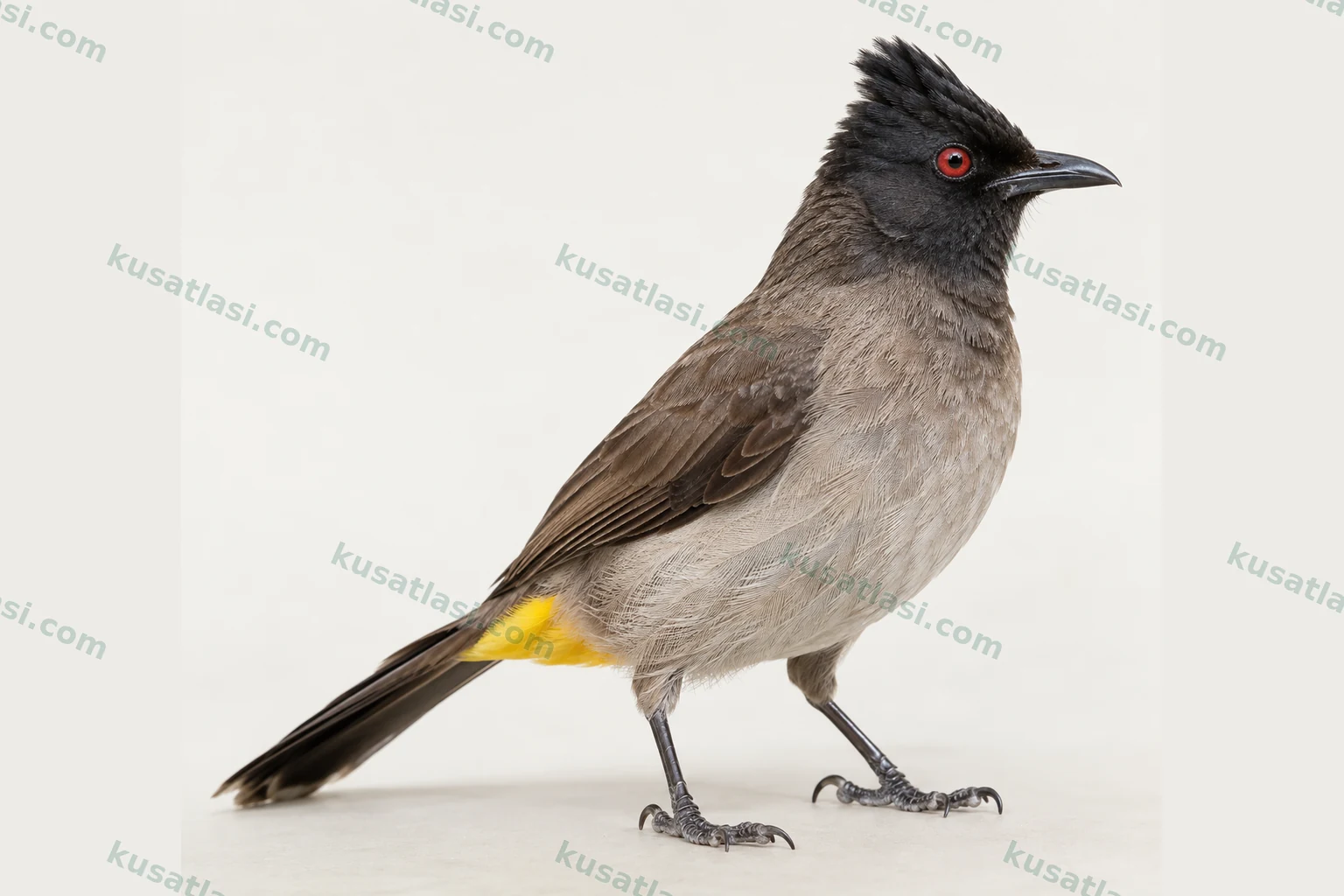
Assess black head, red bare eye-ring, grey breast and yellow undertail together; young birds have a pale eye-ring.
Biometrics
Length
Male19–21 cm
Female19–21 cm
Shared species value
Wing length
Male9.28 cm
Female9.28 cm
Shared species value
Weight
Male21.6–37.4 g
Female30.8–37.5 g
African Red-eyed Bulbul
South Africa, Namibia, Botswana; southwestern Angola and southern ZambiaObservation guide in its natural range
Look for three features together
Do not rely on a single featureBare ring around the eye, not the colour of the eye itself.
Compare the black head with the pale grey breast.
Do not exclude the species merely because red is absent.
Compare male and female
 FemaleMale
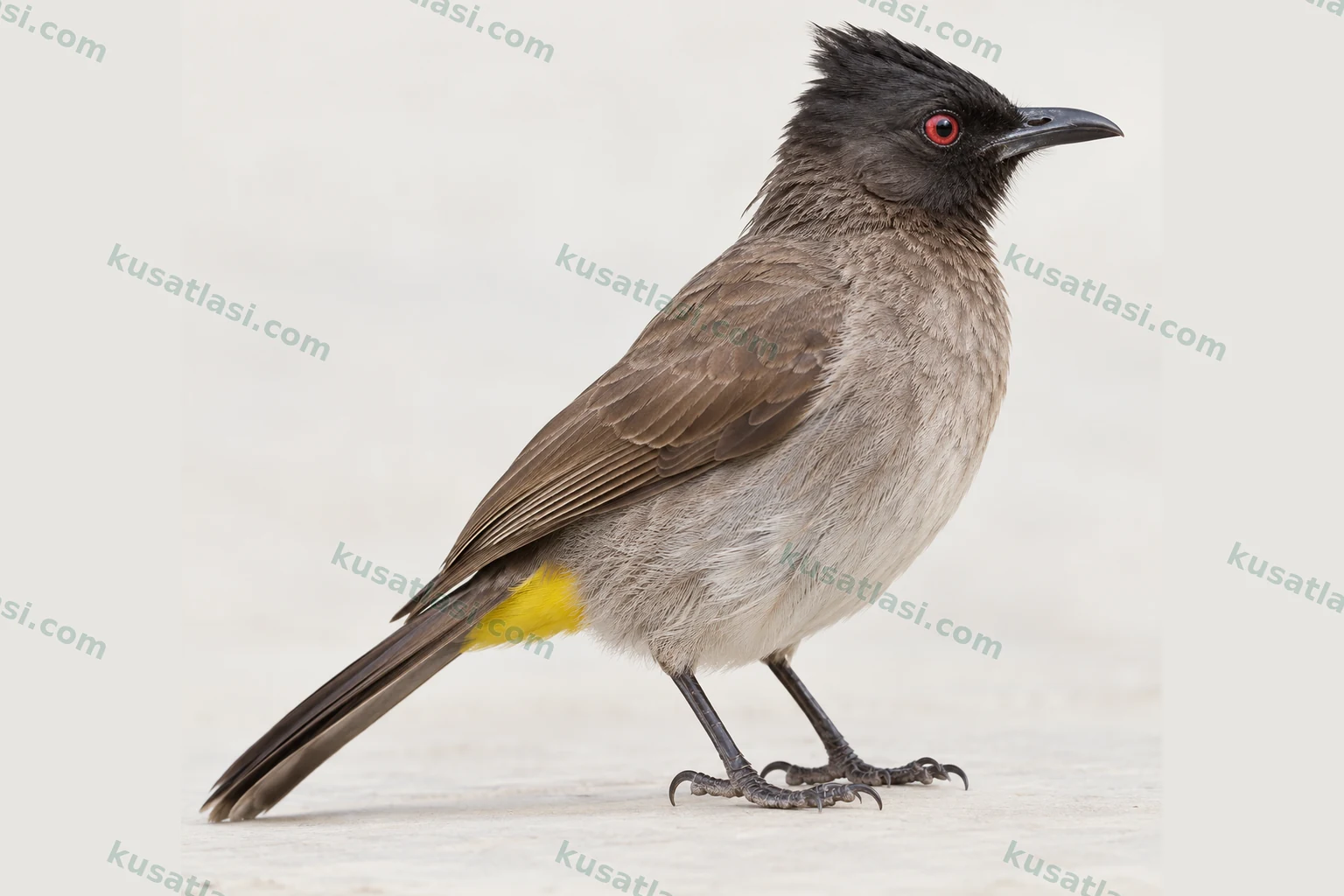
Adult sexes are similar; the red eye-ring is not exclusive to males. In young birds it is narrower and paler.
Where to look in its natural range?
Watch head and eye-ring together around fruiting bushes, dry woodland and water.
Mostly resident, with regional seasonal movements in the north and at range margins. The months below are examples only from the named regional study or expert account.
January
Mostly resident, with regional seasonal movements in the north and at range margins. South African expert account: Laying period; peak in October–December. Botswana, SABAP1: Regional laying peak. Namibia, SABAP1: Regional laying peak.
February
Mostly resident, with regional seasonal movements in the north and at range margins. South African expert account: Laying period; peak in October–December. Namibia, SABAP1: Regional laying peak.
March
Mostly resident, with regional seasonal movements in the north and at range margins. South African expert account: Laying period; peak in October–December.
April
Mostly resident, with regional seasonal movements in the north and at range margins. South African expert account: Laying period; peak in October–December.
May
Mostly resident, with regional seasonal movements in the north and at range margins. No verified regional date specific to this month was given; this does not mean local absence.
June
Mostly resident, with regional seasonal movements in the north and at range margins. No verified regional date specific to this month was given; this does not mean local absence.
July
Mostly resident, with regional seasonal movements in the north and at range margins. No verified regional date specific to this month was given; this does not mean local absence.
August
Mostly resident, with regional seasonal movements in the north and at range margins. No verified regional date specific to this month was given; this does not mean local absence.
September
Mostly resident, with regional seasonal movements in the north and at range margins. South African expert account: Laying period; peak in October–December.
October
Mostly resident, with regional seasonal movements in the north and at range margins. South African expert account: Laying period; peak in October–December. Botswana, SABAP1: Regional laying peak.
November
Mostly resident, with regional seasonal movements in the north and at range margins. South African expert account: Laying period; peak in October–December. Botswana, SABAP1: Regional laying peak.
December
Mostly resident, with regional seasonal movements in the north and at range margins. South African expert account: Laying period; peak in October–December. Botswana, SABAP1: Regional laying peak. Namibia, SABAP1: Regional laying peak.
Nest, egg and incubation
The concealed nest is cup-shaped and holds two or three eggs. The South African specialist account reports that the female incubates for 11–13 days; both parents feed the young. BDI gives 12–13 days, and no new average is calculated.
Vocal groups give frequent contact and alarm calls; match the calling bird with its head and body pattern.
Do not play recordings to attract birds; observe quietly, especially near nests.
Species information
Quick identification
The African Red-eyed Bulbul Pycnonotus nigricans is a black-headed, grey-brown bulbul of southern Africa's dry and semi-dry woodland. The adult's most useful feature is a conspicuous ring of red bare skin around the eye. This red is not the coloured part inside the eye; it is the surrounding skin. Identification is stronger when the boundary between black head and paler grey neck and breast is considered with the pale belly and bright yellow undertail. Yellow undertail alone is insufficient, because close relatives can share it.
The young bird's eye-ring is narrower and paler. Failure to see red therefore does not immediately exclude the species, especially in young or shaded birds. First examine the black head, the neck and breast colours and the whole underbody. Seeing both sides of the head when a bird pauses in a fruiting bush is more helpful than deciding from a blurred photograph. Its English name is African Red-eyed Bulbul; this page concerns Pycnonotus nigricans and cannot be replaced with a general description of another bulbul.
General appearance and posture
Head and face are black, neck and breast paler grey. Back and upperwings are dark grey-brown, and the belly grades towards grey-white. The yellow undertail is easier to see when the bird turns sideways or raises its tail. The balance of grey and brown on the back varies with light. Shade may make the whole body look darker than it is, while strong sun can make pale feathers almost white. The relationship between red eye-ring, black head and paler breast is therefore a sounder starting point than one precise colour shade.
It occurs on bushes or trees in pairs and loose small groups. Several birds may gather at fruiting trees without moving as a tightly organised flock. Individuals accustomed to people may occur in gardens, around farms and near water containers. Slightly raised head feathers change posture and head shape. Expert accounts also report a lowered head and partly opened wings in threat displays. These momentary postures are not permanent anatomy or sex differences.
Males, females and young birds
Adult males and females have similar basic plumage colours. Both may show a black head, red eye surround and yellow undertail. Treating any of these as male-only is wrong. One adult appearing brighter beside another does not determine sex; light, feather condition and viewing angle also affect appearance. The two adult plates represent the sexes, but do not impose a colour distinction that is unreliable in the field.
Young birds resemble adults but look paler, and their red eye skin is not yet as prominent. The South African bird atlas specifically warns that the narrow pale ring can cause confusion with other bulbuls. Do not decide solely from the eye-ring if the head, breast and underparts cannot be seen together. Proximity within a family may help, but different species can feed in the same fruiting tree; each bird's identity must be assessed separately.
Appearance in flight
The black head and red eye-ring are harder to see in flight than on a perched bird. Grey-brown upperparts and pale underparts may be visible during a move between bushes; yellow undertail shows clearly only from a suitable angle. A colour disappearing during a brief passage is not assumed to be truly absent. No flight identification based on a single upperwing or underwing mark is proposed as universally decisive for this species.
While feeding, it may fly up to catch insects above trees and bushes or dart after insects flushed from leaves. This does not make it exclusively insectivorous; fruit, flowers and animal foods are parts of the same behavioural repertoire. Complete the head and breast pattern assessment when it lands again. A short flight's direction does not establish a seasonal migration route, nor does a group taking off imply a long-distance journey.
Voice and behaviour
The species is often vocal and conspicuous. Groups around fruit give frequent, excited contact calls. Matching a call to the visible head and body of its source is helpful; calls of other fruit-eating birds in the same tree should not be attributed to it. The voice description here concerns natural behaviour; one syllable or written imitation is not a reliable sole basis for identification.
It may move its wings and tail when excited. Expert accounts report mobbing snakes and small owls with other birds. When partners perch close, they may preen each other's head feathers. Territorial defence becomes prominent during breeding, with behaviour directed at approaching birds. Gathering near water in dry areas also matters. A crowd at a drinking container nevertheless does not prove an equal number of breeding pairs there.
Species that may be confused
1. Pycnonotus tricolor, Dark-capped Bulbul: the adult eye surround is dark, not red; the contrast between breast and pale belly also differs. Yellow undertail alone does not separate them. Regional birds treated in older southern African sources as P. barbatus or Blackeyed Bulbul must be carefully matched to current taxon names.
2. Pycnonotus capensis, Cape Bulbul: a broader pale white eye-ring and more uniformly dark underparts help. Do not decide from a dark body alone without clearly seeing the head and eye surround.
3. Intermediate-looking birds in contact zones: hybridisation with both close relatives has been reported. A bird whose marks do not fit the expected combination is not assigned a definite species or hybrid name from one photograph; record place, date and several angles.
World distribution
The African Red-eyed Bulbul's natural range is centred in central and western southern Africa. Namibia, Botswana and South Africa's dry interior are core areas, extending to southwestern Angola and the southernmost Zambia. In Zimbabwe it is particularly associated with the west. It should not be considered equally frequent everywhere in South Africa. Suitable vegetation in dry scrub, woodland and around water determines where to look within the broad geographic picture.
Status within its natural range
It may be widespread and locally abundant in suitable areas. Gardens, fruit trees and farms connect natural scrub with human-modified ground. Occurrence in a country does not mean use of every desert or open grassland there. The older atlas clearly distinguishes some extremely dry parts of Namibia and differences along South Africa's coastal belt. When current records are assessed, that historical framework is not an immutable boundary excluding possible range change.
Migration
The species is generally considered resident, but not every population is motionless all year. Atlas work reports increased dry-season records in northern Namibia and the Okavango, and non-breeding birds gathering northeast of breeding areas in northern Botswana. This supports regional seasonal movement. Winter visitation is also recorded in southern Zambia, Zimbabwe and some range edges. “Mostly resident, with seasonal movements in the north and at range margins” is therefore better than “never migrates”. These data do not define an identical route with the same endpoints for every bird.
Breeding habitat
Dry woodland, semi-arid savanna, scrub, Karoo vegetation and strips of riverside bushes are suitable habitats. Orchards, gardens and farms may also be used. A record in grassland does not make it a bird of open grass alone; the atlas specifically emphasises woody patches there. Breeding habitat should be described with both fruiting food plants and bushes or trees able to conceal nests in mind.
Nest site
The female builds an open cup of dry grass, twigs, rootlets and plant fibres; spiderweb can bind the material. It is usually hidden in a bush or tree fork. A South African expert account gives two–three eggs and about 11–13 days of incubation by the female; BDI gives 12–13 days. No average is calculated from those different ranges. Both parents feed the young. About 12 days in the nest, relayed through Roberts, rests on a captive observation and cannot be applied as an exact period for all wild nests.
Daily habitat use
Pairs and small groups visit fruiting bushes and trees and may gather near water in dry periods. Dense cover, an open branch and a fruit source serve different functions within one area. The South African account gives laying in September–April, peaking October–December; the atlas gives peaks in October–January for Botswana and December–February for Namibia. These are not merged into a single continental calendar. Do not open bushes, move branches or wait beside an alarmed pair to see a hidden nest; observing normal habitat use from afar is enough.
What does it eat?
Fruit is a major food, including wild and cultivated kinds. Expert accounts also report flower petals and nectar. Reaching into aloe flowers, feeding at fruit trees and catching insects are compatible behaviours. It consumes various arthropods too. Describing it as solely fruit-eating or solely insect-eating is therefore incomplete. A garden observation does not establish identical food proportions across the range.
How does it forage?
It may forage with its partner or other fruit-eating birds in trees and bushes. It moves among leaves and fruit and sometimes descends to the ground. Short sallies after flushed insects and insect-catching above trees or bushes are reported. Busy movement around a fruiting plant can include several feeding methods. Seeing which part a bird really eats is sounder than naming food from something carried in its bill. A fruit visit alone does not prove successful seed dispersal of a particular plant; that requires separate information about swallowing and the seed's subsequent fate.
The red is around the eye
“Red-eyed” in the English name draws attention to the eye area. The conspicuous mark is actually the ring of bare skin around it. In young birds it is narrower and duller, so the adult's strong mark does not look identical at every age. The atlas warning about juveniles shows why identification cannot rest on one colour. Seeing red is useful; failing to see it is inconclusive without assessing conditions and age.
Residency and seasonal movement can coexist
Year-round presence in one garden does not describe movement across the range. Likewise, a dry-season crowd alone does not prove that all the birds came from a distant country.
Contact with relatives
The African Red-eyed Bulbul may hybridise with Pycnonotus tricolor and Pycnonotus capensis where their ranges meet. Quoting the old atlas name Blackeyed Bulbul without matching current names can mix taxa. Intermediate birds should not always be forced into a typical adult colour scheme. Several views, voice and locality help, but may still not establish every hybrid's ancestry conclusively.
It can rear another species' young
The Jacobin Cuckoo, Clamator jacobinus, is reported among species laying in this bulbul's nests. An odd-looking chick may relate to that association, but not every large chick seen from afar is immediately called a cuckoo. Brood parasitism does not mean the bulbul fails to build its own nest. Adults building a cup and bringing food are one behaviour; another species laying an egg is a separate event. Frightening birds to inspect the nest is not an appropriate way to study it.