

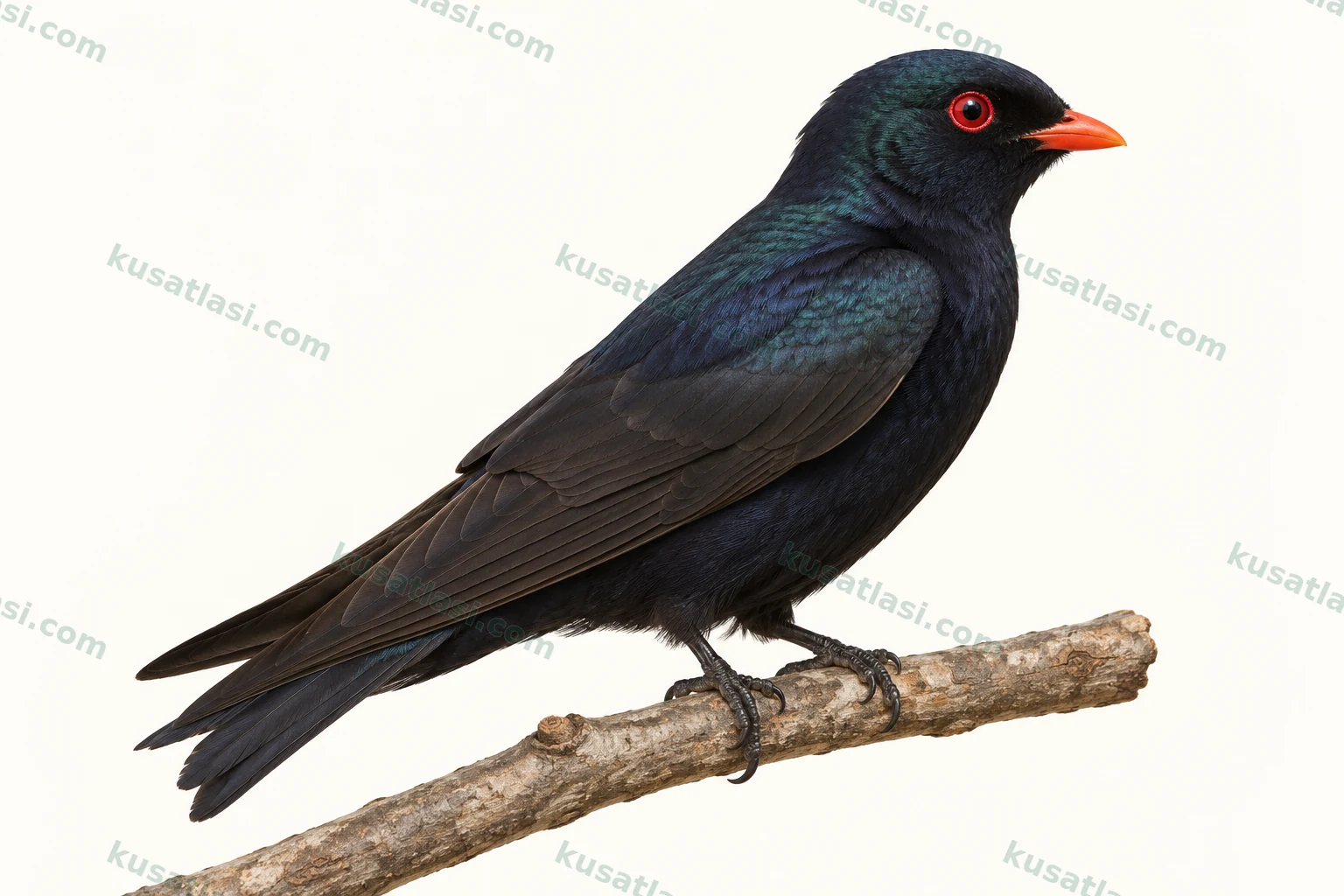
World Birds IUCN statusLC · Least ConcernGlobal IUCN category. BirdLife v10 (2025); taxon matching: AviList 2026 / IOC 15.2; checked: 29.10.2026. The list year is not the species assessment date. Source and method · BirdLife OrderPasseriformesPasserines FamilyHirundinidaeHirundinidae
African River Martin
Pseudochelidon eurystomina
A dark-bodied swallow with a full head and short tail; the adult has a red eye and broad orange-red bill, and colonies occupy sandy tunnels.
Biometrics
Length
Male14 cm
Female14 cm
Shared species value
Wing length
Male11.89 cm
Female11.89 cm
Shared species value
Weight
MaleData unavailable
FemaleData unavailable
African River Martin
Congo–Ubangi river system and the Atlantic coastal area of Gabon and CongoObservation guide in its natural range
Look for three features together
Do not rely on a single featureThe adult has a broad orange-red bill and red eye.
Look for the large head, short tail and somewhat triangular wings.
Colonies use sandy tunnels; not every hole is a successful nest or belongs to the same species.
Compare male and female
 FemaleMale
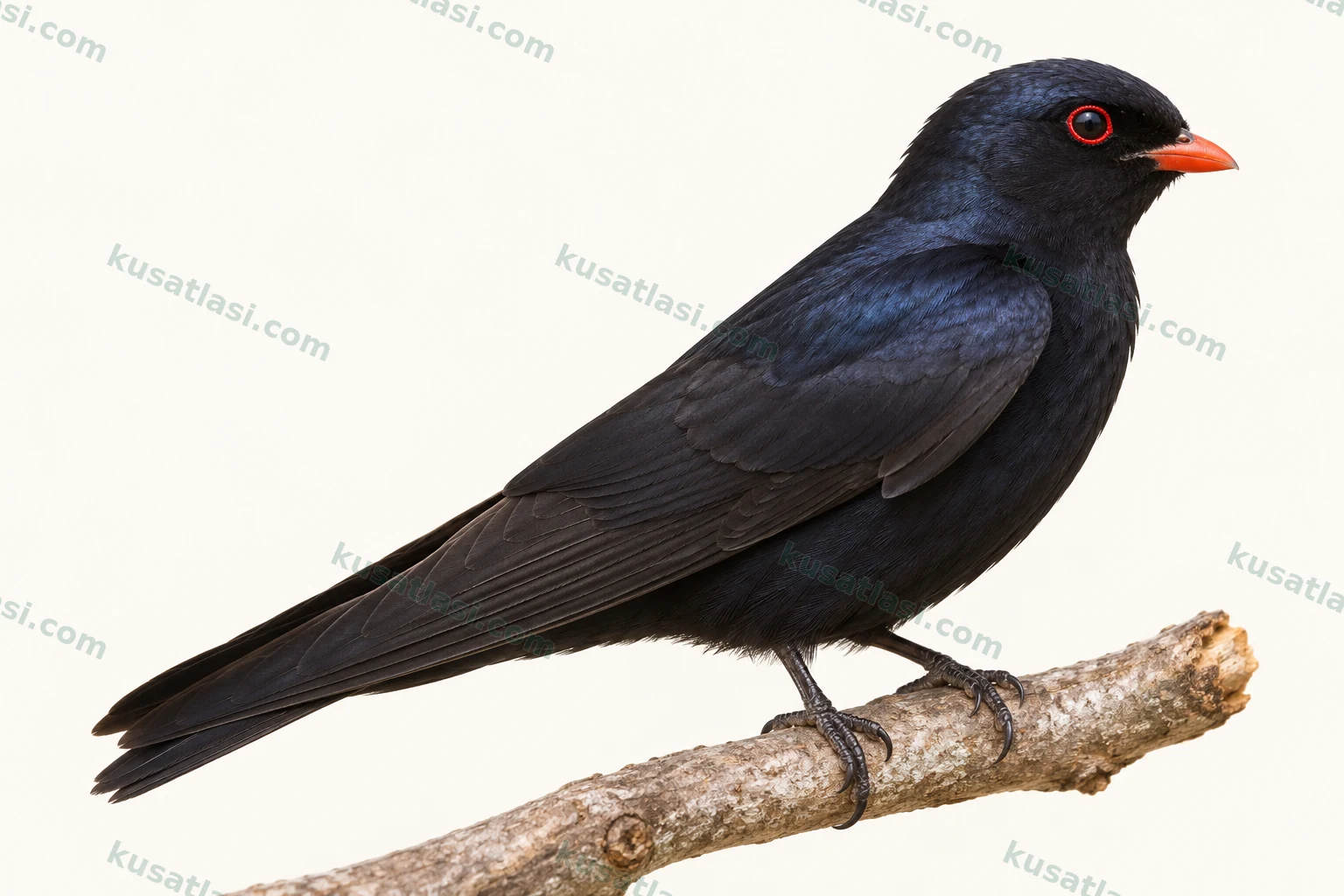
Males and females look similar, while young are duller. Neither sex nor function is determined conclusively from an open-bill display.
Where to look in its natural range?
Watch sandy grassland and wooded wetland areas from a distance; do not step on the colony’s sand.
Breeding contexts in two different geographical areas are shown. The same individual is not assumed to breed in both areas or follow a particular route.
January
Seasonal movements occur between inland areas and the coast; individual routes have not been verified. Inland Congo river areas, specialist account: this is a regional breeding context.
February
Seasonal movements occur between inland areas and the coast; individual routes have not been verified. Inland Congo river areas, specialist account: this is a regional breeding context.
March
Seasonal movements occur between inland areas and the coast; individual routes have not been verified. Inland Congo river areas, specialist account: this is a regional breeding context.
April
Seasonal movements occur between inland areas and the coast; individual routes have not been verified. Inland Congo river areas, specialist account: this is a regional breeding context.
May
Seasonal movements occur between inland areas and the coast; individual routes have not been verified. Inland Congo river areas, specialist account: this is a regional breeding context.
June
Seasonal movements occur between inland areas and the coast; individual routes have not been verified. No verified regional date specific to this month was given; this does not mean local absence.
July
Seasonal movements occur between inland areas and the coast; individual routes have not been verified. No verified regional date specific to this month was given; this does not mean local absence.
August
Seasonal movements occur between inland areas and the coast; individual routes have not been verified. Gabon–Congo coast, specialist account: this is a coastal breeding context; September–October is directly documented at Animba.
September
Seasonal movements occur between inland areas and the coast; individual routes have not been verified. Gabon–Congo coast, specialist account: this is a coastal breeding context; September–October is directly documented at Animba.
October
Seasonal movements occur between inland areas and the coast; individual routes have not been verified. Gabon–Congo coast, specialist account: this is a coastal breeding context; September–October is directly documented at Animba.
November
Seasonal movements occur between inland areas and the coast; individual routes have not been verified. Gabon–Congo coast, specialist account: this is a coastal breeding context; September–October is directly documented at Animba.
December
Seasonal movements occur between inland areas and the coast; individual routes have not been verified. Gabon–Congo coast, specialist account: this is a coastal breeding context; September–October is directly documented at Animba.
Nest, egg and incubation
The nest is a tunnel in sand with grass lining at the far end. Two birds digging and adults carrying food to young have been documented. The exact typical clutch size, incubation period and time to first flight have not been verified.
Harsh, rasping, repeated calls are heard; sounds at entrances and voices of young in the colony have different contexts.
Do not play recordings to attract birds; observe quietly, especially near nests.
Species information
Quick Identification
The African River Martin, Pseudochelidon eurystomina, is a dark-bodied swallow with a large head and short tail. The adult's striking red eye and broad orange-red bill are the most useful marks in a good view. Its somewhat triangular wings and full-headed silhouette stand out in flight. It may feed in small or large groups above wooded rivers, swamps and coastal scrub. A dark swallow alone is not enough to select this species; if eye and bill were unseen, the silhouette also needs careful assessment.
African River Martin is the English name of the same taxon. Association with rivers does not make every black river bird this species. It also nests in sandy grassland around Gabon and Congo. The name is therefore not a rule that it must always be directly above water. Plumage, flight and the actual geography of the record should be read together.
General Appearance and Posture
The whole body looks dark at a distance, and gloss can change with light and angle. The broad bill and head appearing full relative to the body help separate it from slender long-tailed swallows. A red eye easily disappears in a small photograph; not seeing it does not prove the eye is dark. Image processing or sunlight reflection can alter colour perception too. In a reliable view, eye, bill, wing and tail are compared on the same bird.
Near a colony it may land and walk in front of sand holes. This offers a notable opportunity compared with the habit of seeing swallows only in the air. Hole count does not directly give pair or chick count, however. The original Gabon study notes that some holes may be unfinished and used for resting by unpaired birds. Standing outside an entrance is not alone proof that the nest contains eggs.
At the Animba colony in 1989, adults were observed staying in holes at night, leaving in the morning to feed and returning in the evening. This one-colony observation does not establish a fixed departure time for the whole species. Weather and rainfall changed activity during the same day. Ground observation must not block the entrance route; approaching closely may interrupt normal entry and exit.
Males, Females and Young Birds
Male and female look similar in the field. A bird displaying with an open bill is not certainly assumed male: similarity between the sexes limited interpretation in the original colony study. Two birds standing together or one approaching another is not a reliable way to establish sex.
Young are duller. This broad difference does not give age in days; a shaded adult can also look dull. A naked nestling and a flying juvenile are different developmental stages. Some chicks were seen outside at Animba, but successfully fledged young were not monitored. Neither time to first flight nor number of successfully fledged young is therefore calculated from the date when the colony emptied.
An adult carrying food into a hole supports chick care. Simply entering that same hole does not distinguish eggs, young or overnight occupancy with certainty. Broken shell at the entrance also does not give the whole clutch size. Dated behavioural records, made without opening the nest, remain limited to what is genuinely visible outside.
Appearance in Flight
The large head, short tail and somewhat triangular wing silhouette matter in flight, compared with the longer forked tails of other dark swallows. A whole flock need not be one species; different insectivores may share the same airspace. Seeing one bird's red bill does not automatically justify counting every distant dark bird under the same name.
A flock feeding above rivers and forest may later return to its colony. The original Gabon observations show birds hunting away from the colony too; distances in that study are not a fixed daily area for every individual. Direction of birds disappearing behind branches, trees or air gaps can be recorded. Those short flights are not converted into intercontinental or country-by-country migration routes.
Voice and Behaviour
The sounds include harsh rasping repeated calls, and a crowded flock may be noisy. The original study separately recorded different short colony calls, soft sounds at hole entrances and chick sounds. Call context is more useful than a written syllable alone. Not every sound has the same function.
In the Gabon study, some birds approached others with open bills and drooped vibrating wings. Whether this involved pair formation or solicitation was not conclusively resolved; successful copulation was not seen. It can be described as an observed display, without presenting its function as a definite biological finding. Similar-looking sexes were one limit on interpretation.
Two birds were also seen taking turns digging the same hole with their feet. This is direct behavioural evidence of shared nest preparation, not a day count of shared incubation. Rain may collapse sand and require hole maintenance. Human movement near the colony, rain and possible predators are followed as separate influences; the cause of a chick’s loss is not established without seeing it.
Similar Species
Black Saw-wing, Psalidoprocne pristoptera, is another dark forest swallow, but has a longer forked tail. African River Martin combines short tail, full head and the adult red eye and orange-red bill. Underwing appearance in Black Saw-wing can vary geographically; a pale wing area is not treated as compulsory for every population. Dark body alone does not separate them.
Grey-rumped Swallow, Pseudhirundo griseopyga, differs in pale underparts, a slimmer long tail and a grey rump visible in flight. At Animba it was observed using one hole of the small colony. That example particularly disproves the assumption that every bird exiting a hole is African River Martin. Colony location alone does not select a species without seeing the bird's full appearance.
Global Distribution
The Congo and Ubangi river system in western Central Africa and areas near the Atlantic coast of Gabon and the Republic of the Congo are the main geography. The current specialist description also mentions coastal context extending into northern Angola. The Democratic Republic of the Congo and Republic of the Congo are separate countries; similar names must not relocate records to one place. Whole countries are not coloured as continuous breeding habitat.
Status Within Its Native Range
The IUCN update in 2025 changed the category from Data Deficient to Least Concern. The table attributes this to new information, a change not showing genuine improvement. It therefore does not prove increased bird numbers. Data Deficient can still appear in older texts as a dated assessment. One large flock also does not measure the global population or success of all colonies.
Migration
Seasonal movement occurs between inland river areas and the coast. The coast is not only a wintering area: breeding has also been documented there. The specialist account associates the coastal context with August–December and inland Congo breeding with January–May. It is not established that the same individuals breed twice across all these places. The sources give no individual tracking routes, so none is drawn; observations, breeding dates and seasonal movement are assessed separately.
Breeding Habitat
River sandbanks and sandy grasslands near the coast provide nest habitat. The savanna holding the Animba colony was surrounded by swamp forest and distant from the nearest river. The species need not build every nest directly beside running water. Sand hardness, rainfall and grass growth may affect entrances. The same open site is not assumed equally suitable throughout the year.
Nest Site
The nest consists of a tunnel in sand with a chamber at its end. Four vacated Animba holes were examined and fine grass lining was found on the floor; that small sample is not used as invariant dimensions for every nest. Adults were seen digging with their feet and carrying grass. Typical clutch size, verified incubation duration and time to first flight could not be established in the original studies examined. Hole count or shells outside are not used to derive those values.
Daily Space Use
Forest and river near the colony and more distant airspace are used for food. Overnight occupancy of holes and daytime departure were directly observed at one colony. Walking on surrounding sand can collapse entrances. Opening a hole or blocking its front to show the nest is wrong. Rising water and heavy rain may alter the same colony; whether an old location still has the same conditions today needs checking.
What Does It Eat?
Flying insects are the main food. Fry's 1992 study examined prey remains in droppings and regurgitated samples collected at the Animba colony in Gabon. Ants were the largest group and termites the second largest in that dated sample, with other insect remains too. This does not show identical monthly percentages across the continent. The prey counted in samples and the insects one bird eats daily are different measurements.
How Does It Hunt?
Food is caught in the air, with flock feeding recorded over rivers and forest. In the colony observations adults delivered food to chicks, and some large prey pieces could be distinguished from outside. Such visual identification is not as certain as identifying remains in the laboratory. A throat movement may support food delivery; if the insect brought cannot be seen, its name is not invented.
Post-rain concentrations of flying insects may affect feeding flocks. Many birds at one spot do not mean equally many nests there. Daily feeding and breeding-colony size are recorded separately. Pecking an eggshell on sand is also not generalised into a species-wide egg-eating habit; the isolated behaviour remains within the original study's context.
The Coast Is Not Only a Wintering Area
Movement from inland Congo rivers towards the Atlantic could long suggest that coastal birds were merely nonbreeding visitors. Yet breeding has been directly documented in grassy colonies near the coast of Gabon and the Republic of the Congo. This alone does not show that the same bird breeds in two places in one year; population relationships require individual tracking. Map and calendar do not merge those separate inferences.
The Open-Bill Display Has No Settled Meaning
Birds at Animba approaching one another with open bills and vibrating wings were described in detail. Pair-formation and solicitation interpretations were discussed without a conclusive answer. Clearly describing an observed action is different from assigning it a single function. Similar male and female appearance also limits sex assessment from the display alone.
Holes Do Not Give Bird Numbers
Holes may be unfinished or used for resting; another swallow using an entrance is also documented. Every hole in sand cannot therefore be converted into a pair count or assumed a successful nest. Food delivery at an entrance, chick sounds, eggshells and overnight occupancy are different evidence, each recorded with its observation date.
Interpreting a Change in Conservation Category
Least Concern in 2025 replaced the previous Data Deficient category. The IUCN table does not count this as genuine population improvement. A new assessment also does not mean every previously unknown measurement is now available. Length, wing length, mass and chick development are different research questions. Not filling a missing value in one area with new knowledge from another allows accurate updating through later studies.