

World Birds IUCN statusLC · Least ConcernGlobal IUCN category. BirdLife v10 (2025); taxon matching: AviList 2026 / IOC 15.2; checked: 29.10.2026. The list year is not the species assessment date. Source and method · BirdLife OrderPasseriformesPasserines FamilyHirundinidaeHirundinidae
White-headed Sawwing
Psalidoprocne albiceps
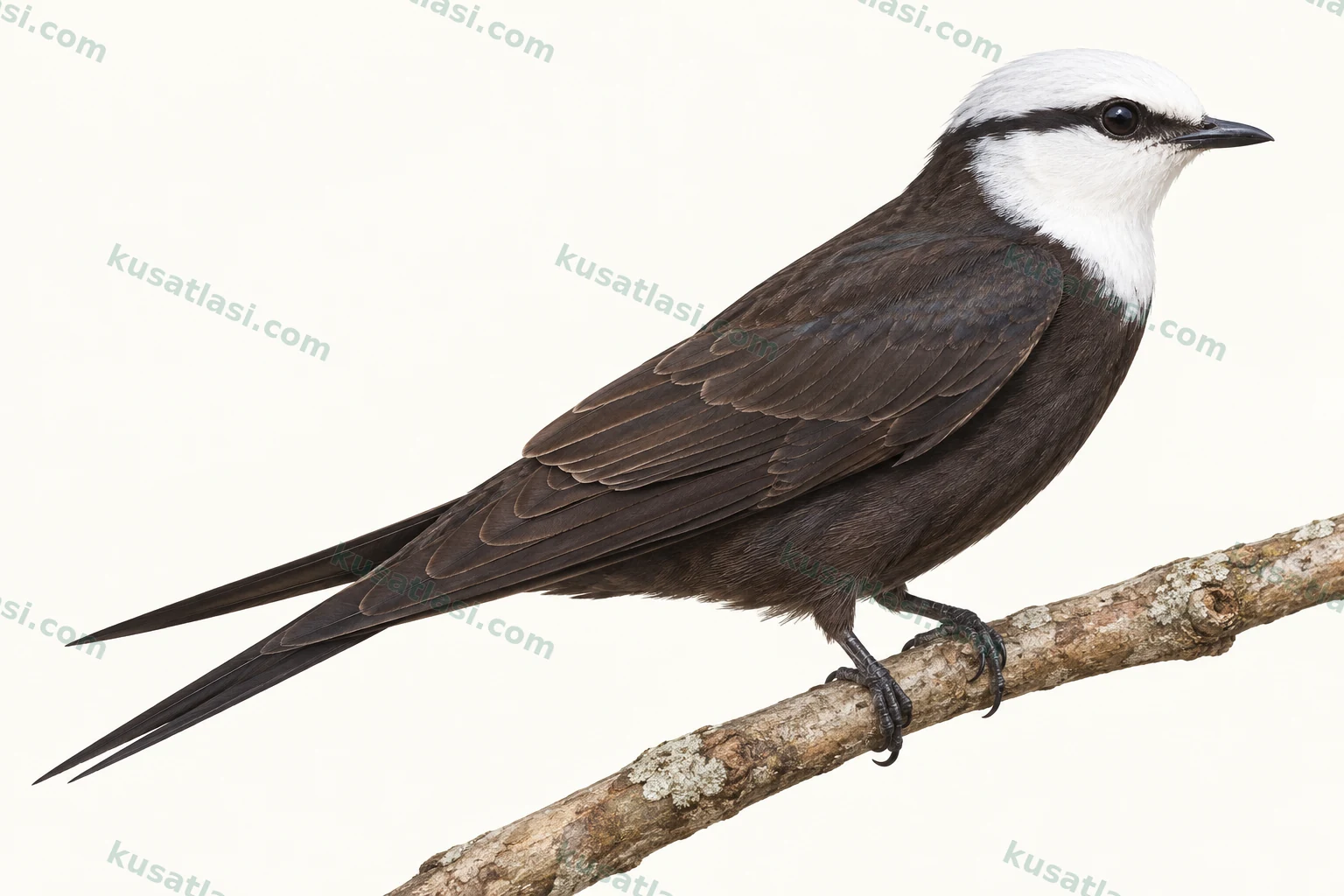
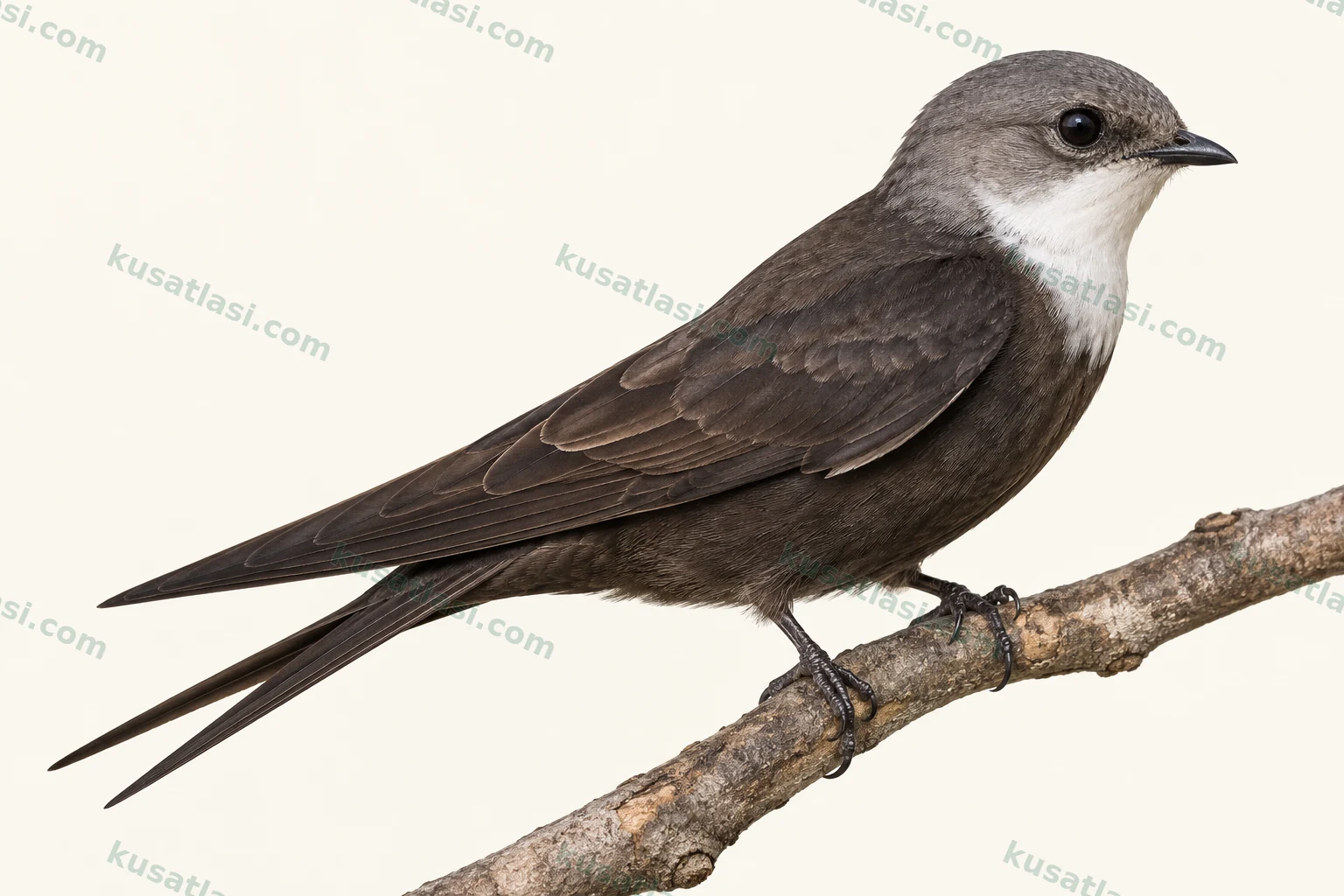
A small, dark African swallow with a forked tail. The adult male has a white head; the female has a greyer-brown head and a white throat.
Biometrics
Length
Male13 cm
Female13 cm
Shared species value
Wing length
Male10.12 cm
Female10.12 cm
Shared species value
Weight
Male6–14 g
Female7–14 g
White-headed Sawwing
East-central Africa and a separate northern Angolan populationObservation guide in its natural range
Look for three features together
Do not rely on a single featureWhite head and a narrow dark eye-stripe.
The female has a pale throat and dark head; head whiteness is not conspicuous in young birds.
Rapid turns and deep wingbeats; it can be confused with dark swifts.
Compare male and female
 FemaleMale
The adult male has a white head; the female has a pale throat and darker head. A young bird has a dark head and a less forked tail; a dark head alone is not evidence that it is female.
Where to look in its natural range?
Wooded clearings, forest edges, scrub and suitable earth banks.
Original regional records from Nyika on the Malawi–Zambia border; occurrence and breeding are shown separately.
January
There are resident populations in East Africa, and seasonal movements within Africa in Zambia–Malawi. Nyika, Malawi–Zambia border: general period of seasonal occurrence; in some years records extend into early May.
February
There are resident populations in East Africa, and seasonal movements within Africa in Zambia–Malawi. Nyika, Malawi–Zambia border: general period of seasonal occurrence; in some years records extend into early May.
March
There are resident populations in East Africa, and seasonal movements within Africa in Zambia–Malawi. Nyika, Malawi–Zambia border: general period of seasonal occurrence; in some years records extend into early May.
April
There are resident populations in East Africa, and seasonal movements within Africa in Zambia–Malawi. Nyika, Malawi–Zambia border: general period of seasonal occurrence; in some years records extend into early May.
May
There are resident populations in East Africa, and seasonal movements within Africa in Zambia–Malawi. No verified regional date specific to this month was given; this does not mean local absence.
June
There are resident populations in East Africa, and seasonal movements within Africa in Zambia–Malawi. No verified regional date specific to this month was given; this does not mean local absence.
July
There are resident populations in East Africa, and seasonal movements within Africa in Zambia–Malawi. No verified regional date specific to this month was given; this does not mean local absence.
August
There are resident populations in East Africa, and seasonal movements within Africa in Zambia–Malawi. No verified regional date specific to this month was given; this does not mean local absence.
September
There are resident populations in East Africa, and seasonal movements within Africa in Zambia–Malawi. Nyika, Malawi–Zambia border: general period of seasonal occurrence; in some years records extend into early May.
October
There are resident populations in East Africa, and seasonal movements within Africa in Zambia–Malawi. Nyika, Malawi–Zambia border: general period of seasonal occurrence; in some years records extend into early May.
November
There are resident populations in East Africa, and seasonal movements within Africa in Zambia–Malawi. Nyika, Malawi–Zambia border: general period of seasonal occurrence; in some years records extend into early May. Zambian part of Nyika: egg-laying period reported from dated nest records; young were not counted as eggs.
December
There are resident populations in East Africa, and seasonal movements within Africa in Zambia–Malawi. Nyika, Malawi–Zambia border: general period of seasonal occurrence; in some years records extend into early May. Zambian part of Nyika: egg-laying period reported from dated nest records; young were not counted as eggs.
Nest, egg and incubation
It nests in a tunnel in an earth bank. The specialist account reports usually 2–4 white eggs and both sexes taking part in incubation. Total incubation duration and time to nest departure were not verified.
It gives a weak twittering call and can often be silent.
Do not play recordings to attract birds; observe quietly, especially near nests.
Species information
Quick identification
The White-headed Sawwing Psalidoprocne albiceps is a small, dark swallow with a forked tail, flying around wooded habitats in Africa. The adult male has a fine dark eye-stripe across its white head; the body is sooty brown-black. The female's head is more ashy grey or brown, and her throat is white. The species name therefore does not mean that every individual has a wholly white head.
Young birds have very little white on the head, or the white is inconspicuous. A bird looking entirely dark is not excluded from the species simply because it lacks a white head. Flight, tail shape, age and sex class are assessed together. Other swallows and swifts may be present at the same forest edge; every bird in a mixed group is not assumed to be the same species.
General appearance and posture
The body is slender, wings long and pointed, and bill small. In the male, white forehead, crown and head sides stand out strongly against the dark body; the narrow dark line through the eye can be seen at close range. A dark area may remain behind the eye region. Adult wings and tail are brown-black, while underwing coverts may be ashier. The bill and eye are dark, and the feet dark brown.
A greenish reflection may show on the male's dark upperparts in suitable light. This does not mean that the body is normally bright green or that the female has a separate green-and-brown form. Feathers look duller in shade. Neither species nor sex is selected from the reflection colour alone in a dark flight photograph.
The opening and closing of the forked tail with posture changes the bird's overall silhouette.
The suffusa form of northern Angola differs from the eastern nominate form in some head and underwing tones; the white on the male's head may be more restricted. This geographical form is not relabelled as an age difference or the appearance of an adult female. The region in which the bird is found must also be recorded when interpreting its appearance.
Males, females and young birds
The male's conspicuous white head is useful in distinguishing the sexes. In the female, white is mostly concentrated on the throat; the top and sides of the head are darker. Her outer tail feathers may be shorter. However, full head detail may not be visible during a brief, distant flight. A head not appearing white does not reliably distinguish a young bird from a female on its own.
Young birds may have an almost wholly brown-black body and an ash-brown throat; a few irregular white feathers may be visible on the top of the head. The tail is less forked than in adults. A tail momentarily held closed is assessed separately from a real age difference. Head and throat feathers must also be seen on the same bird when assessing age.
Some species accounts identify a small serrated structure on the male's outer flight feather as a sex character. This detail cannot be seen in ordinary distant field observation; it is not recommended as an identification step requiring capture. Visible characters such as head and tail take priority. No unverified function in flight efficiency or sound production is inferred here from the flight feather's small structure.
Differences in head colour between adults show that males and females of this species have different appearances. It cannot be concluded that all dark swallows share the same sex pattern. When estimating a sex ratio from a group's bird count, young and uncertain individuals must be kept separate.
Appearance in flight
Long wings and a moderately forked tail are seen in flight. While seeking airborne insects, the bird may make deep wingbeats and rapid changes of direction, flying low over scrub, clearings or forest edges. It may superficially resemble the stiffer-winged appearance of swifts. Speed or a dark silhouette alone is insufficient; head, tail and flight pattern are watched together.
Frequent turns do not show a migration direction; the bird may be circling after prey within the same small area. Perching on a branch adds to the flight observation, but disturbing the bird to make it perch is inappropriate. The male's white head may be easy to see from the front, whereas the mark may look smaller when the head turns sideways away from the body. A short sequence of movement rather than a single frame helps assess different surfaces together.
Voice and behaviour
The specialist species account reports relatively weak twittering calls; the bird may often be silent. Not hearing a sound does not mean the species is absent. If the calling individual in a flying group is not seen, hearing a call in that group alone does not give a definite sex or age identification.
Pairs or small feeding groups use clearings and forest edges. More than one pair may nest in a suitable earth bank. Not every bird flying to and from the same bank belongs to a single shared nest; separate tunnel entrances and care behaviour are considered. Mate guarding, reported as an interpretation of persistent following near the nest, is not presented as the definite and sole cause of all the behaviour.
Similar species
Dark swallows within the Psalidoprocne pristoptera complex may resemble a young or female White-headed Sawwing in particular. The adult male White-headed Sawwing's white head is a strong mark; in the female, white throat, ashy head and tail are assessed together. This distinction becomes harder in young birds. Regional species and subspecies names being used differently among sources prevents a new identification based solely on an old name.
A forked tail, head pattern and wingbeats with rapid turns are useful in separating the bird from dark swifts, but movement alone is not a definite identification. A distant bird whose head and tail cannot be seen can remain uncertain. Not all dark individuals flying beside a white-headed male are automatically his female or young.
World distribution
The main eastern part of the natural range extends from southeastern South Sudan and around eastern Democratic Republic of the Congo through Uganda, western Kenya, Rwanda–Burundi and suitable parts of Tanzania to northern Zambia and northern Malawi. A separate northern Angolan population is recognised as the suffusa form. Not every country and forest between these two areas is coloured as continuous range.
The accepted species name is Psalidoprocne albiceps. The broad swallow phylogeny study of 2024 showed that some details of classification concerning relationships with related species need re-examination. This work does not automatically abolish the accepted species name; the current taxonomic list and interpretation of the genetic tree are assessed separately.
Status within its natural range
It may be seen in forest clearings, edges, scrub and wooded farmland. Its occurrence within the range is local; not every forest in the same country supports it regularly. Seasonal occurrence on Nyika at the Malawi–Zambia border shows why empty months at one locality do not mean absence across the continent. Suitable nesting banks also matter for habitat use.
Migration
Resident populations in East Africa are distinguished from southern populations making seasonal movements within Africa. Nyika records report presence mainly from late September to late April, with observations extending into early May in some years. Winter records also exist from lower areas. This does not mean one fixed route or all birds departing on the same day; no shared migration line is invented on the map.
Breeding habitat
Wooded clearings, humid forest edges and suitable earth banks among scrub and grassland are important. Nyika records document seasonal occurrence especially around the edges of the high plateau; this elevation is not a required lower or upper limit throughout East Africa. A feeding clearing and the bank containing a nest tunnel may be different places.
Nest site
The nest is at the end of a tunnel excavated into a steep earth bank or slope. A road cutting or similar excavatable surface may be used as well as a riverbank. The specialist compilation reports mostly 2–4 white eggs and participation of both sexes in incubation, but leaves total incubation and nestling periods unknown. A Nyika nest record of two young is not presented as a direct count of two eggs.
Daily habitat use
It seeks insects in flight over clearings and vegetation; small groups may form while feeding. Blocking a nest hole, approaching the bank to flush a bird or shining a light inside is inappropriate. Activity at a tunnel entrance alone does not reveal egg numbers or a date of emergence. Active nests should be assessed by specialists during roadworks and bank modifications.
What does it eat?
It feeds on small flying insects. Detailed annual dietary proportions are insufficiently known; the specialist account reports flying ants and small beetles. Prey in one stomach record is not a constant preference or daily food percentage in every region. The fact that swallows are generally insectivorous does not prove this species uses each insect group in the same proportion.
How does it hunt?
It searches for prey in the air over clearings, scrub and grassland, turning towards flying insects with wingbeats and rapid changes of direction. Circling repeatedly at the same spot does not show a fixed migration direction. Feeding in pairs or small groups may occur, but bird numbers are not directly converted into the amount of prey caught.
Small prey is often invisible to an observer. When an uncertain object is seen in the bill, the observed movement is recorded instead of assigning a definite insect name. Direct carrying behaviour must be watched to link food taken in the air to the care of young inside a tunnel. Insecticide use in feeding areas may affect natural prey resources; no species-specific experimentally measured loss rate is given here.
Males and females of the same species have different heads
The adult male attracts attention with his white head, whereas the female's pale area may be confined to the throat. Young birds look darker still. Making the illustrated female's head as white as the male's on the basis of the species name would lose the real difference in appearance. Age and sex information is part of identification in this small swallow, not merely an additional note.
Migration status is more than one word
Residency is reported for East Africa and seasonal breeding visits for Zambia–Malawi. Arrival and departure records at Nyika varied between years; some birds were seen until early May. Isolated winter records farther south or lower down remind us that the whole population does not share one seasonal pattern. A general migrant label in a database does not replace all these regional details.
Two young are not a direct count of two eggs
The number of young in a nest may not show all the eggs originally laid. Egg loss and chick development are separate stages. The Nyika compilation's record of two young is retained here as a young-bird record. The egg range reported by the specialist account is separate evidence; the two kinds of information are not presented as the same count confirming one another.
Genetic relationships and field identification ask different questions
The study published in 2024 compared many genetic regions across much of the swallow family. Relationships between White-headed Sawwing and its dark relatives showed that some details of the existing classification are complex. Such a tree alone does not identify the individual seen by an observer. Head, tail, age and geography continue to be used in the field; a genetic result does not allow breeding data such as egg numbers and incubation duration to be transferred from related species.