

World Birds IUCN statusLC · Least ConcernGlobal IUCN category. BirdLife v10 (2025); taxon matching: AviList 2026 / IOC 15.2; checked: 29.10.2026. The list year is not the species assessment date. Source and method · BirdLife OrderPasseriformesPasserines FamilyHirundinidaeHirundinidae
Tree Swallow
Tachycineta bicolor
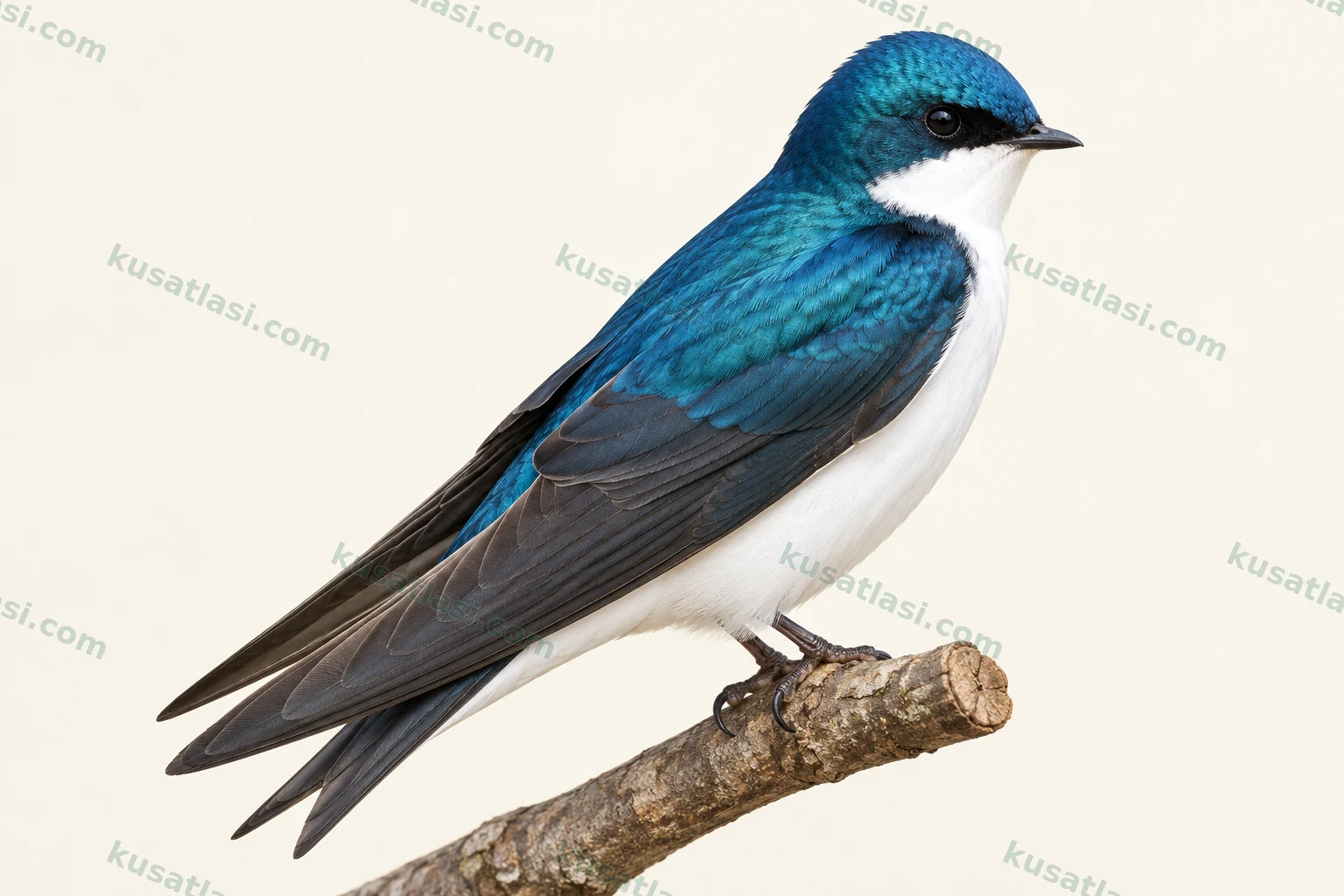
Blue-green adult upperparts, white underparts and a short notched tail; juveniles and first-year females may be brown.
Biometrics
Length
Male14 cm
Female14 cm
Shared species value
Wingspan
Male30–35 cm
Female30–35 cm
Shared species value
Weight
Male20–21 g
Female20.9 g
Female weight is the published mean for 120 adult females measured during the 2009–2012 breeding seasons at Red Slough, Oklahoma, USA, not a species-wide mean. The male value has a separate source.
Tree Swallow
North America; wintering areas farther southObservation guide in its natural range
Look for three features together
Do not rely on a single featureGlossy blue-green upperparts, white breast and belly.
A short shallow notch, dark face and small white crescents at the tail base.
Brown upperparts; a faint diffuse breast wash may be present.
Compare male and female
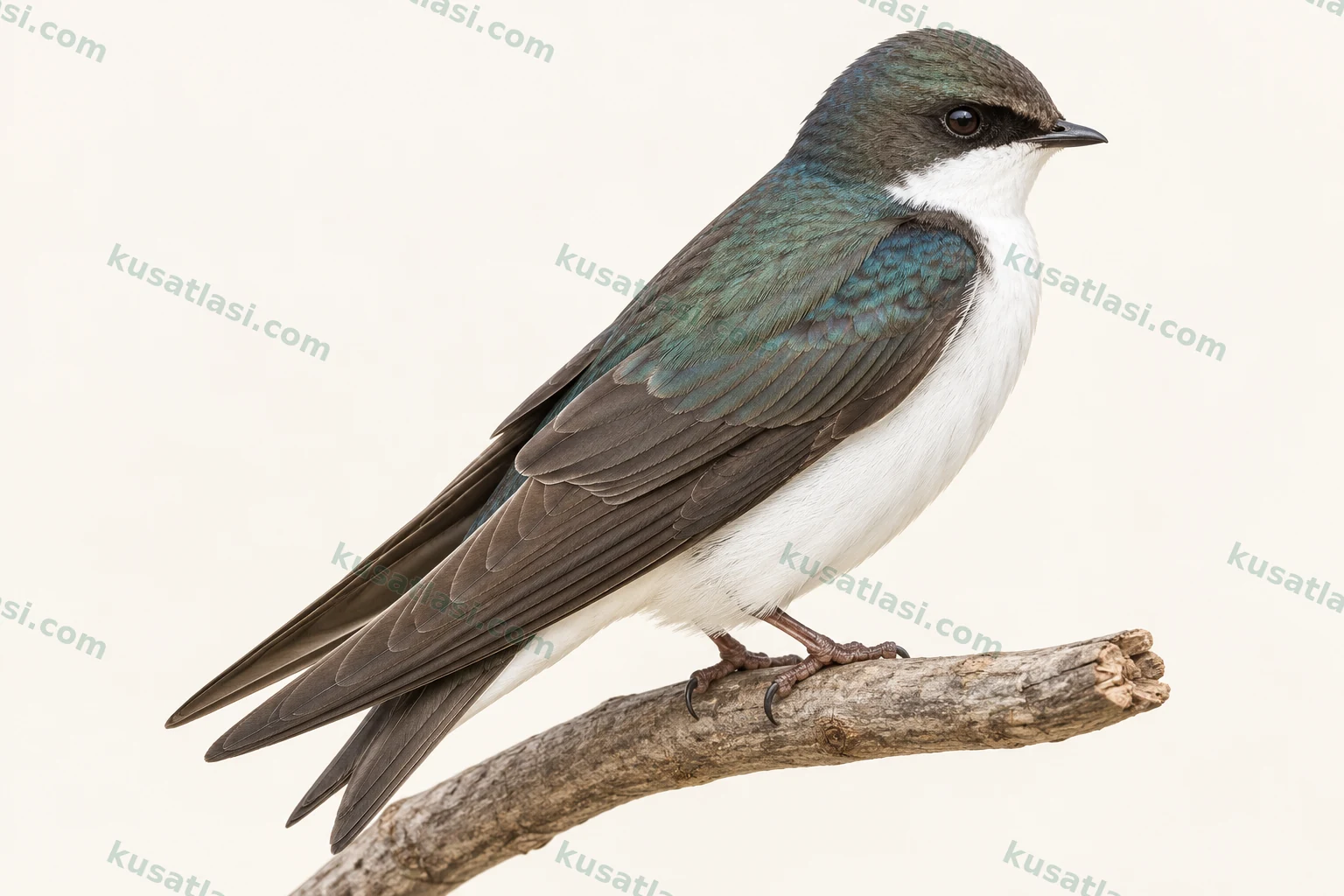 FemaleMale
The female may be duller or brown; some adult females are very glossy. In young birds, the brown back and indistinct breast wash are assessed together.
Where to look in its natural range?
Watch flocks above wetlands and open meadows and the surroundings of cavities.
North American breeding and migration stages vary with location and weather; the New York example is not a calendar for the whole continent.
January
Migratory; breeding, passage and wintering areas differ. No verified regional date specific to this month was provided; this does not mean local absence.
February
Migratory; breeding, passage and wintering areas differ. No verified regional date specific to this month was provided; this does not mean local absence.
March
Migratory; breeding, passage and wintering areas differ. No verified regional date specific to this month was provided; this does not mean local absence.
April
Migratory; breeding, passage and wintering areas differ. No verified regional date specific to this month was provided; this does not mean local absence.
May
Migratory; breeding, passage and wintering areas differ. North American university compilation: The broad reported breeding period; not every month means active breeding in every region.
June
Migratory; breeding, passage and wintering areas differ. North American university compilation: The broad reported breeding period; not every month means active breeding in every region. Ithaca, New York, 2015: The study period following the end of breeding and juvenile visits; the same movement was not seen in every individual.
July
Migratory; breeding, passage and wintering areas differ. North American university compilation: The broad reported breeding period; not every month means active breeding in every region. Ithaca, New York, 2015: The study period following the end of breeding and juvenile visits; the same movement was not seen in every individual.
August
Migratory; breeding, passage and wintering areas differ. North American university compilation: The broad reported breeding period; not every month means active breeding in every region. Ithaca, New York, 2015: The study period following the end of breeding and juvenile visits; the same movement was not seen in every individual.
September
Migratory; breeding, passage and wintering areas differ. North American university compilation: The broad reported breeding period; not every month means active breeding in every region. Ithaca, New York, 2015: The study period following the end of breeding and juvenile visits; the same movement was not seen in every individual.
October
Migratory; breeding, passage and wintering areas differ. Ithaca, New York, 2015: The study period following the end of breeding and juvenile visits; the same movement was not seen in every individual.
November
Migratory; breeding, passage and wintering areas differ. No verified regional date specific to this month was provided; this does not mean local absence.
December
Migratory; breeding, passage and wintering areas differ. No verified regional date specific to this month was provided; this does not mean local absence.
Nest, egg and incubation
A grass cup with a feather lining inside a cavity or box; typically 4–7 eggs. The female incubates for 11–20 days; the nestling period is 15–25 days. Both partners feed the young.
Series of variable short chirps and calls; flock activity, nest defence and pair communication are different contexts.
Do not play recordings to attract birds; observe quietly, especially near nests.
Species information
Quick identification
The adult Tree Swallow Tachycineta bicolor stands out through the contrast between its shining blue-green upperparts and clean white underparts. It has a small head, a very short bill, long pointed wings and a short, slightly notched tail. A narrow dark area around the eye makes the face look darker. Small white crescents may occur on either side of the tail base; these should not be confused with the broad white areas of its close relative. When the bird faces the observer, its white breast and belly are easier to see, while the bright colour above may be harder to distinguish depending on the light. Identification becomes stronger when the short-tailed silhouette, face pattern and arrangement of upper and lower colours are seen together.
Juveniles and some first-year females are brown above. They may have a faint, diffuse grey-brown wash across the breast. Assuming that this appearance always belongs to another swallow species can lead to mistakes. Particularly when comparing with Sand Martin, the definition of the breast band, face and tail structure should be checked together. Several species may hunt together over the same wetland; joining a flock does not make a bird the same species as its companions. Waiting for the individual being followed to perch may reveal more reliable detail than a brief view in flight.
General appearance and posture
It is a slender swallow with a rather full-looking body. The adult's dark flight feathers contrast with its shining back and white body. The upperparts may appear blue from one angle, green from another and dark in shade; this change alone does not indicate a different sex or species. Although the bill looks small externally, it is used with a gape suited to catching flying insects. When perched on a branch, wire or nest entrance, the short legs and the proportions of the long wings relative to the body can be seen. The tail is distinctly shorter than the long forked tail of a Barn Swallow.
Males, females and young birds
Adult males are usually brighter blue-green above. Females may be duller or carry brown feathers, although some adult females develop a bright appearance very similar to males. A first-year female may have a few glossy feathers among its brown upperparts. Thus brightness alone cannot determine the sex of every adult. Age, feather condition and lighting must be considered. Seeing a pair side by side likewise does not establish a general rule that the brighter bird is always the male.
Juveniles are brown above and white below, sometimes with an indistinct dark breast wash. A newly fledged bird may have yellowish gape edges. The white crescents at the tail base seen in adults may also be visible in young birds. Before separating a brown juvenile as another species, check the sharpness of the breast band, head pattern and tail notch. Nestlings hatch unable to feed themselves, and parental support does not stop immediately when they begin flying. The university account reports continued feeding for at least several days after nest departure.
Appearance in flight
It pursues insects over water and open country, combining wingbeats with gliding. On turns, the white underparts, dark wings and short, shallowly notched tail can be seen together. The shining back may be hidden in an approaching bird; following it for a while can allow the upperparts to catch the light during a turn and assist identification. Agile flight is a family characteristic and does not identify this species by itself. A flock may include birds with long forked tails, obvious breast bands or different tail-base patterns; each must be examined individually.
When bathing, it may approach the water very low, touch its body to the surface and rise quickly, shaking off droplets. This behaviour is described in the specialist account; brief contact with water does not show that the bird routinely dives for aquatic prey. Most hunting targets flying insects. If only a flash of white belly has been seen in flight, there may not be enough information for a definite species record. Following until the view improves helps reveal the head and tail base together.
Voice and behaviour
Its song is a series of short chirps and variable notes; different calls are used in pair and flock communication. A sound's function should be considered alongside whether the bird is defending a nest, feeding or moving within a flock. Both sexes may defend the nest surroundings against rivals. When danger approaches, several swallows may fly around the same predator and call. Outside breeding, however, large communal roosts and migratory flocks form. Defence at a nest and collective behaviour in a roosting flock are different social situations.
Similar species
1. Violet-green Swallow Tachycineta thalassina is similar in its white underparts and glossy upperparts. It has more extensive white on the face reaching the eye area, and larger white areas beside the tail base. Tree Swallow has a darker face and smaller white crescents at the tail base. In rapid flight, the face and tail base should be seen together rather than relying on one white patch.
2. Sand Martin Riparia riparia may be confused with a brown juvenile Tree Swallow. Its more conspicuous, more sharply defined breast band is an important difference; the breast wash of a young Tree Swallow can be more diffuse. Size, face pattern and body proportions in flight should also be compared; a brown back alone is not definitive.
3. Barn Swallow Hirundo rustica differs in its long, deeply forked tail and dark rufous throat. The Tree Swallow's short, shallowly notched tail should be seen together with its white throat and underparts. Head and throat patterns become particularly important in an individual with a damaged tail.
World distribution
The breeding range spans North America from the treeline region of Alaska and Canada to southern parts of the United States. In winter it moves farther south to the southern USA, Mexico, Central America and the Caribbean region, and, within the current taxonomic summary, may reach northern South America. Breeding, migration and wintering sites are not the same throughout this large area. A pond used for nesting in summer should be distinguished from open ground used only for feeding or roosting in winter.
Status within its natural range
Its current global category is Least Concern, but declines reported for particular periods by North American monitoring programmes still matter. The population increase mentioned in the older university account should not replace the 1966–2019 decline reported in the newer Cornell assessment. Loss of natural tree cavities and exposure to pollutants through insect prey are important research topics. Use of nest boxes does not show that all natural nesting sites have been replaced adequately.
Migration
It is migratory and may move in loose flocks by day and gather in large groups at night. Leaving a site after breeding does not mean that every individual immediately starts the same distant migration route. Cornell's 2015 regional tracking study showed that some juveniles revisited their natal area and some marked adults were found in Florida the following winter. Connections involving a small number of relocated birds should not be drawn as a route or distance shared by the entire population. The timing and life stage of records must be retained when interpreting migration from observation locations.
Breeding habitat
It breeds around open meadows, wetlands, shorelines, ponds and wooded swamps. Proximity to water may provide flying insects, but a suitable cavity is also an essential nesting resource. Open feeding areas and trees with cavities need to occur together. Not every part of dense closed forest or every treeless meadow is equally suitable. Although artificial nest boxes can be used, conserving natural tree cavities remains an important part of its habitat.
Nest site
A cup of grasses is built in a natural cavity, an old woodpecker hole or a suitable box; the female undertakes most construction. The interior may be lined with feathers from other birds. Specialist accounts give a typical clutch of 4–7 eggs. Cornell gives 11–20 days for incubation and 15–25 days for the nestling period; the university account lists 14–15 days as the most frequent incubation duration. These are the scopes of different compilations, not an identical number of days at every nest. The female incubates the eggs, and both partners bring food to the young. Nest checks should not obstruct the birds' access.
Daily space use
During breeding, the pair defends the nest surroundings and may travel over water and open areas to feed. Outside breeding, large flocks, perches and communal roosts become prominent. Conditions for observation and maintenance differ between nesting in boxes and in natural cavities. The ease of monitoring research nest boxes does not show that all natural populations breed at the same density or with the same success. Daily space use should be assessed alongside nest stage, weather and insect availability.
What does it eat?
Flying insects are its main food. Flies, beetles, flying ants, dragonflies and the winged stages of various aquatic insects appear in specialist and university accounts. Food carried to the young is linked to these prey sources in open country and wetlands. The diet is not made up of just one insect group; prey diversity varies with place and season. When insects become scarce in poor weather, it may also use fruit and other plant foods. Its use of waxy fruits in particular shows that it does not remain entirely dependent on the same insect abundance during cold periods; this does not make fruit its main food in every season.
How does it hunt?
It catches most prey in flight, making turns and short dashes over water or open ground. Many individuals may feed together where insects concentrate. Some prey may be taken from the water surface or near other surfaces; not all food is obtained by one method. Rain and cold can alter the availability of flying insects. The prey of an adult repeatedly passing a nest is not always visible; seeing food transport is not enough to identify a particular insect species or a fixed daily consumption amount. Nor can flock hunting be treated as an exact measure of insect density based only on the number of birds.
A young female may be brown
The adult's shining blue-green back is not the same at every age. First-year females may combine brown feathers with a small number of glossy feathers, and juveniles are brown too. Some adult females, however, are bright and look very much like males. Thus a brown bird should not automatically be assigned to another species, nor every glossy bird to the male sex. Breast band, face and tail patterns should be examined together with age.
Returning to a breeding area does not immediately mean a new nest
A 2015 study at Cornell ponds in New York used radio transmitters to follow the presence of 32 adults and 36 newly fledged birds in the breeding area. Some juveniles revisited their natal area after leaving, whereas most adults left when the nesting attempt ended and did not return later in summer. The researchers discussed whether the juveniles might be exploring future nest sites; this possible explanation is not the demonstrated purpose of every return. The transmitter sample also selected heavier nestlings and was mostly male. The results should not be used as a juvenile–adult movement calendar for the entire continent.
Feathers in a nest are more than decoration
The female builds a grass cup inside the cavity and lines it with other birds' feathers. Cornell's specialist account reports that in some populations the male collects most of the feathers, while in others the task is shared. A feather may also be carried through the air and chased by other birds. Rather than calling this behaviour only play, its nest-preparation context should also be considered. Taking feathers from the nest or rearranging it can alter the structure the bird has created.
An insect-eating bird also uses plant foods
Although flying insects are its main food, it may use fruit and other plant resources in poor weather. This flexibility shows that the same feeding method is not obligatory every day of the year. A single observation of fruit eating, however, does not provide a year-round dietary percentage. Considering wetland insect production together with flight space in open country makes it clear that protecting a nest box alone cannot meet all of the bird's needs.