

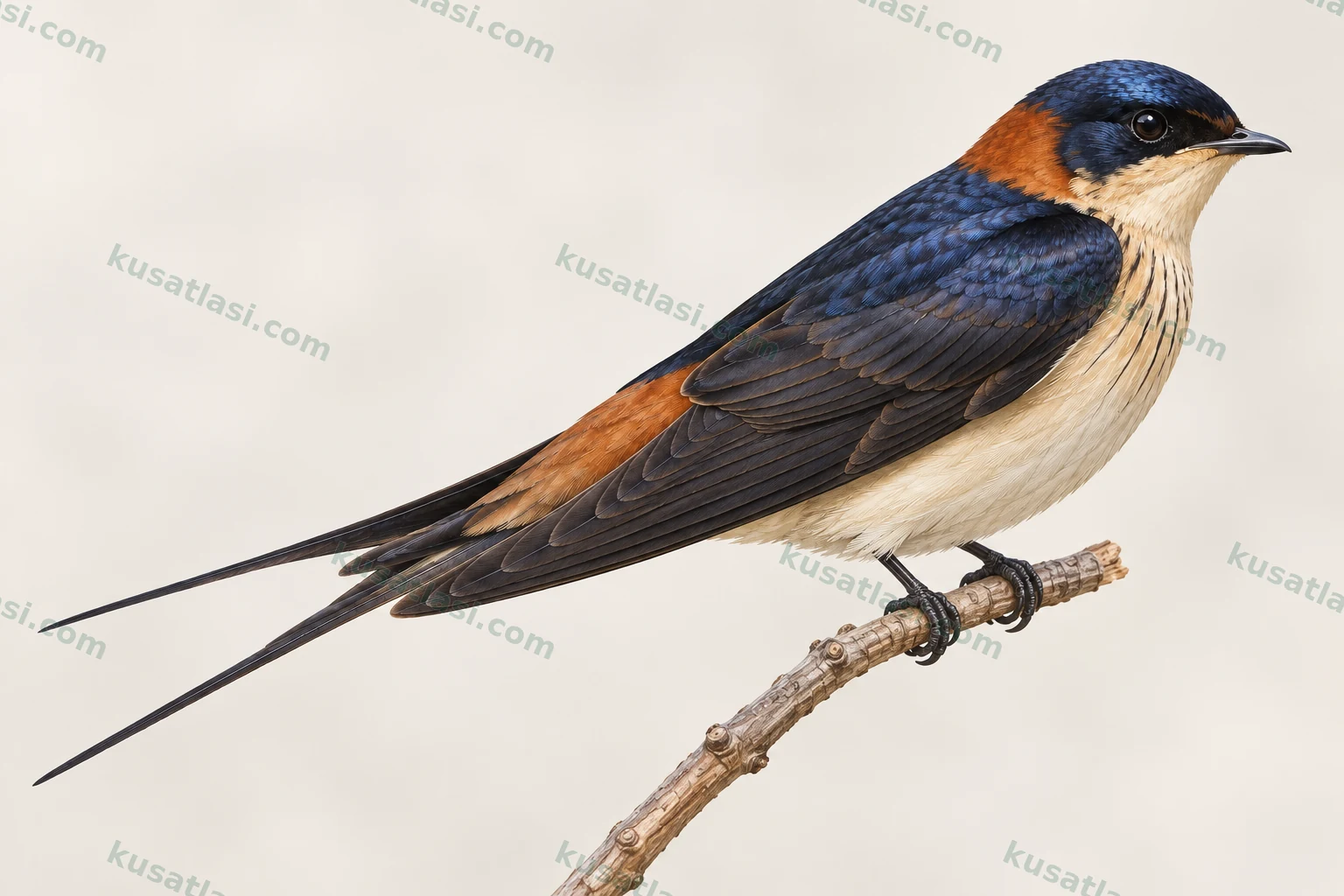
World Birds IUCN statusAccording to the source taxonGlobal IUCN. BirdLife v10 (2025); taxon matching AviList 2026 / IOC 15.2; checked: 29.10.2026. The list year is not the species’ assessment date. Source and method OrderPasseriformesPasserines FamilyHirundinidaeHirundinidae
African Red-rumped Swallow
Cecropis melanocrissus
Rufous rump, interrupted nape collar, dark lores and dark undertail; the European species may occur in the same region in winter.
Biometrics
Length
Male16–17 cm
Female16–17 cm
Shared species value
Wingspan
MaleData unavailable
FemaleData unavailable
Weight
Male22.5–30 g
Female22.5–30 g
Shared species value
African Red-rumped Swallow
Fragmented western and eastern populations of sub-Saharan AfricaObservation guide in its natural range
Look for three features together
Do not rely on a single featureIn adults, the rufous-chestnut area extends across the whole rump.
There is no complete rufous nape collar; the lores are dark.
The European species winters in Africa too; the continent alone cannot establish identity.
Compare male and female
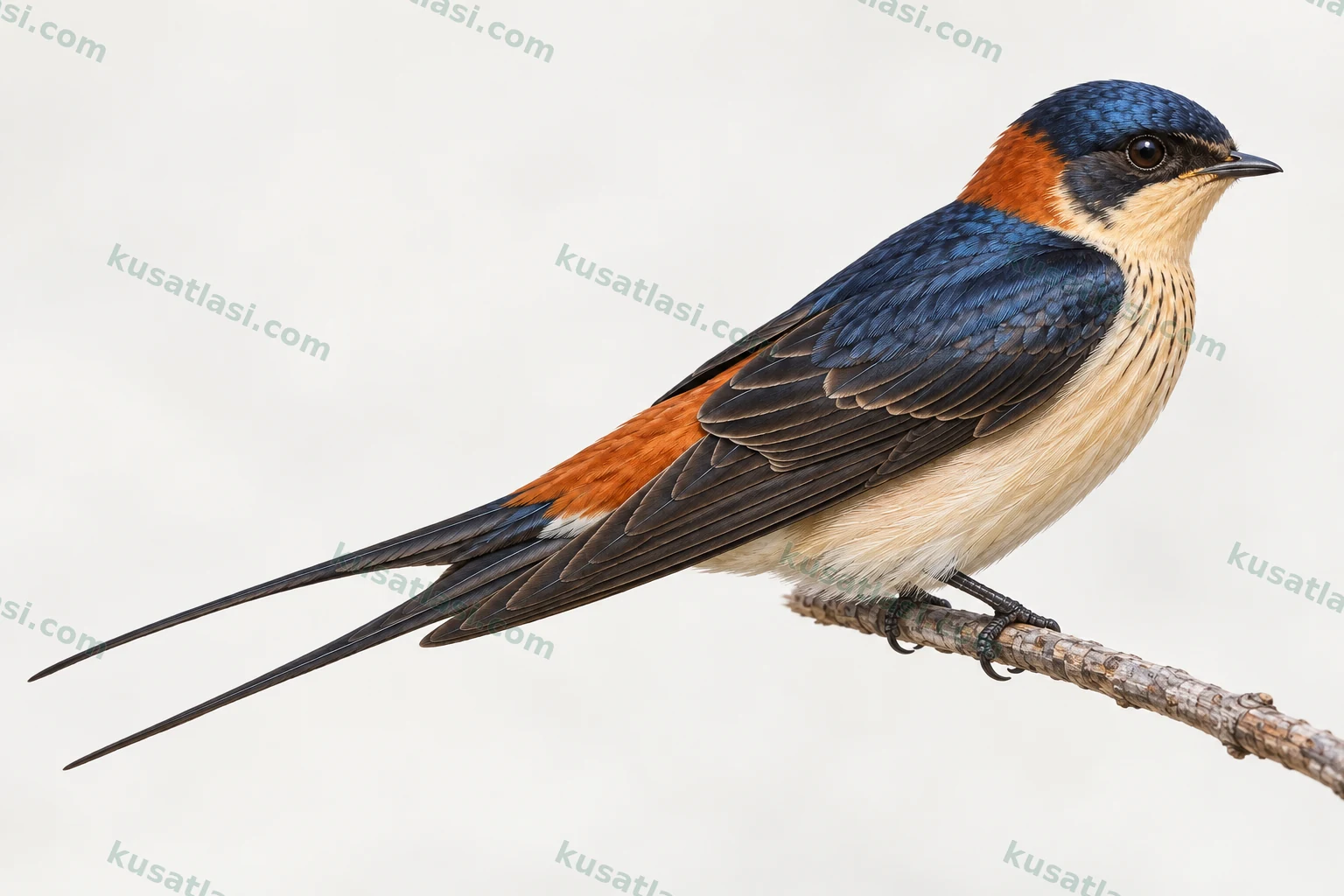 FemaleMale
Young are generally paler with less extensive orange-rufous areas; one view of tail or colour cannot establish sex or age in days.
Where to look in its natural range?
Watch rump, nape and lores together in open areas; consider winter confusion with the European species.
Resident breeding has been documented in the Ethiopian highlands; no verified monthly egg-laying limits cover all subspecies.
All months: Local residency is documented; no egg-laying or migration date representing the entire taxon was provided for this month. No verified regional date specific to this month was provided; this does not mean local absence.
January
February
March
April
May
June
July
August
September
October
November
December
Nest, egg and incubation
Mud-carrying and nesting behaviour beneath structures are documented; typical clutch size and incubation duration were not verified.
A frequent short, two-part call resembles a sparrow; it is not a definitive key to the three close taxa on its own.
Do not play recordings to attract birds; observe quietly, especially near nests.
Species information
Quick identification
African Red-rumped Swallow Cecropis melanocrissus is a swallow of sub-Saharan Africa with a long, deeply forked tail. Glossy dark blue-black upperparts, a chestnut rump, paler underparts, dark feathers beneath the tail and a narrow dark nape line that does not form a complete rufous collar are assessed together. It was long combined in one broad species with European Red-rumped Swallow Cecropis rufula and Eastern Red-rumped Swallow Cecropis daurica, so older image labels and field records can be confused. Cornell's 2024 taxonomy update separated three species, a treatment also adopted by the IOC. Seeing the bird in Africa is not enough: the European species winters in parts of sub-Saharan Africa. A single distant photo can be misleading, especially in winter or during migration.
In Cornell's comparison the African species has a richly chestnut rump throughout; the European species has a rufous-orange upper rump, while the lower rump may carry a whitish band. The African species does not have a complete rufous nape collar, its lores are dark and the fine underpart streaking is very faint or absent. These are a useful combination of adult characters, not one unchanging colour key. The underparts vary from pale whitish to rufous among African subspecies. Light, feather wear and age also affect appearance. Dark undertail feathers and the forked tail offer further support in a close flight view. An unseen mark is not treated as an absent one.
General appearance and posture
A slender body, narrow pointed wings and long outer tail feathers create the swallow's flight silhouette. The upperparts are metallic dark, while the rump between back and tail is warm chestnut. From below, the boundary between pale body and dark undertail can be conspicuous. This slender silhouette varies with tail wear and whether the tail appears open or closed. A tail feather invisible during one turn is not assumed missing.
Males, females and young birds
Adult appearances are similar, so one distant colour or tail view cannot establish sex. Cornell notes that young are generally paler and lack the extensive orange-rufous areas of adults. A young bird can therefore resemble house-martins; the deeply forked tail is checked together with this appearance. No colour chart for age in days is supplied. A short-looking tail alone does not prove that a bird is female or young.
African underparts vary geographically from whitish to rufous, with few or no fine streaks. This variation means birds must not all be required to have the same underpart colour. Domicella, kumboensis, melanocrissus and emini are recognised within the current taxon. Geographic form, age and sex are different assessments. A dark appearance in shade is not labelled male, nor a pale one female; record which feather area was actually visible.
Appearance in flight
Narrow pointed wings, a deeply forked tail and a rufous rump can become visible in turn in flight. A turn may expose pale underparts and dark undertail feathers. The European species is also long-tailed with similar flight, so flight style cannot reliably separate the three taxa. For adult Africans Cornell recommends assessing absence of a complete rufous collar, dark lores and a richly chestnut rump together. These marks may not all be visible in one brief view. Check whether a photograph of an area thought entirely rufous behind the body actually shows the rump's lower boundary. Leaving an uncertain record at group level is more honest than forcing a species name onto a distant blurred image.
A bird carrying mud for a nest or repeatedly entering beneath the same structure supports the possibility of local breeding. Cornell uses such behaviour as supporting evidence when assigning older records to the new taxa. Nevertheless, one passing flight or a flight near a nest-like structure does not establish ownership of a particular nest. Confusion with the European species present in the same region in winter deserves particular consideration. A photo series, date, locality and body and tail marks recorded together allow later examination.
Voice and behaviour
Catching insects in the air and manoeuvring nimbly over open space are general swallow feeding behaviours also expected in the African species; seeing those movements alone is not species identification. Cornell explicitly notes that African and European red-rumped swallows can occur in the same broad African region and retains many old records as an uncertain combined group. Hearing a voice can support identification; Cornell describes a frequent short call as a two-part sound reminiscent of a sparrow. That call is not used as a key that reliably separates the three close taxa on its own. Within a gathering of birds especially, the individual producing the sound must also be confirmed.
Nesting birds may frequently travel back and forth collecting mud and taking it to a structure. Cornell's record assessment treats this behaviour and pairs around nests as important context for local species identity. General swallow biology must not, however, be used to produce an exact clutch size or incubation duration for the African species. Because older sources covered the three species together, breeding numbers must be resolved further by subspecies and region. Approaching a nest entrance, opening the structure to reveal young or blocking a regular flight path does not improve observation; distant watching and a dated record are enough.
Similar species
1. European Red-rumped Swallow Cecropis rufula occurs around the Mediterranean and may also winter in sub-Saharan Africa. A whitish band on the lower rump, a complete warm rufous nape collar and rufous lores are compared with the African species' richly chestnut rump, interrupted nape line and dark lores. Migration season and worn feathers can make separation difficult.
2. Eastern Red-rumped Swallow Cecropis daurica is a separate, Asia-centred species. A chestnut rump and interrupted nape marking may resemble the African bird; stronger underpart streaking and geography can help. An old record under the broad species name is not automatically assigned to the Eastern or African species without review against the new boundaries.
3. Barn Swallow Hirundo rustica is another widespread swallow. Its distinct rufous throat and different tail–underpart pattern are checked together. Seeing only a long forked tail does not establish the African red-rumped species.
World distribution
African Red-rumped Swallow in its current limits belongs to sub-Saharan Africa. In Cornell's 2024 taxonomy, the western domicella population extends from Senegambia and Guinea to western Ethiopia and the Sudan region. Other populations occur regionally in the mountains of Sierra Leone and Cameroon, the highlands of Ethiopia and Eritrea, and through South Sudan and the Uganda–Kenya belt to Malawi and northern Zambia.
Status within its natural range
These pieces should not be imagined as one continuous coloured belt. The boundaries of the four subspecies, particularly where they approach one another, must be checked against separate specialist maps. A record in one country does not mean suitable breeding habitat covers that entire country.
Seasonal movements
The African species is described as resident in some regions; this does not prove that every subspecies never moves. Confusion with European birds wintering in the same areas makes older African records difficult to assign to species. Cornell often retains winter and passage records under a combined European/African option in particular. Presence near a nest or breeding behaviour adds support for a local African bird, though one view may still be insufficient. A movement claim should be based on individual identity, date, locality and, if possible, successive observations.
Breeding habitat
The species' different populations occupy open, sometimes hilly or wooded settings south of the Sahara. Gedeon and colleagues' 2017 checklist describes a resident breeding population of nominate melanocrissus in the highlands of Ethiopia and Eritrea; the same work explicitly notes that the European rufula population can winter there, making separation difficult. This finding does not place every African subspecies within one altitude limit. Cornell notes feeding in various open spaces and mud nests on rock faces as well as human structures. Mountain slopes, open hunting space and undersides of structures are distinct observation contexts.
Nest site
Cornell's record notes include examples of African birds carrying mud and travelling back and forth beneath bridges or building eaves. This is evidence that some birds can use artificial surfaces. An enclosed mud nest with an entrance tunnel is described for the red-rumped swallow group, but nest dimensions, clutch size and incubation duration given for the old broad species do not automatically transfer to the new African species. The examined sources did not supply a reliable representative egg count or duration for the four African subspecies. This gap is not filled by invented numbers. Mud-carrying and entrance use can be watched externally without approaching an existing nest.
Daily habitat use
An open aerial foraging space and a source of nest mud can serve different requirements within the same small area. Pairs may be seen repeatedly around a bridge, eaves or natural shelter. One swallow passing beneath a structure is not breeding evidence; repeated visits, mud-carrying and pair behaviour supply stronger context. Because European birds enter the same geography in winter, season and plumage marks accompanying this behaviour are particularly important to record. Residency confirmed by Gedeon for Ethiopian highlands is not directly generalised to another West African population. Preserving insect and mud conditions helps understand the space the species uses.
What does it eat?
Aerial insect-catching is widespread among swallows, and Cornell describes the African species as a slender, pointed-winged swallow. The species-specific sources examined for African Red-rumped Swallow did not give a reliable insect species list or prey percentages representative of every region. It is therefore not claimed to eat a particular number of flies, bees or termites daily. An insect list published for the old broad Cecropis daurica cannot be transferred here without knowing which of the three separate species was examined. The general ecological framework of small invertebrates caught in flight is distinct from a claim that a particular prey item is proven at species level. If a photographed prey object cannot be distinguished, it is not given a definite name.
How does it forage?
Long pointed wings and a forked tail provide a structure suited to rapid changes of direction in flight. A swallow turning after airborne insects is an observation; that flight alone does not prove it is African Red-rumped Swallow. European birds can occur in the same region, so identity should rest on appearance, date and locality together rather than feeding movements. Mud-carrying around nests is a different action and must not be confused with foraging. The examined sources did not verify a species-specific hourly prey count, daily food mass or fixed hunting height for this African bird. Instead of adding numbers, record direction of movement, visible properties of prey, surroundings and date.
From one name to three species
European, African and Eastern red-rumped swallows were long treated under a broad Cecropis daurica. Cornell's 2024 update and the IOC separated this group into three species, the African bird becoming Cecropis melanocrissus. Nest duration given under the same name in an old book does not necessarily refer to today's African species. First establish the specimen's origin and its former subspecies.
The West African population is included too
Cecropis domicella was once considered a separate West African swallow. The current Cornell and IOC treatment includes it among the subspecies of African Red-rumped Swallow. The current African species thus covers four subspecies: domicella, kumboensis, melanocrissus and emini. This is more than a change in a name list; old maps and photographic records must be read again against the new boundaries. Cornell also highlights a need for research into domicella's distinctive appearance.
Not every red rump seen in Africa belongs to the African species
European Cecropis rufula winters in some sub-Saharan regions. Cornell therefore retained many older observations as combined European/African records rather than moving them to definite species names. In winter, locality, date and a brief flight view can be insufficient on their own. Chestnut across the entire rump, a nape that does not form a complete collar and dark lores are checked together. Nest behaviour also helps, but cannot remove every uncertainty on its own.