

World Birds IUCN statusLC · Least ConcernGlobal IUCN. BirdLife v10 (2025); taxon matching AviList 2026 / IOC 15.2; checked: 29.10.2026. The list year is not the species’ assessment date. Source and method · BirdLife OrderPasseriformesPasserines FamilyCisticolidaeCisticolidae
White-chinned Prinia
Schistolais leucopogon
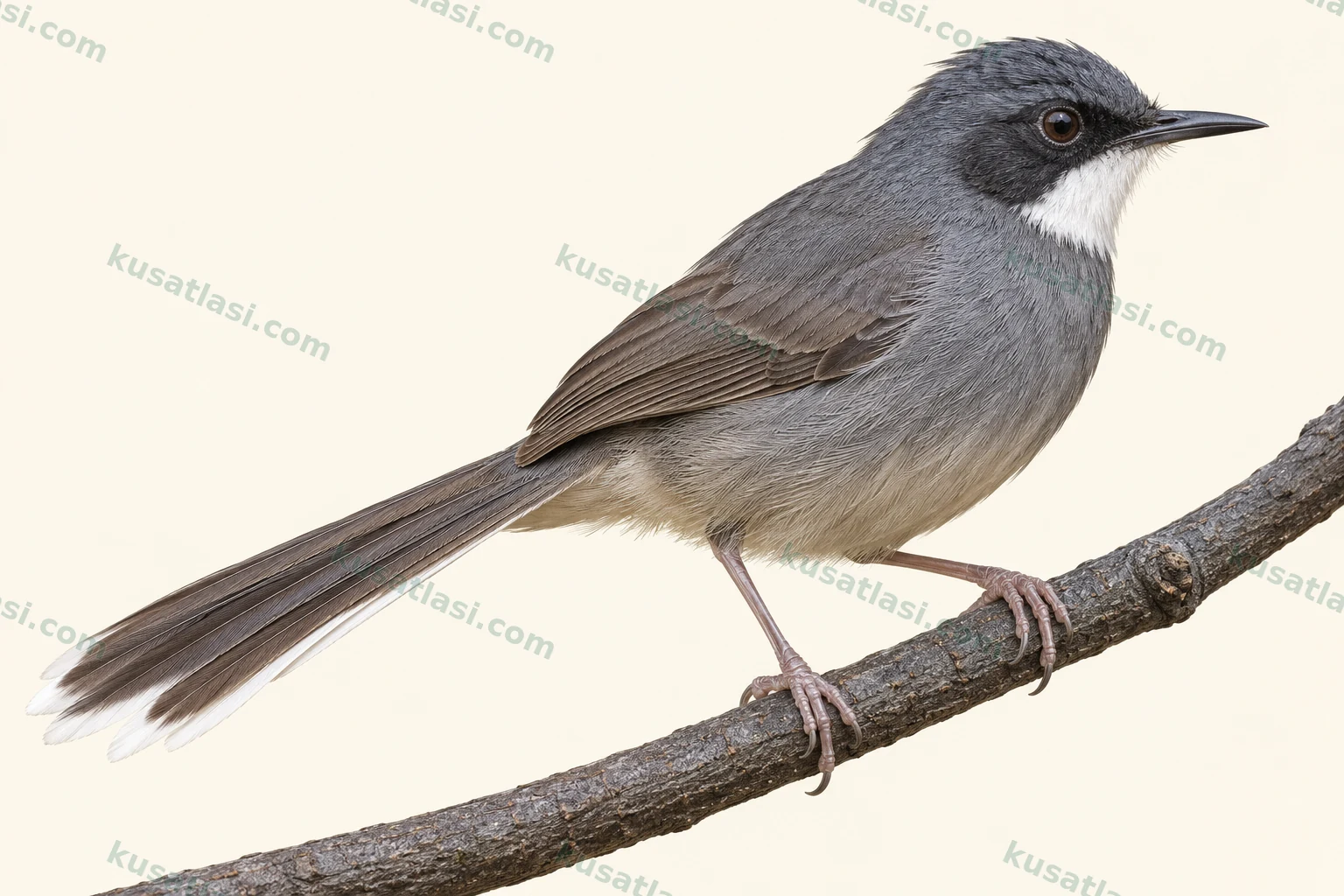
Small African forest bird with black cheeks, a white throat and a broad tail.
Biometrics
Length
Male13 cm
Female13 cm
Shared species value
Wing length
Male5.67 cm
Female5.67 cm
Shared species value
Weight
Male9.5–12 g
Female13–15 g
White-chinned Prinia
Congo Basin and surroundingsObservation guide in its natural range
Look for three features together
Do not rely on a single featureWhite throat, black cheek, grey underbody.
Broad; white in the outer feathers.
Small active vocal groups.
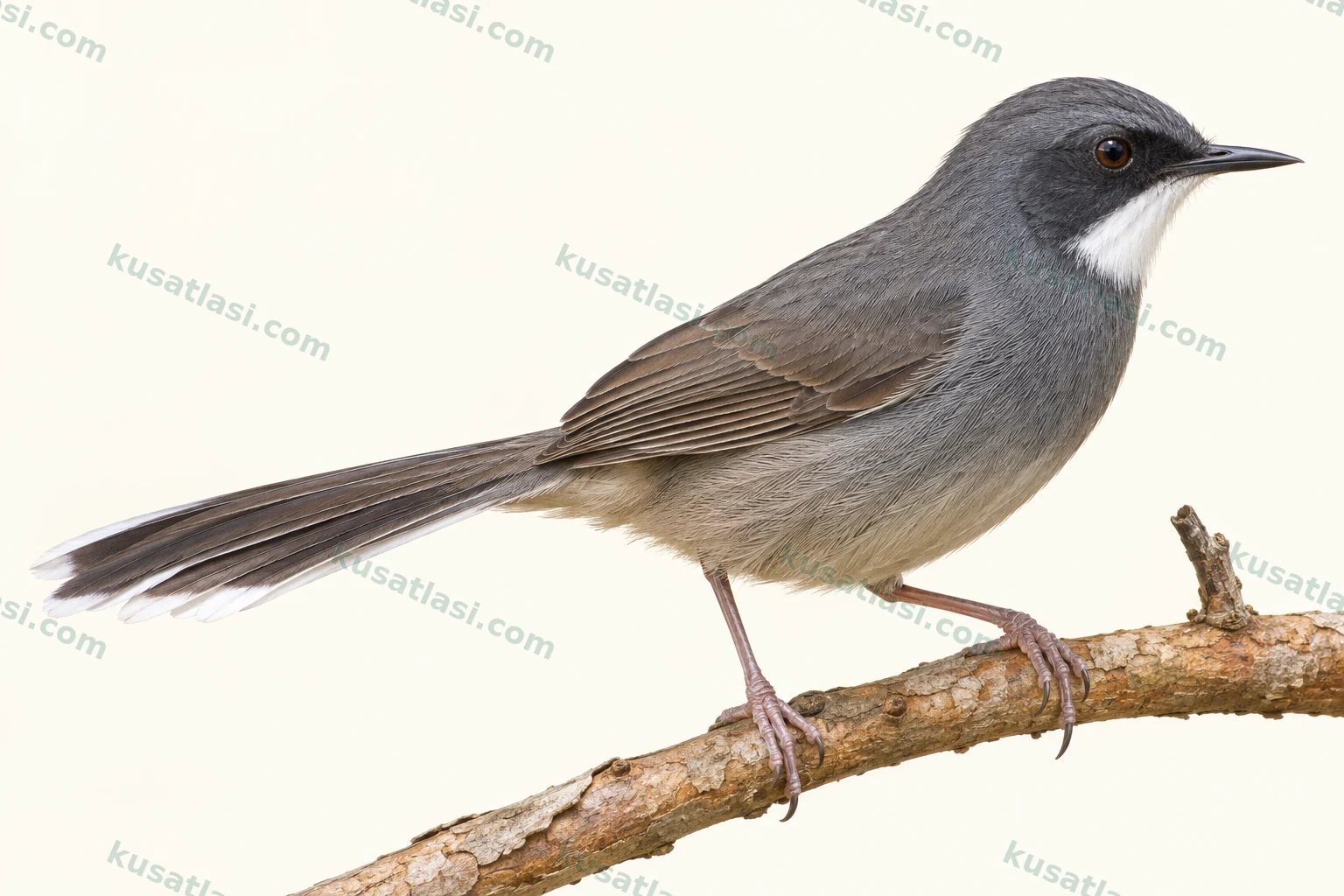
Compare male and female
 FemaleMale
No reliable detailed field key for sex/age was found.
Where to look in its natural range?
Dense undergrowth, covered clearings, river forest and well-developed farmland edges.
Resident; breeding months across the full range unverified. No breeding-calendar data found.
All months: Data unavailable
January
February
March
April
May
June
July
August
September
October
November
December
Nest, egg and incubation
A compilation records two eggs; detailed nest structure, incubation and fledging periods unverified.
Thin short notes may be rapidly repeated by a small group.
Do not play recordings to attract birds; observe quietly, especially near nests.
Species information
Quick identification
White-chinned Prinia Schistolais leucopogon is a small active passerine of African forest undergrowth and edges. White throat, black cheek, grey underbody and broad tail identify it together. White outer tail feathers are another useful mark. Thin notes rapidly repeated by small groups help reveal birds hidden in dense cover.
General appearance and posture
The white throat has a clear boundary against the plain grey body. The black cheek lies beside this pale area. Do not treat its tail as an ordinary pointed prinia tail: look for its broad shape and white outer feathers.
Older publications may use Prinia leucopogon. Its current scientific name is Schistolais leucopogon. Molecular research did not support including Schistolais in the same genus as Prinia and discussed differences in bill and tail shape. This classification change does not replace the white-throated bird with another species.
Males, females and young birds
The open sources examined did not provide a reliable detailed field key for sex and young birds. A white throat looking broad or narrow in a photograph does not establish sex certainly.
Appearance in flight
White outer tail feathers can help in motion. No verified identification pattern based on the underwing alone was found. When it returns to cover, assess white throat, black cheek and grey body together.
Voice and behaviour
Cornell's specialist account describes thin short notes like “tew” and “tsik” that a group can repeat rapidly. Birds usually occur in small active groups. Joint vocal activity alone does not show a nest or young. The 2021 Malebo research documented two birds singing together near Lekuma with a photograph and sound recording.
Similar species
Some apalises are similarly small grey forest birds. Compare this species' sharply bounded white throat adjoining grey underparts, black cheek and broad tail. Its close relative Schistolais leontica is a separate species in forests farther west in West Africa; that bird's nest and breeding details are not transferred here.
World distribution
Its natural area extends from eastern Nigeria through the Congo Basin to Uganda, Rwanda, Burundi, Kenya and western Tanzania. Specialist sources also report it around northern Angola and northern Zambia. The current list recognises two subspecies: leucopogon of western and central areas and reichenowi farther east, with separate geographic scopes.
Status within its natural range
The global category is Least Concern. Its observation in savanna cover near Lekuma in the Malebo research is a local habitat example different from records associated with riverside woodland and forest patches in northern Zambia. This is not extended to every open savanna.
Movements
It is classified as resident; no regular long-distance migration route was verified. Small groups moving through cover reflect daily space use. The two-day October Malebo record alone does not establish a seasonal arrival and departure calendar.
Breeding habitat
Dense forest undergrowth, clearings and edges are the main habitats. It may also occur in old farmland with well-developed cover. A life-history compilation records two eggs; this number is not presented as the result of a new nest experiment.
Nest site
A specialist field website published a photograph of a nest attributed to the species at Kakamega. However, the sources examined did not reliably complete all structural details, incubation length or age at fledging. Missing details are not borrowed from a close relative's nest description.
Daily use of space
Look for active groups in low dense vegetation. Riverside forest patches and other covered edges may be local use areas. Direct savanna observation at Malebo is retained only as a record from that study area.
What does it eat?
The verified feeding class is small-invertebrate eating. Compilations treat the species as insectivorous. Proportions of particular insect families, changes in diet across the year and a complete list of prey fed to young were not found.
How does it forage?
It collects small prey from vegetation. Active groups moving through dense undergrowth and edge plants fit this feeding environment, but being grouped does not mean all birds catch the same prey together. No details of aerial hunting or specialisation on one prey type were added.
The shared voice of a small group
Several birds rapidly repeating the same short notes can be detected before being seen in dense cover. In addition to Cornell's account of group calls, the Malebo team's documentation of two birds singing together at Lekuma is a direct local example. Group calling and two individuals singing in response are not identical observation types.
Forest edge is not one vegetation type
Malebo researchers compared their observation at a savanna location with the species' association with river forest and larger forest patches in northern Zambia. This discourages looking for it only deep in closed forest. Conversely, it does not show that all uncovered terrain is suitable habitat.
Prinia in the name, a different current genus
The established common name retains prinia while its scientific genus is Schistolais. Research using nuclear and mitochondrial DNA supports placing this group in Cisticolidae. Those data address relationships; unknown incubation periods or migration routes are not inferred from the same paper.