

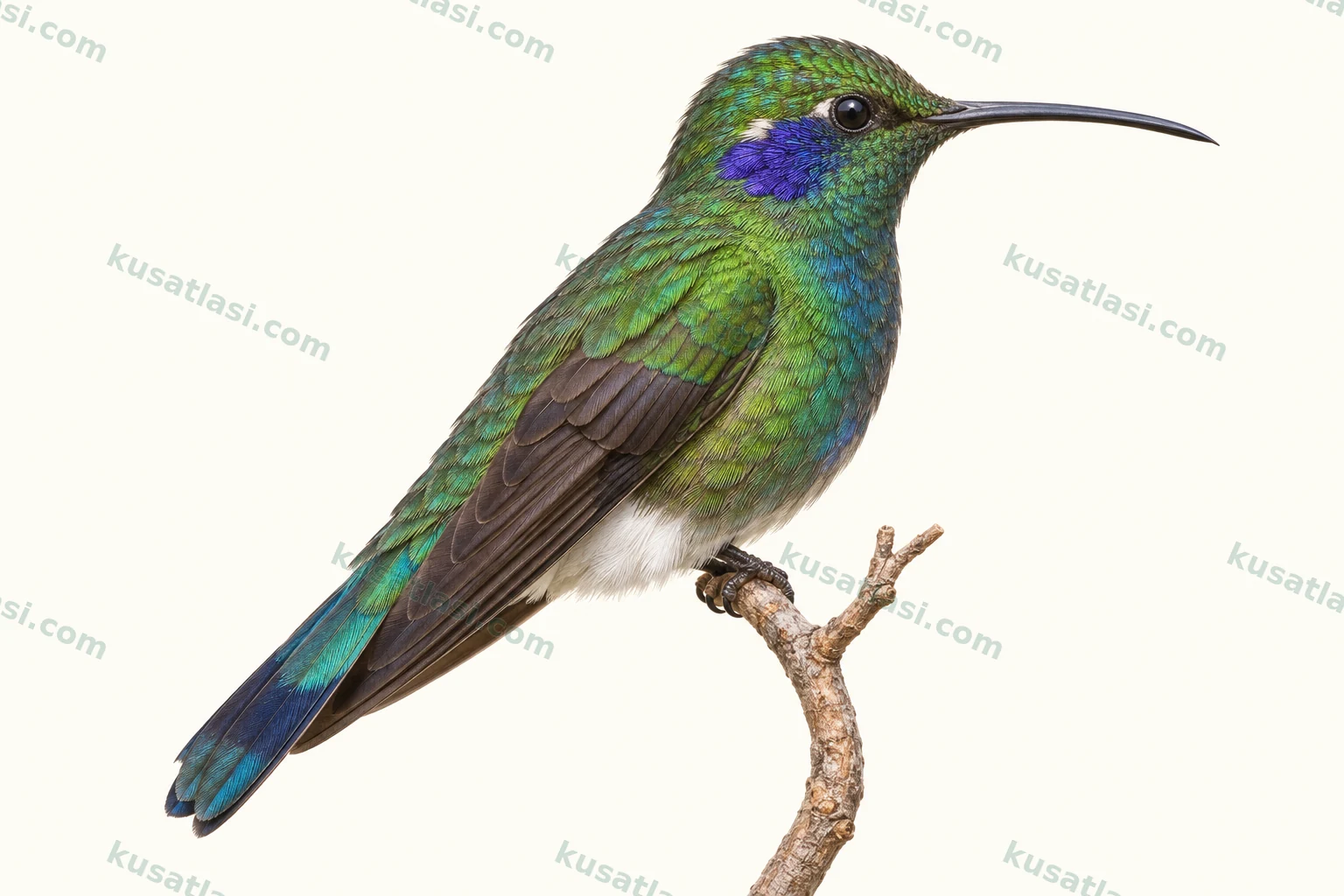
World Birds IUCN statusLC · Least ConcernGlobal IUCN. BirdLife v10 (2025); taxon matching AviList 2026 / IOC 15.2; checked: 29.10.2026. The list year is not the species’ assessment date. Source and method · BirdLife OrderApodiformesSwifts, hummingbirds and allies FamilyTrochilidaeTrochilidae
White-vented Violetear
Colibri serrirostris
Shimmering green hummingbird; violet-blue head sides and white undertail are checked together.
Biometrics
Length
Male12–13 cm
Female12–13 cm
Shared species value
Wing length
Male6.79 cm
Female6.79 cm
Shared species value
Weight
Male5.6–6.8 g
Female5.6–6.8 g
Shared species value
White-vented Violetear
South American savannas and open vegetationObservation guide in its natural range
Look for three features together
Do not rely on a single featureThe violet-blue feather patch can be raised; check where it is.
Confirm the white on the same bird; a green body alone is insufficient.
Flowers in savanna, scrub and forest edges.
Compare male and female
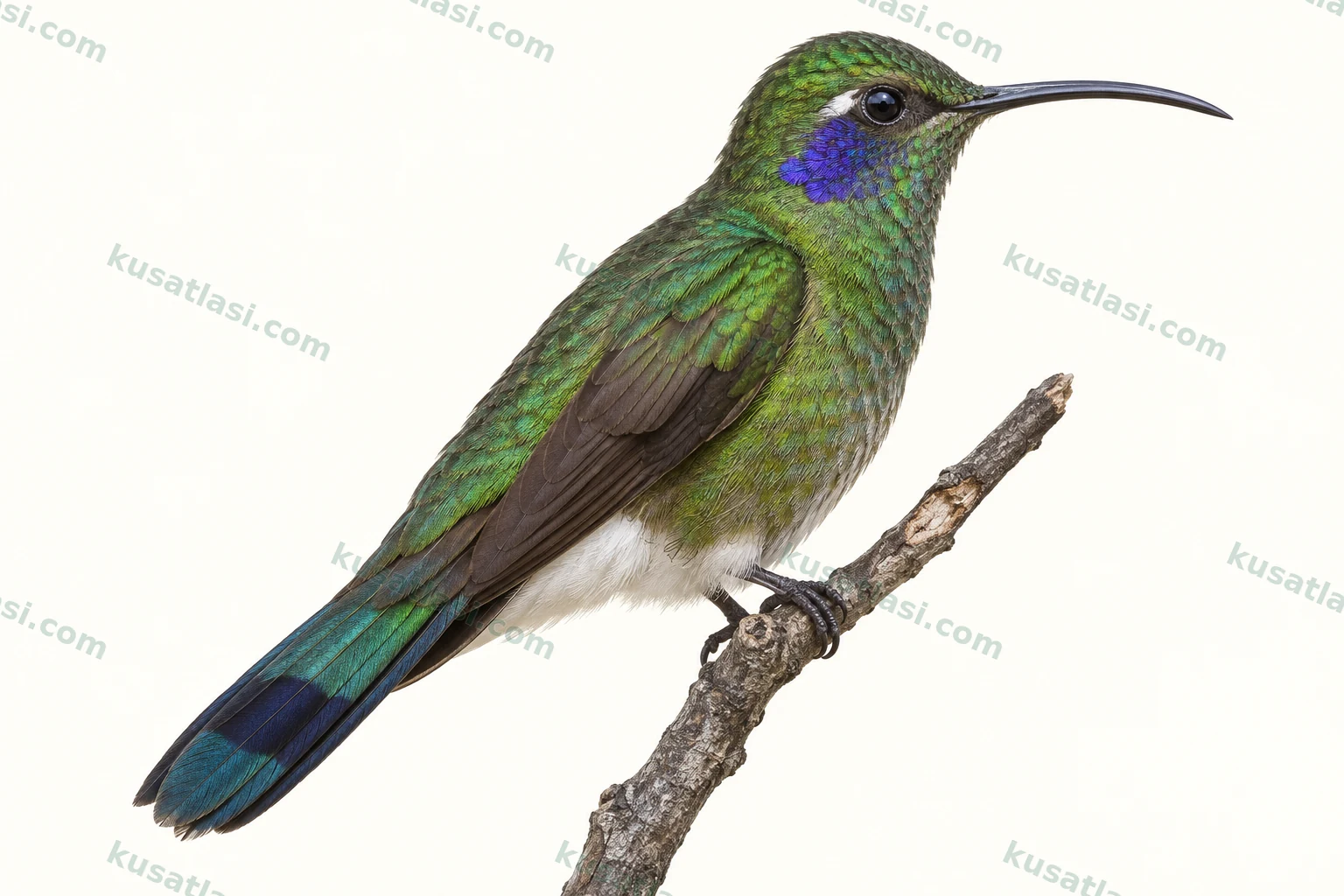 FemaleMale
No certain visual sex key or detailed juvenile profile was verified; raising the violet feathers does not prove sex.
Where to look in its natural range?
Flowering openings around eastern Bolivia, Paraguay, Brazil and northern Argentina.
Mainly resident. A regional December nest record does not make that the only breeding month throughout the range. Local habitat use changes with flowering.
All months: Data unavailable
January
February
March
April
May
June
July
August
September
October
November
December
Nest, egg and incubation
A life-history compilation gives two eggs; a December nest record comes from around Santa Teresa. Nest details, incubation and fledging duration were not sufficiently verified.
Call and song recordings exist; check the caller together with its head and undertail appearance.
Do not play recordings to attract birds; observe quietly, especially near nests.
Species information
Quick Identification
The White-vented Violetear Colibri serrirostris is a medium-sized hummingbird of South American savannas and open vegetation. Look for the shimmering green body, violet-blue patch on the side of the head and white undertail together. The violet area consists of coloured feathers beside the head, not the ear opening itself. The bird can raise these feathers, so the same individual’s head may appear narrower or broader at different moments. The white in its name does not mean a uniformly white belly.
As a bird approaches a flower, first locate the coloured patch beside the head, then inspect the undertail. Shining green feathers alone are insufficient because other green hummingbirds share the surroundings. The violet-blue head patch and white undertail must be confirmed on the same bird.
General Appearance and Posture
The body shines green and can suggest a scaly pattern in places. The violet-blue head patch forms a distinct island of colour among the surrounding green feathers. Check the white undertail independently of this striking head mark.
Flowers around savanna trees, shrubs and forest edges may offer suitable observation places. Cornell also describes frequent feeder use. A feeder visit nevertheless does not mean that its natural diet consists solely of sugar supplied by people.
Males, Females and Young Birds
This account uses green body, violet-blue head sides and white undertail as the basic adult identification marks. The sources examined did not provide a sufficiently detailed visual key for certain male–female separation. A bird chasing another is not necessarily male; food defence and sex identification are separate matters.
A sufficiently independent identification profile for detailed juvenile plumage colours was not found. Older specimen records from Santa Teresa, Brazil, mention young birds and moult, but their existence does not mean that all young occur on the same dates or share the same plumage. An individual whose adult marks are unclear is first assessed through other views of the same bird.
Appearance in Flight
It may hover before a flower with rapid wingbeats and fly between feeding points. Although familiar as hummingbird flight, this does not identify the species without head and undertail markings. Fast wing movement may blur photographs; do not describe a line or white area that cannot actually be seen on a blurred wing.
The Serra da Canastra study in Brazil documented flower visits in both open rocky grassland and riparian forest patches. A short flight between these habitats is not evidence of intercontinental migration. Nor does an index summarizing wing pointedness alone demonstrate migration. Structure, daily feeding flights and seasonal movements are separate information.
Voice and Behaviour
It feeds around flowering plants and may defend valuable food patches. A Brazilian study on Palicourea rigida observed territory-defending birds visiting different flower types within the defended area. Such defence does not mean that every flower is used by only one bird or that the bird never visits another plant. Food-territory boundaries may change with flower abundance and conditions during the day.
Call and song recordings exist, but this work did not verify a detailed vocal key giving certain identification in every context. Identify the caller near a feeder by seeing it. Do not attribute nearby hummingbirds’ calls to the same bird. Watch natural visits and chases from a distance instead of provoking birds with sound or approaching defended flowers too closely.
Confusable Species
When comparing other violetears such as the Sparkling Violetear Colibri coruscans, violet head sides alone are insufficient. Check the White-vented Violetear’s white undertail in particular. Iridescent body colour is a supporting feature that can change with the light.
Against the Brown Violetear Colibri delphinae, assess overall body tone and the surroundings of the head-side patch together. Sharing a violet patch does not make all plumage patterns identical. If only a flash beside the head is visible in a brief flight, leave identification unresolved.
World Distribution
Its natural geography is savanna and open vegetation in interior and eastern South America. The current taxonomic account lists eastern Bolivia, Paraguay, southern Brazil and northern Argentina. Scientific studies in Brazil’s Cerrado document flower visits and different open habitats in detail. This framework does not justify colouring entire countries as uniform habitat.
Status in Its Natural Range
It is globally categorized as Least Concern. Use of open vegetation does not mean that every form of tree removal benefits it. The Santa Teresa study examines a local bird community altered by people; it does not interpret this species’ occurrence in some shrubby openings as absence of ecosystem loss. Continuity of natural flower resources and different habitat patches also matters.
Migration
Specialist datasets classify it as mainly resident. Visits and short movements may follow local flowering, but no regular long-distance route covering the same months throughout the range was verified. Seasonal flower visits in one study do not mean the entire population makes the same journey. Map points are record localities, not a tracked route of flights between flowers.
Breeding Habitat
Used habitats include wooded savanna, shrubby openings, forest edges and rocky grasslands. Flower visits are also documented in riparian forest patches. These observations show that using open habitats does not mean spending the whole day in completely treeless places. Seasonal flower resources as well as vegetation structure influence habitat use.
Nest Site
The Santa Teresa species account from Brazil reports a December nest and female record around Alto Santo Antônio. It is regional breeding evidence, not grounds for making December the only nesting month throughout the range. A scientific life-history compilation gives two eggs. The examined sources did not sufficiently verify all nest details, incubation or fledging duration. Durations from other hummingbirds are not added to this species.
Daily Habitat Use
It may move between flowering shrubs and nearby resting branches. Defending valuable flower clusters helps explain repeated appearances in the same opening. Record flower visits and chasing separately. If a nest is found, do not block the approach or cut nearby branches for a better photograph.
What Does It Eat?
Flower nectar is a main food. Its nectar use is not confined to one plant: the Serra da Canastra study in Brazil recorded visiting relationships with 18 plant species. Heavy flowering of Qualea cordata explained an important share of the many visits in that study. This local result does not mean that the same plant is the most important food in every country.
How Does It Feed?
It approaches flowers to reach nectar and may visit open flowers successively within a cluster. The Brazilian Palicourea rigida study describes a bird returning to a particular study patch at varying intervals of 10–30 minutes during the day. That timing belongs to the observation’s context, not a feeding interval expected everywhere in the species.
In a Brazilian study of Dyckia tuberosa, it was documented as a visitor actually touching the flower’s reproductive parts. Taking nectar and effective pollination are different things; the role of a forager or visitor is verified by its observed movements on the plant. Feeding at the flower’s base or standing nearby is not automatic evidence of contact with reproductive surfaces.
One Bird Connects Many Plants
The Serra da Canastra study in Brazil, from November 2018 to October 2019, recorded, among 10 hummingbird and 23 flowering plant species, 647 visiting interactions. This species accounted for 359 of those interactions and was linked with 18 plants. These are not counts of individuals but observed visiting interactions. They show broad flower-resource relationships in the park’s studied sites, not world population size.
Defending Food Does Not Necessarily Stop Pollination
The Brazilian Palicourea rigida study found plants with different flower structures together inside defended areas. Birds continued visiting these plants, so territorial defence alone did not stop pollen transfer between them. The researchers also discuss changes in area and defence during the day. This conclusion concerns the particular plant and study area; not every case of nectar defence has the same outcome.
It Can Visit Flowers Suited to Insects Too
In the Brazilian Canastra study, Qualea cordata flowers, generally associated with insect visits, were among this bird’s heavily used resources. A plant’s general pollination type does not mean no hummingbird ever visits it. Flower abundance may affect local visiting patterns. Whether every visit provides equally effective pollination nevertheless requires separate evidence.
A Shape Index Does Not Give a Migration Route
A scientific index summarizing folded-wing shape does not replace an observed journey. A bird with a wing apparently suited to flight can be mainly resident. Definite migration months are therefore not derived from wing measurements; seasonal movements require geographically located and dated observations.