

World Birds IUCN statusEN · EndangeredGlobal IUCN. BirdLife v10 (2025); taxon matching AviList 2026 / IOC 15.2; checked: 29.10.2026. The list year is not the species’ assessment date. Source and method · BirdLife OrderPasseriformesPasserines FamilyPellorneidaePellorneidae
White-throated Wren-Babbler
Napothera pasquieri
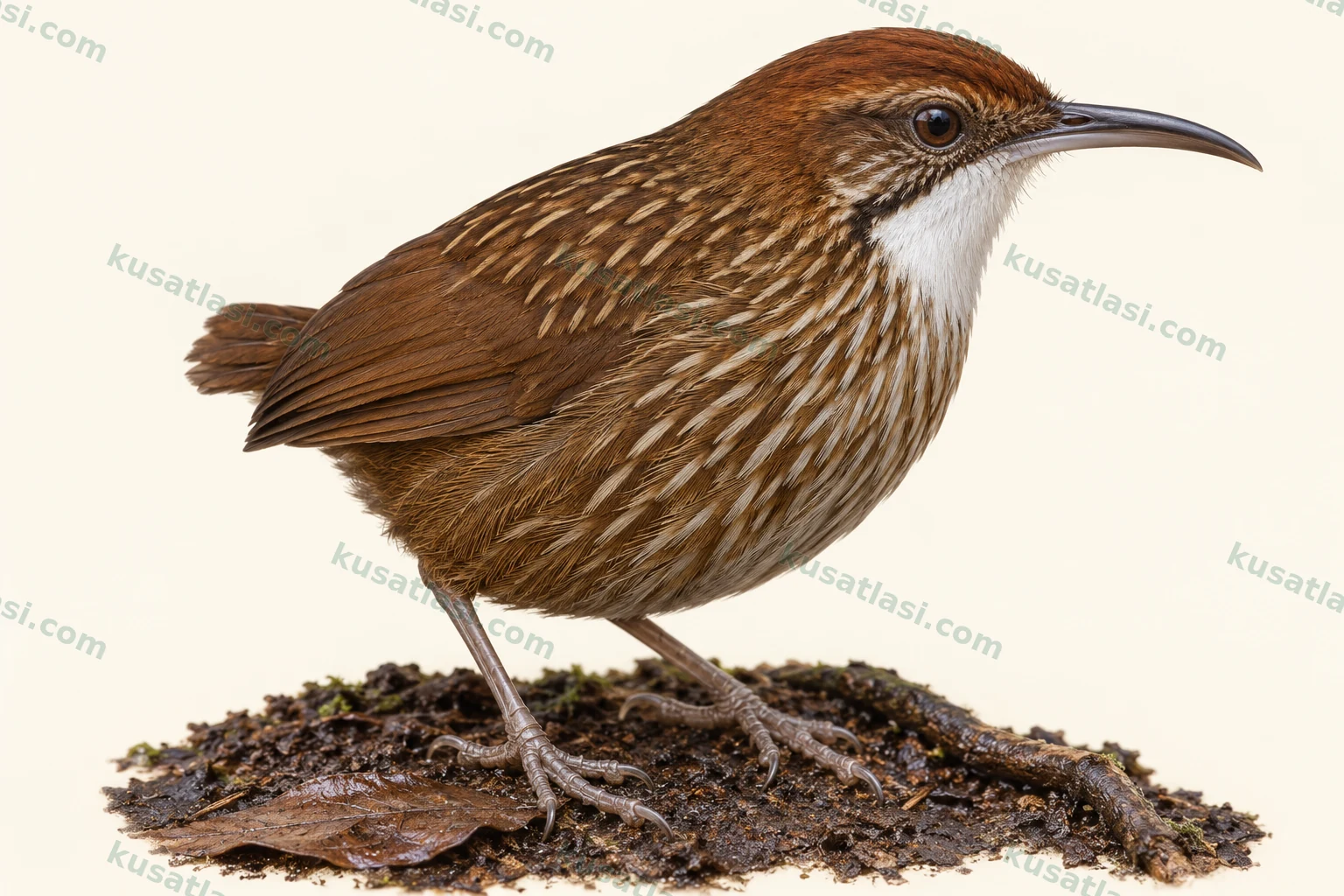
Ground bird of northwestern Vietnam’s forests, with a white throat, long bill and very short tail.
Biometrics
Length
Male11–12 cm
Female11–12 cm
Shared species value
Wing length
Male5.58 cm
Female5.58 cm
Shared species value
Weight
Male19.4 g
Female19.4 g
Shared species value
White-throated Wren-Babbler
Hoang Lien, northwestern VietnamObservation guide in its natural range
Look for three features together
Do not rely on a single featureWhite throat, streaked brown body, long bill.
Dense bamboo undergrowth in humid mountain forest.
Parts ground leaf litter to forage.
Compare male and female
 FemaleMale
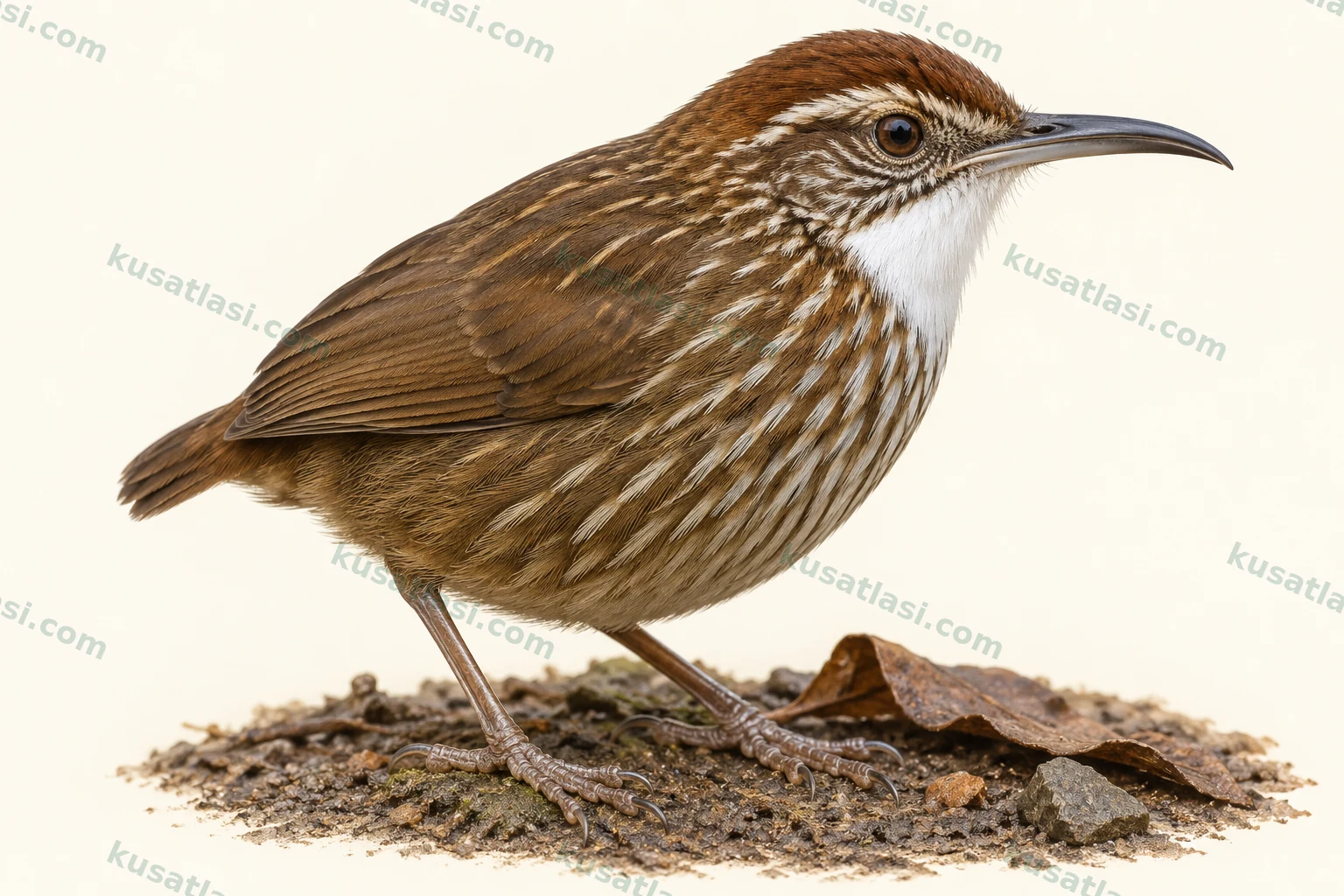
Underbody colour may vary between individuals; the sex of the 2010 birds and the cause of their difference remained unknown.
Where to look in its natural range?
Bamboo undergrowth in humid mountain forests of Fansipan, Mu Cang Chai and Van Ban.
Resident mountain bird; breeding calendar unverified, possible elevational movement remains open. No data found for breeding months.
All months: Data unavailable
January
February
March
April
May
June
July
August
September
October
November
December
Nest, egg and incubation
Nest form, egg number, incubation and juvenile development periods unverified.
High descending whistle; occasional sharp short notes and bubbling or rough calls.
Do not play recordings to attract birds; observe quietly, especially near nests.
Species information
Quick identification
White-throated Wren-Babbler Napothera pasquieri is a small, very short-tailed, long-billed bird of humid mountain forests in northwestern Vietnam. Bright white throat, streaked brown body and a slightly downcurved bill form its basic identification combination. It feeds on or very close to the ground in dense undergrowth. It is often heard first rather than sitting conspicuously on an open branch for long.
Small size and concealment in low cover help explain why it is overlooked. Its voice includes a whistle starting distinctly high and descending, sometimes joined by sharper short notes. The direction can become difficult to locate when the bird is close. This was among the features attracting direct observers' attention before they saw it in 2010.
General appearance and posture
Pale streaks divide the brown head, back and body. The white throat is clearly bounded, extending sideways below the cheek. The facial sides were described as plain mouse-brown. A very short tail and relatively long bill help separate it from other small forest birds sharing a brown body.
Mean bill length in four specimens in the 2006 taxonomic study was 2.7 cm.
Underpart appearance cannot be reduced to one illustration. Of two birds caught together in November 2010, one was extensively white below, the other brown below its white throat. Upperparts and bill appearance were more similar. This direct record cautions against requiring the same brown pattern below every white-throated bird.
Males, females and young birds
The two birds caught together in 2010 could not be sexed. Researchers discussed whether their underpart difference reflected individual variation, sex or age, without proving one explanation. Extensive white underparts must therefore not be labelled male and brown ones female. No reliable detailed juvenile field-plumage key was found either.
The birds were caught very close together in the same net and left together when released. This indicates an association, not necessarily a breeding male–female pair. No egg, nest or chick was found, so proximity is not interpreted as breeding success. Two similar bills establish neither a sex difference nor two species.
Appearance in flight
The direct field record describes a short flight across a path less than a metre wide, followed by brief perching in low bamboo. The short tail can be seen in this low movement. No particular underwing pattern giving certain identification was verified. Re-seen long bill and white throat complete identification after the short flight.
Flight appearance and migration are different information. Crossing a bamboo-lined path does not show seasonal movement along a mountain range. Researchers explicitly left possible descent to lower elevations in winter as an open question. That possibility is not converted into a certain mapped seasonal migration line.
Voice and behaviour
Cornell's specialist description reports descending high whistles, repeated bubbling-like calls and rougher short sounds. Dry pieces moving as it parts ground leaves can also be heard. The 2010 bird under dense bamboo searched by conspicuously tossing litter aside. It is therefore not merely hidden, but actively ground-foraging within suitable cover.
Low forest structure is important to its behaviour. Sources repeatedly describe leaf-littered ground and dense bamboo undergrowth rather than open treetops as search habitat. Difficulty seeing it despite its voice shows why noisy or visible feeding movements do not always allow easy counts. The two birds provide a local record, not an estimate for the whole mountain.
Similar species
Napothera malacoptila shares a long bill and short tail. The taxonomic review compared this species' cleaner white throat, whiter feather centres below and darker brown rear underparts. Malacoptila may have a duller yellowish throat and more rufous rear underparts. This comparison prevents older broad species names from being used interchangeably.
Napothera albostriata is a separate Sumatran species. The same review stresses its larger size, more streaked facial sides and strong dark facial lines. White-throated Wren-Babbler has plainer brown facial sides and a more sharply bounded lower throat edge. A similar white throat does not put the Sumatran species in the Vietnamese bird's range; geography complements identification.
World distribution
It is endemic to the Hoang Lien mountains of northwestern Vietnam, with scientific records from Fansipan, around Mu Cang Chai and Van Ban. This small mountain-forest bird is not confused with an older broad account spanning Vietnam or all the Himalayas. The accepted name is Napothera pasquieri; Rimator pasquieri in older works is the same taxon's former genus placement.
Status within its natural range
The current conservation category is Endangered. A 2011 specialist study called for reconsidering the older low-risk assessment in view of restricted range and habitat damage. A 2025 scientific assessment also lists it among declining Vietnamese endemics covered by three protected areas. That area count is not a bird count, nor does every hectare within park boundaries necessarily provide suitable habitat.
Movements
It is considered resident, but local seasonal elevational movements are poorly studied. The 2010 dry-season record was at about 1,950 m; lack of observations higher up does not prove absence or obligatory downward migration. The supported mountain belt is shown without drawing a definite route for an unresolved movement question.
Breeding habitat
It occurs in dense undergrowth of humid evergreen broadleaf mountain forest. Bamboo, developed secondary cover and leaf-littered ground are shared record features. The verified elevational scope is 1,220–2,500 m.
Nest site
Nest structure, egg number, incubation and juvenile development periods were not verified here. Ground feeding does not prove an exposed ground nest. Two birds seen together do not replace nest evidence.
Daily use of space
It moves through bamboo leaves and ground litter to feed and also perches on low bamboo stems. The 2011 study discusses simplification of the understorey through removal for cardamom cultivation and possible harm to the bird. The effect's magnitude was not experimentally measured. Nevertheless, losing natural undergrowth while trees remain standing can change its feeding layer.
What does it eat?
Feeding sources classify it as a ground bird consuming small invertebrates. Verified detailed prey species and food proportions were not found. Its long bill is therefore not used to infer specialisation on a particular insect group. Food lists of related wren-babblers are not presented as its own stomach contents.
How does it forage?
Direct field observation recorded ground-foraging by tossing dry leaves and litter under dense bamboo. This shows access to invertebrates beneath leaves. Seeing it on a branch must not make tree feeding seem the main method. Cornell's ground or near-ground account agrees with the observed litter use. The record explains one individual's method, not its total daily feeding time or energy intake.
A historical specimen can change the search elevation
The male used in the original description was collected on Fansipan at 2,500 m on 3 December 1929. A later observation confirms the same elevational belt. Some guides repeating a 2,000 m ceiling may have discouraged searches higher in suitable forest. A dated specimen is not merely an old museum bird: it is evidence relevant to deciding where to look today.
Two birds can look unexpectedly different
Researchers documented different underpart colours in two birds caught simultaneously. Bills and upperparts were similar, but one was broadly white below and the other brown. Whether age, sex or individual variation explained this remained open. Reducing all the underparts to one fixed colour unnecessarily narrows the existing observation evidence.
Separation is not based on a white throat alone
The 2006 review compared facial feathers, underparts and small-sample measurements alongside throat colour. It found bill and leg measurement differences from the Himalayan bird. Current taxonomy treats the Vietnamese bird as distinct from Himalayan and Sumatran relatives. Since white throats occur in other species too, assess face, short tail, bill and geography together.
Understorey can disappear inside protected areas
Field researchers highlighted simplification of natural forest undergrowth by cardamom farming. Because the bird is associated more with low cover than trunks and crowns, assessing forest solely by overhead canopy closure may be insufficient. This is a habitat concern supported by research, not proof that it is absent from every cultivated place.