

World Birds IUCN statusVU · VulnerableGlobal IUCN. BirdLife v10 (2025); taxon matching AviList 2026 / IOC 15.2; checked: 29.10.2026. The list year is not the species’ assessment date. Source and method · BirdLife OrderPasseriformesPasserines FamilyLeiothrichidaeLeiothrichidae
White-throated Mountain-Babbler
Turdoides gilberti
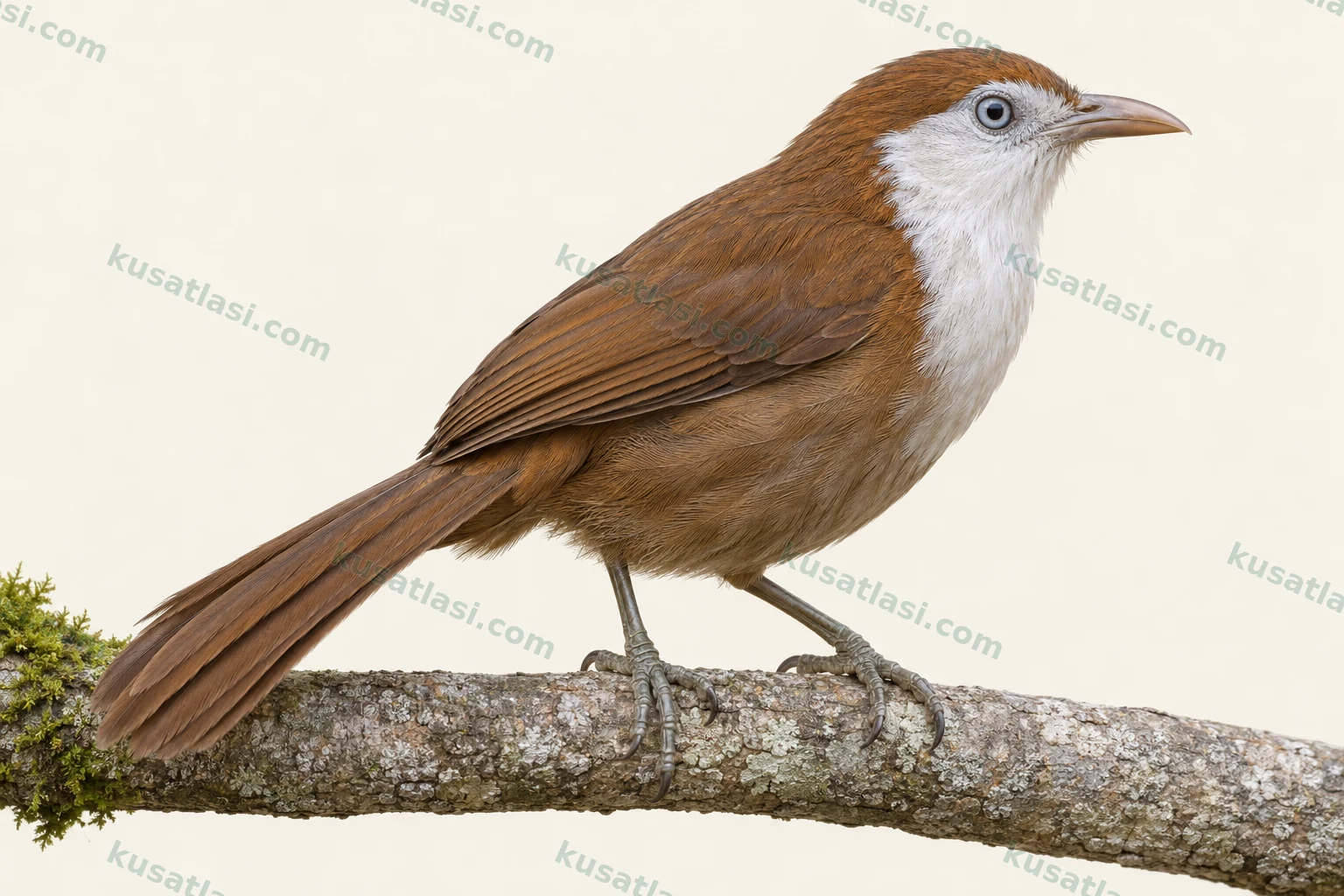
Rusty brown body, white face and throat, pale bill and pale blue-grey eye in the mountain forests of Nigeria and Cameroon.
Biometrics
Length
Male21–23 cm
Female21–23 cm
Shared species value
Wing length
Male10.64 cm
Female10.64 cm
Shared species value
Weight
Male64 g
Female64 g
Shared species value
White-throated Mountain-Babbler
Mountain forests of southeastern Nigeria and southwestern CameroonObservation guide in its natural range
Look for three features together
Do not rely on a single featureExamine the white face and throat, pale bill and eye together.
Look for groups in the middle and upper forest levels. They may hang upside down while searching mossy branches.
Compare male and female
 FemaleMale
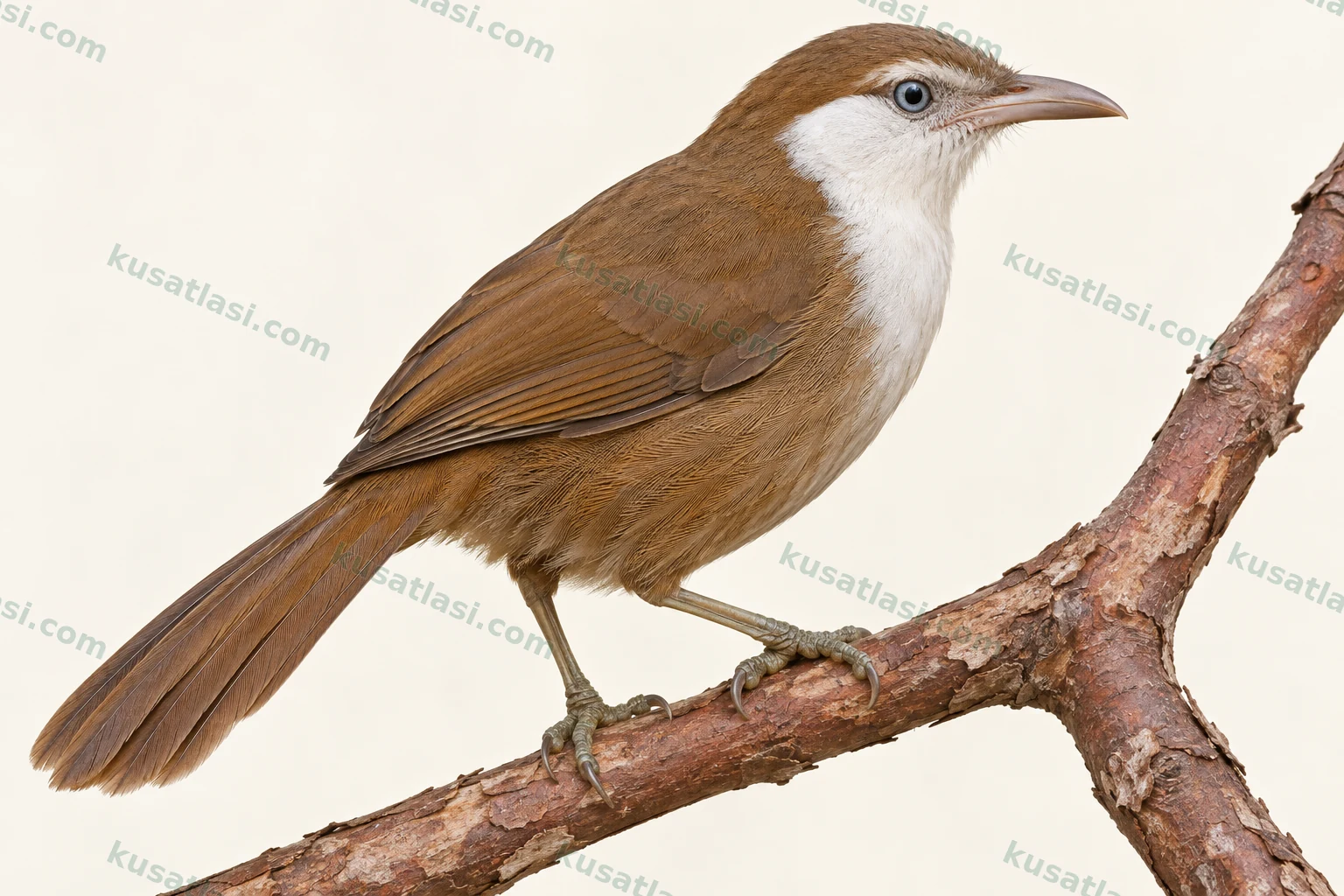
No reliable visual key distinguishes adult sexes at a distance. Young birds may have a browner throat.
Where to look in its natural range?
Look in the middle and upper levels of mossy trees in mountain forest.
A resident mountain-forest bird. Exact breeding months have not been verified across the range.
All months: The species is resident. A monthly nesting calendar has not been verified. No verified regional date is given for this month. This does not indicate local absence.
January
February
March
April
May
June
July
August
September
October
November
December
Nest, egg and incubation
The typical clutch size, incubation duration and duration of young development were not verified from original species data. Living in groups does not prove cooperative breeding.
Softer, nasal notes mix with harsh, rasping calls. Check which bird is calling and look at its head pattern.
Do not play recordings to attract birds; observe quietly, especially near nests.
Species information
Quick identification
The White-throated Mountain-Babbler Turdoides gilberti is a robust songbird of the mountain forests of Nigeria and Cameroon. Its rusty brown body, white face and throat, pale bill and pale blue-grey eye stand out together. Look for this combination on one bird rather than identifying any white-headed or white-breasted bird as this species. Several birds moving together in the middle and upper levels of the forest support the identification, but a large group alone is insufficient. The white face forms a conspicuous pale area at the front of the head between the bill and the body.
Try to see both where the bird is in the mountain forest and the pattern on its head. Noise from a treetop does not identify the species while the birds are hidden by leaves. A brief crossing on an open branch may show the colours of the face, eye and body together. In dim light the white may look pale grey and the rusty brown may look dark brown. If the eye colour cannot be made out at a distance, leave it unrecorded. Note the visible marks and the sound separately.
General appearance and posture
Distance, branch thickness and posture affect how large the bird looks.
The bird moves along mossy branches and around tree trunks. The predominantly brown body and pale area of the face can be picked out separately in a brief view between leaves. It has been described hanging upside down while searching for food. Its head may be low and its feet gripping a support above it. Briefly hanging upside down does not mean the bird is injured. Do not expect every bird to use the same movement each time it searches. Ordinary movements along branches are also part of the observation.
Males, females and young birds
No reliable visual key to distinguish adult males and females at a distance was confirmed. A whiter face or warmer body colour is not evidence of sex on its own. Comparing a shaded bird with one on a bright branch can create a false impression of a sex difference. The two adult views show the same basic species pattern. Leave sex undetermined when the field observation does not establish it.
The specialist description notes that a young bird may have a browner throat. This can help distinguish it from the white throat of an adult, but one shaded view does not establish age. If a bird in a group looks less white, check the state of the feathers and the light again. No verified data describe every juvenile stage, moult date or time to independence. Seeing a bird join a group and seeing adults feed it are different observations.
Appearance in flight
Watching a bird fly between branches can show which tree the group moves to. No identification key based solely on the upperwing or underwing pattern was confirmed for this species. If a brown bird appears briefly in the open, wait for it to perch again and check the head and throat. Wing details hidden when it passes behind a tree remain unknown. A brief flash of the white face does not replace the other marks.
The group's movement between trees is not long-distance migration. Records in different trees on a mountainside may show daily habitat use, but do not prove that the same birds were tracked between mountains. Joining points on a map would therefore be misleading. Follow the source of calls to observe movement inside the forest. Trying to make the birds fly is not an ethical way to improve the flight view.
Voice and behaviour
The specialist voice description distinguishes harsh, rasping calls from softer, nasal sounds mixed among them. Group members may call together. Record whether you saw the bird giving the sound instead of assuming all notes came from one individual. Watching several birds move to the same tree helps track the group. Calling together does not by itself establish a nest or care of young. A vocal group can make birds easier to find in the closed forest canopy.
A scientific study of Nigeria's Sankwala Mountains recorded groups of 5–10 birds. These figures describe individual encounters, rather than the regional population or a fixed group size. Foraging together does not prove that every adult helps another pair raise its young. Breeding assistance can be assessed only by observing the nest and care directly. Watching from an existing path without disrupting movement or calls yields a more reliable account of natural behaviour.
Similar species
When comparing other brown songbirds in the mountain forests of Nigeria and Cameroon, check the extent of the white face, throat, pale bill and eye together. A white throat alone is insufficient. Compare posture and head pattern with bulbuls in the same region. Moving like a bulbul does not place the bird in the same family. Searching moss is not diagnostic on its own.
Older sources may use Kupeornis gilberti, a former genus placement for this species. Information about an East African bird formerly placed in the same genus does not apply to the Nigeria–Cameroon bird. In particular, a Kupeornis record from Rwandan forests does not belong on this species' distribution map without checking the scientific species name. Identifying the bird and matching a historical name are separate checks. A shared former genus does not establish the same species or range.
Global range
The natural range lies in the mountain forests of southeastern Nigeria and southwestern Cameroon. The shared mountain belt crosses the national border. Records from Sankwala in Nigeria and surveys of Bakossi, Kupe and Manenguba in Cameroon document different parts of the same regional forest system. The species does not inhabit every part of either country. The presence and continuity of mountain forest matter.
Status within its natural range
The published HBW/BirdLife v10 (2025) list gives the global category as Vulnerable (VU). AviList 2026 and IOC 15.2 confirm that Turdoides gilberti and the BirdLife record under Kupeornis gilberti refer to the same taxon. A proposed category change for 2026 does not replace a published assessment. The global category does not imply that all local populations are in the same condition.
Surveys in Cameroon highlight the importance of some forest fragments. The 2000 assessment drew attention to Bakossi and the southern slopes of Manenguba. Local abundance at that time does not establish the current condition of every population or the global population size. The Nigerian study also discusses pressures on mountain forest from fire, grazing, agriculture and logging. Its findings for birds as a whole are not a calculated population trend for this species.
Movements and migration
An ecological review classifies it as a resident forest bird. Regular intercontinental migration or a verified annual route is not documented. Movement within a forest patch does not establish a migration route. Approximate observation points show where the bird was recorded. They do not show breeding on every connected mountain. A conservation recommendation to keep forests connected is separate from a tracked journey by individual birds between mountains.
Breeding habitat
The bird uses the middle and upper levels of mountain forest. The specialist field description mentions elevations of roughly 1,000–2,100 m. This range does not set precise limits for every slope. Surveys in Cameroon show the importance of mature forest, damp branches and mossy trees. Forest cover on a mountain does not constitute a nest record. Presence, signs of breeding and direct nest observations should be treated separately.
Nest site
The original field studies examined did not verify the species' typical clutch size, incubation duration or time for young to develop. A group moving together does not establish shared nest care. Nest data from close relatives are not used to fill these gaps. Waiting for a long time under a branch that might hold a nest can keep the birds from approaching. Observe from a distance.
Daily use of habitat
Birds searching among moss, ferns and bark move between forest trees. Bakossi and Manenguba observations show why looking only at low terrain is insufficient to assess a mountain-forest bird. Observe the closed canopy and undergrowth separately. One record at a forest edge does not show that open farmland supports the full life cycle.
What does it eat?
This mountain-forest bird feeds on invertebrates. An ecological review classifies it as an invertebrate eater, but the percentages of foods eaten over the day were not verified. A bird on a mossy branch is not necessarily eating moss. Searching among fern leaves does not establish that it eats the fern. Distinguish the surface the bird searches from the prey it picks up in its bill.
How does it forage?
The specialist description reports searching among bark, moss and plants growing on trees. The bird may hang upside down to reach different surfaces. A brief stay under a branch does not reveal the identity of the prey. Record it separately if you can actually see it. Do not assume that all members of a foraging group take the same prey. Shaking branches or opening the vegetation to see birds foraging in the canopy disturbs natural feeding. Watch from a clear viewing point instead.
The forest belt crosses national borders
Southeastern Nigeria is part of the natural range as well as Cameroon. An association with a mountain name does not confine the species to that mountain or country. Scientific records from Sankwala show the importance of forest on the other side of the border. Conservation of the species cannot be assessed by looking at a single locality.
Later surveys add to earlier findings
Later fieldwork around Manenguba documented the bird in forest fragments that had previously been little studied. An old publication without a record at a site does not establish absence when a newer direct observation exists. Conversely, a statement of local abundance more than twenty years ago is not a present population estimate without a new survey.
Group size does not measure population size
The groups of 5–10 birds in the Sankwala study describe particular encounters. Those counts cannot be added into a population estimate without knowing the number of groups and whether the same birds were seen again. The possible presence of young in a group does not prove that every adult helps at the nest. Group observations and the breeding system are separate research questions. Seeing movement in a tree crown differs from seeing prey carried to a nest. Observe without disturbing the birds' natural behaviour.
An old name can refer to the same species
Kupeornis gilberti and Turdoides gilberti are genus placements used for the same bird at different times. A study using the older genus name does not thereby concern another species. Check its scientific species name and locality together. Measurements, voice and breeding information of other African species once placed in the same genus do not apply to this one.