

World Birds IUCN statusLC · Least ConcernGlobal IUCN. BirdLife v10 (2025); taxon matching AviList 2026 / IOC 15.2; checked: 29.10.2026. The list year is not the species’ assessment date. Source and method · BirdLife OrderPasseriformesPasserines FamilyTroglodytidaeTroglodytidae
White-headed Wren
Campylorhynchus albobrunneus
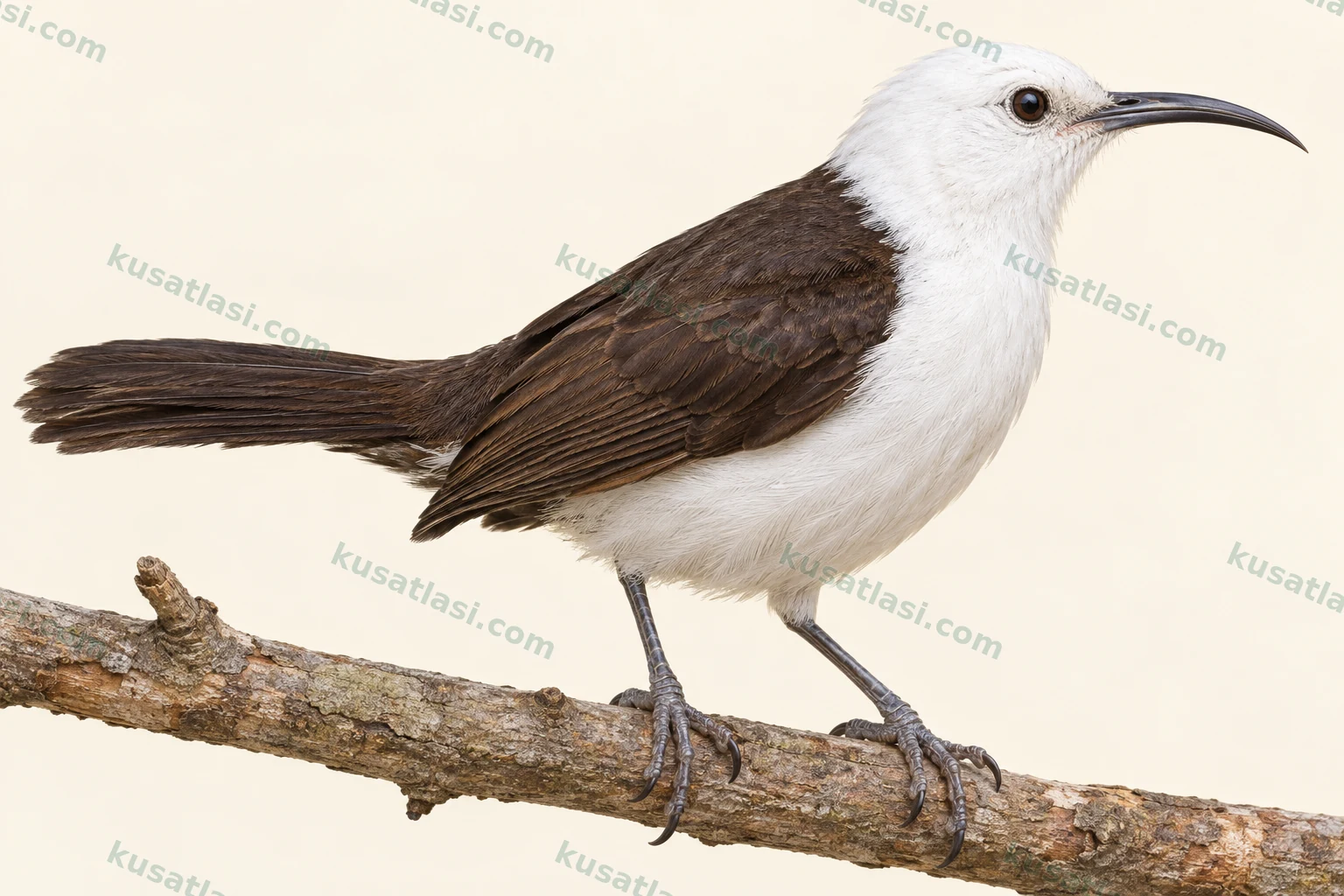
A long-tailed wren of humid forest. Adults combine an extensively white head and white underparts with a dark back.
Biometrics
Length
Male18 cm
Female18 cm
Shared species value
Wing length
Male8.22 cm
Female8.22 cm
Shared species value
Weight
Male27.5–39 g
Female27.5–39 g
Shared species value
White-headed Wren
Central and eastern Panama, and humid forests west of the Andes in ColombiaObservation guide in its natural range
Look for three features together
Do not rely on a single featureThe crown and face are both white in adults.
The back and wings are dark and the underparts mostly white.
It searches for food in clumps of plants growing on trees, in pairs or small groups.
Compare male and female
 FemaleMale
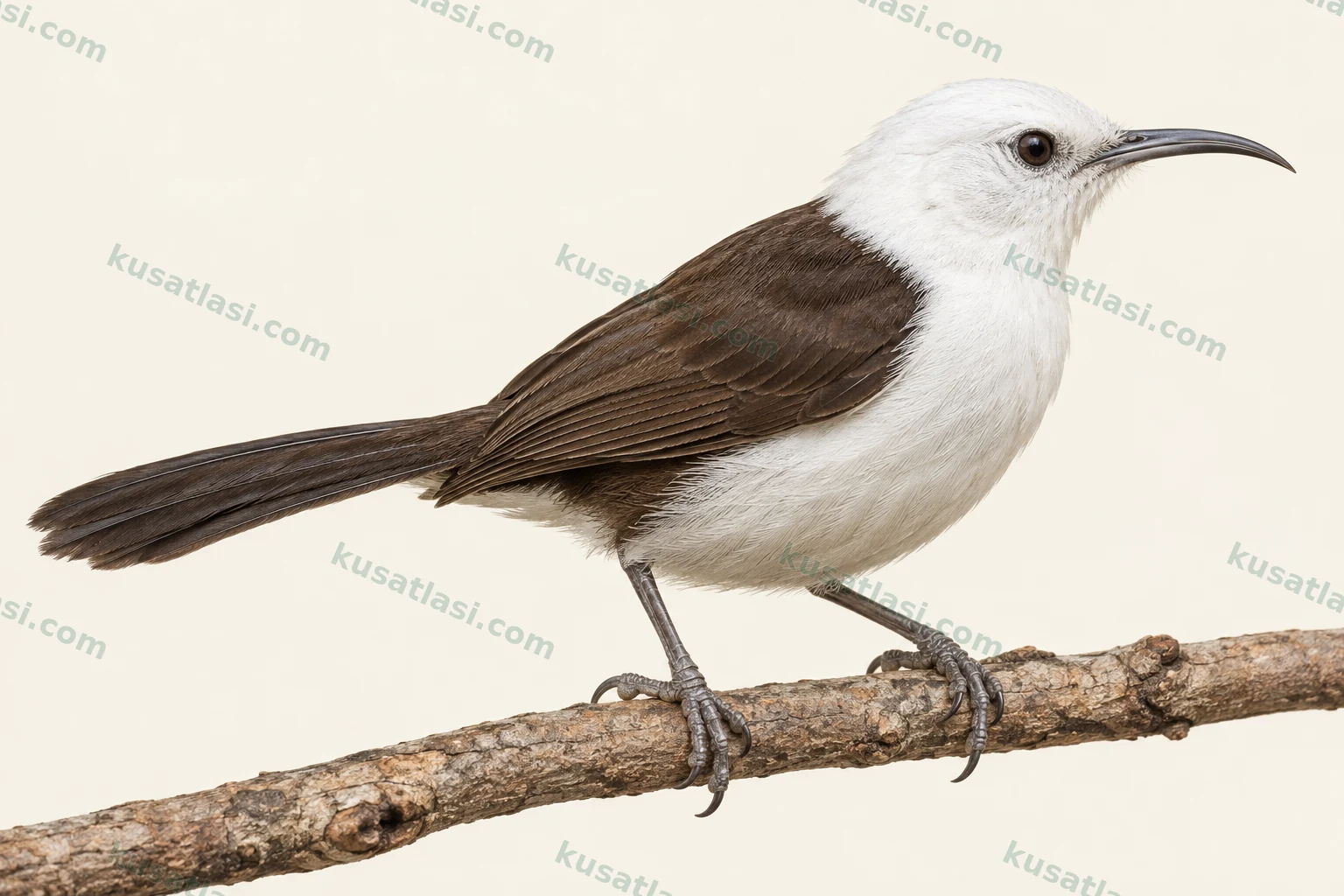
Adults of both sexes look alike. Young birds may have a darker, streaked head, which does not reliably indicate sex or hybrid ancestry.
Where to look in its natural range?
Look in humid lowland forest and on slopes, in dense clumps of plants on branches.
An original nest-building record from 25 March at Filo de Abibe, Colombia, at 600 metres. It does not establish a calendar for the entire range.
January
The species is resident. No long-distance migration route was verified. No verified regional date specific to this month was given; this does not mean local absence.
February
The species is resident. No long-distance migration route was verified. No verified regional date specific to this month was given; this does not mean local absence.
March
The species is resident. No long-distance migration route was verified. Filo de Abibe, Colombia, at 600 m. Nest building was observed on 25 March in a local field record.
April
The species is resident. No long-distance migration route was verified. No verified regional date specific to this month was given; this does not mean local absence.
May
The species is resident. No long-distance migration route was verified. No verified regional date specific to this month was given; this does not mean local absence.
June
The species is resident. No long-distance migration route was verified. No verified regional date specific to this month was given; this does not mean local absence.
July
The species is resident. No long-distance migration route was verified. No verified regional date specific to this month was given; this does not mean local absence.
August
The species is resident. No long-distance migration route was verified. No verified regional date specific to this month was given; this does not mean local absence.
September
The species is resident. No long-distance migration route was verified. No verified regional date specific to this month was given; this does not mean local absence.
October
The species is resident. No long-distance migration route was verified. No verified regional date specific to this month was given; this does not mean local absence.
November
The species is resident. No long-distance migration route was verified. No verified regional date specific to this month was given; this does not mean local absence.
December
The species is resident. No long-distance migration route was verified. No verified regional date specific to this month was given; this does not mean local absence.
Nest, egg and incubation
An enclosed, spherical nest with a side entrance. Nesting was recorded directly in a low tree in a forest clearing. The usual number of eggs, incubation duration and time spent in the nest by the young are unknown.
The song is a series of rough, grating notes. The call is harsh and creaky. Both sexes sing.
Do not play recordings to attract birds; observe quietly, especially near nests.
Species information
Quick identification
The White-headed Wren Campylorhynchus albobrunneus is a long-tailed wren of humid forests in Panama and in Colombia west of the Andes. Adults have a white head and mostly white underparts, with dark brown back and wings. The white extends beyond a stripe above the eye to cover the crown and face. The contrast between the extensive pale head and the dark upperparts can stand out even during a brief view of the bird on a branch.
See the head, back and underparts together to identify the bird. A white throat glimpsed through leaves is insufficient. Related wrens can have a white eyebrow, a pale breast or pale lines on the back. A young White-headed Wren may have a less cleanly white head than an adult, so the adult description is not a fixed template for every individual.
General appearance and posture
The dark back, wings and fairly long tail extend behind the pale head. The body is full and the bill slender and fairly long. The belly below the white breast is largely pale. Dark markings can occur on the feathers covering the tops of the legs and on the undertail coverts. A specialist monograph reports that these markings differ in extent between two geographic forms. Do not expect the entire underside of every bird to be unmarked white.
The white on the head can look grey in shade or brownish when the feathers are soiled. The eye ranges from dark brown to reddish tones. The upper bill is dark and the lower bill is greyer. The legs are lead-grey. A directly lit head and a shaded back may receive very different light in the same photograph. Pale feathers around the eye do not make the eye itself white.
Males, females and young birds
The original account of morphology explicitly describes adult males and females as similar in appearance. Neither the extent of the white head nor the darkness of the back provides a reliable sexing key. A singing bird is not automatically a male, because the specialist account reports that both sexes sing. Sex and apparent age are assessed separately.
Young birds can have faint or distinct grey-brown streaks on the crown and sides of the head. The upperparts are browner than in adults and some of the underparts are washed with pale buff. Some young birds have thin, irregular white tips to the tail. The features vary in prominence, and lack of white at the tail tip does not by itself establish adulthood.
Juvenile plumage is followed by an appearance closer to that of adults. A single photograph cannot date this transition in days or weeks. Dark marks on the head, especially in a young bird, do not by themselves indicate hybrid ancestry. Distinguishing the unusual birds discussed from southwestern Colombia from ordinary young birds requires the overall plumage pattern and the locality.
Appearance in flight
As a bird moves among branches, look for the combination of long tail, dark wings and pale head. A brief view from above reveals the dark back, while a view from below highlights the pale body. The two angles provide different information. If leaves obscure the head, pale underparts alone are insufficient for reliable identification.
The pale areas of the underwing coverts and the dark flight feathers are different parts of the wing. The original monograph notes geographic variation in dark marks on the coverts. Do not assume that these fine marks are present when they cannot be seen in a distant silhouette.
Voice and behaviour
The song is a series of rough, grating notes, and the call can sound harsh and creaky. Similar wrens sound alike, so a written imitation of syllables alone does not reliably identify a sequence. Watch different levels of the tree from which the sound comes to look for the white-headed bird. Check both what the bird looks like and whether it is actually making the sound.
The birds can be seen in pairs or small groups. Searching through clumps of plants on branches can help locate them, but direct evidence is needed to say that the group is a family or that its members help at a nest. Watching the trees at the edge of a small clearing from a distance reveals behaviour without using calls to draw the bird out. Approaching the entrance of an active nest can disturb its normal movements.
Similar species
Campylorhynchus zonatus has conspicuous pale and dark crossbars on the back, dark spots on the breast and warm brownish colour on the belly. Adult White-headed Wrens differ in their extensively white head and more uniformly dark back. The less distinct colours of young birds can make that adult comparison harder. A breast that appears unspotted does not establish the identification on its own.
Campylorhynchus griseus also gives an initial impression of contrasting white underparts and brown upperparts. Its black crown and bold white eyebrow distinguish it from the white extending over the whole head of the White-headed Wren. Its occurrence in more open woodland, scrub and gardens in northern Colombia provides additional context. Habitat does not replace the head pattern as an identification feature.
World distribution
The range extends from central Panama eastward and into humid forests west of the Andes in Colombia. The Panamanian account puts the main western limits west of Colón on the Caribbean side and around the canal on the Pacific side. Darién and the Chocó region of Colombia are important parts of the range. It does not cover all of Panama or the Amazonian forests east of the Andes.
Status within its natural range
The current global assessment is Least Concern. The category does not mean the bird is abundant in every forest patch. Haffer’s original research lists separate localities in humid forest and forest scrub in northwestern Colombia. Dated field localities such as Río Napipí and Río Tanela give concrete evidence of the broad distribution, but not every place between them was observed.
Birds known as aenigmaticus, with distinctive plumage in southwestern Colombia, have been discussed in taxonomic work. A possible hybrid origin is not an established conclusion for each individual. The older discussion is not combined with the current two-subspecies arrangement to create a new subspecies or a confirmed natural range across Ecuador. Map estimates are restricted to the broad geographic area supported by evidence.
Movements
Specialist classifications treat the species as resident. No regular seasonal route of long-distance migration has been verified. Residence does not mean a bird stays on the same branch or in the same small forest patch all its life. Daily foraging movements and dispersal by young birds are distinct from long-distance migration. Monthly boundaries or route arrows unsupported by sources are not added to the map.
Breeding habitat
Humid lowland forest, forest edges and well-developed secondary woodland are the main habitats. The birds make particular use of trees with many plants growing on the trunks and branches. Specialist accounts describe lowlands and slopes reaching about 1,500 metres. That upper figure does not imply the same frequency everywhere or breeding at every elevation.
Nest site
The specialist account describes an enclosed, spherical nest with a side entrance. Haffer directly recorded nesting in a low tree in a small clearing surrounded by forest in the upper Río Napipí valley. Willis’s field note reports nest building on 25 March at 600 metres at Filo de Abibe. This local record does not establish the annual start of breeding across the whole range. The usual egg count, incubation duration and time spent in the nest by the young have not been verified.
Daily use of space
The bird may be seen foraging in the middle and upper parts of trees and is not restricted to the ground. The Río Tanela record shows that it can also use tall scrub around a forest stream without houses or clearings. One nest record near a settlement does not establish dependence on human structures. Assess humid vegetation, natural branch clusters and the passages between them together.
What it eats
Its diet is based mainly on invertebrates. The specialist account includes beetles, grasshopper-like animals and ants, and AVONET’s broad diet category also places it among birds that eat invertebrates. This classification is not a single measured dietary percentage for the entire year. The share of plant food is insufficiently known, so no definite proportion of fruit or seeds is given.
How it forages
It searches on branches and among plants growing on trunks and branches. Small gaps formed by leaves and accumulated material are among the places it examines for food. The Cornell account says it can use different levels of a tree. It is therefore not described as foraging at a fixed height on every occasion or feeding only on the ground.
Putting its bill into a clump of vegetation is foraging behaviour. Seeing what animal it takes provides different information. If the food cannot be identified, do not record a specific insect. Several birds moving around the same tree do not by themselves show coordinated hunting or help with nestlings. The plant used and the action of taking food can be recorded separately.
The name does not identify a dry-scrub bird
Haffer specifically argued that his direct observations in northwestern Colombia did not show this to be a bird of savanna or dry scrub forest. It was also recorded in humid scrub along the Río Tanela where there were no houses or clearings. Other members of the genus living in dry places do not make all members use the same habitat. Humid forest structure matters as much as the white head when looking for the White-headed Wren.
Plants growing on trees form another layer of habitat
The bird forages in clumps of plants established on branches and trunks. These plants need not be parasites that take nutrients from the tree. They use it for support. Describing the places the bird searches only as tree leaves overlooks this separate small habitat on the trunk. Seeing which branch and clump of plants the bird enters tells you something different from knowing only the tree’s name.
Seeing a nest does not answer every breeding question
The 25 March record from Filo de Abibe directly documents nest building. It does not give the egg count, how long incubation lasted or when young first flew. Different stages of breeding behaviour require separate evidence. A record with a particular date and elevation does not establish a fixed calendar for all pairs elsewhere.
A hybrid hypothesis is distinct from a demonstrated result
The aenigmaticus appearance in southwestern Colombia has long been debated. The SACC expert assessment does not present a possible hybrid-zone interpretation as conclusive. A 2024 genetic study of other Campylorhynchus forms in Ecuador cannot be applied directly to all White-headed Wrens. An unusual head colour does not establish a bird’s ancestry from one image. Consider its age, location and broader plumage pattern together.