

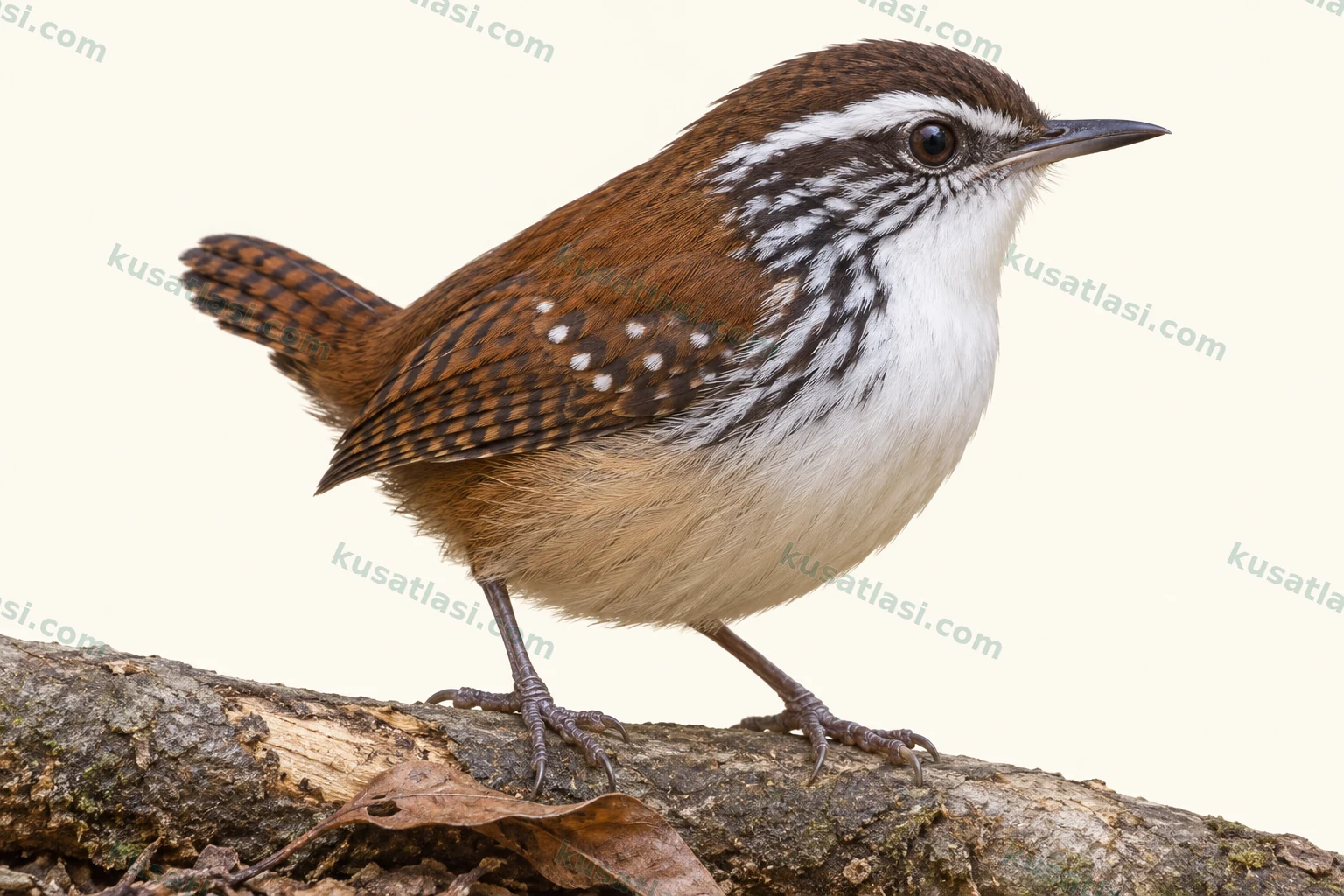
World Birds IUCN statusLC · Least ConcernGlobal IUCN. BirdLife v10 (2025); taxon matching AviList 2026 / IOC 15.2; checked: 29.10.2026. The list year is not the species’ assessment date. Source and method · BirdLife OrderPasseriformesPasserines FamilyTroglodytidaeTroglodytidae
White-breasted Wood-Wren
Henicorhina leucosticta
In low cover of humid forest, read the very short tail, striped face and white breast together.
Biometrics
Length
Male10–12 cm
Female10–12 cm
Shared species value
Wing length
Male5.42 cm
Female5.42 cm
Shared species value
Weight
Male13.5–17 g
Female12.2–15.2 g
White-breasted Wood-Wren
Mexico, Central America and northern South AmericaObservation guide in its natural range
Look for three features together
Do not rely on a single featureSmall and plump; very short tail, often raised.
Dark brown upperparts, striped face and white breast.
Ground and low cover of humid forest.
Compare male and female
 FemaleMale
Similar adult colours do not provide a certain sex key. Juvenile crown and breast are duller.
Where to look in its natural range?
Low cover in humid forest, around ferns and fallen trees.
Resident. Breeding months vary by region; February–May is reported in Costa Rica. Resident; regional breeding examples are not one shared calendar.
January
Data unavailable
February
Costa Rica: start of the reported February–May breeding period.
March
Suriname: reported March–May period; regional information.
April
Data unavailable
May
Data unavailable
June
Data unavailable
July
Data unavailable
August
Data unavailable
September
Data unavailable
October
Data unavailable
November
Data unavailable
December
Data unavailable
Nest, egg and incubation
Low, roofed, side-entrance nest; typically two white eggs, about 18 days of incubation by the female. Nestling period not verified.
Short metallic call; short variable whistled song. Both sexes sing.
Do not play recordings to attract birds; observe quietly, especially near nests.
Species information
Quick identification
White-breasted Wood-Wren Henicorhina leucosticta is a very small, short-tailed bird of humid forests in Central America and northern South America. Read its dark brown upperparts, striped black-and-white face and white throat and breast together. Warmer brown belly and flanks begin below the breast.
It is often heard first. The source of its short metallic call can be difficult to locate; leaves and roots may hide it even in apparently open forest undergrowth. Look for the actual bird on the ground below or near the branch from which the sound seems to come.
General appearance and posture
The body looks short and plump; the tail does not extend behind it like those of long-tailed forest wrens. The dark crown contrasts with the pale eyebrow and pale markings over the dark cheek. The eyebrow may be greyer in front of the eye and whiter behind it. The bright white area below the face is not the same tone as the warm-coloured belly.
The back is dark brown and may become more rufous towards the rump. The short tail has dark transverse bars. The eye is brown, the upper bill dark, and the base of the lower bill paler.
It often raises the tail towards the back. Tangled vegetation around fallen trees, ferns and roots offers places to watch its natural movement. It forages between the ground and low plants; searching mainly among birds high in the forest canopy is generally unnecessary.
Males, females and young birds
No colour key reliably separates adult males and females at every sighting. A bird that looks large is not automatically labelled male. Both sexes sing, so hearing song alone is not a male marker.
Young birds do not show the adult's full bright contrast. The crown may be brown rather than black; the throat and upper breast can look duller, greyish or pale yellowish. The underparts may also be greyer, sometimes with indistinct crossbars.
Young may follow adults in family groups. They have been reported sharing a roost nest with an adult, but that adult is not confirmed to be female in every case. Participation by both adults in nest building and feeding young does not mean they spend equal time on every separate task.
Appearance in flight
Short crossings inside dense forest reveal the small body and short tail; fine facial lines are often invisible. Brown markings on the folded wing are not used as a distant flight key. The appearance of the spread underwing alone does not provide certain identification.
Daily movement through leaf cover is not a north–south migration. Short crossings between resting and feeding places may show use of the same local area. Watching without flushing it allows its movements in low cover and its own chosen perch to be seen.
Voice and behaviour
Cornell emphasises a metallic call and short, variable whistled songs. A low, whisper-like whistle may precede the song. Both sexes may defend their local areas by singing.
A 2009 study in Costa Rica's La Selva forest examined areas used by pairs and family groups with young outside the breeding season. Birds occurred in both old forest and regrown forest on farmland abandoned for more than forty years. This does not mean a newly cleared field and mature forest are equivalent. The study concerns the actual structure of regenerated cover.
Similar species
Henicorhina leucophrys, Gray-breasted Wood-Wren, differs in its grey breast and is associated with higher areas in Cornell's account. Elevation alone nevertheless does not establish identity. Look for the white breast and warm brown flanks of White-breasted Wood-Wren; a dull juvenile must not be judged solely by a colour name.
Uropsila leucogastra, which can occur alongside it in Mexico, is compared by its less conspicuous facial ornaments and paler appearance. Other long-tailed wrens may have facial stripes; this species' very short tail and plump body matter together. Identification remains cautious when voice, natural geography and appearance do not match on the same bird.
World distribution
Its range extends from Mexico's humid forests through Central America to Panama and northern South America. Western Colombia, northwestern Ecuador and, east of the Andes, Colombia, Ecuador and northeastern Peru hold different regional populations. It also occurs in forests of Venezuela, the Guianas and northern Brazil. This broad geography does not make every open field or settlement suitable; the actual distribution of humid forest and undergrowth matters.
Status within its natural range
The current list snapshot places it in Least Concern. A broad range does not mean equal abundance everywhere. The La Selva research compared undergrowth in old forest and forest regrown over a very long time. Its presence there is not evidence that a large new clearing is harmless. Regional differences in appearance and voice gain meaning with a record of the place observed.
Movements
It is generally regarded as resident; no regular seasonal intercontinental migration route was verified. Pairs and families may use local areas throughout the year. Young following daily, seeking a new area and crossing into neighbouring cover are not the same process. Elevational limits in Mexico, Costa Rica and South America are not copied from one to another. Regional observation months do not create one migration calendar for the whole range either.
Breeding habitat
It uses low levels of humid tropical forest and adjacent shady, well-developed secondary growth. Fallen trees, ferns and leaves accumulated on plants form part of its daily habitat. Elevation varies by country; it is not restricted solely to sea level or mountains.
Nest site
The breeding nest is hidden close to the ground in dense cover around roots, ferns or logs. Made with plant fibres and small roots, the mossy oval roofed structure has a side entrance. Both adults help build it. The specialist account reports typically two white eggs and incubation by the female for about 18 days. The nestling period was not verified; the 17–18 days of a related species are not presented as measured here.
Daily use of space
Night roost nests differ from breeding nests; they are lighter and often higher. An individual may use several roost nests in the same area. These structures are not called egg nests. Breeding in Costa Rica is mainly February–May, while reported months vary in other countries. Do not open cover while looking for possible nests or block the birds' entrance route.
What does it eat?
It feeds mainly on small invertebrates, especially insects. Prey is not confined to bare ground; it may occur among dead leaves accumulated on palm and fern leaves. The specialist account reports small larvae and similar animal food brought to young. This does not imply identical prey on every feeding visit or a fixed menu across all regions.
How does it forage?
It moves between the ground and low plants, inspecting leaves, roots and tangled vegetation. Pockets of leaf litter caught above ground on plants matter in foraging. Researchers in Costa Rica's La Selva discussed a possible connection between these pockets and area size; the cause was not established. It sometimes joins birds following ant swarms, but is not regarded as a constant obligate ant follower. Do not lift fallen leaves to see prey; watch its natural search from a distance.
Two nests have different purposes
The breeding nest, concealed in cover with a sturdier roof and base, differs from the light structure used at night. Roost nests may be built throughout the year, and several can occur in one area. Seeing a roofed structure in a tree therefore does not show that eggs are present on that date. The bird's actual use matters.
Leaves do not collect only on the ground
Pockets of dead leaves on palms, ferns and other low plants are small feeding places where invertebrates may occur. The La Selva study discusses the relationship between this structure and local area size. An explanation of how more leaves provide food is a hypothesis, not an experimentally proven rule for every forest.
Area size is not one fixed number
The mean size calculated from ten areas examined in Costa Rica in 2009 was 3.8 hectares. This is a local result using circular approximations for areas whose true boundaries were incompletely known. It does not mean every pair in every country has precisely that area. Forest structure, measurement method and sample size are considered alongside the result.
Age changes face and breast contrast
The adult's black crown and white breast may be browner and duller in young birds. Rejecting a juvenile just because its breast does not look white enough is misleading. The very short tail, arrangement of facial marks and nearby adults help identification. Do not confuse shade from cover with a real age difference.
Breeding months depend on geography
Costa Rica's February–May period is not extended to the whole continent. The specialist account reports different regional periods, such as March–May for Suriname and January–July for Colombia. These describe records from particular areas, not a shared calendar claiming every pair breeds in every month.