

World Birds IUCN statusLC · Least ConcernGlobal IUCN category. BirdLife v10 (2025); taxon matching: AviList 2026 / IOC 15.2; checked: 29.10.2026. The list year is not the species assessment date. Source and method · BirdLife OrderPasseriformesPasserines FamilySalpornithidaeSalpornithidae
African Spotted Creeper
Salpornis salvadori
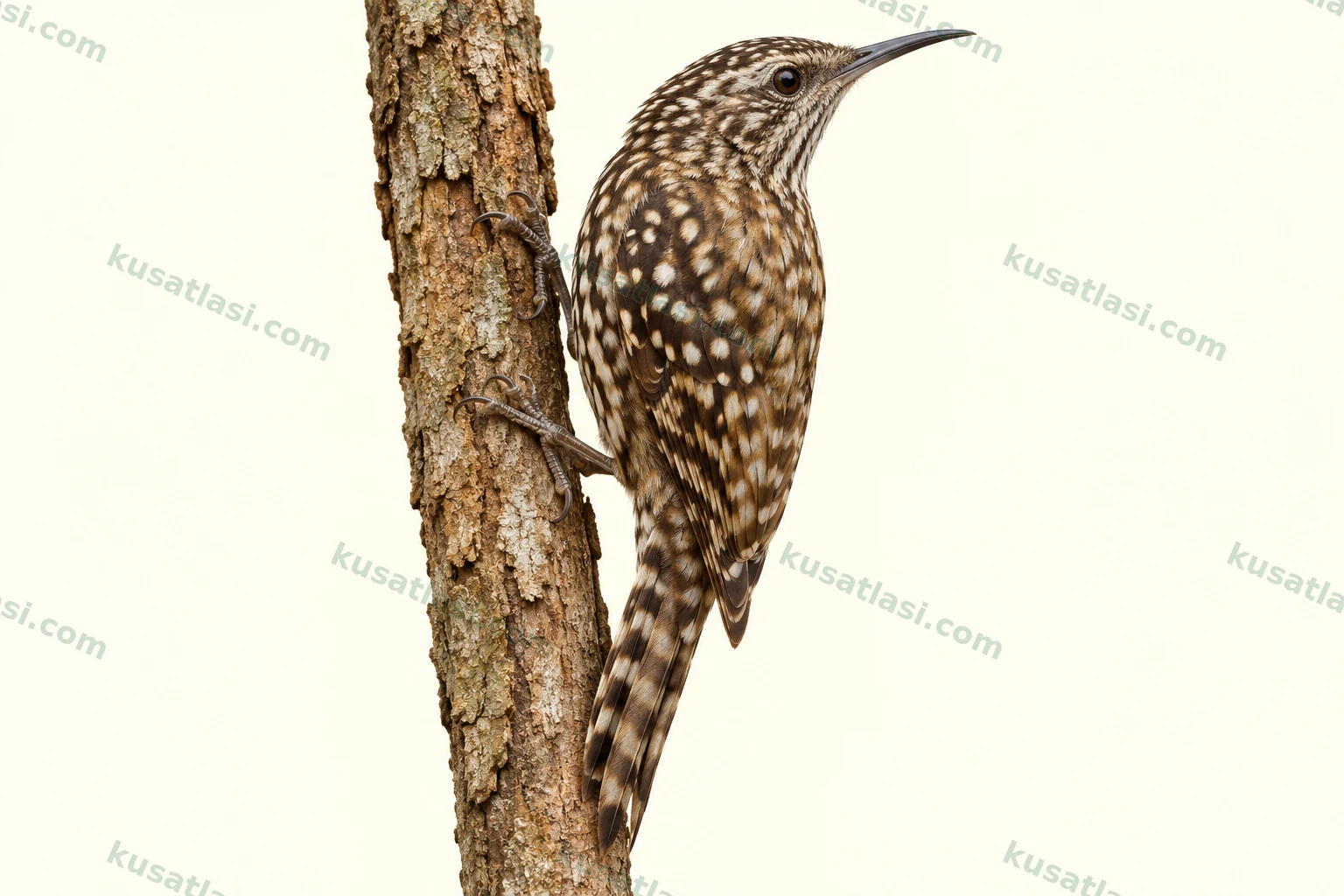
A small brown passerine spotted white; the slender curved bill and foraging on trunks without tail support are assessed together.
Biometrics
Length
Male15 cm
Female15 cm
Shared species value
Wing length
Male9.21 cm
Female9.21 cm
Shared species value
Weight
Male13.5–16 g
Female13.5–16 g
Shared species value
African Spotted Creeper
Patchy woodlands of sub-Saharan Africa; miombo in the southObservation guide in its natural range
Look for three features together
Do not rely on a single featureWhite spots on brown plumage; the wings and tail are also spotted.
It is slender and downcurved, unlike a woodpecker’s thick bill.
It moves upwards on tree trunks without using its tail as a prop.
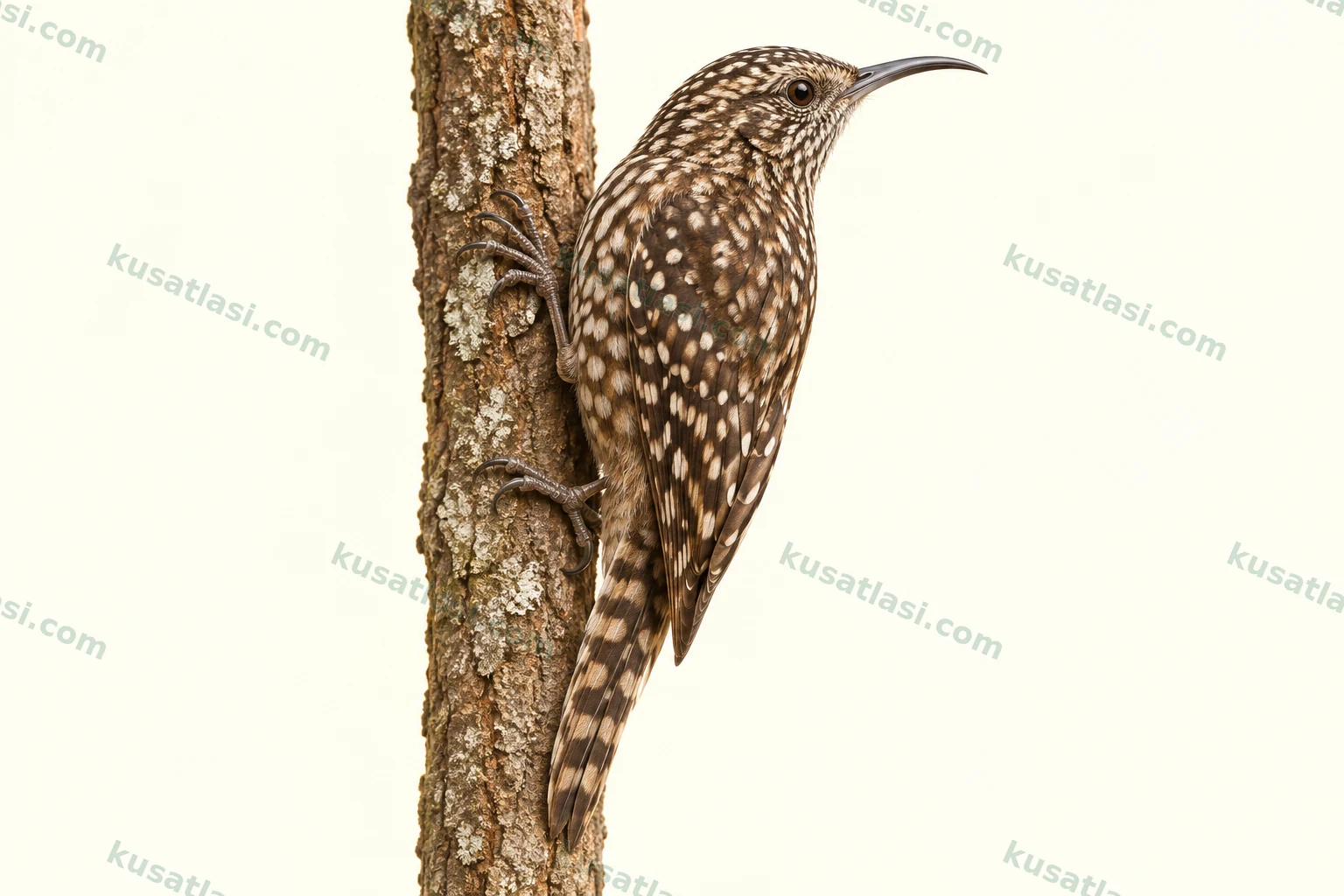
Compare male and female
 FemaleMale
Adult sexes look alike. No reliable young-bird plumage key has been verified; the behaviour of a youngster begging for food is recorded separately.
Where to look in its natural range?
Watch rough-barked tree trunks and thick branches.
The species is resident. The southern African atlas’s September–January breeding records are regional, not a shared calendar for the whole continent.
January
The species is resident, with rare wandering records. Zimbabwe and the southern African atlas region: These are regional breeding records; egg-laying and the complete breeding period are not the same.
February
The species is resident, with rare wandering records. No verified regional date specific to this month was given; that does not mean local absence.
March
The species is resident, with rare wandering records. No verified regional date specific to this month was given; that does not mean local absence.
April
The species is resident, with rare wandering records. No verified regional date specific to this month was given; that does not mean local absence.
May
The species is resident, with rare wandering records. No verified regional date specific to this month was given; that does not mean local absence.
June
The species is resident, with rare wandering records. No verified regional date specific to this month was given; that does not mean local absence.
July
The species is resident, with rare wandering records. No verified regional date specific to this month was given; that does not mean local absence.
August
The species is resident, with rare wandering records. No verified regional date specific to this month was given; that does not mean local absence.
September
The species is resident, with rare wandering records. Zimbabwe and the southern African atlas region: These are regional breeding records; egg-laying and the complete breeding period are not the same.
October
The species is resident, with rare wandering records. Zimbabwe and the southern African atlas region: These are regional breeding records; egg-laying and the complete breeding period are not the same.
November
The species is resident, with rare wandering records. Zimbabwe and the southern African atlas region: These are regional breeding records; egg-laying and the complete breeding period are not the same.
December
The species is resident, with rare wandering records. Zimbabwe and the southern African atlas region: These are regional breeding records; egg-laying and the complete breeding period are not the same.
Nest, egg and incubation
It builds an open cup nest with high sides in a tree; the regional account reports 2–3 eggs. The old compilation and newer field observations differ on incubation duties; verified incubation and first-flight times in days were not found.
It gives high, linked whistles and sometimes a single thin call; voice is assessed together with the bird’s appearance.
Do not play recordings to attract birds; observe quietly, especially near nests.
Species information
Quick Identification
African Spotted Creeper Salpornis salvadori is a small passerine that forages on tree trunks. White spots on a brown background, a slender downcurved bill, spotted wings and tail and climbing behaviour are considered together. Not every small bird moving upwards on a tree is this species. In particular, the complete body pattern, bill shape and the position of the tail relative to the trunk need to be seen; a view of the back alone may leave identification incomplete.
Its current English name is African Spotted Creeper. AviList recognizes the African bird as Salpornis salvadori in the family Salpornithidae. Older sources may describe Africa and India together under Salpornis spilonotus or spilonota. The current Indian species is outside this page's scope. An old record, measurement or behaviour is not transferred here before establishing the continent on which it was studied.
General Appearance and Posture
Brown and pale patterning breaks up the bird's outline against bark. White spots on the wings and tail become exposed to different degrees as it changes direction. Pale areas can look sharply white in a photograph but dirtier or cream-coloured in shade. Rather than interpreting this as a sex difference, it is better to follow pattern placement and bill proportions. If every dark feather detail is not visible, new lines are not imagined in the image.
The bill is slender and downcurved. This is important in a bird searching bark crevices, and it does not have the shape of a thick, straight woodpecker bill. As it moves on a trunk, the bird does not use its tail as a prop in the way true treecreepers do. The rounded tail can be held away from the trunk. Seeing this behaviour may be more helpful than judging one spot shape; the bird should not be chased around the tree to observe it.
Males, Females and Young Birds
Adult sexes look alike. More obvious white back spots or a slightly longer-looking bill in a photograph do not establish a male on their own. Posture, distance from the camera, light and concealed feathers affect appearance. The behaviours of both members of a pair can be recorded separately, but the sex of a food-carrying individual cannot be established from that behaviour alone.
No species-specific plumage key that reliably identifies young from a distance has been verified here. A bird begging for food and being fed by adults can be supported as young through behaviour; that observation does not allow every plumage feature to be applied identically to other young. A paler bird should not be judged young solely from colour either. Age, sex and species identification are assessed separately.
A Zimbabwe field note describes a flying young bird begging on low branches while adults brought food. Its exposed position does not mean that low branches are the species' usual foraging layer. The tree where adults forage and the branch where they feed a youngster may differ. Watching the family naturally makes these two behaviours easier to distinguish.
Appearance in Flight
A foreign specialist account reports undulating flight. Wingbeats and brief glides between trees can make the body appear to move up and down. That flight style is not exclusive to this species, however. The spotted appearance, slender curved bill and behaviour on the trunk after landing should be assessed together. A diagnostic pattern is not added to an underwing surface unseen during a brief flight.
The East African guide describes the bird flying to a tree's base and climbing upwards to forage. This offers a stronger behavioural context than merely watching an exposed bird passing between trees. Nevertheless, not every landing necessarily ends in feeding. Probing bark crevices or taking prey needs to be observed separately. The rounded tail and its spotting can be examined from a suitable angle; there is no need to make the bird fly to see them.
Voice and Behaviour
The specialist guide reports high, linked whistles and sometimes a single thin call. Written description can only approximate the sound. Since other small birds give thin calls in the same woodland, matching voice to appearance or repeated natural observation is useful. A call heard from behind a branch indicates approximate position, but does not by itself prove a nest.
The southern African atlas notes that the bird is difficult to find because of its habit of keeping the trunk between itself and the observer. Invisibility does not show that the occupied tree has no bird. Territorial pairs have been reported during breeding, and participation in mixed-species groups at other times. Feeding alongside other species in the same group does not mean that all belong to one family or have an obligatory feeding relationship.
Similar Species
Salpornis spilonota is the separate Indian spotted creeper in the current classification. An older shared common name in a source title can lead to mixing the two species' measurements or breeding information. Natural African and Indian records are not combined as one taxon; geography and population name in the older publication are checked.
Woodpeckers also move upwards on trunks. In African Spotted Creeper, the slender curved bill, small passerine build, brown white-spotted plumage and lack of tail support are important together. Climbing behaviour alone cannot establish the species if other details are hidden.
Comparison with other small passerines foraging on trunks and branches should not rely solely on “feeding in a tree”. Bill thickness, tail shape, complete plumage pattern and locality are assessed together. Listing European treecreepers as usual alternatives in every African miombo woodland distorts the natural-range context.
Global Distribution
The species has a patchy sub-Saharan African distribution. Populations in the current taxonomic account extend in the west from the Gambia region to northeastern Democratic Republic of the Congo and northwestern Uganda, east to Ethiopia, and farther south through eastern Uganda, western Kenya, Tanzania, Zambia, Malawi, Zimbabwe and neighbouring Mozambique. This geographical overview does not describe continuous occurrence across entire countries. Gaps between suitable woodland patches and open or altered land matter.
Status Within Its Natural Range
The current global category is Least Concern. In the dated atlas for the southern African region, records are concentrated particularly in miombo woodland on Zimbabwe's Mashonaland Plateau. Rare visitor records have been reported from peripheral places such as Kasane and Kruger. Such an observation does not prove a large permanent breeding population there. Fragmentation of miombo and loss of old trees may affect local life; global status and the conservation needs of a particular forest are different scales.
Movements and Migration
The species is generally described as resident and remaining in the same surroundings, with occasional wandering records. No verified regular long-distance migration route is drawn in this account. Joining a mixed-species group does not make that group a migration flock. The atlas's September–January breeding records for the southern African region are not shared breeding months for the whole continent. Breeding evidence and records showing presence only are kept separate in the calendar.
Breeding Habitat
Tall, largely undisturbed miombo woodland is important in the southern African region. The atlas states that rough-barked msasa Brachystegia spiciformis trees are used more, and that not every Brachystegia species is equally suitable. This local finding does not mean that all African populations live only on one tree species. Tree structure, bark surface and continuity of woodland cover are assessed together.
Nest Site
The southern African specialist compilation describes an open cup nest with high sides, made using materials such as grasses, leaf stalks, bark and lichens, with spiderweb and soft plant pieces. It is on a fork or horizontal branch, mostly 3–12 m above ground. The regional clutch size is reported as 2–3 eggs. While the old account states that only the female incubates, the later Zimbabwe field note reports observations of both parents taking turns sitting on the nest. Incubation duration and time to first flight have not been verified here.
Daily Space Use
It searches for food in bark crevices on trunks and thick branches. Waiting when it passes behind a trunk can allow it to reappear naturally. Remaining on an existing path is appropriate rather than approaching a nest tree or a tree with a young bird being fed. Several observations are needed to assess an entire area from one bird's use; a brief quiet visit is not reliable evidence of absence.
What Does It Eat?
It feeds on small arthropods taken from bark crevices. The regional specialist description records moths, caterpillars, insects, some wood-borers within bark and spiders. This list describes food types; it does not mean that each group has a fixed share throughout the range. Observing food delivered to young and measuring everything adults eat themselves are also different studies. If prey cannot be identified, no specific insect name is recorded.
How Does It Forage?
The bird may start low on a tree and move upwards around the trunk, probing crevices with its bill. In some observations the movement appears to spiral around the trunk. Rough bark may increase the surfaces containing small prey, but this does not prove prey in every crack. Being in a mixed-species flock does not remove the bird's own way of foraging. Separately recording the tree used and prey-taking behaviour provides more detail than simply counting the group's size.
Not Every Climbing Bird Uses Its Tail the Same Way
Someone familiar with true treecreepers might expect every bird moving up a trunk to use its tail as a similar prop. African Spotted Creeper does not use its rounded tail for that support. Along with the slender curved bill and brown spotted appearance, this behaviour is a helpful clue. Similar movement does not mean the same anatomical arrangement.
Three Adults Can Feed One Young Bird Without Their Kinship Being Known
At Gosho Park in Zimbabwe in December 2023, three adults were seen bringing food to one flying young bird. The third bird's relationship to the youngster was unknown. This interesting record does not prove helpers at every nest throughout the species. A single observation is valuable when told without adding unknown details. Care of a nestling and of a young bird that has left the nest are also kept as separate stages.
Newer Observations Can Test Older Accounts of Care
While the older regional compilation assigns incubation only to the female, the later field note reports both parents taking turns sitting on the nest. The difference shows why task-sharing should not be written as an unchanging certainty for all populations. Observation duration, how individuals were recognized and the breeding stage watched are important. Sitting to incubate, shading young and feeding are different behaviours.
Bark Surface Matters Alongside Woodland Type
The southern African atlas considers rough msasa bark together with the species' use of these trees. Treating all woodland as one green area conceals that detail. Conserving old trees, bark structure and continuity between woodland patches matters for understanding local habitat. This relationship is not directly generalized to every tree preference elsewhere.