

World Birds IUCN statusAccording to source taxonGlobal IUCN. BirdLife v10 (2025); taxon matching AviList 2026 / IOC 15.2; checked: 29.10.2026. The list year is not the species’ assessment date. Source and method OrderPasseriformesPasserines FamilyMimidaeMimidae
Martinique Thrasher
Ramphocinclus brachyurus
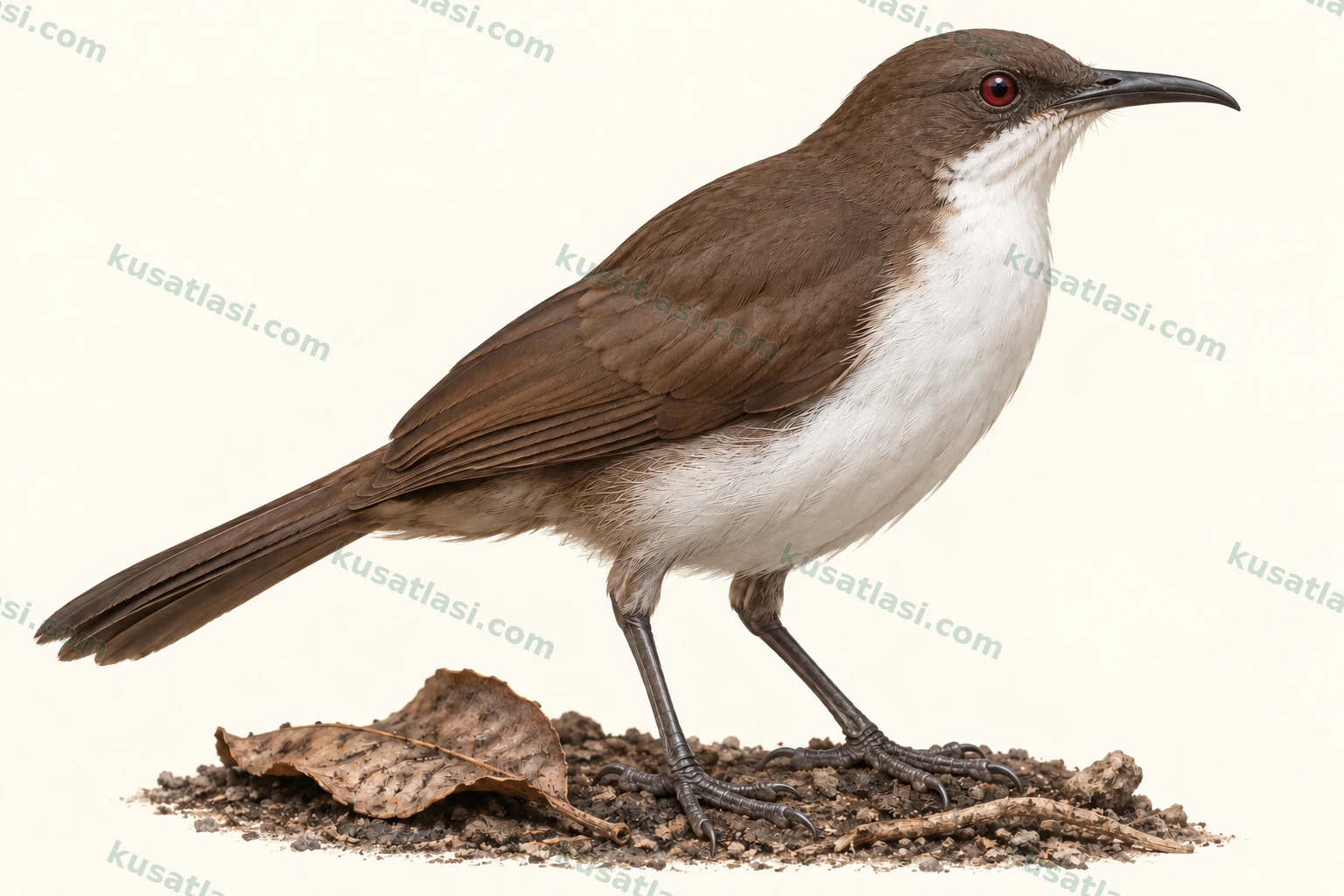
Caravelle forests on Martinique: dark upperparts, white breast, red eyes and feeding among leaves.
Biometrics
Length
Male20–23 cm
Female20–23 cm
Shared species value
Wing length
Male9.65 cm
Female9.84 cm
Weight
Male50 g
Female50 g
Shared species value
Martinique Thrasher
Martinique · Caravelle PeninsulaObservation guide in its natural range
Look for three features together
Do not rely on a single featureDark brown upperparts and flanks, white throat, breast and belly.
Dark red in adults; browner in young.
Caravelle’s dry forest with leaf litter and low cover.
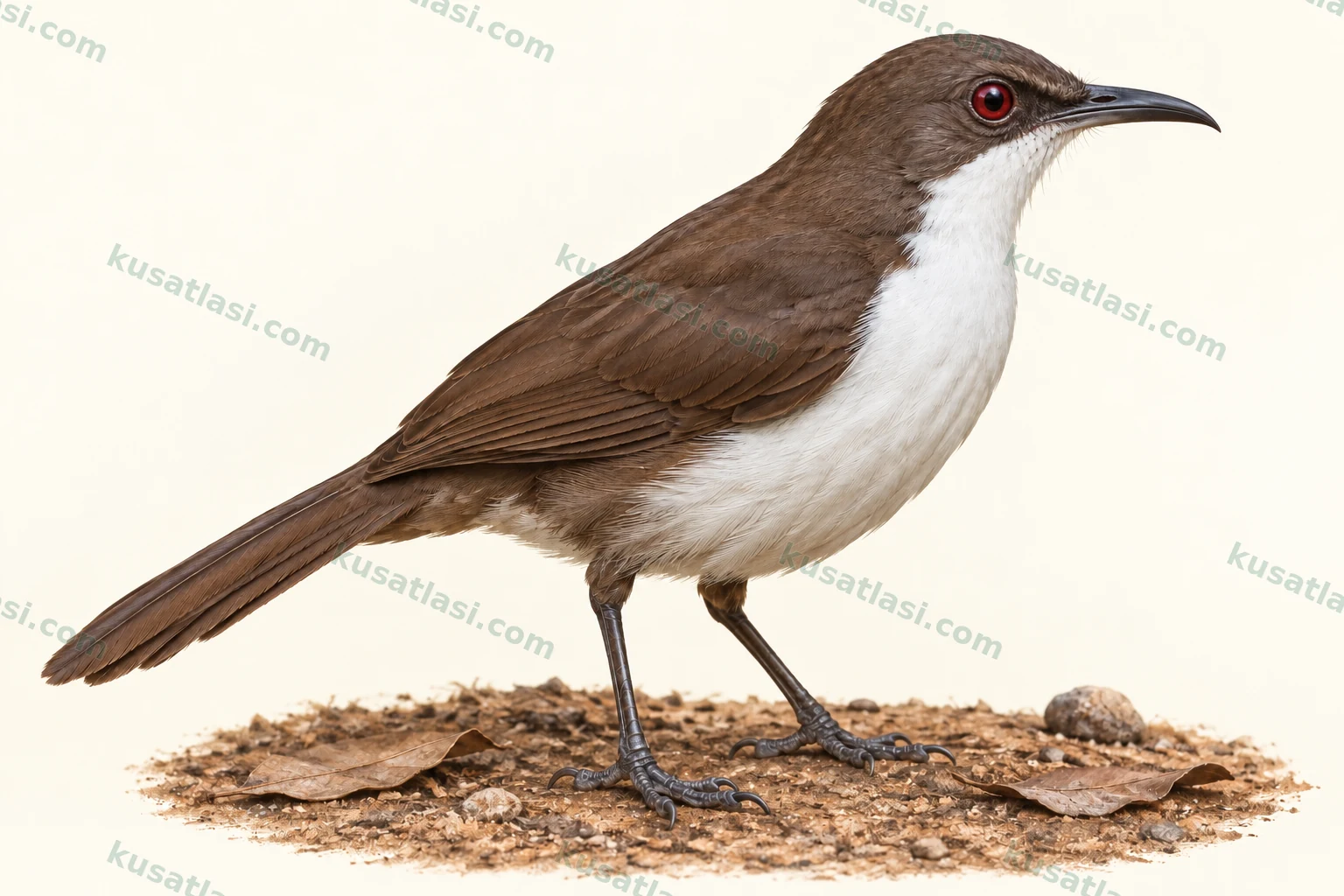
Compare male and female
 FemaleMale
Adult plumages are similar. Young are initially brown.
Where to look in its natural range?
Caravelle’s wooded slopes, low cover and valley bottoms accumulating leaves.
Resident. The 2011–2012 Martinique study reports nest activity from April, with egg and incubation observations in May–August. Resident; breeding examples come from the Martinique field study.
January
Data unavailable
February
Data unavailable
March
Data unavailable
April
Martinique: 2012 Caravelle: increase in nest-building activity.
May
Martinique: Caravelle: egg and incubation records during May–August 2012.
June
Data unavailable
July
Data unavailable
August
Martinique: 2012 Caravelle: records of fledged young.
September
Data unavailable
October
Data unavailable
November
Data unavailable
December
Data unavailable
Nest, egg and incubation
Martinique 2011–2012 study: cup nest in a shrub fork; 1–2 blue eggs, 12–14 days’ incubation, 11–12 days in the nest. Sex-specific tasks were not fully verified.
Short rough calls; the Martinique study distinguished several calls and a complex song.
Do not play recordings to attract birds; observe quietly, especially near nests.
Species information
Quick identification
The Martinique Thrasher Ramphocinclus brachyurus depends on forest cover on Martinique's Caravelle Peninsula. The adult's dark brown upperparts and flanks contrast with its white throat, breast and belly. Dark red eyes and a dark bill downcurved near the tip support identification. It is often seen foraging on the ground among fallen leaves.
Its current English name is Martinique Thrasher. Older accounts under White-breasted Thrasher also included Saint Lucia birds, now Ramphocinclus sanctaeluciae. This page concerns Martinique: breeding helpers or population estimates from Saint Lucia are not treated as general properties of this species. The island covered by an old scientific name must be checked.
General appearance and posture
The thrush-shaped bird walks and hops through low cover, moving leaves with its bill. Head, back, wings and tail are dark brown; lower back and rump can be warmer. Read the white throat and breast alongside the dark flanks. Dark sides do not mean the entire underside is brown.
Head sides are darker and eyes red or reddish brown. The dark bill curves down near its tip. Regularly lifting its head to scan interrupts leaf-litter searching naturally. It may droop its wings; this posture alone does not establish injury. It is not described as a bird frequently cocking its tail upwards.
Males, females and young birds
Adult sexes have similar plumage. Authors of the 2011–2012 field behaviour study explicitly noted that inability to sex birds by appearance limited interpretation of nesting roles. Do not call a sitting bird female or the outside bird male from that observation alone. A later measurement study determined sex genetically.
Young initially lack the adult's sharply white breast. They have warm brown plumage and dark brown eyes; white throat and breast develop gradually. The Martinique study describes gradual white acquisition with the first moult in the second month. This local observation is not an invariant daily age chart. Assess a brown youngster through its actual appearance and association with nearby adults.
Newly fledged young may not fly well. Adults continue feeding them in bushes or on the ground. In the study, young withdrew into the nest and hid after danger calls. Bringing one into the open or handling it to establish identity disrupts care. Brown feathers can also reduce visibility among leaves.
Appearance in flight
The ground and low-scrub forager makes short passages through cover when moving or threatened. Cornell stresses drooping wings; the Martinique study recorded varied wing movements and chases. Not every movement is courtship. Open wings may reveal the dark upperparts briefly, but the white underside seen in natural posture remains the strongest identification cue.
Two-syllable calls in flight were recorded in Martinique. No tracking route demonstrates regular migration between islands. A flight line shows daily movement through cover, not an intercontinental journey for the map. Dispersing young are distinguished from an adult pair moving within its feeding area.
Voice and behaviour
The most noticeable sounds are short rough calls, sometimes repeated. The Martinique study distinguished several call forms and a more complex song of chirps and trills. One deep short call was associated with early responses to environmental change, a harsher one with evident danger. These interpretations used behaviour context, not an invariant meaning for every similar sound.
Pairs or small groups occur on the ground. Pairs became more conspicuous around nests as breeding began in 2011–2012. Chasing another bird may relate to nest defence. Without verified sex and age the authors could not explain every social bond conclusively. Detailed cooperative breeding from another island is therefore not considered fully demonstrated here.
Similar species
Martinique's Gray Trembler Cinclocerthia gutturalis has comparable posture and bill shape. The thrasher's sharply white underside and dark red eye help distinguish the greyer, pale-eyed bird. Both may droop their wings, so posture alone is not diagnostic.
A brown youngster may not yet have the white adult breast. Nearby adults, Caravelle geography, foraging and facial appearance must be assessed together. Saint Lucia's Ramphocinclus sanctaeluciae belongs to another island; an old shared name does not justify merging measurements or conservation estimates.
Global range
The accepted species is endemic to Martinique in the Caribbean. Its natural range centres on particular dry-forest and scrub patches on the northeastern Caravelle Peninsula. Saint Lucia birds form a separate species. A map should make the Martinique location clear; a few square kilometres of habitat do not cover all Caribbean islands.
Status within its natural range
Old accounts describe a formerly wider Martinique range followed by severe contraction. Thought lost in 1950, its presence was demonstrated by a bird found at Caravelle in 1951. A nature reserve was established in 1976. The 200–400-bird estimate based on 2005 is historical, not a current census. The current combined list carries an unevaluated category for the newly restricted species concept; the old two-island threat label is not silently transferred. This does not diminish the importance of its small range or known threats.
Movements and migration
It is a resident island bird. Research reporting Martinique ringing records from the 1990s notes that some birds remained in their original areas, others were found hundreds of metres away. These are limited examples of space use and dispersal, not one distance travelled by every bird. Regular seasonal migration between Martinique and Saint Lucia has not been verified; no such island-crossing route is invented.
Breeding habitat
It uses Caravelle's seasonally dry forest, dense scrub, wooded slopes and valley bottoms accumulating leaf litter. More humid pockets occur within this broadly dry setting. Neither coastline alone nor open grass alone constitutes suitable habitat. Low cover and the ground feeding layer matter together.
Nest site
The Martinique study describes large cup nests in forks of shrubs and small trees, 1.5–5 m above ground. Two adults participated in building. Observations in 2011–2012 recorded 1–2 blue eggs, 12–14 days' incubation and departure 11–12 days after hatching. The reason for disagreement with older accounts of three eggs remains unresolved; preserve the contexts. The incubating adult's sex was not directly verified.
Daily habitat use
Leaf-covered ground, low bushes and fruiting branches are parts of one daily environment. Defence around nests may increase during breeding. A nest was lost during path maintenance in the local study. Do not cut cover or approach a possible nest-bearing bush; observe quietly from paths.
What does it eat?
Leaf-litter invertebrates are important; fruit is also used. Martinique research observed small fruits of Ardisia obovata and Eugenia cordata early in breeding, while invertebrate food was brought to young. Not every insect, spider or snail found in the study's litter samples was necessarily eaten: available prey and actual diet are different evidence.
How does it forage?
It walks and hops, lifting and tossing leaves aside with its bill. It may peck soil, pursue prey quickly, or search logs and bushes. It periodically raises its head to scan. Some fruits were held in the bill and processed again later. Seasonal feeding changes in 2011–2012 are not an obligatory schedule on the same dates every year. Ground invertebrate searching and fruit use on branches are distinct natural behaviours.
A bird thought lost was found again
The Martinique population was considered lost in 1950; a bird at Caravelle the following year showed persistence. This does not mean the species was recreated or arrived from elsewhere. Sparse historical records and true extinction differ. Later conservation and research better defined the small remaining range.
Night-time nest danger was directly observed
Automatic cameras near Martinique nests recorded rats reaching eggs at night. Not every previously empty nest can be assigned to the same animal, but the recording shows a real predation mechanism. Dense leaves alone do not protect every nest.
Leaving the nest is not mastering flight
In the study, young left at 11–12 days and were fed by adults on the ground or in bushes before they could fly well. This is not independence. A brown youngster can hop into cover; quiet waiting need not mean abandonment. Watch actual food deliveries from a distance.
Material from a raided nest may be reused
In 2011–2012, fine twigs from an old nest were taken for a new structure nearby five days after a predation event. This is a local example of another attempt after loss, not an invariant five-day programme for every pair. Suitable cover and food conditions matter.
An old shared island name can hide present limits
Martinique and Saint Lucia birds were formerly two subspecies of one species. The current split restricts this page to Martinique. Check the island particularly for population, breeding assistance and measurements. An old shared scientific name does not make every figure applicable to both islands.