

World Birds IUCN statusEN · EndangeredGlobal IUCN. BirdLife v10 (2025); taxon matching AviList 2026 / IOC 15.2; checked: 29.10.2026. The list year is not the species’ assessment date. Source and method · BirdLife OrderPasseriformesPerching birds FamilySturnidaeSturnidae
Black-winged Myna
Acridotheres melanopterus
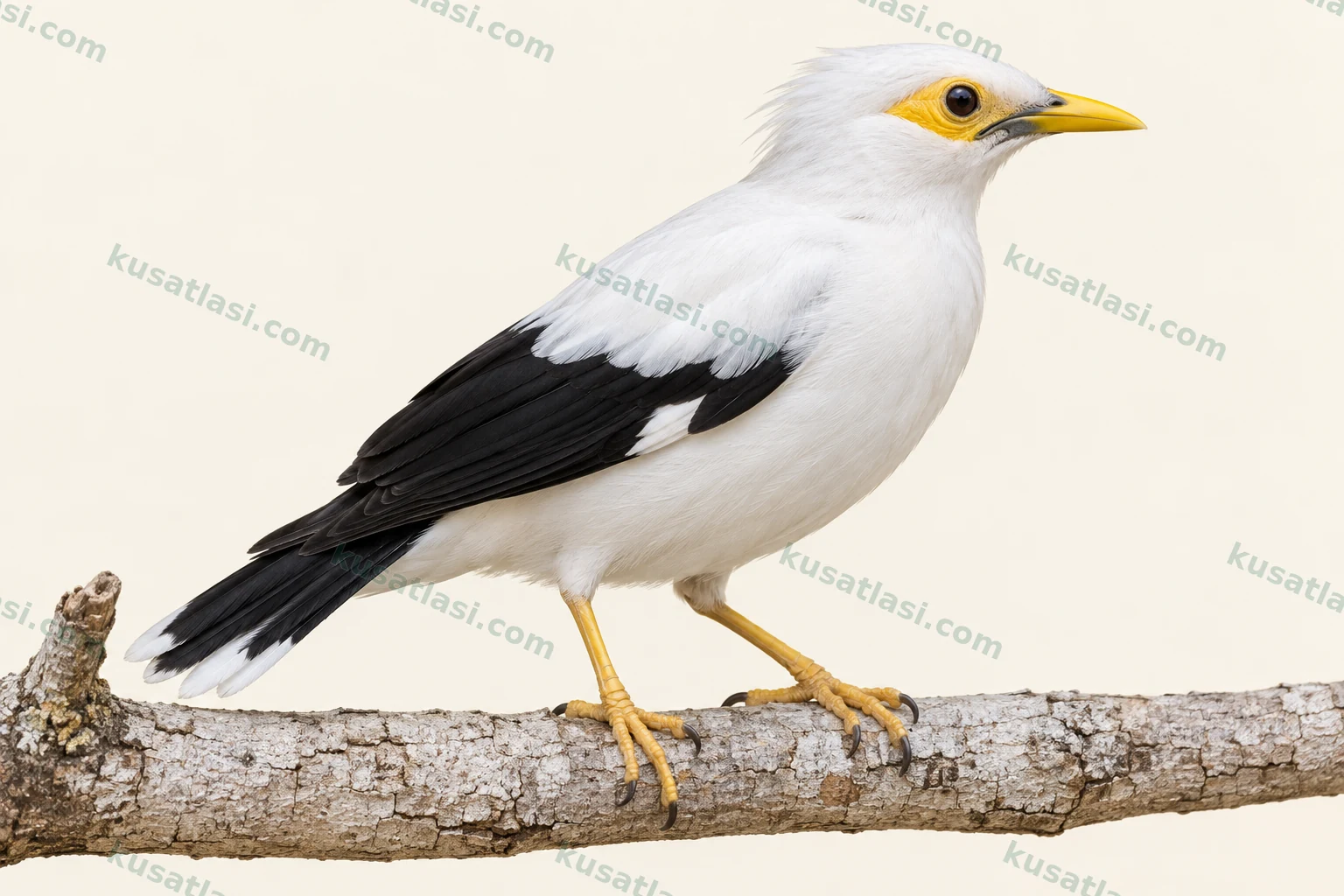
Bare yellow skin around the eye, yellow bill and legs; a white body with dark wings. Eastern Javan and Balinese forms can be grey above.
Biometrics
Length
Male23 cm
Female23 cm
Shared species value
Wing length
Male12.42 cm
Female12.42 cm
Shared species value
Weight
Male89 g
Female89 g
Shared species value
Black-winged Myna
Java and BaliObservation guide in its natural range
Look for three features together
Do not rely on a single featureAssess the bare yellow skin together with the white head and dark wings.
Geographic forms can also be grey; this alone proves neither youth nor hybrid ancestry.
Compare male and female
 FemaleMale
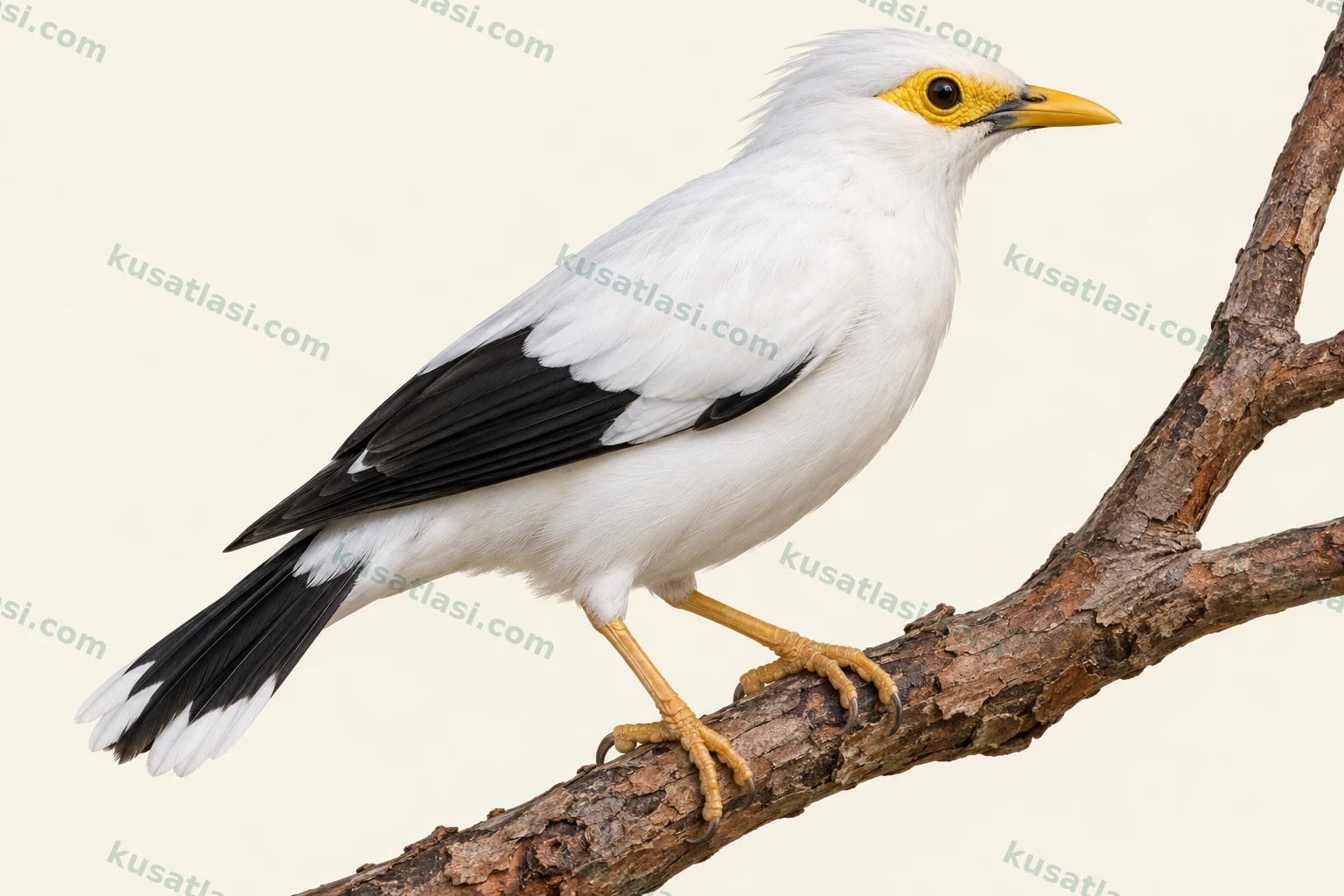
No definite field colour key applies to every individual; geographic greyness is not a sex difference.
Where to look in its natural range?
Forest edges, wooded clearings and local mangrove areas.
Resident, with reported food-related local movements. Java’s breeding period is given as January–May.
January
Java example; not generalised to all islands and subspecies. Java: reported breeding period.
February
Java example; not generalised to all islands and subspecies. Java: reported breeding period.
March
Java example; not generalised to all islands and subspecies. Java: reported breeding period.
April
Java example; not generalised to all islands and subspecies. Java: reported breeding period.
May
Java example; not generalised to all islands and subspecies. Java: reported breeding period.
June
Java example; not generalised to all islands and subspecies. No verified regional date is given for this month. This does not imply local absence.
July
Java example; not generalised to all islands and subspecies. No verified regional date is given for this month. This does not imply local absence.
August
Java example; not generalised to all islands and subspecies. No verified regional date is given for this month. This does not imply local absence.
September
Java example; not generalised to all islands and subspecies. No verified regional date is given for this month. This does not imply local absence.
October
Java example; not generalised to all islands and subspecies. No verified regional date is given for this month. This does not imply local absence.
November
Java example; not generalised to all islands and subspecies. No verified regional date is given for this month. This does not imply local absence.
December
Java example; not generalised to all islands and subspecies. No verified regional date is given for this month. This does not imply local absence.
Nest, egg and incubation
A tree or rock cavity; usually 3–4 eggs reported for Java. EAZA gives 14 days of incubation in human care; young of released birds reportedly leave the nest at about 28 days.
Varied chattering calls, whistles and buzzing sounds.
Do not play recordings to attract birds; observe quietly, especially near nests.
Species information
Quick Identification
The Black-winged Myna Acridotheres melanopterus is a black-and-white starling of Java and Bali. Bare yellow skin around the eye, a yellow bill and yellow legs matter for identification. The wings and tail are dark, contrasting strongly with the white body. Remember that birds in southeastern Java and Bali may have a grey back. The species name does not mean that every individual has the same white pattern from head to tail.
Begin with the eye area, then the distribution of colour between wings and body. A distant white body alone does not distinguish it from the Bali Myna. If leaves hide the yellow face, bill and leg colour may help; if light conceals these small areas, wait for a better view before deciding.
General Appearance and Posture
When perched, the black of the folded wing may look narrow beside the white body. As the bird turns, the same wing presents a much larger dark surface. This change of angle does not mean a different individual or a new colour form. Compare the head, back, wings and tail in the same natural posture.
The yellow around the eye is not a feather patch. Seeing the boundary of the bare skin helps distinguish it from white head feathers. Do not rely on the brightness of one photograph to measure length or colour. Overexposure can erase detail in white feathers; reflections on a dark wing can make its black surface look pale grey.
Males, Females and Young Birds
No separate field colour key reliably applies to every adult male and female. Some body measurements were larger in males measured at a conservation centre; this is insufficient to identify the larger of two distant birds as male. Measurement context and individual variation remain separate from sexing by appearance.
Grey on the head and back may help assess youth, but grey alone does not establish age. Geographic forms also have backs of differing darkness. Do not confuse juvenile appearance with the colour differences of eastern Javan and Balinese adults. Assess feather development together with other features actually visible.
Current classification includes melanopterus, tricolor and tertius as subspecies of one species. Some older publications treated them as separate species. When an old name appears, check which island and form the bird belongs to; do not present all the page's appearances as male and female versions of each other.
Appearance in Flight
The white body contrasting with dark wings also helps in flight. As a bird recedes, the yellow face may disappear; colour contrast alone does not then establish identification. Where possible, connect the flight view with the same individual's perched view. Do not assemble different flock members' patterns into the appearance of one bird.
Lighting differences between upperwing and underwing may change the apparent extent of dark areas. The upperparts must really be visible to assess geographic back-colour differences; do not make definite claims about the back of a bird seen only from below.
Voice and Behaviour
Cornell's identification account describes varied chattering sounds, whistles and buzzing calls. Usually seen in small groups, it feeds in trees and sometimes descends to the ground. Not every call can be rendered as one short syllable. Rhythm, intervals between repetitions and the visible bird's behaviour may help more than loudness alone.
When counting birds arriving together at a tree, do not add a bird reappearing from behind a branch as a new individual. A feeding group, a roost gathering and a family with young are not the same. Naming a group correctly preserves the behaviour actually observed. Movement near a nest is not a reason to approach the nest to watch birds.
Similar Species
The Bali Myna Leucopsar rothschildi is also largely white, but has blue bare facial skin and long head feathers trailing backwards. Assess the Black-winged Myna's yellow facial skin together with its more extensive dark wings. If the eye area cannot be seen, occurrence on Bali alone does not distinguish them.
The Javan Myna Acridotheres javanicus has a much darker body. Compare the white body areas and facial pattern with grey-backed Black-winged Mynas. Historical gene flow reported by genetic studies does not justify calling every dark field bird a hybrid. Hybrid ancestry requires evidence beyond feather colour.
World Distribution
Its native distribution centres on the Indonesian islands of Java and Bali. Forms in western Java are whiter above, those in eastern Java and Bali greyer. Historical records and the areas of surviving populations are not identical; past abundance does not show that it still occurs at every site today. Escaped birds have been suggested as a possible origin of records around Lombok.
Status within Its Natural Range
The current combined taxon is Endangered. Critically Endangered headings in older studies must be read with the taxonomic scope of their time; a category change does not mean trapping pressure has ended. The Baluran study considered illegal trapping, overgrazing and habitat contraction through invasive thorn trees together. A local population estimate is not a current global count.
Migration
It is generally resident, with possible local movements linked to seasonal food availability. These are not regular intercontinental migration routes. Escape-origin Singapore records are not added to the natural island range. A new record of a conservation-released bird is not evidence of natural expansion without its origin being stated. The island overview on the map is not confused with tracked individual routes.
Breeding Habitat
It uses wooded clearings, forest edges and, locally, open savanna surroundings. Mangrove forest matters at remaining sites in northwestern Java. The savanna and grazing results of the Baluran study are not generalised to mean that the bird can live only in the same vegetation throughout Java.
Nest Site
It nests in tree or rock cavities; January–May breeding and usually 3–4 eggs have been reported for Java. EAZA's conservation-breeding guide gives 14 days of incubation, retained in its managed-care context. Young of released birds reportedly left the nest at about 28 days. One nest does not establish the same exact development schedule for every subspecies.
Daily Use of Space
It may move between trees and open ground to feed. Brief use of a tree does not prove a nest there. Do not look inside cavities to improve the view; watch natural entries and exits from a distance.
What Does It Eat?
It has a mixed diet including fruit and insects. Seeing it in a fruit tree does not mean it eats only fruit, nor does seeing it on the ground mean it hunts only insects. Record food when it is actually visible in the bill or during swallowing. Regional food lists are not turned into an identical menu for every island.
How Does It Feed?
It searches in trees and descends to suitable open ground. If an object taken from behind a branch was not seen, its identity remains uncertain. Other birds in the same tree alone do not demonstrate a mixed feeding group moving together. Insect eggs and adult insects are also separate food records. Leaving fruit or bait can change natural searching behaviour. Keep a suitable distance without blocking the bird's route or standing between the tree and its ground-landing area.
Colour Differences Do Not Alone Explain Genetic Differences
A 2020 genetic study showed that darkness in three geographic forms did not simply match genetic differentiation. It found evidence of gene flow from Javan Myna in the Balinese form. Samples came from conservation centres, and the study stressed the need for more detailed tests with wild samples. Its result does not mean every dark bird is a recent hybrid.
Habitat Suitability and Actual Use Differ
The Baluran study separately estimated currently occupied habitat and habitat considered suitable by its model. Modelled suitability does not demonstrate actual presence. Factors such as trapping and vegetation change were discussed to explain the difference. Potentially suitable habitat is not coloured on a map as the area of a confirmed population.
A Market Count Is Not a Wild Population Census
Jakarta market surveys in 2010–2014 documented continuing open trade despite conservation laws. Fewer birds in a market do not prove a growing wild population; availability, trade and capture are different processes. Researchers challenged the assumption that commercial breeding would automatically remove pressure on wild populations.
One Appearance Does Not Support Three Conclusions
Grey upperparts can raise different questions about age, geographic form and genetic origin. Each needs its own evidence. Recording a grey back in a photograph is useful, but the same image does not jointly establish definite sex, subspecies and hybrid ancestry. Yellow bare facial skin and the black-and-white body pattern are assessed for species identification; more detailed identities remain open without sufficient evidence. Record the island and whether the observation was in the wild or in human care separately.