

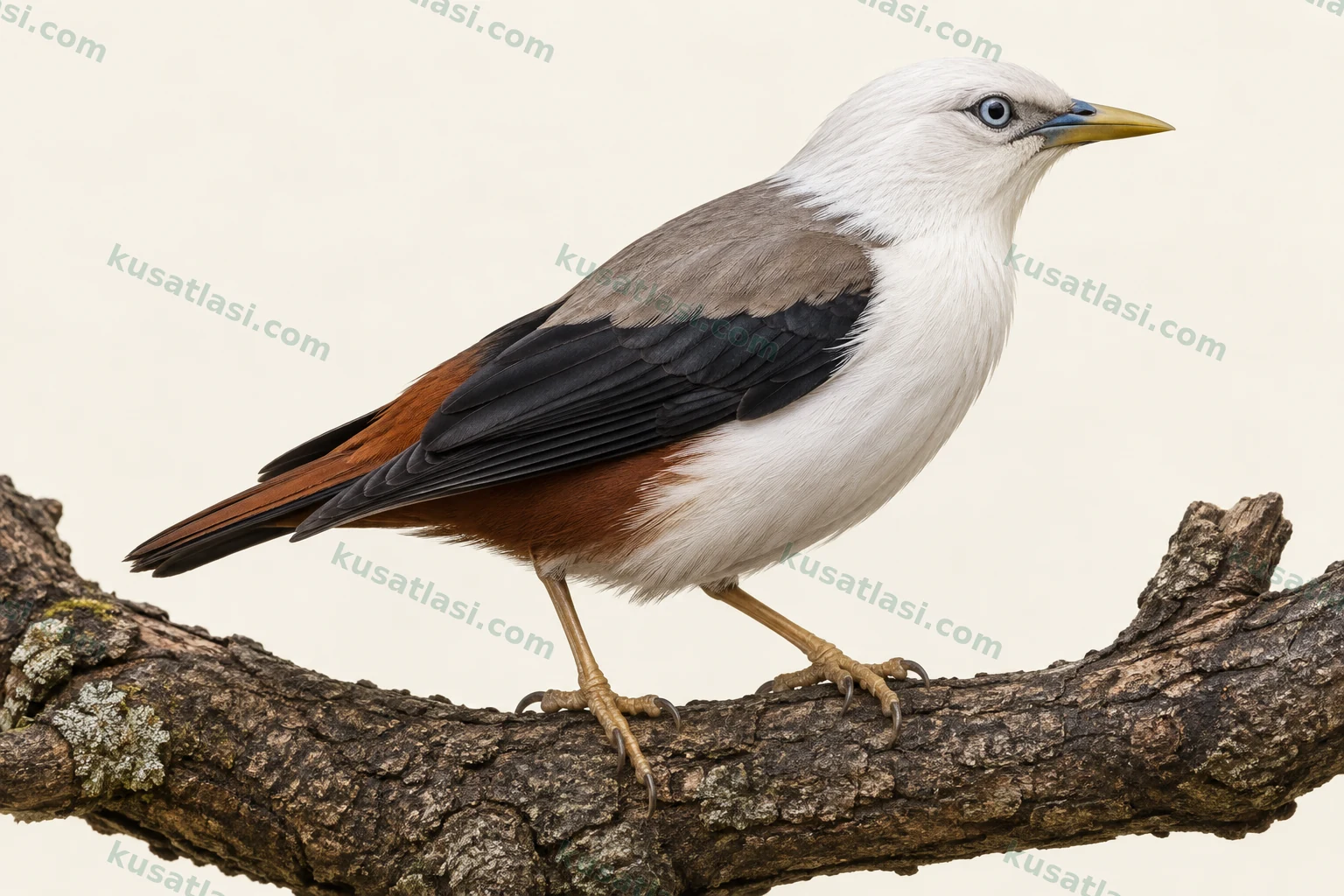
World Birds IUCN statusLC · Least ConcernGlobal IUCN category. BirdLife v10 (2025); taxon matching: AviList 2026 / IOC 15.2; checked: 29.10.2026. The list year is not the species assessment date. Source and method · BirdLife OrderPasseriformesPasserines FamilySturnidaeSturnidae
White-headed Starling
Sturnia erythropygia
A starling of the Andaman and Nicobar Islands with a whitish head and breast, grey back and dark wings. Rufous or greyish-white areas around the tail vary geographically.
Biometrics
Length
Male20 cm
Female20 cm
Shared species value
Wing length
Male10.88 cm
Female10.88 cm
Shared species value
Weight
MaleData unavailable
FemaleData unavailable
White-headed Starling
Andaman and Nicobar IslandsObservation guide in its natural range
Look for three features together
Do not rely on a single featureThe head and breast are extensively pale, with a grey back and dark wings.
This area is more greyish white in the Andamans, with rufous areas in the Nicobars and an intermediate appearance on Katchal.
The bill is pale yellowish, sometimes with a bluish base, and the legs are yellowish.
Compare male and female
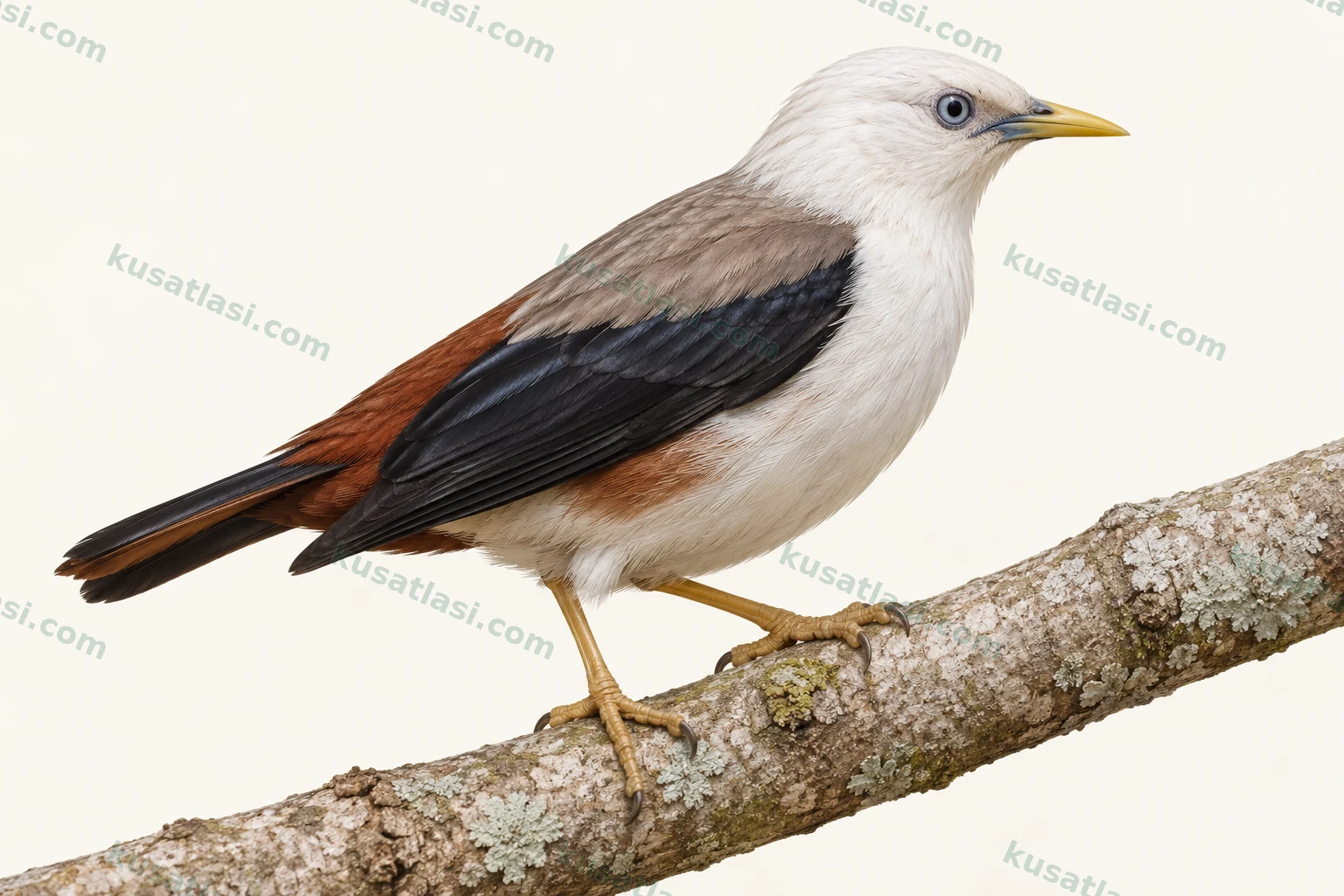 FemaleMale
Adults of both sexes look alike. Rufous around the tail is not a reliable sex mark. A detailed description of the young at different ages was not sufficiently verified.
Where to look in its natural range?
Open woodland, forest edges, plantations and farmland.
Regional breeding records from the original historical accounts. They do not establish an invariable annual calendar for all island populations.
January
The species is resident. No regular migration to the mainland was verified. No verified regional date is given for this month. This does not imply local absence.
February
The species is resident. No regular migration to the mainland was verified. No verified regional date is given for this month. This does not imply local absence.
March
The species is resident. No regular migration to the mainland was verified. Andaman Islands: The historical account records breeding from late March to mid-May. This does not imply uniform intensity throughout those months.
April
The species is resident. No regular migration to the mainland was verified. Andaman Islands: The historical account records breeding from late March to mid-May. This does not imply uniform intensity throughout those months. Car Nicobar: A record of one egg dated 21 April does not establish clutch size.
May
The species is resident. No regular migration to the mainland was verified. Andaman Islands: The historical account records breeding from late March to mid-May. This does not imply uniform intensity throughout those months.
June
The species is resident. No regular migration to the mainland was verified. No verified regional date is given for this month. This does not imply local absence.
July
The species is resident. No regular migration to the mainland was verified. No verified regional date is given for this month. This does not imply local absence.
August
The species is resident. No regular migration to the mainland was verified. No verified regional date is given for this month. This does not imply local absence.
September
The species is resident. No regular migration to the mainland was verified. No verified regional date is given for this month. This does not imply local absence.
October
The species is resident. No regular migration to the mainland was verified. No verified regional date is given for this month. This does not imply local absence.
November
The species is resident. No regular migration to the mainland was verified. No verified regional date is given for this month. This does not imply local absence.
December
The species is resident. No regular migration to the mainland was verified. No verified regional date is given for this month. This does not imply local absence.
Nest, egg and incubation
In the Andamans, the nest is made of small twigs and feathers in a tree cavity. A specialist synthesis reports 4 eggs. Incubation duration and time to first flight were not verified.
A detailed, measured description of this species’ calls was not verified. In a mixed group, identify the bird that gave the call by sight as well.
Do not play recordings to attract birds; observe quietly, especially near nests.
Species information
Quick identification
The White-headed Starling Sturnia erythropygia is a pale-headed starling native only to the Andaman and Nicobar Islands. An adult is identified by the combination of a whitish head and breast, grey back, dark wings, pale bill and yellowish legs. Its body cannot be described as entirely black with just a white head. The pale areas of the breast and back should be assessed separately from the folded wing.
The colours of the rump, outer tail feathers and underside of the tail vary between islands. It is useful to compare the greyish-white areas of Andaman birds with the rufous-brown areas of Nicobar birds. This difference is not a contrast between males and females. The island on which the bird was recorded helps interpret its colours. Noting the white head without the island makes confusion with similar starlings more likely.
General appearance and posture
The head and neck are pale and the breast is largely whitish. The grey back contrasts with the dark wings. The flight feathers and the dark surface of the folded wing can show a metallic green sheen. Feathers that look plain black in shade and green in sunlight do not indicate two different birds or two different sexes. A more reliable identification is possible when the pale head, breast colour and grey back are all visible in the same posture.
The current specialist description summarises the areas around the tail as greyish white in Andaman birds and rufous brown in Nicobar birds. The original historical accounts describe more detailed island differences. Specimens from Car Nicobar have a stronger rufous-chestnut rump, whereas Katchal specimens have a paler rump and a rufous area under the tail. It is therefore inappropriate to assume that every Nicobar bird has an identical colour pattern in every detail.
The centre of the tail is dark and glossy. The paler or rufous areas of the outer feathers show according to the angle. When the tail is closed, only a small part of the outer feathers may be visible. Their absence from a photograph does not show that the entire tail is black. The rump above the tail and the undertail coverts are different anatomical areas. The colours of one cannot be assigned to the other.
The bill is pale, yellow or greenish yellow, and may have a bluish base. Notes on the original museum specimens describe an iris ranging from pale blue to white and legs ranging from pale yellow to deeper yellowish tones. Light and distance affect subtle differences in colour. Seeing the bill base is useful, but a single bill colour does not replace the overall pattern of the head and body and the island locality.
Males, females and young birds
The specialist institution’s species summary describes adult males and females as similar in appearance. Calling a rufous-rumped bird male and a paler bird female is especially misleading because the same areas vary among island populations. Sex identification is separate from differences in appearance between places. The pale breast and head help identify the species but do not determine the sex of every bird.
The original accounts examined did not yield a reliable detailed plumage key for all juvenile ages of this species. A description of young birds of another Sturnia species nearby in an old book is no basis for transferring it to this starling. For a bird thought to be young, record the visible colours and any direct feeding by an adult separately. Do not infer its exact age in months.
A weak sheen on the feathers, a head hidden behind a branch or a photograph taken in shade is not proof of youth. If the head and breast cannot be seen, the identification should remain tentative. The presence of other starlings and insect-eating birds in the same flock also makes it difficult to identify young birds from group association alone. Each bird in the group should be assessed separately.
Appearance in flight
In flight, the contrast between the pale head and breast and the dark wings may be visible. The original description of Katchal specimens records white underwing coverts and pale hidden bases on some of the long flight feathers. This limited specimen evidence does not establish that the entire underside of the wing is white. The dark flight feathers as the wing opens are considered separately from the pale coverts.
Paler or rufous patches on the outer tail feathers may stand out in flight. Keep in mind which island’s form is being compared. If a fast passage reveals only a flash of white on the head, there may not be enough detail for a firm identification. Short movements with a flock do not establish annual migration from the islands to the mainland. The sources treat the species as resident.
Voice and behaviour
It is an active bird and can form groups with other birds in plantations, rice fields, open woodland and forest edges. Richmond’s original Car Nicobar notes describe it moving with other starlings and using coconut and casuarina trees. This observation does not show that it necessarily ate the fruit of these trees or that it uses only these two kinds of tree.
The sources examined did not provide a measured sound description that distinguishes all its call types for this page. A sound comparison from another Sturnia account is not attributed to this species. If it is unclear which bird called in a mixed group, the voice alone should not be used as a certain identification. Listen to the natural call and consider the visible colours together. Avoid repeated playback to draw the bird out.
Similar species
The Chestnut-tailed Starling Sturnia malabarica can look similar because of its pale head, grey upperparts and colourful bill. In the current specialist description, its belly and rump are orange-tinged. In checking the White-headed Starling, assess the pale breast pattern together with the confirmed island locality. An older classification placed them within a broader species group, but the names cannot now be used interchangeably.
The Brahminy Starling Sturnia pagodarum has a prominent dark crown, pale eye and two-coloured bill, with cinnamon-rufous underparts. Compare these features with the extensive pale head and whitish breast of the adult White-headed Starling. Since many starlings have a grey back or yellow legs, neither feature alone establishes the species.
Global range
The native range comprises the Andaman and Nicobar island groups in the Bay of Bengal. The islands belong politically to India, but this does not imply that the bird occurs naturally throughout mainland India. Islands such as Car Nicobar and Katchal are named explicitly in the historical specimen records. The differences in appearance between Andaman and Nicobar birds are interpreted within that limited island geography.
Status in its natural range
The current global category is Least Concern. In contrast, the 2023 assessment monitoring India’s birds reports a declining trend and high conservation priority in the island region. The global category and regional monitoring answer different questions and both are relevant. The report is not a 2026 census or an exact bird count for every island.
Older studies mention the release of Andaman birds on Kamorta. Richmond discussed whether the appearance of Katchal birds might derive from those birds. This historical possibility has not been confirmed by an experiment on their origins. It does not establish that all of today’s Katchal population arose through human introduction. The specimen locality, natural distribution and hypothesis about origins are considered separately.
Movements and migration
The sources treat the species as resident. Feeding and group movements do not constitute a measured regular migration route to the mainland. The map shows the natural island range. Mainland records of a different species are not added based on resemblance between pale heads. The fact that fieldwork took place from January to March does not establish that the birds occur on the islands only in those months.
Breeding habitat
The species can use open woodland, forest edges, farmland and plantations. It is not described as restricted to the interior of closed forest. Seeing one feeding in a rice field does not show that it nests on the ground or on rice stems. Feeding habitat and directly documented nest sites are described separately.
Nest site
Baker’s Andaman account describes a nest of small plant twigs and a few feathers placed in a tree cavity. The reported height is about 1.8–9.1 m or more, converted from the original 6–30 feet. These figures are not exact lower and upper limits for every nest. The same account records breeding from late March to mid-May. There is also a separate record of one egg from Car Nicobar on 21 April.
A specialist data synthesis reports four eggs. The twenty eggs in the accessible original Andaman text are the number of measured specimens, not a clutch of twenty in one nest. The incubation duration and time to first flight were not sufficiently verified for this species. Durations from another starling cannot fill those gaps.
Daily use of habitat
An old field note from Car Nicobar describes groups moving through coconut and casuarina trees. These trees provide useful places to watch the birds. Visits to their branches are not direct evidence that the birds eat food from those trees. Tree cavities can be important for breeding, but a hole should not be assumed to contain a nest. Do not open cavities used by birds to look inside.
What does it eat?
A mixed diet of fruit and insects has been reported. An older scientific dietary synthesis records leaf-rolling caterpillars in bamboo for Andaman birds, and small fruits and occasional flying insects for Nicobar birds. These are historical regional observations. The detailed table of stomach contents for a different starling nearby in the same book does not belong to this species.
How does it find food?
Searching for food on vegetation and moving towards flying insects are different feeding behaviours. The exact species of prey that could not be seen is not stated with certainty. A proposed caterpillar identification in the old synthesis is also kept distinct from a confirmed prey identification. Perching in a tree does not show that the bird is eating fruit at that moment.
The sources examined provide no measured diet proportions for all island groups and seasons. Therefore, there is no basis for a calendar in which the birds eat only fruit in the wet season and only seeds in the dry season. Directly recording fruit and insect use with separate dates is more useful than pooling the feeding observations of different birds in the same group into a single species account.
Tail colour reflects island differences
The areas around the tail can show different colours in Andaman and Nicobar birds. Old Katchal specimens also show that the rump and underside of the tail are not always the same colour. Calling a bird male from a rufous area in a photograph can confuse geographic variation with a difference between sexes. Keep the head, breast, tail and island information together and specify which anatomical area shows each colour.
A historical possibility does not establish origins
In 1902 Richmond discussed whether Katchal birds might descend from Andaman birds previously released on Kamorta. The text also says the question remained unresolved. The researcher’s favoured possibility cannot be reported as a later proven genetic result. A direct specimen record provides strong evidence of presence without necessarily explaining the origins of the entire population.
What is being counted matters
The twenty eggs in a museum account can represent the total number of specimens measured. They do not give the number of eggs in one nest or measure breeding success. A single egg found on Car Nicobar also does not establish that the nest held a completed clutch of one egg. This distinction is fundamental to interpreting old but valuable scientific records. The number of specimens and the count for a biological event refer to different things.
Global status can coexist with local decline
The global Least Concern category and the conservation priority in the 2023 island monitoring assessment can be considered together. The regional report interprets changes within a particular dataset and period. It does not provide a new count for every island or identify a single cause of decline. In a narrow island range, regular records help assess the present status of a bird that an old book described as common in one place.