

World Birds IUCN statusLC · Least ConcernGlobal IUCN category. BirdLife v10 (2025); taxon matching: AviList 2026 / IOC 15.2; checked: 29.10.2026. The list year is not the species assessment date. Source and method · BirdLife OrderPasseriformesPasserines FamilyTurdidaeTurdidae
African Thrush
Turdus pelios
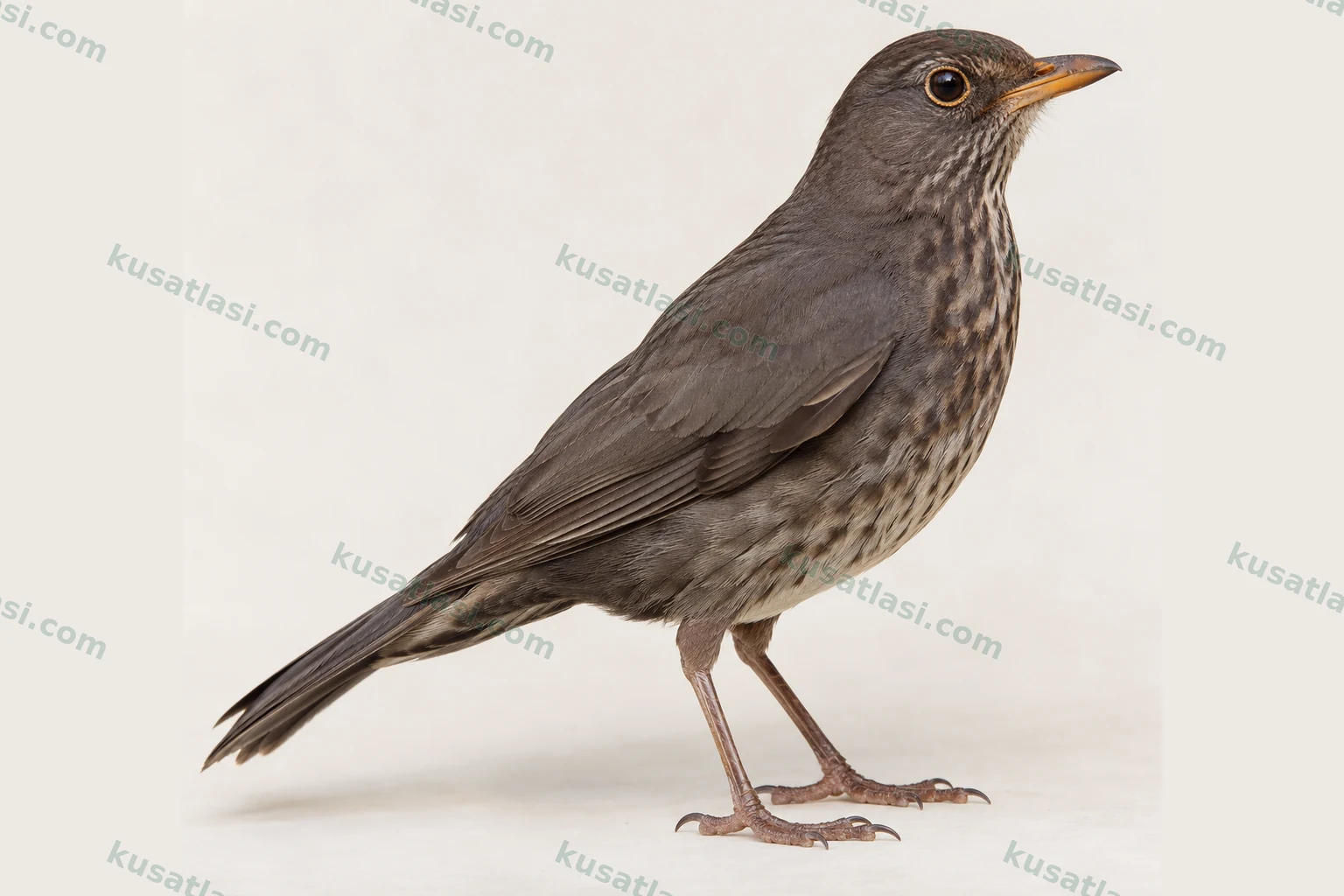
Grey-brown upperparts, yellow-orange bill, grey breast, warm flanks and white belly; young birds have more breast spots.
Biometrics
Length
Male21–23 cm
Female21–23 cm
Shared species value
Wing length
Male11.06 cm
Female11.06 cm
Shared species value
Weight
Male46–51 g
Female70–72 g
African Thrush
Sub-Saharan western, central and eastern Africa; south to Angola and northern ZambiaObservation guide in its natural range
Look for three features together
Do not rely on a single featureGrey breast, warm-coloured flanks and white belly.
Not alone, but with throat and head.
Breast spots do not resemble the adult pattern.
Compare male and female
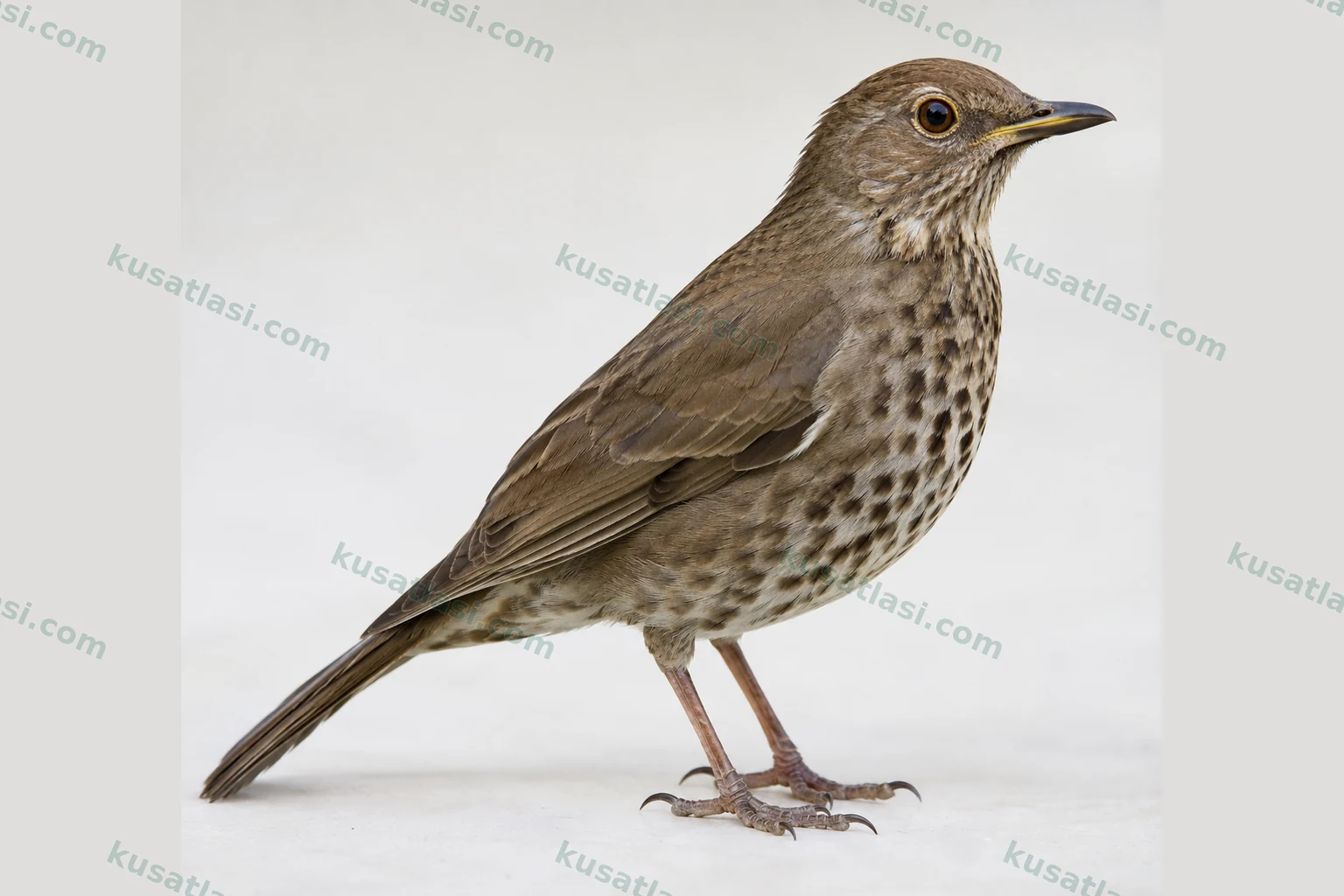 FemaleMale
Adult males and females look very similar; young birds have conspicuous breast spots and pale back streaks.
Where to look in its natural range?
Compare bill and underparts in woodland leaf litter, grassy clearings and fruiting trees.
Essentially resident; breeding time varies with region and rainfall. The months below are examples only from the named regional study or expert account.
January
Essentially resident; breeding time varies with region and rainfall. No verified regional date specific to this month was given; this does not mean local absence.
February
Essentially resident; breeding time varies with region and rainfall. No verified regional date specific to this month was given; this does not mean local absence.
March
Essentially resident; breeding time varies with region and rainfall. No verified regional date specific to this month was given; this does not mean local absence.
April
Essentially resident; breeding time varies with region and rainfall. Ile-Ife, Nigeria; 1998 study: Nest-building observations; not the same event as laying or all breeding stages.
May
Essentially resident; breeding time varies with region and rainfall. Ile-Ife, Nigeria; 1998 study: Nest-building observations; not the same event as laying or all breeding stages.
June
Essentially resident; breeding time varies with region and rainfall. Ile-Ife, Nigeria; 1998 study: Nest-building observations; not the same event as laying or all breeding stages.
July
Essentially resident; breeding time varies with region and rainfall. Ile-Ife, Nigeria; 1998 study: Nest-building observations; not the same event as laying or all breeding stages.
August
Essentially resident; breeding time varies with region and rainfall. Ile-Ife, Nigeria; 1998 study: Female reproductive activity period in the study; not a shared season for all Africa.
September
Essentially resident; breeding time varies with region and rainfall. Ile-Ife, Nigeria; 1998 study: Female reproductive activity period in the study; not a shared season for all Africa.
October
Essentially resident; breeding time varies with region and rainfall. Ile-Ife, Nigeria; 1998 study: Female reproductive activity period in the study; not a shared season for all Africa.
November
Essentially resident; breeding time varies with region and rainfall. Ile-Ife, Nigeria; 1998 study: Female reproductive activity period in the study; not a shared season for all Africa.
December
Essentially resident; breeding time varies with region and rainfall. No verified regional date specific to this month was given; this does not mean local absence.
Nest, egg and incubation
The nest is a cup of plant and root material and holds two or three eggs. In the study at Ile-Ife, Nigeria, the mean incubation period for nine nests was 14.11 ± 0.26 days, and young remained in the nest for 15 ± 1 days. These local results are not generalized to all Africa.
Clear whistles, repeated melodic phrases and harsher alarm calls; used together with visual identification.
Do not play recordings to attract birds; observe quietly, especially near nests.
Species information
Quick identification
The African Thrush Turdus pelios lives in wooded areas, forest edges and suitable gardens in sub-Saharan Africa. Grey-brown upperparts, a paler breast, orange-yellow bill, pale orange-brown flanks and white belly are considered together. Short dark streaks on the pale throat may also be visible. The warm flanks should not be imagined as an unbroken orange area across the entire breast. Boundaries between breast, flanks and belly help identification alongside head colour.
When ground-feeding, it advances a few steps and stops, searches leaf litter and retreats beneath bushes when disturbed. These behaviours occur in other thrushes too. Bill colour, the distribution of colours below and head appearance must complete identification. African Thrush is matched here to Turdus pelios. Muscicapidae in older paper titles does not mean a species different from today's Turdidae record was studied; family placement has changed.
General appearance and posture
Crown, nape and back are grey-brown, sometimes slightly olive in certain light. Wings and tail have darker parts within the same brown pattern. The throat has short brown streaks on a pale cream or whitish background. The breast may look grey, grey-brown or pale brown; pale orange-brown becomes stronger at the sides of the lower breast and flanks. The belly centre and undertail are white. Seeing the full pattern prevents deciding from an orange flank patch alone.
The bill is orange or yellow-orange, possibly dark along its upper edge. The iris is light brown and surrounding skin yellow-orange; eye-ring and eye colour are not confused. Legs and feet are described as pale brown. In shade the bill can look darker and warm flanks duller. A front view shows white belly and breast, while a side view better reveals the flanks; another angle fills what one view misses.
Males, females and young birds
Adult males and females look very similar. The Nigerian study explicitly says field separation by appearance is difficult. There is no reliable basis for calling a yellow-billed bird male or a paler bird female. Lighting, wear and individual variation affect shades. A bird carrying food has an observable task, but that does not invariably determine sex; both parents may feed young.
Young birds may show paler orange streaks above, especially on crown and back. The breast has more conspicuous dark spotting than an adult's, and flanks look greyer. The young bird's bill can also be yellow, so the bill alone does not establish age. Dark breast spots, pale upperpart streaks and overall appearance are considered together. An incompletely developed adult pattern is not a definite sign of another species.
Appearance in flight
Head and throat details vanish quickly when a bird rises from the ground or low cover. Grey-brown upperparts and dark wings may show; warm orange underwing tones are visible from a suitable angle. They are not a sole decisive distinction. Once the bird lands again, checking breast, flanks and white belly strengthens identification. A colour missed in a short flight is not assumed anatomically absent.
The Nigerian field study describes courting pairs moving together among branches and taking off together to disappear in vegetation. This is breeding behaviour observed at one study site, not an obligatory sequence for all African birds. A bird going to a treetop or fleeing to scrub does not indicate a seasonal migration route. During most brief observations, flight adds identification information rather than replacing the ground pattern entirely.
Voice and behaviour
Song includes clear whistles and melodic repeated short phrases, sometimes with harsher or throaty notes. A harder call may precede take-off and rapid repeated sounds accompany alarm. For an unseen singer, match its branch with the bird subsequently seen. Another thrush's melodious voice is not attributed to this species just because it sounds beautiful. Voice description is guidance used with visual and geographic evidence.
It is usually solitary or paired; several can gather at fruiting trees. Shade and undergrowth may make it seem scarcer than it is. Undisturbed birds also feed on open grass. Probing litter with the bill, finding small animals on the ground and visiting fruit trees are different parts of foraging. A local study found marked morning and evening activity; this is not an invariant timetable across the range.
Species that may be confused
1. Turdus libonyana, Kurrichane Thrush: similar size, bill and warm underparts can confuse. Compare throat streaks, breast and flank pattern and white belly together; a yellow bill alone does not identify it. Natural geography must also be checked.
2. Turdus olivaceus, Olive Thrush: similar grey-olive-brown upperparts and warm lower colours can mislead. Assess the extent of colour on lower breast, belly and flanks with the head. A forest sighting alone does not establish this species.
3. Spotted young thrushes: young birds can have breast spots unlike adults. Do not name them definitely by the breast alone without completing head, bill, back streaks, accompanying adults and locality.
World distribution
The African Thrush has a broad but not everywhere continuous sub-Saharan distribution. Populations extend from around Senegal through central Africa to Sudan, Eritrea, Ethiopia and the Great Lakes in the east, south to Angola and northern Zambia. Taxonomic sources distinguish several regional subspecies, including populations of separate areas such as Mount Cameroon and Bioko. This is not a single distribution occupying every country at equal density.
Status within its natural range
It uses forests, edges, riverine woodland, woody patches in savanna and suitable gardens. Western lowland populations and montane forest birds are not forced into one altitude band. For example, the expert account separately describes western populations near sea level and the high forest population on Mount Cameroon. A wide range does not imply normal occurrence in every city park or open farmland. Density and detection vary with vegetation.
Migration
It is essentially resident; no demonstrated regular continent-wide route is given here. Feeding sites and daily ranges can change in a resident species. Seasonal breeding, moult and mass differences in Nigeria's annual study are not themselves evidence of migration. More records in certain months need not mean arrivals from far away; song and detectability may matter. Monthly direction or distance is not calculated without knowing geography, year and record quality.
Breeding habitat
Dry, wet and locally swampy forests, riverbank trees, forest clearings and settlement woodland may be used. It is not sought only deep inside closed forest. Litter, feeding ground near the surface and branches or vegetation supporting a nest matter together. Nigerian studies followed nests in campus trees and near human settlement; that regional finding does not imply breeding around every building.
Nest site
The nest is a cup of coarse grass, plant fibres, root pieces and sometimes moss and mud, lined with finer plant material. A branch or tree fork is usual; bushes, climbers and suitable building ledges are also reported. Typical clutch size is two–three. Akinpelu's Nigerian study published incubation for nine nests as 14.11 ± 0.26 days (a local sample mean, not an exact hatching time for every nest). Nestling duration in the same study was 15 ± 1 days. Leaving the nest does not end parental feeding immediately.
Daily habitat use
It can forage among shaded leaf litter, open grass and fruiting trees. Observations throughout 1998 at Ile-Ife, Nigeria, showed breeding particularly linked with rainfall; nest building, laying and sexual activity are not the same calendar event. Ugandan nest records at various times also show there is no shared continental breeding month. Watch food-carrying adults from afar instead of approaching nests, climbing trees or opening branches to see young.
What does it eat?
It eats fruits, small seeds and various animal foods. Expert accounts include wild figs and other fruit, as well as ground worms, insects and other small invertebrates. Akinpelu and Oyedipe's Nigerian study throughout 1998 found plant food important. That sample's proportions are not a fixed African menu. Adult food, food carried to chicks and different seasonal resources are not confused.
How does it forage?
It searches undergrowth and ground, moving leaves with its bill to reach small animals below. In open grass, it gathers food between short pauses. Fruit trees complement ground hunting. The expert account also reports breaking snail shells on stones, not a guaranteed act of every bird in every observation. The Nigerian study found considerable overlap in prey sizes between sexes; this does not yield separate immutable male and female menus. Marked morning and evening activity is also interpreted within that field study's conditions.
Care continues after leaving the nest
In the Nigerian field study some young were still fed by adults several days after leaving. Nestling duration and independent feeding are thus different stages. An empty nest does not imply ended care. A young bird waiting in bushes and calling to adults may show ordinary behaviour during the period after leaving the nest; being alone does not immediately mean abandonment.
Moult does not finish at once
Akinpelu's annual study describes an ordered replacement of adult flight feathers. The interval from the first bird starting to the last finishing does not mean one individual remained at the same stage throughout. The population period and interpretation of recaptured individuals are separate. This matters in an annual calendar: a long period does not prove all birds look the same each month.
A changing scientific framework for the same species
Two Nigerian papers from 2004 and 2005 place Turdus pelios in Muscicapidae in their titles; current taxonomy places it in Turdidae. The old family in the title is preserved; matching the scientific name establishes the study species. Older classification does not invalidate every observation. The local sample scope still matters when interpreting measurements and breeding results.